水泥

Search documents
10月经济数据点评:需求再走弱,债市仍横盘
Shenwan Hongyuan Securities· 2025-11-15 11:19
Group 1 - In October 2025, consumer spending continued to decline, with a notable increase in restaurant consumption growth, potentially driven by the Mid-Autumn Festival and National Day holidays, but sustainability remains uncertain and requires ongoing policy support [1][4][19] - The cumulative year-on-year growth rate of industrial added value in October 2025 decreased by 0.1 percentage points to 6.1%, primarily due to the continued drag from real estate-related industries and a post-holiday production decline [1][2][5] - October saw a slight increase in inflation, supported by rising service, food, and gold prices, with the Consumer Price Index (CPI) rising to 0.2% year-on-year, while the Producer Price Index (PPI) showed a reduced year-on-year decline of 2.1% [1][4][11] Group 2 - Fixed asset investment in October 2025 showed an expanded year-on-year decline of 1.7%, with real estate, infrastructure, and manufacturing all weakening, indicating that stabilization in the real estate sector requires additional policy measures [1][5][16] - Economic data for October indicates a continued weakening of the fundamentals, with consumer spending and inflation as bright spots, but their sustainability is still in question, while investment growth and real estate prices are declining rapidly [1][19][25] - The bond market is currently in a sideways trend, with the 10-year government bond yield fluctuating around 1.8%, as the market has priced in the central bank's resumption of government bond trading and the weakening fundamentals [1][19][25]
中金 | 深度布局“十五五”:基础材料与工程篇
中金点睛· 2025-11-15 00:07
Core Viewpoint - The article emphasizes the importance of optimizing supply and focusing on high-quality development across various industries during the "15th Five-Year Plan" period, highlighting the need for structural adjustments and sustainable growth strategies. Coal Industry - The coal consumption is expected to peak between 4.95 to 5.1 billion tons during the "15th Five-Year Plan" period, with a slight decline to around 4.9 billion tons by 2030 [2] - Coal remains a crucial stabilizer for energy supply during the transition to a new energy system, with a gradual reduction in coal usage expected [3] - The coal sector is projected to maintain investment value due to favorable supply-demand dynamics, with high-quality companies expected to sustain profitability and cash flow [3] Building Materials - Cement demand is forecasted to decline by 30-40% from 2024 to 2030, necessitating capacity reduction to maintain profitability [4] - The industry is expected to focus on overseas expansion, particularly in Africa, as a growth strategy [4] - Glass fiber demand is anticipated to grow at an annual rate of around 5%, driven by wind power installations [4] - The construction materials sector is under pressure, but segments like coatings are expected to recover, with the market size projected to exceed 100 billion yuan by 2030 [5] Steel Industry - The steel industry is transitioning from scale expansion to quality and efficiency improvement, with a focus on high-end product development [6] - Demand for construction steel is expected to decline due to demographic changes, while high-end manufacturing will continue to drive demand for specialized steel products [6] - The industry is undergoing supply-side reforms to eliminate inefficient capacity and improve competitiveness [6] - Green transformation initiatives are being prioritized, with a focus on reducing carbon emissions and enhancing sustainability [7] - The industry aims to increase self-sufficiency in iron ore and expand overseas operations to enhance global competitiveness [8] Paper Industry - The paper industry is experiencing a slowdown in capacity expansion, with demand expected to recover moderately due to supportive consumption policies [9] - The industry is shifting towards self-produced pulp to enhance profit margins amid fluctuating raw material prices [9] Construction Industry - The construction sector is expected to focus on "stock clearance and incremental transformation," with significant government support for infrastructure investment [10] - The sector's financial health is projected to improve as local government debt restructuring progresses, enhancing cash flow and reducing impairment losses [10] - New business models and overseas expansion are seen as key growth drivers for construction companies [12]


“仅碳成本就达5万亿韩元”韩产业界呼吁重新审视2035年国家自主贡献配额方案
Shang Wu Bu Wang Zhan· 2025-11-14 16:35
Core Viewpoint - The Korean industry is urging the government to reconsider the 2035 Nationally Determined Contribution (NDC) target and the fourth phase of the emissions trading system, emphasizing the need for realistic reduction goals that consider industrial capabilities and competitiveness [1][2] Group 1: Industry Concerns - Eight major industry associations, including the Korea Chamber of Commerce and Industry and the Korea Iron and Steel Association, have submitted a joint proposal to the government regarding the upcoming greenhouse gas reduction targets [1] - The industry expresses concern over three of the proposed reduction scenarios (53%, 61%, and 65%), stating that they lack specific pathways for reductions by sector and industry [1] - The industry argues that reasonable reduction targets should be supported by government financial assistance, low-carbon market development, and the establishment of zero-carbon energy infrastructure [1] Group 2: Financial Implications - The industry estimates that during the fourth phase of the emissions trading system, the steel, refining, cement, and petrochemical sectors will need to purchase an additional 910 million tons of emissions rights [1] - At a cost of 50,000 KRW per ton, the total cost for these sectors would reach 50 trillion KRW, which could disadvantage Korean companies in international competition [1] - A representative from the Korea Chamber of Commerce and Industry stated that the industry is not avoiding its reduction responsibilities but seeks to establish a more realistic and feasible target system [1]
扬帆非洲:非洲水泥十问十答
Changjiang Securities· 2025-11-14 09:48
Investment Rating - The investment rating for the cement industry in Africa is "Positive" and is maintained [11] Core Insights - Africa has a low urbanization rate and underdeveloped infrastructure, indicating significant long-term demand potential for cement, with a projected future demand of nearly 800 million tons if benchmarked against current North African per capita consumption [3][20] - Domestic leading companies maintain a net profit of over 100 RMB per ton, suggesting that Chinese companies entering Africa will benefit from technological, process, and management advantages, leading to potentially higher profitability [3][20] Summary by Sections Current Demand and Medium-term Potential - The current cement demand in Africa is projected to reach 250 million tons in 2024, with a growth rate closely aligned with GDP growth [7][20] - The urbanization rate in Africa is similar to that of China in the 1990s, but economic growth and urbanization progress are expected to lag behind China's golden years [7][20] Low Capacity Utilization and High Price Paradox - Cement prices in Africa are 3-6 times higher than in China, yet capacity utilization is below 60% due to various constraints including outdated equipment and resource scarcity [7][35] - The paradox arises from factors such as uneven coal and electricity supply, outdated local equipment, and low cement density, which allows for high pricing despite low utilization [7][35][42] Impact of Chinese Enterprises on Local Pricing - Chinese companies currently hold less than 10% market share in Africa, reducing the likelihood of rapid price wars [8][55] - The entry of Chinese firms is profit-driven rather than price-driven, as they possess significant cost advantages over local companies [8][55] Local Enterprises' Capacity Expansion Plans - Major local players like Dangote and BUA have completed large-scale expansions, with future growth expected to be limited and focused on diversification into other sectors [8][68] - Dangote's expansion plans are primarily long-term and will not significantly impact current market prices [8][68] Comparison of Huaxin Cement and Western Cement in Africa - Both companies entered the African market around the same time, with Huaxin's capacity projected at 20.5 million tons and Western Cement at 9.8 million tons by mid-2025 [8][68] - Huaxin focuses on mergers and technological upgrades, while Western Cement emphasizes new construction [8][68] Reasons for European Cement Giants Exiting Africa - European companies like LafargeHolcim are shifting focus to greener building materials and have found their operational capabilities in Africa lacking compared to local firms [8][9] - The sale of assets to more competitive Chinese subsidiaries is seen as a more cost-effective strategy [8][9] Profitability in African Markets for Chinese Enterprises - The African market presents a long-term growth opportunity, with demand expected to expand significantly [8][7] - Chinese firms leverage their operational advantages to improve profitability through acquisitions and technological upgrades [8][7] Cement Supply and Demand in Nigeria - Nigeria's cement market is characterized by high concentration, with Dangote holding about 50% market share and a stable pricing foundation [8][9] Cement Supply and Demand in Ethiopia - Ethiopia shows strong GDP growth and low urbanization, indicating substantial construction potential [8][9] Impact of Currency Fluctuations on Chinese Enterprises - Currency fluctuations have led to exchange losses for Chinese companies operating in Africa, but strategies are being developed to mitigate these risks [10][9]

绿色工厂申报开启简便模式 企业为何感觉变难了
Zhong Guo Zheng Quan Bao· 2025-11-14 09:39
Core Viewpoint - The enthusiasm for applying for green factory certification has significantly increased among enterprises, driven by policy support and market demand, with a total of 1,382 new national-level green factories expected in 2024, bringing the cumulative total to 6,430 [1][5]. Summary by Sections Application Requirements Update - The application process for green factory certification has been simplified, with the removal of third-party evaluation reports, allowing companies to self-report through an online platform [2][3]. - The new evaluation criteria have been streamlined, reducing the number of secondary indicators from 92 to 14, focusing on five primary indicators: energy decarbonization, resource efficiency, clean production, product greenness, and land intensiveness [2][3]. Increased Standards for Certification - The evaluation now emphasizes quantitative assessments, with 11 out of 14 secondary indicators being quantitative, requiring companies to meet industry benchmarks for energy consumption and carbon emissions [3]. - The weight of the "energy decarbonization" criterion is set at 30%, necessitating detailed calculations of energy consumption and carbon emissions [3]. Corporate Engagement in Green Factory Applications - The number of applications for green factory certification has surged due to local government incentives, with financial rewards ranging from 200,000 to 1,000,000 yuan for successful applicants [5]. - Companies are increasingly motivated to pursue green factory status to comply with stricter environmental regulations and to enhance their market competitiveness [5][6]. Technological Innovation and Digital Management - Enterprises are leveraging technological innovations and digital management to facilitate their green transformation, focusing on energy efficiency and carbon reduction [7][8]. - The integration of digital technologies, such as IoT sensors and data analytics, is becoming crucial for real-time monitoring and optimization of energy consumption [8][9]. Recommendations for Companies - Companies are advised to maintain comprehensive records of their energy consumption and emissions data to support their green factory applications [9]. - It is recommended that enterprises prepare for certification by implementing systematic management practices and aligning with industry standards for sustainability reporting [9].

华新水泥将于12月24日派发前三季度股息每股0.372827港元
Zhi Tong Cai Jing· 2025-11-14 09:35
华新水泥(06655)发布公告,将于2025年12月24日派发截至2025年9月30日止前三季度股息每股0.372827 港元。 ...
华新水泥(06655)将于12月24日派发前三季度股息每股0.372827港元
智通财经网· 2025-11-14 09:29
智通财经APP讯,华新水泥(06655)发布公告,将于2025年12月24日派发截至2025年9月30日止前三季度 股息每股0.372827港元。 ...
高碳行业基准减碳路径发布 马骏:下一步发布细分行业减碳目标基准
Xin Lang Cai Jing· 2025-11-14 09:07
Core Insights - The report by the Beijing Green Finance and Sustainable Development Research Institute presents the first phase of research on carbon reduction benchmarks for high-carbon industries in China, suggesting that the transformation pathways under a 2-degree scenario should serve as a benchmark for financial institutions and third-party organizations to evaluate corporate transformation plans [1] Group 1: Research Findings - The report systematically displays the benchmark carbon reduction pathways for six high-carbon industries in China, including electricity, steel, cement, chemicals, non-ferrous metals, and glass, from 2020 to 2060 under the "dual carbon" context [1] - It assesses the long-term dynamic impacts of transformation risks and climate physical risks on China's macroeconomy, industrial structure, and carbon emissions [1] - The report simulates the transformation pathways of typical high-carbon industries from 2020 to 2060, covering changes in industry output, carbon emissions, and carbon intensity based on different climate warming scenarios (1.5 degrees, 2 degrees, and 3 degrees) [1] Group 2: Future Research Directions - The director of the Beijing Green Finance Institute, Ma Jun, emphasized that transformation finance is a crucial breakthrough and growth point for the future development of green and sustainable finance [1] - The next phase of research will optimize relevant models and data, focusing on carbon reduction target benchmarks for sub-sectors such as construction, real estate, water transport, air transport, ceramics, and paper [1]
水泥板块11月14日跌0.22%,四川金顶领跌,主力资金净流出1.94亿元
Zheng Xing Xing Ye Ri Bao· 2025-11-14 08:58
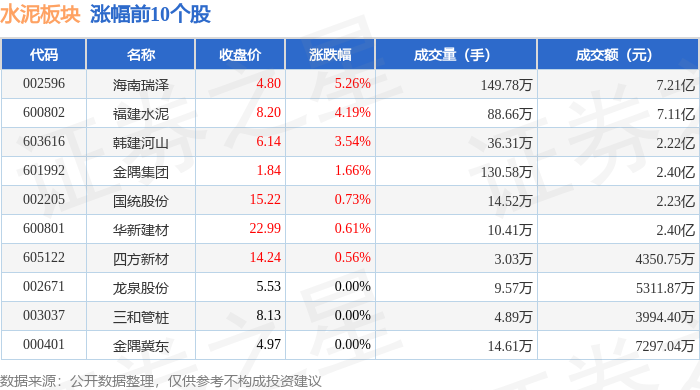
Market Overview - The cement sector experienced a decline of 0.22% on November 14, with Sichuan Jinding leading the drop [1] - The Shanghai Composite Index closed at 3990.49, down 0.97%, while the Shenzhen Component Index closed at 13216.03, down 1.93% [1] Individual Stock Performance - Notable gainers in the cement sector included: - Hainan Ruize (002596) with a closing price of 4.80, up 5.26% on a trading volume of 1.4978 million shares and a turnover of 721 million yuan [1] - Fujian Cement (600802) closed at 8.20, up 4.19% with a trading volume of 886,600 shares and a turnover of 711 million yuan [1] - Major decliners included: - Sichuan Jinding (600678) which closed at 10.29, down 5.77% with a trading volume of 715,100 shares and a turnover of 748 million yuan [2] - Qingsong Jianhua (600425) closed at 4.84, down 1.43% with a trading volume of 310,500 shares and a turnover of 151 million yuan [2] Capital Flow Analysis - The cement sector saw a net outflow of 194 million yuan from institutional investors, while retail investors contributed a net inflow of 174 million yuan [2] - The capital flow for specific stocks showed: - All Yu Group (601992) had a net inflow of 17.78 million yuan from institutional investors, but a net outflow of 2.87 million yuan from retail investors [3] - Fujian Cement (600802) experienced a net inflow of 12.18 million yuan from institutional investors, but a net outflow of 15.99 million yuan from retail investors [3]


研报掘金丨长江证券:予海螺水泥“买入”评级 判断公司2025年销量表现有望优于同行业
Ge Long Hui A P P· 2025-11-14 08:50
Core Viewpoint - The report from Changjiang Securities indicates that both the real estate and infrastructure sectors are under pressure, leading to a continuous decline in national cement production [1] Industry Summary - National fixed asset investment (excluding rural households) reached 37.15 trillion yuan in the first three quarters of 2025, a year-on-year decrease of 0.5% [1] - Infrastructure investment increased by 1.1% year-on-year, while manufacturing investment grew by 4.0% [1] - Real estate development investment saw a significant decline of 13.9% [1] - National cement production for the first three quarters of 2025 was 1.259 billion tons, down 5.2% year-on-year [1] - In September alone, national cement production was 154 million tons, reflecting an 8.6% year-on-year decrease [1] Company Summary - Considering Conch Cement's comprehensive competitiveness and regional advantages, the company is expected to outperform its peers in terms of sales in 2025 [1] - The demand for cement has historically been driven by real estate and infrastructure; however, under the current steady growth context, infrastructure is expected to provide marginal support [1] - Certain regions may stabilize first due to accelerated construction of key projects [1] - The share of real estate in cement demand has significantly decreased due to the decline in real estate central area [1] - The company's projected performance for 2025 and 2026 is 83 billion yuan and 100 billion yuan, respectively, with corresponding P/E ratios of 15 and 12 times, leading to a "buy" rating [1]