
交通基建

Search documents
猛砸万亿做基建 越南在布什么“棋局”?
2 1 Shi Ji Jing Ji Bao Dao· 2025-09-22 23:36
Core Viewpoint - Vietnam is launching an ambitious infrastructure investment plan with a total investment of 1,280 trillion VND (approximately 50 billion USD) for 250 large-scale projects, marking the beginning of a 10 to 20-year economic development and modernization phase [1][6]. Infrastructure Challenges - Vietnam's road quality ranks 109th globally, with only 60% of national roads being asphalted and many roads remaining in poor condition [2]. - The railway system largely consists of narrow-gauge tracks from the colonial era, limiting capacity and speed, with average speeds around 50 km/h [2]. - Power supply issues have led to nationwide blackouts, causing significant losses for major companies, with a reported loss of 1.4 billion USD for firms like Foxconn and Samsung [3]. Government Initiatives - The Vietnamese government is focusing on infrastructure to address economic challenges, with public investment spending increasing by 40% year-on-year in the first half of the year [6]. - As of June 30, public investment reached 268.1 trillion VND (approximately 10.3 billion USD), accounting for 32.5% of the approved budget for 2025 [6]. Investment Landscape - The government is funding 129 of the 250 projects, with a total investment of approximately 478 trillion VND (about 18 billion USD), while 121 projects are supported by private and foreign capital, totaling around 30.5 billion USD [7]. - Private and foreign investments account for 63% of the total investment in these projects [7]. Market Opportunities for Chinese Enterprises - Chinese companies are increasingly involved in Vietnam's infrastructure projects, with significant contracts awarded for metro and highway construction [10][11]. - The shift towards smaller, more manageable projects is noted as a strategy to mitigate risks associated with large-scale investments [11]. Strategic Considerations - Experts suggest that Chinese enterprises should form strategic alliances to avoid internal competition and price wars in the crowded Vietnamese market [11]. - Identifying new opportunities in sectors like renewable energy, electricity, and telecommunications is recommended, as traditional infrastructure sectors may face protectionist barriers [11].
猛砸万亿做基建,越南在布什么“棋局”?
2 1 Shi Ji Jing Ji Bao Dao· 2025-09-22 13:07
Group 1 - Vietnam government has announced the launch and completion of 250 large-scale infrastructure projects with a total investment of 1,280 trillion VND (approximately 50 billion USD) [1] - The infrastructure investment is seen as a key driver for Vietnam's economic growth and modernization over the next 10 to 20 years [1][4] - The public investment expenditure in Vietnam surged by 40% year-on-year in the first half of the year, reaching 268.1 trillion VND (approximately 10.3 billion USD) [6] Group 2 - Vietnam's road quality ranks 109th globally, indicating significant infrastructure challenges, particularly in major cities like Ho Chi Minh and Hanoi [2] - The railway system is largely outdated, with most tracks dating back to the French colonial era, limiting capacity and speed [2] - Power supply issues have led to nationwide blackouts, affecting major companies and prompting the government to seek electricity imports [3] Group 3 - Vietnam is focusing on improving infrastructure to address challenges such as increased tariffs from the US and to meet its GDP growth target of 8.3%-8.5% for the year [6] - The government is funding 129 of the 250 projects, while 121 projects are supported by private and foreign capital, highlighting a reliance on external investment [7] - The participation of Chinese companies in Vietnam's infrastructure projects is increasing, with examples including the construction of metro lines and highways [10][11] Group 4 - The Vietnamese government aims to alleviate financial pressure through Public-Private Partnerships (PPP), but attracting private investment remains a challenge [7][8] - Experts suggest that Chinese companies should form strategic alliances to avoid internal competition in the crowded Vietnamese market [11] - There is a shift in Chinese companies' approach to overseas infrastructure projects, focusing on smaller, manageable projects to mitigate risks [11][12]
西部证券晨会纪要-20250922
Western Securities· 2025-09-22 01:58
Group 1: Guangdong Hongda (002683.SZ) - The company is a leader in the civil explosives industry, with growth rates exceeding the industry average, and military business is poised for expansion [7][8] - Expected net profits for 2025-2027 are projected at 1.196 billion, 1.415 billion, and 1.772 billion yuan, respectively, with a target price of 47.2 yuan based on a 30x PE for 2025, rated as "Accumulate" [7][8] - Revenue from the domestic regions of Northwest, Southwest, and North China for 2024 is expected to be 2.69 billion, 1.14 billion, and 2.34 billion yuan, respectively, with significant year-on-year growth [8] Group 2: Yangnong Chemical (600486.SH) - The company is positioned as a leader in the pesticide industry, benefiting from an upward trend in industry conditions and a recovery in the market [11][12] - Projected revenues for 2025-2027 are 11.484 billion, 12.325 billion, and 13.536 billion yuan, with net profits of 1.443 billion, 1.654 billion, and 1.884 billion yuan, respectively, rated as "Accumulate" [11][12] - The company is expected to transition from a generic pesticide manufacturer to a CDMO for innovative drugs, enhancing its growth potential [12] Group 3: China Communications Construction Company (601800.SH) - The company holds a leading position in transportation infrastructure and is expected to benefit from increased domestic infrastructure projects and international expansion [14][15] - The company is the largest international engineering contractor in China, with a strong historical presence in overseas markets, contributing to growth [14][15] - A dividend plan has been announced, ensuring stable returns for investors, with a target price of 11.78 yuan based on an 8x PE for 2025, rated as "Buy" [14][15] Group 4: Xinzhou Bang (300037.SZ) - The company is focused on a comprehensive layout in the lithium battery and fluorochemical sectors, with clear growth in demand for fluorochemicals [18][19] - Expected net profits for 2025-2027 are projected at 1.130 billion, 1.501 billion, and 1.859 billion yuan, with significant year-on-year growth rates [18][19] - The company is enhancing its vertical integration and global layout, with ongoing projects in Malaysia and the US expected to boost profitability [18][19] Group 5: Haian Home (600398.SH) - The main brand has shown improvement, with revenue for the first half of 2025 reaching 11.566 billion yuan, a year-on-year increase of 1.73% [21][22] - The company is expanding its direct sales while reducing franchise operations, with a focus on new retail formats [21][22] - Projected net profits for 2025-2027 are 2.421 billion, 2.700 billion, and 2.947 billion yuan, with a growth rate of 12.2%, 11.5%, and 9.1% respectively, rated as "Buy" [24] Group 6: Xtep International (01368.HK) - The main brand has shown steady growth, with revenue for the first half of 2025 reaching 6.838 billion yuan, a year-on-year increase of 7.1% [26][27] - The company is focusing on the running segment, with strong performance in its professional sports line [26][27] - Projected net profits for 2025-2027 are 1.379 billion, 1.516 billion, and 1.664 billion yuan, with growth rates of 11.3%, 9.9%, and 9.8% respectively, rated as "Buy" [28] Group 7: Mindray Medical (300760.SZ) - The company reported total revenue of 16.743 billion yuan for the first half of 2025, a year-on-year decrease of 18.45% [30][31] - International business showed resilience with revenue of 8.332 billion yuan, a year-on-year increase of 5.39%, while domestic revenue declined significantly [30][31] - The company plans to distribute a total of 3.298 billion yuan in cash dividends for 2025, representing 65.06% of its net profit for the first half of the year [31]





共享机遇,共促未来,构建更为紧密的中国—东盟命运共同体
Ren Min Ri Bao· 2025-09-21 22:41
Group 1: Event Overview - The 22nd China-ASEAN Expo and China-ASEAN Business and Investment Summit concluded in Nanning, Guangxi, attracting 3,260 enterprises from 60 countries and regions, with a total attendance of 226,000, setting a new historical record [1] - Over 700 outcomes were achieved during the expo, including more than 500 signed economic and trade projects and over 270 results across multiple fields and formats [1] Group 2: Technological Innovations - The expo featured a dedicated AI pavilion covering 10,000 square meters, showcasing around 1,200 exhibits, with a trade turnover exceeding 140 million RMB [2] - Companies presented advanced AI applications, including real-time translation smart glasses and heavy-lift drones, indicating a strong interest in AI technology among attendees [2] Group 3: Cross-Border Cooperation - CuberAI showcased AI-driven cross-border logistics solutions, emphasizing the potential for AI applications in enhancing trade efficiency between ASEAN countries and China [3] - A total of 44 "AI+" projects were signed at the expo, spanning manufacturing, services, and agriculture sectors, highlighting the growing integration of AI in various industries [3] Group 4: Trade Agreements and Economic Integration - The China-ASEAN Free Trade Area 3.0 negotiations have been completed, aiming to elevate economic cooperation to new heights and solidify the foundation for regional economic integration [6] - The expo served as a platform for mutual economic needs, with significant participation from Chinese enterprises in infrastructure projects across ASEAN countries, totaling over 69 billion USD in contracts signed in the last five years [6] Group 5: Cultural Exchange and Future Cooperation - The expo featured cultural activities that fostered people-to-people connections, which are essential for strengthening economic and investment cooperation [7] - The focus on youth cooperation was highlighted, with initiatives aimed at investing in long-term relationships between ASEAN and China [8]


鲁企积极开拓海外市场,寻找“第二增长曲线”
Da Zhong Ri Bao· 2025-09-21 00:55
Core Viewpoint - Shandong High-speed Group's recent success in securing two major contracts in Malaysia highlights the company's strategy to expand into overseas markets and seek new growth opportunities, particularly in emerging industries such as smart logistics and intelligent manufacturing [2][3][4] Group 1: Project Details - The Malaysia Smart Warehouse project involves the construction of smart warehouses across several states, with a total contract value of 60 million Malaysian Ringgit (approximately 10.2 billion RMB) [2] - The Nilai Smart City project plans to invest 7 billion USD (approximately 50.1 billion RMB) over the next decade, with an initial contract value of about 1.6 billion USD (approximately 11.45 billion RMB) [2] - Both projects leverage advanced technologies such as IoT, big data, and AI, showcasing Shandong High-speed Group's capabilities in providing integrated solutions [3][4] Group 2: Business Strategy and Performance - Shandong High-speed Group's overseas project contracts signed this year amount to approximately 27 billion RMB, representing a year-on-year growth of 360% [4] - The company has been recognized as one of the top 250 international contractors globally, ranking 51st, which enhances its credibility in securing large contracts [4] - The dual projects signify a strategic shift from traditional construction to modern logistics and supply chain services, marking a significant breakthrough in project scale and local impact [4] Group 3: Collaborative Ecosystem - The successful execution of these projects is expected to significantly increase the revenue scale and proportion of Shandong High-speed Group's overseas business, enhancing its resilience in the new economic landscape [5] - The projects also align with Malaysia's industrial upgrade and digital transformation needs, as the country seeks to enhance efficiency and competitiveness through smart solutions [6] - The establishment of a cooperation alliance in Shandong aims to create a collaborative ecosystem that promotes "Shandong manufacturing" and "Shandong services" on a global scale [6] Group 4: Industry Trends - Shandong High-speed Group is actively pursuing an international strategy that integrates foreign trade, services, and investment, thereby enhancing its competitiveness in the global market [7] - The company is also involved in various projects across different regions, including smart transportation systems in Ethiopia and renewable energy initiatives in Singapore [7] - Other Shandong enterprises are similarly exploring overseas markets to find new growth avenues, with a focus on high-tech and high-value products [8] Group 5: Economic Impact - In the first eight months of this year, Shandong's total import and export volume reached 2.32 trillion RMB, reflecting a year-on-year growth of 5.8%, the highest among the top five foreign trade provinces [10] - The provincial government is implementing measures to support enterprises in exploring new markets and fostering new growth drivers, further solidifying Shandong's position in the global market [10]

双百亿大单里,窥见鲁企出海新范式
Da Zhong Ri Bao· 2025-09-20 22:54
Core Insights - Shandong High-speed Group has successfully secured two major overseas projects in Malaysia, marking a significant expansion into Southeast Asia with contract values exceeding 100 billion RMB [1][5] - The projects include a smart warehousing initiative and a smart city construction plan, highlighting the company's focus on integrating advanced technologies such as IoT, big data, and AI [2][3] Group 1: Project Details - The smart warehousing project involves the construction of 2 million pallet spaces across various Malaysian states, with a contract value of 60 million ringgit (approximately 102 billion RMB) [1] - The smart city project is set to invest 7 billion USD (approximately 501 billion RMB) over the next decade, with an initial contract value of 1.6 billion USD (approximately 114.5 billion RMB) [1][2] Group 2: Strategic Advantages - Shandong High-speed Group leverages its strong supply chain capabilities across various sectors, including transportation infrastructure and construction, to support its international projects [3][5] - The company has seen a 360% year-on-year increase in overseas project contracts, totaling approximately 27 billion RMB this year, reinforcing its position as a leading international contractor [5] Group 3: Collaborative Ecosystem - The successful execution of these projects is expected to enhance the company's revenue and market share in overseas operations, while also contributing to Malaysia's industrial upgrade and digital transformation [7][8] - A new investment cooperation alliance in Shandong aims to foster collaboration among various enterprises, enhancing the global presence of "Shandong manufacturing" and "Shandong services" [8][9] Group 4: Broader Industry Trends - The company is part of a larger trend among Shandong enterprises seeking to expand into international markets, with a focus on high-tech and high-value products [12][13] - Shandong's overall foreign trade has shown resilience, with a reported 5.8% year-on-year growth in import and export totals, positioning the province as a key player in global trade [13]

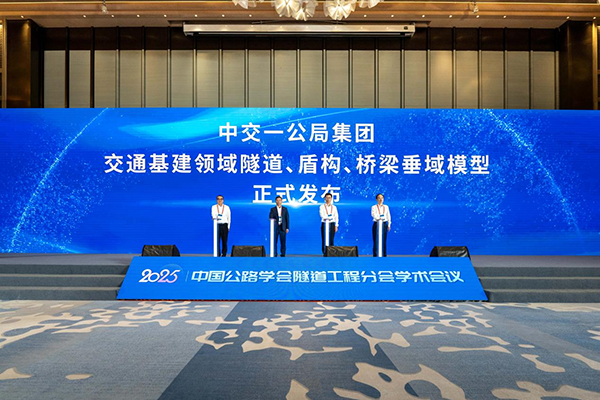
中交一公局发布交通基建领域三大垂域模型
Zhong Guo Jing Ji Wang· 2025-09-12 07:58
Core Insights - The launch of three vertical domain models by China Communications First Highway Engineering Group marks a significant breakthrough in the digital transformation of the infrastructure sector, particularly in tunnel, shield, and bridge construction [1][3][5] Group 1: Model Details - The three models introduced are "Blue Wing. Chuan Yue" for drill-blast tunnels, "Blue Wing. Qian Long" for shield tunnels, and "Blue Wing. Fei Hong" for arch bridges, all utilizing the "Blue Wing" general model capabilities [1][3] - These models incorporate 30,755 standards, regulations, and technical solutions, along with 150TB of production data and over 10 billion tokens of high-quality training corpus, creating a comprehensive application system for vertical domain composite models [3] Group 2: Functional Capabilities - "Blue Wing. Chuan Yue" covers advanced geological forecasting, surrounding rock identification, drill-blast construction, and equipment scheduling, ensuring safety and cost efficiency throughout the construction process [3] - "Blue Wing. Qian Long" establishes an intelligent construction system that integrates shield selection, excavation construction, risk identification, and auxiliary operations, advancing the smart construction of shield tunnels [3] - "Blue Wing. Fei Hong" supports core processes such as mix design optimization, arch seat construction, steel arch bridge assembly, and cable control, ensuring safety and control throughout the arch bridge construction lifecycle [3] Group 3: Industry Impact - The release of these models is seen as a milestone moment for the empowerment of the industry through artificial intelligence, with the company committed to developing richer AI application scenarios for engineering construction [5] - The company aims to collaborate with industry peers to foster innovation and create a strong engine for new productive forces, contributing to the digital advancement of China's modernization efforts [5]
宁夏国资国企资产总额突破3000亿元
Sou Hu Cai Jing· 2025-09-05 01:19
Group 1 - The total assets of state-owned enterprises in the region have exceeded 300 billion yuan, reaching 301.52 billion yuan, with a year-on-year growth of 9.9% [1] - Operating income for the first seven months reached 19.37 billion yuan, reflecting a year-on-year increase of 33.2%, while profit amounted to 2.145 billion yuan, up 27.3% [1] - The region's state-owned enterprises ranked first and second in operating income and profit growth among the five provinces in Northwest China, indicating strong competitive momentum [1] Group 2 - Investment by state-owned enterprises reached 16.365 billion yuan in the first seven months, a staggering increase of 279% year-on-year, with an investment completion rate exceeding 72% [2] - Key projects in renewable energy, infrastructure, and other sectors are accelerating, serving as significant drivers of economic growth [2] - The net asset return rate for state-owned enterprises is 1.3%, with labor productivity per person increasing to 248,000 yuan, marking improvements of 0.2 percentage points and 27.18% respectively [2] Group 3 - The regional state-owned assets supervision and administration commission plans to enhance dynamic scheduling and seize policy opportunities to optimize credit structure and reduce financing costs [3] - There will be a focus on accelerating key projects such as the Baoyin Railway and green energy parks, while deepening cooperation with central enterprises in the region [3] - The commission aims to expand employment opportunities and provide tailored services to enterprises, emphasizing the role of state-owned enterprises in stabilizing growth and benefiting the public [3]
四川路桥2025中报:订单充足龙头实力稳固 回购分红双管齐下彰显信心
Quan Jing Wang· 2025-09-01 10:32
Core Viewpoint - Sichuan Road and Bridge (600039.SH) reported strong financial performance for the first half of 2025, with significant revenue and profit growth, reinforcing its leading position in the southwestern infrastructure sector [1] Financial Performance - The company achieved a total operating revenue of 43.536 billion yuan and a net profit attributable to shareholders of 2.78 billion yuan in the first half of 2025 [1] - The total assets amounted to 239.856 billion yuan, with basic earnings per share at 0.32 yuan [1] - The company proposed a cash dividend of 0.32 yuan per 10 shares, totaling 278 million yuan, reflecting a dividend payout ratio of 50.02% over the past three years [1] Order Book and Project Pipeline - Sichuan Road and Bridge secured 218 new projects with a total contract value of 72.24 billion yuan, marking a year-on-year increase of 22.20% [2] - The company has a backlog of orders totaling 291.321 billion yuan, providing a solid foundation for future revenue generation [2] - Significant projects include various highway and railway constructions, with several expected to be operational within the year [2] Operational Strategy - The company employs a "participation + construction" model, engaging in projects like the G5 Jingkun Expressway expansion, which has a total investment of 28.548 billion yuan, optimizing cash flow while ensuring stable revenue [3] Innovation and Technology - Sichuan Road and Bridge has focused on innovation, achieving 18 invention patents and 74 utility model patents during the reporting period [4] - The company has implemented advanced technologies, such as an AI-driven automated steel bridge material warehouse and a quadruped robot for tunnel inspections, enhancing operational efficiency [4] Recognition and Achievements - The company has completed several landmark projects, including the world's largest mountain railway tunnel and the largest underground interchange, receiving international accolades [5] Market Environment and Policy Support - Recent government policies are expected to boost infrastructure investment, with projected public budget expenditure growth in the construction sector [6] - Sichuan's strategic position in the "Belt and Road" initiative enhances its role in international infrastructure projects, with significant contributions to regional development [7] Future Outlook - With ongoing policy support, a robust order backlog, and technological advancements, Sichuan Road and Bridge is well-positioned to lead in southwestern infrastructure upgrades and contribute to national strategic initiatives [8]

中国交建:上半年新兴业务领域新签合同额3202.55亿元
Zhong Zheng Wang· 2025-08-30 01:07
Core Viewpoint - China Communications Construction Company (CCCC) reported steady operational performance in the first half of 2025, focusing on high-quality development and actively fulfilling its responsibility to serve national strategies [1][2]. Financial Performance - In the first half of 2025, CCCC achieved operating revenue of 337.055 billion yuan and a net profit attributable to shareholders of 9.568 billion yuan, with earnings per share of 0.56 yuan [1]. - The new contract value reached 991.054 billion yuan, representing a year-on-year increase of 3.14% [3]. Business Development - The new contracts in emerging business areas amounted to 320.255 billion yuan, accounting for approximately 32% of the total new contracts [1]. - The company held an unexecuted contract amount of 3.428988 trillion yuan as of June 30, 2025 [1]. Shareholder Returns - CCCC has distributed approximately 55.6 billion yuan in dividends to shareholders and is committed to a dividend policy with a minimum payout ratio of 20% [2]. - The company aims to enhance the transparency and predictability of cash dividends and plans to implement a mid-term dividend or pre-dividend as a regular practice [2]. Strategic Focus - CCCC is focusing on innovation, green development, digital transformation, and sustainable practices, with an emphasis on "full transportation, full cities, and full water areas" [2]. - The company is accelerating its transition to a "fully green and fully digital" model, leveraging digitalization to promote green development [2]. Market Position and Growth - CCCC maintains its leading position in the industry, with significant contributions to national key projects, including the completion of the Tianshan Victory Tunnel [3]. - The company reported a 15.9% year-on-year increase in new contracts for domestic port construction, totaling 53.191 billion yuan, and a 5.69% increase in dredging contracts, totaling 63.077 billion yuan [3]. Research and Innovation - CCCC's R&D expenditure was 8.891 billion yuan, accounting for 2.64% of operating revenue [3]. - The company has made breakthroughs in key technologies and established national-level innovation platforms, including the approval of the "National Key Laboratory for Estuary and Coast" [4]. Future Outlook - CCCC plans to continue focusing on growth and aims to achieve its annual targets while laying a solid foundation for high-quality development [4].