
健康

Search documents
一组组税收数据勾勒中国经济高质量发展“画卷” 多领域“亮点”不断涌现
Yang Shi Wang· 2025-12-08 09:54
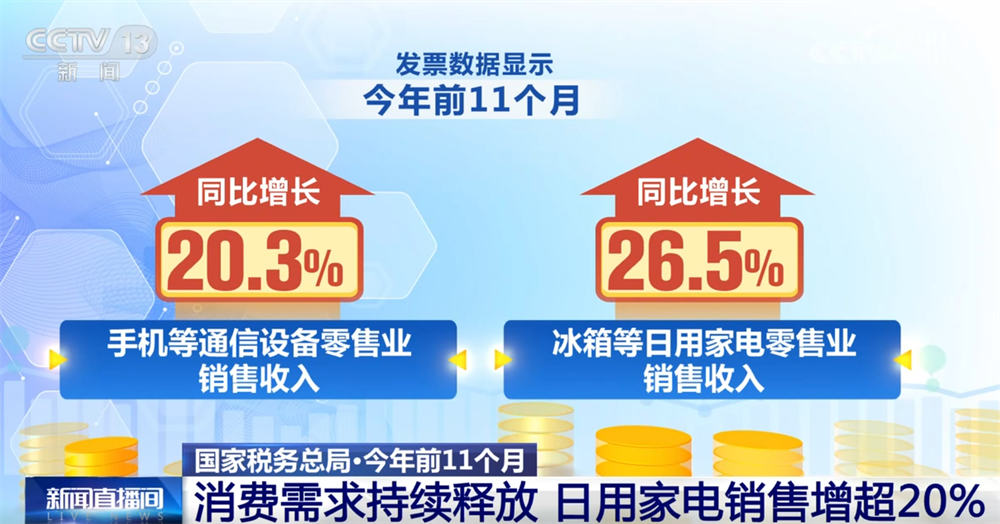
Group 1: Consumer Demand and Sales Growth - Consumer demand has been continuously released this year, driven by policies such as the trade-in program for consumer goods [1] - Sales of home appliances and new energy vehicles have maintained rapid growth, with retail sales of communication devices and daily household appliances increasing by 20.3% and 26.5% year-on-year, respectively [1] - The sales revenue of new energy passenger vehicles has also shown a positive trend, with a year-on-year increase of 19.1% [1] Group 2: Cultural and Tourism Sector Growth - The cultural and tourism market has seen the emergence of new business formats and scenarios, enhancing consumer vitality [3] - Sales revenue from artistic creation and performance, as well as film screenings, increased by 15.6% and 19.1% year-on-year, respectively [5] - The integration of tourism with cultural activities has led to a surge in immersive and scenario-based tourism consumption [5] Group 3: Sports and Health Sector Performance - The sports and health sectors have exhibited high consumer enthusiasm, with sports exhibition services and retail sales of sports goods increasing by 29.7% and 6.6% year-on-year, respectively [5] - Health-related consumption has become a new hotspot, with retail sales of health auxiliary treatment equipment and health consulting services maintaining double-digit growth [5] Group 4: Elderly Care Services Demand - The consumption demand from the elderly population has increased, driving diversified growth in essential elderly care services [7] - Sales in elderly care, social assistance, and nursing home services have increased by 33.6%, 9.6%, and 14.6% year-on-year, respectively [7] Group 5: Tax Refunds and Cross-Border Trade - The sales volume and tax refunds for tax refund goods have increased by 98.8% year-on-year, reflecting the optimization of the tax refund policy and services [8] - The number of tax refund stores has reached 12,252 nationwide, with over 7,000 stores offering "buy and refund" services [8][10] - The variety of goods eligible for tax refunds has expanded significantly, with 329 categories available, an increase of 84 categories year-on-year [10] Group 6: Water Resource Tax Reform - The implementation of the water resource tax reform has shown significant results, with a 26.9% increase in the number of tax filers and an 18.5% increase in tax revenue [11] - The tax reform has led to a notable decrease in groundwater and special water usage, with a 13% and 49.7% reduction, respectively [13] Group 7: Inter-Provincial Trade Growth - The proportion of inter-provincial trade sales in the national sales revenue has increased to 41.1%, up 0.8 percentage points year-on-year [16] - The number of provinces experiencing growth in inter-provincial trade has risen from 19 to 27, indicating deepening trade connections [16] - The average processing time for cross-regional tax-related business has been reduced by 5 to 10 days, enhancing efficiency [18]

税收大数据显示:新场景新模式带动服务消费快速增长
Sou Hu Cai Jing· 2025-12-08 08:41
新华社北京12月8日电(记者刘开雄)国家税务总局12月8日发布的最新税收大数据显示,今年以来,在 国家一系列提振消费政策的支持以及消费新场景、新模式带动下,我国服务消费亮点不少。 "今年以来,文化、旅游新业态新场景不断涌现,消费活力释放。"国家税务总局总经济师、新闻发言人 荣海楼在当日举行的例行新闻发布会上说。 从税收发票数据看,今年前11个月,文艺创作与表演、电影放映销售收入同比分别增长15.6%和 19.1%,并与旅游产业融合,带动沉浸式、场景式旅游消费蓬勃发展。同期的旅行社及相关服务、名胜 风景区、休闲观光活动销售收入同比分别增长10.8%、29.4%和16.6%。 从税收发票数据看,前11个月,老年人及残疾人养护、社会看护与帮助、疗养院服务消费同比分别增长 33.6%、9.6%和14.6%。而在年轻消费群体中,以游戏动漫等数字文化服务为代表的情绪价值、社交属 性消费颇受年轻人青睐,展现出一定消费潜力。前11个月,与其相关的数字文化服务销售收入同比增长 16.5%。 "税务部门将持续落实好支持消费的税费政策,不断优化办税缴费服务举措,促进以政策红利和服务便 利更好地激发内需潜力、提升消费活力。"荣海楼说 ...
税务总局:前11月家电零售收入增长26%,体育消费热度高
2 1 Shi Ji Jing Ji Bao Dao· 2025-12-08 06:09
Economic Performance - The National Taxation Administration reported that from January to November, the amount of machinery and equipment purchased by enterprises increased by 10.7% year-on-year, indicating a stronger investment in equipment [1] - Sales revenue in the home appliance and communication retail sectors, supported by the old-for-new consumption policy, grew by 26.5% and 20.3% respectively, reflecting the ongoing effectiveness of consumption promotion policies [1] - Export tax refunds processed by tax authorities increased by 6.8% year-on-year, showcasing the resilience of Chinese enterprises in maintaining good growth amid complex international trade conditions [1] Consumption Trends - The integration of culture and tourism has stimulated new consumption vitality, with sales revenue from cultural and artistic performances and film screenings increasing by 15.6% and 19.1% respectively [2] - The travel industry has also benefited, with sales from travel agencies and related services, scenic spots, and leisure activities growing by 10.8%, 29.4%, and 16.6% respectively [2] - The sports and health sectors have shown high consumer enthusiasm, with sales in sports exhibition services and sports goods retail increasing by 29.7% and 6.6% respectively [2] Demographic Insights - The elderly population has shown increased consumption demand, leading to diverse growth in elder care services, with spending on elder care and social assistance rising by 33.6% and 9.6% respectively [3] - The younger demographic is also exhibiting significant consumption potential, particularly in digital cultural services related to gaming and animation, which saw a sales increase of 16.5% [3] - The tax authorities plan to continue implementing supportive tax and fee policies to further stimulate domestic demand and enhance consumption vitality [3]
前11个月消费需求持续释放 日用家电销售增长超20%
Yang Shi Xin Wen· 2025-12-08 03:50
Group 1 - The core viewpoint of the articles highlights the sustained growth in consumer demand driven by policies such as the trade-in program for consumer goods, with significant sales increases in home appliances and new energy vehicles [1][2] - In the retail sector, sales revenue for communication devices like mobile phones increased by 20.3%, while daily household appliances such as refrigerators saw a 26.5% rise in sales revenue year-on-year [1] - The sales revenue for new energy passenger vehicles also showed positive growth, with a year-on-year increase of 19.1% [1] Group 2 - The sports and health sectors are experiencing high consumer enthusiasm, with sports exhibition services and retail of sports goods and equipment growing by 29.7% and 6.6% respectively year-on-year [2] - Health-related consumption is emerging as a new hotspot, with sales of health auxiliary treatment equipment and health consulting services maintaining double-digit growth [2]
博时基金桂征辉:股债均衡,市场波动中的投资“平衡术”
Xin Lang Ji Jin· 2025-12-02 02:00
Group 1: A-Share Market Insights - The A-share market in 2025 is characterized by "structural differentiation and prominent main lines," with technology, non-ferrous metals, and new energy sectors standing out, particularly in AI computing power, semiconductor equipment, gold, and lithium resources [1] - The rise in these sectors is driven by the global explosion in AI demand, supportive new energy policies, and improved supply-demand relationships [1] - Challenges include slow recovery in traditional real estate and consumer sectors, as well as external factors like fluctuating Federal Reserve policies and geopolitical conflicts affecting market trends [1] Group 2: Global Economic Impact - Global macroeconomic events, such as Federal Reserve interest rate cuts and geopolitical tensions, have an indirect but significant impact on A-shares [2] - Interest rate cuts can attract foreign capital into A-shares, but expectations during the cut process may lead to short-term volatility [2] - Geopolitical conflicts may increase energy prices, affecting industry costs and enhancing the attractiveness of assets like gold [2] Group 3: Investment Opportunities - Three key areas to focus on include: 1. Technological innovation, such as AI, semiconductors, and biomanufacturing, benefiting from national policies and technological breakthroughs [3] 2. Consumption upgrades, including cultural tourism, health, and green consumption, showing strong demand resilience [3] 3. High-end manufacturing, like new energy equipment and industrial mother machines, aligning with global industrial chain restructuring trends [3] - Some sectors have seen valuation recoveries, suggesting a diversified approach through index or sector funds to mitigate risks associated with single-stock bets [3] Group 4: Bond Investment Risks - Key risks in bond investment include interest rate risk, where market rate changes can lead to bond price fluctuations, and credit risk, which refers to the possibility of the issuer failing to pay interest or principal [4] - Investors are advised to prioritize government bonds or high-credit-rated bonds to mitigate these risks [4] Group 5: Balanced Investment Strategy - The effectiveness of a balanced stock-bond strategy lies in the inverse relationship between stocks and bonds, where stocks provide returns during market upswings and bonds may appreciate during downturns, thus cushioning losses [5] - Historical data indicates that during significant A-share adjustments, the bond market often performs well, leading to lower drawdowns in balanced portfolios compared to pure equity investments [5] Group 6: Public Fund Benefits - Public funds address the high entry barriers of direct stock and bond investments by offering professional management, diversified investment, and low minimum investment thresholds [6] - Funds select a basket of stocks or bonds, automatically diversifying risk, and have flexible investment amounts starting as low as 10 yuan [6] Group 7: Risk Preference-Based Fund Allocation - Investors should assess their risk tolerance before determining stock-bond fund ratios, with suggested allocations for different risk profiles: 1. Defensive investors: Up to 30% in stock funds, at least 70% in bond funds, focusing on low-volatility assets [7] 2. Moderate investors: Approximately equal allocation (around 50% each) with potential inclusion of thematic or convertible bond funds [7] 3. Aggressive investors: 70%-80% in stock funds, 20%-30% in bond funds, focusing on growth-oriented stock funds [7] Group 8: Additional Considerations - Factors such as age and investment horizon should influence asset allocation, with younger investors leaning towards aggressive strategies and those nearing retirement shifting to defensive ones [8] - Regular review and adjustment of investment ratios are essential to align with life stages, market changes, and goals [8] - Diversification within the same asset class is crucial to further reduce non-systematic risks [8]
六部门促消费新政:文旅/康养/运动/非遗/低空迎品质升级!
Sou Hu Cai Jing· 2025-11-28 05:44
Core Viewpoint - The implementation plan aims to enhance the adaptability of supply and demand in consumer goods, targeting significant improvements in the supply structure by 2027, including the establishment of three trillion-level consumption sectors and ten hundred-billion-level consumption hotspots [1][6][25]. Group 1: Enhancing Consumer Goods Supply - The plan focuses on optimizing the supply structure of consumer goods, with a goal to create high-quality products that are culturally rich and globally recognized by 2027 [6][22]. - It emphasizes the importance of integrating traditional craftsmanship with innovation, supporting the development of non-heritage workshops and promoting domestic products in duty-free shops [2][11]. Group 2: Expanding Consumption Areas - The plan outlines the expansion of cultural and tourism consumption by focusing on various sports and outdoor activities, including mountain, water, and ice sports, as well as promoting new consumption models like low-altitude tourism and RV camping [2][10]. - It aims to deepen the integration of tourism and health care, supporting customized services in traditional Chinese medicine and dietary therapy [3][11]. Group 3: Matching Diverse Consumer Needs - The initiative seeks to develop interest-based consumer products, such as those related to pets, anime, and trendy fashion, to cater to diverse consumer preferences [3][12]. - It also highlights the importance of enhancing the supply of quality products for children and students, as well as promoting fashionable "trendy" items [13][31]. Group 4: Fostering New Consumption Scenarios and Business Models - The plan encourages the establishment of flagship stores and new concept stores to promote product launches, integrating online and offline experiences [15][32]. - It supports the development of new business models such as live e-commerce and instant retail, while ensuring the quality and safety of shared consumption products [16][34]. Group 5: Creating a Supportive Environment - The plan emphasizes the need for financial support and policy measures to enhance the quality of consumer goods and stimulate consumption [17][21]. - It calls for the establishment of a robust regulatory framework to maintain market order and protect consumer rights, particularly in the context of online sales [18][34].

大力提振消费 夯实发展根基
Qi Huo Ri Bao Wang· 2025-11-21 01:32
Core Viewpoint - The "14th Five-Year Plan" emphasizes boosting consumption as a key driver for sustainable economic growth and improving the quality of life for citizens, especially in the context of a complex global economic environment and domestic economic transformation [1] Group 1: Implementation of Consumption Boosting Actions - The government will implement targeted actions to stimulate consumption through a combination of policies aimed at enhancing market vitality [2] - Focus on increasing employment and income, particularly for key groups such as recent graduates and migrant workers, to enhance consumer capacity [2] - Increase public service spending in areas like education and healthcare to reduce the financial burden on residents, encouraging them to spend more [2] Group 2: Development of International Consumption Centers - The plan includes cultivating international consumption center cities to attract global quality consumption resources and enhance the national image [3] - Improvement of urban consumption infrastructure and introduction of international brands to meet consumer demand for global products [3] - Expansion of inbound consumption by optimizing the environment for international tourists, including simplifying visa processes and enhancing payment options [3] Group 3: Direct Consumer Benefits through Inclusive Policies - The government will increase funding for consumer welfare initiatives, such as issuing consumption vouchers and providing subsidies for upgrading old products [4] - Policies will target high-demand sectors like dining and tourism to stimulate market recovery [4] - Removal of unreasonable restrictions on consumption, such as easing car purchase limits, to unleash consumer potential [4] Group 4: Strengthening Consumer Rights Protection - Enhancing consumer rights protection is crucial for boosting consumption, with plans to improve legislation and market regulation [5] - Establishing efficient complaint resolution mechanisms to lower the cost of consumer rights protection [6] - Promoting consumer education to foster informed and responsible consumption behaviors [6]
名单公示!最高4亿元资金支持 50城打造消费“新三样”
Zheng Quan Shi Bao· 2025-11-20 10:46
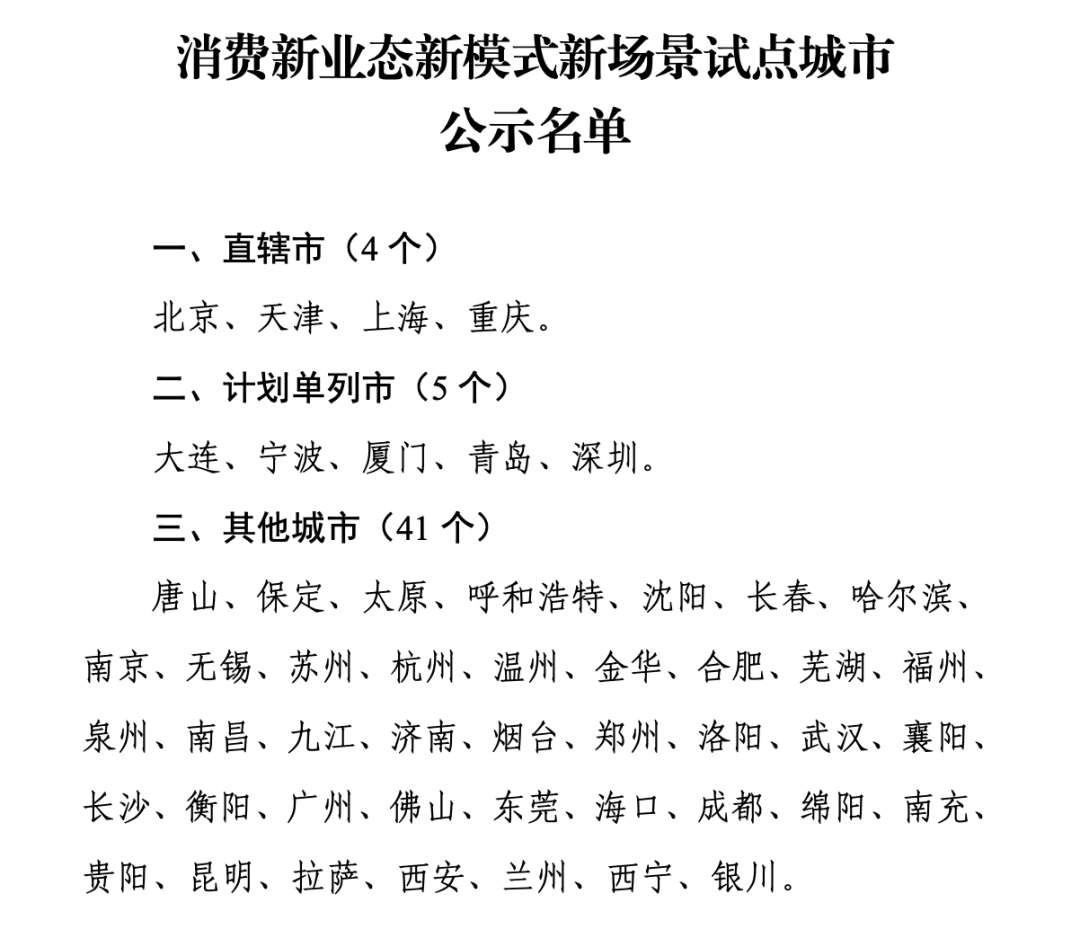
Core Viewpoint - The Ministry of Finance and the Ministry of Commerce have initiated a pilot program to stimulate consumption potential and expand domestic demand, with 50 cities selected for the trial [1][3]. Funding and Support - The pilot program will last for two years, with a maximum financial subsidy of 400 million yuan per city based on city size, aimed at enhancing the service system for new consumption [3][4]. - The funding will be distributed in two batches, with remaining funds allocated based on performance evaluations [4]. Focus Areas - The program emphasizes three main areas: 1. Supporting the establishment of a service system for new consumption, including the creation of launch centers and platforms for new product releases [4][5]. 2. Promoting innovative and diverse service consumption scenarios, enhancing cultural, health, and entertainment offerings in key commercial areas [5][6]. 3. Encouraging collaboration between quality consumption resources and well-known IPs to create engaging and innovative consumption experiences [5][6]. Economic Impact - The pilot aims to enrich consumption supply and stimulate industry innovation while stabilizing employment, with expectations to create numerous job opportunities across various service sectors [6][7]. - The program is designed to meet the differentiated and quality demands of consumers, fostering new growth points in service consumption [7].
名单公示!最高4亿元资金支持 50城打造消费“新三样”
证券时报· 2025-11-20 10:40
Core Viewpoint - The article discusses the significant progress in the pilot program for new consumption formats, models, and scenarios initiated by the Ministry of Finance and the Ministry of Commerce to stimulate domestic demand and unleash consumer potential [1][2]. Group 1: Pilot Program Details - On November 20, 50 cities were officially announced as candidates for the pilot program, including all four direct-controlled municipalities and five cities with independent planning, covering major provinces [2]. - The pilot program will last for two years, with the central government providing up to 400 million yuan per city in financial subsidies based on city size, aimed at enhancing the consumption market [4][6]. - The funding will be allocated in two batches, with remaining funds distributed based on performance evaluations [6]. Group 2: Focus Areas of Support - The program emphasizes three main areas for support: 1. Establishing a robust first-release economic service system, including the creation of first-release centers and platforms for product launches in key commercial areas [7]. 2. Innovating diverse service consumption scenarios, promoting the transformation of traditional shopping areas into multi-functional consumption hubs [7]. 3. Supporting collaborations between quality consumption resources and well-known intellectual properties (IPs) to create engaging consumption experiences [8]. Group 3: Economic and Employment Impact - The pilot program aims to enrich consumption supply while activating industry innovation and stabilizing employment, with expectations to create numerous job opportunities across various service sectors [10][11]. - The initiative will focus on high-quality, innovative consumption offerings to meet diverse consumer demands and promote typical experiences to stimulate innovation in the consumption sector [11].

策略专题:“十五五”投资机遇
Tianfeng Securities· 2025-11-17 11:15
Group 1 - The core conclusion of the report explores investment opportunities in the "14th Five-Year Plan" from two dimensions: strategic directions indicated by planning suggestions and historical focus industries from previous five-year plans [1] - The three main policy lines of the "14th Five-Year Plan" are summarized as "Development," "Livelihood," and "Security," with "Development" focusing on advanced manufacturing and new productivity, "Livelihood" emphasizing domestic demand expansion, and "Security" reinforcing national defense and key technology areas [1][2] - The report indicates that while certain industry themes may create long-term excess returns if performance continues to validate, the likelihood of sustained excess returns throughout the entire five-year planning cycle is low [3] Group 2 - The "14th Five-Year Plan" emphasizes high-quality development, breaking down economic and social development goals into three main lines: "Development," "Livelihood," and "Security," with 12 key tasks identified [2][8] - The "Development" line focuses on enhancing traditional industries, scaling new pillar industries, and ensuring supportive industries for high-quality growth, with a strong emphasis on technological self-reliance [9][10] - The "Livelihood" line aims to address issues related to population structure changes and economic development, focusing on expanding domestic demand and improving residents' income levels to boost consumption in health, education, and elderly care sectors [11][12] - The "Security" line highlights the importance of national defense and ecological safety, with a focus on military modernization, key resource security, and the development of critical technologies [14][17] Group 3 - The investment guidance indicates that key themes and newly emphasized industries may not achieve significant excess returns over the entire five-year cycle, citing examples from previous plans where certain sectors underperformed [15][16] - The report notes that while industries like new energy vehicles have shown potential for long-term excess returns, the possibility of sustained excess returns throughout the five-year planning cycle remains limited due to over-optimistic pricing and cyclical nature of industries [15]