可控核聚变

Search documents
利空也砸不下大A
虎嗅APP· 2026-01-15 00:29
Core Viewpoint - The A-share market is experiencing extreme enthusiasm, prompting regulatory measures to cool down the market, indicating a shift towards a "slow bull" market rather than a "crazy bull" market, emphasizing the need for investors to focus on fundamentals rather than emotions [5][6]. Market Sentiment and Regulatory Response - On January 14, the exchange announced an increase in the minimum margin ratio for financing from 80% to 100%, leading to an immediate market downturn [5]. - The regulatory stance is clear: the market can rise, but it should not be driven solely by emotions, and investors must return to fundamentals [6]. Investment Opportunities and Risks - The focus should be on identifying key sectors that are likely to perform well while avoiding those that may pose risks [7][8]. - The analysis will cover 13 high-interest sectors to provide insights on potential investment opportunities [9]. AI Computing Power - The rise of AI infrastructure is supported by increased investments from cloud vendors, with companies like "易中天" (New Yizhong, Zhongji Xuchuang, Tianfu Communication) showing significant stock price increases [11]. - However, the current high valuations may be unsustainable, and without new positive developments, there is a risk of a bubble burst in this sector [11]. Space Computing Industry - The space computing industry is expected to emerge as a significant market, with technologies deploying data centers in space to address ground-based limitations [13][15]. - China's advancements in space computing are supported by government initiatives, with plans for a comprehensive deployment strategy by 2025 [17][18]. Humanoid Robots - The humanoid robot sector is anticipated to see differentiation by 2026, with industrial applications being the primary focus, while household robots remain underdeveloped [20][22]. - Companies like 优必选 (UBTECH) are ramping up production, with expectations of significant output increases in the coming years [22][23]. Semiconductor Equipment - Domestic wafer fabs are planning expansions to meet AI chip demand and enhance production capacity, which will benefit semiconductor equipment suppliers [25][26]. Controlled Nuclear Fusion - The commercialization of controlled nuclear fusion is accelerating, with multiple technological pathways being explored [28][30]. - China is making significant strides in fusion energy, with projects like EAST and BEST expected to lead to practical applications by 2027 [32][33]. Commercial Aerospace - The commercial aerospace sector is experiencing a surge, driven by fears of missing out on investment opportunities, although there are concerns about the sustainability of this growth [41][42]. - China's satellite deployment is rapidly increasing, positioning the country as a major player in the global space race [44]. Photovoltaics - The photovoltaic sector is expected to reach a turning point in 2026, driven by supply-side adjustments and improved fundamentals [47][51]. - The cancellation of export tax rebates is likely to increase costs for exporters, benefiting larger firms with economies of scale [51][52]. Consumer Sector - The consumer sector is seen as a safe haven during market volatility, with specific focus areas including media, service consumption, and premium goods like liquor [66][70]. - The overall consumer demand is expected to recover gradually, but structural changes may lead to a lack of strong support for broad-based growth [67]. Banking Sector - The banking sector has shown resilience despite fundamental pressures, with attractive dividend yields drawing in long-term investors [72][73]. - However, the sector is unlikely to lead the market due to its lower growth potential compared to technology and growth stocks [74]. Insurance Sector - The insurance sector has outperformed banks, benefiting from stock market recovery and expected growth in both asset and liability sides [76]. - The aging population is likely to increase the importance of insurance companies in key areas like healthcare and retirement [76]. Brokerage Firms - Brokerage firms have seen strong earnings growth but face challenges in maintaining investor interest due to perceived volatility and lack of long-term growth [77].


报告征集 | 如日之升·2026年中国可控核聚变发展报告
艾瑞咨询· 2026-01-15 00:06
Core Viewpoint - Controlled nuclear fusion is transitioning from a long-term scientific concept to a critical phase of engineering validation and commercialization, driven by global energy transition and carbon neutrality goals [2]. Group 1: Research Background - Global private investment in controlled nuclear fusion has surpassed $10 billion, with over 40 countries actively engaging in this field [2]. - The International Atomic Energy Agency (IAEA) has indicated that the development of fusion energy has entered a "decisive new stage," becoming a cornerstone of national energy strategies and a key area of global technological competition [2]. - For China, the urgency to focus on controlled nuclear fusion is threefold: ensuring energy security and achieving carbon neutrality, leading a new wave of technological revolution and industrial transformation, and enhancing international technological governance [2]. Group 2: Purpose of the Report - The report aims to systematically outline the latest developments in controlled nuclear fusion globally and in China, analyzing the technological, industrial, and policy ecosystems to provide forward-looking references for decision-makers, industry players, and investors [3]. Group 3: Research Content - The report will focus on defining controlled nuclear fusion and its key technologies, the driving forces and environment for its development, critical points for commercialization breakthroughs, and advanced measures taken by industry institutions and enterprises in technology, policy, construction, business models, and financing [6]. Group 4: Industry Trends and Participation Value - Participating enterprises and institutions will have the opportunity to be included in the "Rising Sun: 2026 China Controlled Nuclear Fusion Development Report," enhancing brand visibility and showcasing industry influence [8]. - The report will be published on official platforms, including the iResearch website and WeChat account, with dissemination through multiple media channels [8]. Group 5: Target Participants - The report seeks contributions from enterprises in the controlled nuclear fusion sector, including upstream core materials and components suppliers, midstream key equipment and system integrators, and downstream operational entities [9]. - Relevant institutions involved in the top-level design and management of fusion projects, as well as local government departments promoting fusion energy installations, are also encouraged to participate [9].

不做选择题:同泰基金经理陈宗超四季报“All in”AI与核聚变,押注现在与未来
Xin Lang Cai Jing· 2026-01-14 10:18
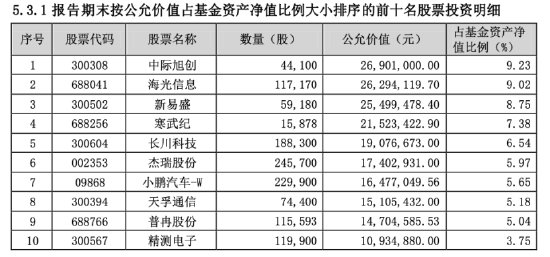
Core Insights - The 2025 fund reports indicate a clear "dual bet" strategy by fund manager Chen Zongchao, focusing on AI applications and controlled nuclear fusion as key investment themes for 2026 [1][9]. Group 1: Same Fund Performance - The fund "Tongtai Digital Economy A" has evolved into an "AI computing power hardware fund," with its top ten holdings accounting for 66.51% of the fund's net asset value by the end of Q4 [2][10]. - Key holdings include Zhongji Xuchuang, Haiguang Information, Xinyi Sheng, and Hanwha, which together represent over 34% of the fund [2][10]. - The fund achieved a return of 3.49% in Q4 2025, reflecting its focused investment strategy [6][16]. Group 2: Investment Strategy - Chen Zongchao has strategically reduced exposure to general tech hardware stocks while increasing stakes in core holdings like Haiguang Information and Xinyi Sheng, reinforcing the focus on domestic AI computing power [3][11]. - New investments in companies like Jereh and XPeng Motors indicate an expansion into AI-enabled high-end manufacturing and smart driving [3][11]. Group 3: Future Outlook - The fund "Tongtai New Energy Preferred" is focused on the ultimate energy solution of controlled nuclear fusion, with a portfolio heavily invested in companies linked to high-temperature superconductors and special metals [5][14]. - Chen Zongchao predicts that advancements in high-temperature superconductors and AI will accelerate the realization of controlled nuclear fusion, potentially surpassing the commercial scale of wind and solar storage industries [6][16]. - The fund's concentrated strategy yielded a remarkable quarterly return of 26.28%, ranking it first among similar products [6][16]. Group 4: Market Sentiment and Risks - Despite acknowledging the high uncertainty and risks in the controlled nuclear fusion sector, Chen Zongchao remains optimistic about the long-term potential of AI computing stocks, which have shown resilience amid market skepticism [8][18]. - The AI computing sector is viewed as entering a new Kondratiev wave, with the main battleground shifting from the West to China [20].
中油资本:参股企业昆仑资本重点聚焦新能源、新材料、数智产业、低空经济等领域投资
Mei Ri Jing Ji Xin Wen· 2026-01-14 09:56
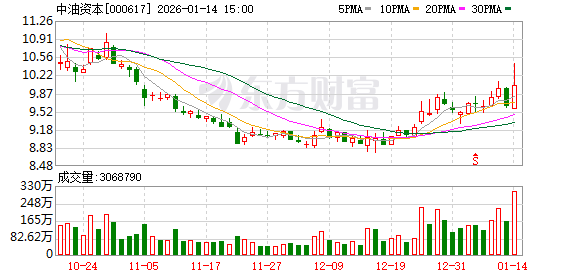
Group 1 - The company, Zhongyou Capital, has confirmed its subsidiary, Kunlun Capital, is actively investing in the commercial aerospace sector, specifically in companies like Hongqing Technology and Aerospace Times Feipeng [2] - Kunlun Capital is implementing a "fund + direct investment" dual-drive strategy, focusing on investments in new energy, new materials, digital intelligence industries, and low-altitude economy [2]

A股三大指数下挫,沪指17连阳终结,成交额3.7万亿元,再刷历史纪录
Mei Ri Jing Ji Xin Wen· 2026-01-13 10:01
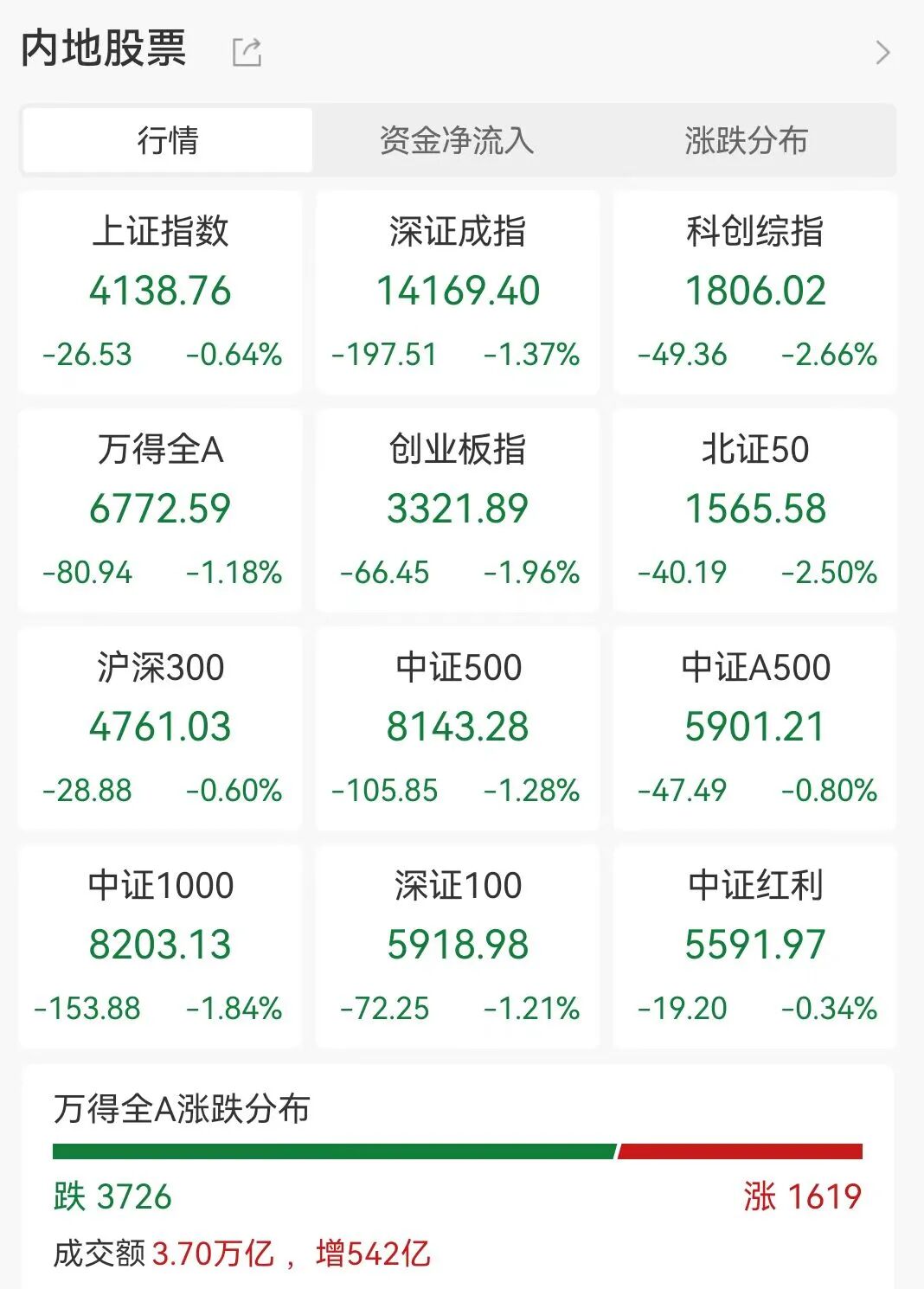
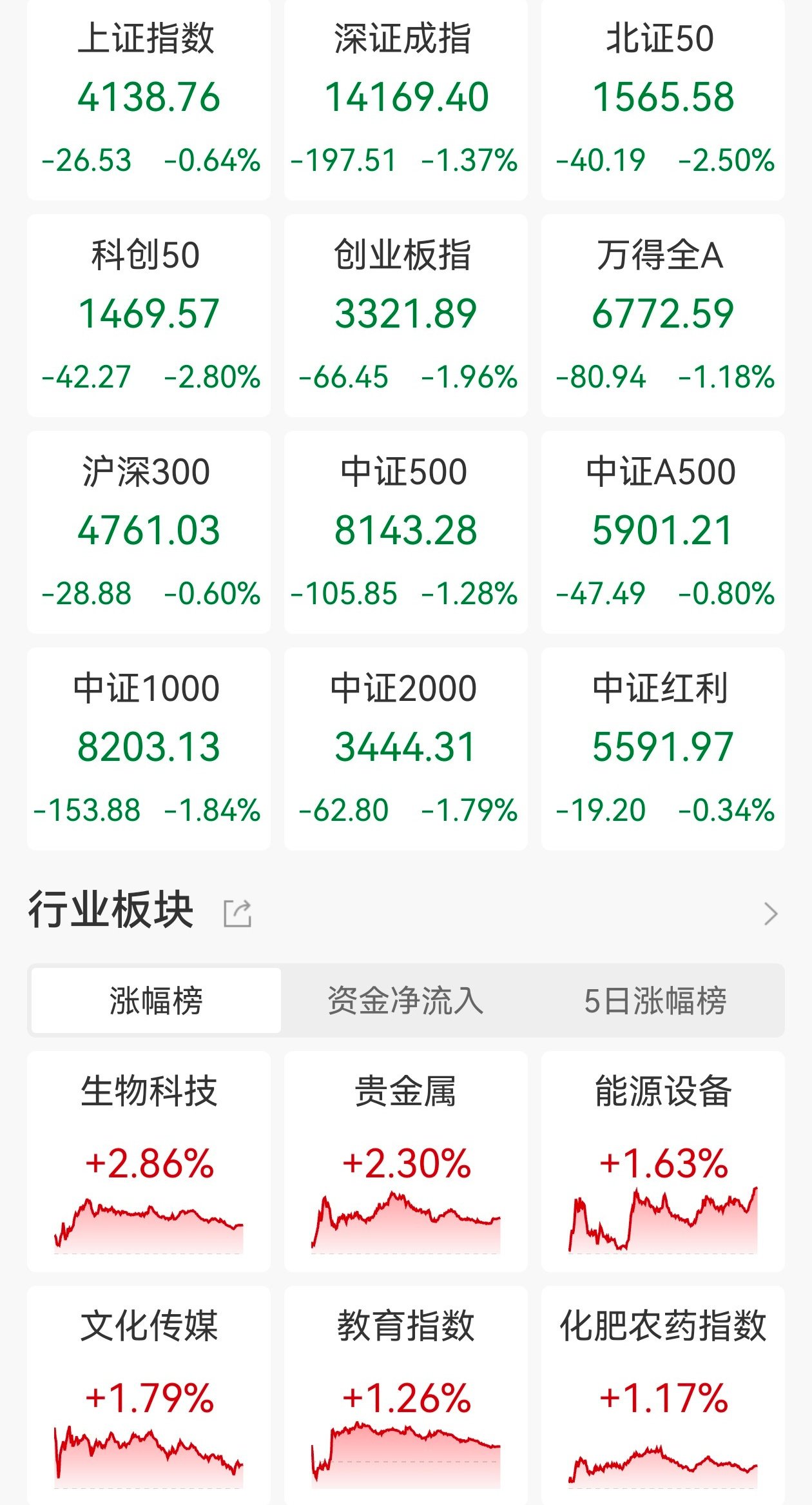
Market Overview - The A-share market experienced a collective pullback on January 13, ending a 17-day winning streak, with the Shanghai Composite Index down by 0.64%, the Shenzhen Component down by 1.37%, and the ChiNext Index down by 1.96% [1][2] - The trading volume in the Shanghai and Shenzhen markets reached a record high of 3.7 trillion yuan [1] Sector Performance - Multiple companies issued risk warnings, leading to significant declines in sectors such as commercial aerospace and satellite internet, with nearly a hundred stocks, including Aerospace Electronics and China Satellite Communications, dropping over 8% [3] - The large aircraft and military sectors also saw declines, with stocks like Zhongtian Rocket and Leike Defense hitting their daily limit down [3] - The controllable nuclear fusion sector faced a downturn, with Wangzi New Materials hitting its daily limit down [3] - The communication equipment sector declined, with Changjiang Communication hitting its daily limit down [3] - Other sectors such as Beidou Navigation, quantum technology, 3D printing, CPO concepts, and F5G concepts experienced significant losses [3] Analyst Insights - Analyst Liu Hangdeng from Haineng Investment noted that after the 17-day rally, the market faced a volume adjustment of 3.65 trillion yuan, with commercial aerospace being the main sector under pressure [4] - The market encountered resistance near the 4180 level, indicating a short-term pullback, with support expected around the 4090 level [4] - The AI application sector, which had a strong performance previously, opened high but closed lower, although its structural trend and fundamental application logic remain strong [4] - The afternoon session saw a rapid surge in the electric power and grid equipment sector, indicating potential short-term opportunities [4] Precious Metals - Gold and silver prices showed volatility, but precious metal stocks led gains in the non-ferrous metal sector, with Mingbai Jewelry hitting the daily limit up and Hunan Silver approaching the daily limit up [4] - As of the report, spot gold fell slightly below 4590 USD/ounce, while spot silver fell below 85 USD/ounce [4][5]
杨德龙:2026年市场行情开局良好
Xin Lang Cai Jing· 2026-01-13 09:32
Core Viewpoint - The market in 2026 is expected to continue the trends of 2025, with a more diversified performance across various sectors, moving away from the "barbell" strategy observed in 2025, where low-valuation, high-dividend sectors like banks and high-performing tech stocks dominated [1][10]. Group 1: Market Trends and Investor Behavior - In 2025, the market exhibited a "barbell" characteristic, with significant gains in low-valuation sectors and standout performance in tech stocks, while traditional sectors showed lackluster performance [1][10]. - Many investors did not achieve satisfactory returns in 2025 due to inadequate allocation towards the two main investment themes, leading to lower overall returns and even losses [1][10]. - The strong performance of the market in 2026 is anticipated to enhance investor confidence and improve the overall market sentiment [1][8]. Group 2: Capital Market Dynamics - A significant shift in resident savings is expected, with a large influx of funds into the capital market, driven by declining savings rates and limited investment opportunities in traditional sectors [2][11]. - In 2025, new fund issuance exceeded 1 trillion yuan, primarily in equity funds, marking a notable shift where equity fund sales surpassed fixed-income products for the first time [2][11]. - The number of new stock accounts opened in 2025 reached over 27 million, indicating strong investor interest and engagement in the capital market [2][11]. Group 3: Economic Impact and Consumer Behavior - The capital market's recovery is seen as a crucial mechanism for boosting consumer spending, as families recover from significant wealth losses due to declining real estate values [3][12]. - The market's performance is expected to help stabilize the real estate sector, particularly in core areas of first-tier cities, while many regions still face oversupply issues [3][12]. - The ongoing bull market is viewed as a vital tool for enhancing household financial health and increasing disposable income, thereby stimulating consumption [3][12]. Group 4: Technological Innovation and Investment Opportunities - The strengthening of the stock market is projected to facilitate a resurgence in IPOs, allowing more tech innovation companies to access capital [4][13]. - The focus of the "14th Five-Year Plan" aligns with sectors that performed well in 2025, such as semiconductors and quantum technology, indicating significant opportunities for growth in these areas [4][13]. - The AI technology sector is still in its early stages, with substantial potential for growth as it moves towards large-scale commercialization [5][14]. Group 5: Investment Strategy and Sector Differentiation - Investment in tech stocks in 2026 will require a more differentiated approach, focusing on companies with core technologies and real application potential, as opposed to those that are merely conceptual [6][15]. - The human-robotics sector is expected to shift from a phase of expectation to one of actual order fulfillment, with companies securing contracts from leading manufacturers likely to see greater growth [6][15]. - Other tech sectors are anticipated to follow a similar trajectory, with software companies and data-related enterprises poised for growth as the industry evolves [7][15]. Group 6: Overall Market Sentiment - The market is expected to see an increase in profitability and investor satisfaction, contributing to a sustained recovery in market confidence [8][16].
A股收评:3.7万亿元!成交额再创历史天量,深证成指、创业板指跌逾1.3%,商业航天板块大退潮
Ge Long Hui· 2026-01-13 07:12
Market Overview - The three major A-share indices collectively declined, with the Shanghai Composite Index down 0.64% to 4138 points, the Shenzhen Component Index down 1.37%, and the ChiNext Index down 1.96% [1] - The total market turnover reached a record high of 3.7 trillion yuan, an increase of 54.2 billion yuan compared to the previous trading day, with over 3700 stocks declining [1] Sector Performance - The commercial aerospace and satellite internet sectors experienced significant downturns, with nearly 100 stocks, including Aerospace Electronics, China Satellite Communications, and Aerospace Science and Technology, falling over 8% [1] - The large aircraft and military sectors also declined, with stocks like Zhongtian Rocket and Leike Defense hitting the daily limit down [1] - The controllable nuclear fusion sector saw a drop, with Wangzi New Materials hitting the daily limit down [1] - The communication equipment sector fell, with Changjiang Communication hitting the daily limit down [1] - Other sectors with notable declines included Beidou Navigation, quantum technology, 3D printing, CPO concepts, and F5G concepts [1] Positive Sector Movements - The pharmaceutical sector saw a broad increase, with recombinant proteins, CRO, and medical services leading the gains, and stocks like Baihua Pharmaceutical and Boji Pharmaceutical hitting the daily limit up [1] - The precious metals sector rose, with Xiaocheng Technology increasing over 8% [1] - Pfizer announced plans to launch a GLP-1 weight loss drug by 2028, boosting the weight loss drug sector, with Prolo Pharmaceutical nearing the daily limit up [1] - Other sectors with notable gains included innovative drugs, lithium mining concepts, and gaming [1]

可控核聚变板块大幅调整,弘讯科技跌停
Xin Lang Cai Jing· 2026-01-13 01:48
Group 1 - The controllable nuclear fusion sector has undergone significant adjustments, leading to a sharp decline in stock prices [1] - Hongxun Technology experienced a trading halt, while other companies such as Srei New Materials, Tianli Composite, Zhongtian Rocket, Parker New Materials, Sichuang Electronics, and Hualing Cable also saw declines [1]

商业化进程提速 可控核聚变板块热度攀升
Zheng Quan Ri Bao Wang· 2026-01-12 12:49
Core Viewpoint - The A-share controllable nuclear fusion sector is experiencing significant growth, with the sector index rising by 4.74% and several stocks reaching their daily limit up, driven by recent technological breakthroughs and industry advancements in the nuclear fusion field [1][2]. Industry Developments - The global nuclear fusion market is projected to reach $496.55 billion by 2030 and exceed $1 trillion by 2050, indicating substantial growth potential for upstream and downstream companies in the industry [2]. - The controllable nuclear fusion industry encompasses high-barrier segments such as ultra-low temperature refrigeration and superconducting materials, creating a competitive moat for companies with core patents and national project certifications [2]. Company Highlights - Snowman Group, a leader in nuclear fusion equipment, produces helium compressors essential for large scientific projects, achieving international leading standards in technology with applications in major national research projects [3]. - Zhongtai Deep Cold Technology Co., Ltd. has established a strong position in deep cooling technology for nuclear fusion projects, collaborating with universities for ongoing research and development [3]. - Antai Technology recently won a significant contract worth 69.9 million yuan for a critical component in nuclear fusion technology, reinforcing its technical capabilities and positioning for future projects [3]. Market Sentiment and Future Outlook - Other companies in the sector are also making progress in nuclear fusion-related business, although some report that their contributions to overall orders remain limited [4]. - Experts suggest that recent breakthroughs in key technologies are transitioning the industry from research and development to engineering validation, which will lead to increased order releases and benefits for companies with core supply capabilities [4]. - The A-share technology sector is shifting focus from mature AI applications to advanced manufacturing, with controllable nuclear fusion aligning with high-end manufacturing and national strategic interests, indicating a potential new investment focus [4].


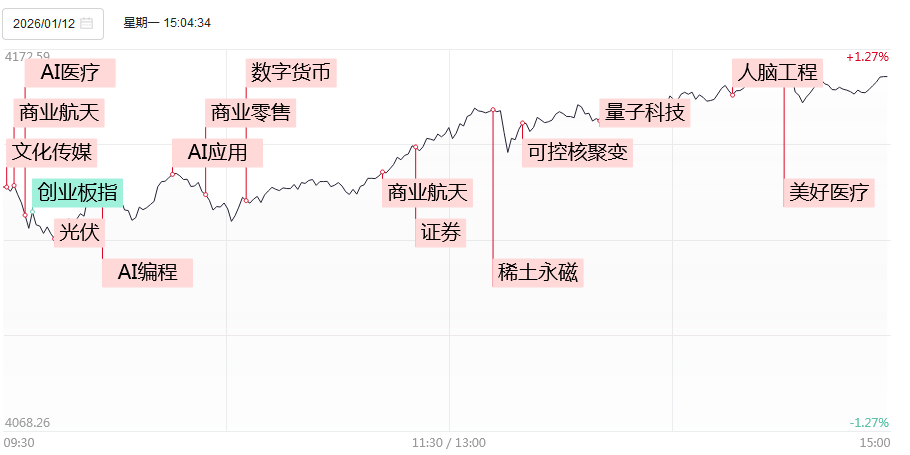
涨停复盘:今日全市场共197只股涨停,连板股总数45只,两市成交额3.6万亿创历史新高!嘉美包装复牌后涨停,17天13板!
Jin Rong Jie· 2026-01-12 11:00
Market Overview - On January 12, the market experienced a significant rally, with all three major indices rising over 1%. The Shanghai Composite Index increased by 1.09% to close at 4165.29 points, the Shenzhen Component rose by 1.75% to 14366.91 points, and the ChiNext Index gained 1.82% to 3388.34 points. The total trading volume in the Shanghai and Shenzhen markets reached 3.6 trillion yuan, marking the second consecutive day of surpassing 3 trillion yuan, an increase of 478.7 billion yuan compared to the previous trading day, setting a new historical record for trading volume in 2024 [1]. Sector Performance - The AI application sector saw a broad surge, with stocks like Ingrity Media achieving five consecutive daily limits, and other companies such as Liou Co., Meian Health, and Tianxia Show also hitting daily limits. The commercial aerospace sector continued its strong performance, with Jin Feng Technology achieving five consecutive limits and Tongyu Communications hitting three limits in four days. The controllable nuclear fusion concept also showed active performance, with China Nuclear Engineering hitting three limits in four days. Conversely, sectors such as insurance, oil and gas, and real estate experienced notable declines [1]. Stock Highlights - A total of 183 stocks in the market (excluding ST and delisted stocks) hit daily limits, with 45 stocks achieving consecutive limits. The overall limit rate was 79%. Notable stocks included Jiamei Packaging, which saw a change in control and achieved 13 limits in 17 days, and Fenglong Co., which achieved 12 consecutive limits. Other highlighted stocks included commercial aerospace stocks like Luxin Investment and Lei Ke Defense, which achieved 10 and 7 limits respectively, and AI application stock Zhi Te New Materials, which achieved six consecutive limits [1]. Emerging Trends - The commercial aerospace sector is gaining traction, with a reported 200,000 new satellite applications in China, primarily from the newly established Radio Innovation Institute. In the nuclear power and fusion sectors, Meta has partnered with Vistra, Oklo, and TerraPower to invest in nuclear power plants to supply electricity for AI applications. Additionally, Elon Musk announced plans to open-source new algorithms within a week, which will include codes for recommending natural content and advertisements to users [14].