
美妆

Search documents
济南|济南新春发展热潮涌动 工地不打烊 车间赶工忙
Da Zhong Ri Bao· 2026-02-27 01:37
Group 1: Project Development - Jinan's key projects are actively under construction during the Spring Festival, with companies maintaining production to ensure a strong start to the first quarter [1][2] - The Honglou Urban Renewal Project's Dazhongfa site has seen significant progress, with 250 tons of rebar tied, 5,000 square meters of formwork set, and 120 cubic meters of concrete poured during the holiday [2] - The project aims for completion of the main structure by June 30, 2026, with the first phase already achieving a completion rate of 45% for the basement level [2] Group 2: Workforce and Production - The Dazhongfa site increased its workforce from 130 to approximately 260 workers during the holiday period, demonstrating a commitment to project timelines [2] - The Northeast site of the Full River project also ramped up its workforce, with an expected peak of 350 workers by February 27, 2023 [3] - Jinan Airport's Phase II expansion saw over 5,000 construction workers return to work, ensuring continuous progress on critical infrastructure [3] Group 3: Industrial Growth - Companies like Shandong Huijin Co., Ltd. and Shandong Furida Bio Co., Ltd. resumed operations early to meet high demand, with export orders increasing by about 5% year-on-year [4] - The Jinan government has set clear targets for industrial growth, aiming for the electronic information industry to reach 240 billion yuan, the automotive industry to hit 180 billion yuan, and the modern pharmaceutical industry to achieve 52 billion yuan by 2026 [4]
REDUCED完成融资;联合利华控股膳食补充剂品牌
Sou Hu Cai Jing· 2026-02-26 12:19
Group 1: REDUCED Financing - Danish food technology company REDUCED has completed a financing round of €4 million (approximately 32.45 million RMB), bringing the total financing to €12 million (approximately 97.38 million RMB) to industrialize its fermentation-based savory ingredient platform [3] - The financing was led by Delphinus Venture Capital, with participation from NovoHoldings, ECBF, and EIFO [3] - REDUCED aims to transform food industry byproducts into natural savory ingredients, positioning itself as an alternative to traditional hydrolyzed plant proteins and yeast extracts [3] Group 2: Unilever Acquisitions - Unilever announced the acquisition of the remaining 49% stake in Indian dietary supplement company Zywie Ventures Private Limited for ₹824 million (approximately 62 million RMB), which owns the nutrition brand OZiva [6] - Unilever also sold a 19.8% minority stake in Nutritionalab Private Limited for ₹307 million (approximately 23 million RMB) [6] - OZiva is expected to reach a scale of approximately ₹4.8 billion (approximately 360 million RMB) by 2025, with a compound annual growth rate of 130% over the past two years [6] Group 3: LVMH Brand Sale Consideration - LVMH is considering selling its makeup brand Make Up For Ever and has approached several strategic investors and private equity firms to gauge market interest [9] - The brand currently sells exclusively through Sephora in Europe and North America [9] - The potential sale aligns with LVMH's focus on high-end luxury products, as Make Up For Ever is perceived to cater more to the mass market [9] Group 4: PepsiCo Brand Revamp - PepsiCo has rebranded its Sunbites brand to SUN in the U.S. market, emphasizing dietary fiber content [12] - The new packaging highlights core ingredients such as rice, wheat, corn, and oats, and includes a new series called SUN Sticks made from peas and legumes [12] - Sales for the SUN brand are projected to grow by 31% year-on-year, reaching £18.9 million by 2025 [12] Group 5: MAC's Retail Expansion - MAC has announced its entry into 105 Sephora stores and online platforms in the U.S., marking its first presence in Sephora after 41 years [15] - This move is part of MAC's strategy to accelerate sales growth through diverse retail channels [15] Group 6: Nestlé Business Restructuring - Nestlé plans to sell its ice cream business and has initiated negotiations with Froneri, aiming to complete the sale by 2027 [18] - The company reported a revenue of CHF 89.49 billion (approximately 774 billion RMB) for 2025, a 2% decline year-on-year, with a net profit decrease of 17% [18] - The restructuring focuses on consolidating core business areas into coffee, pet care, nutrition, and snacks, while exiting low-margin, high-capital expenditure sectors [18] Group 7: Leadership Changes - Milk Makeup appointed Frank B as global art director, effective immediately, who has a history with the brand and extensive experience in the fashion industry [21] - Zadig & Voltaire appointed Dan Sablon as creative director, who will oversee ready-to-wear, accessories, and store design [24] - Kraft Heinz appointed Nicolas Amaya as the new North America president, effective immediately, to accelerate integration of recently acquired WK Kellogg products [30]



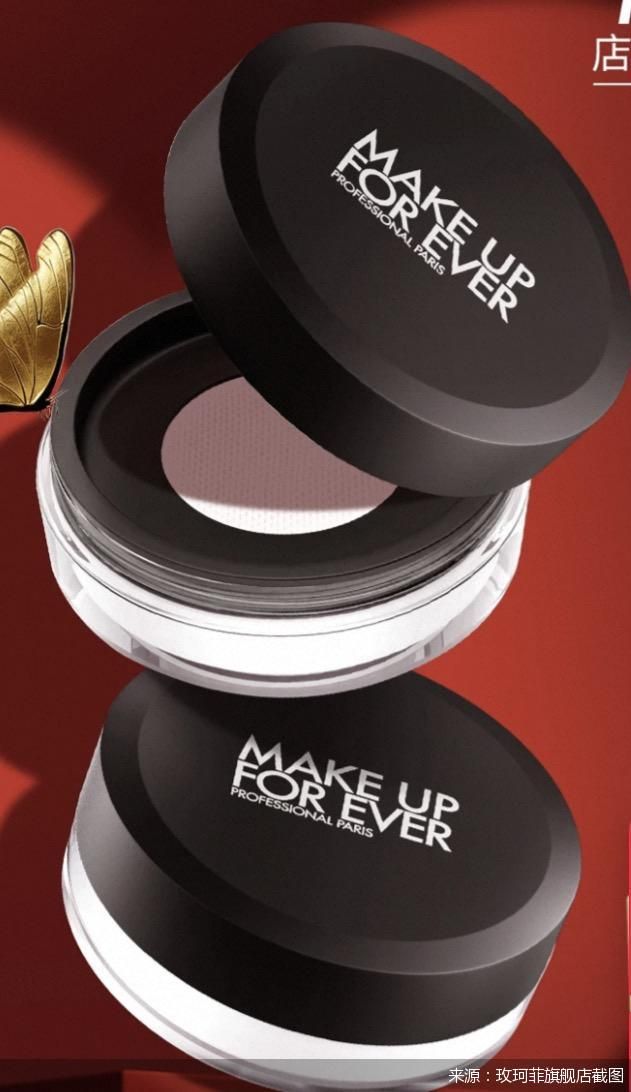
考虑出售玫珂菲,LVMH集团“甩包袱”?
Bei Jing Shang Bao· 2026-02-26 11:53
Core Viewpoint - LVMH is considering selling its makeup brand Make Up For Ever and skincare brand Fresh, as well as divesting part of its stake in Fenty Beauty due to declining performance and profitability challenges in the luxury market [2][3][4]. Group 1: Brand Performance - Make Up For Ever, founded in 1984 and acquired by LVMH in 1999, has been experiencing losses for several years, with an average price point of 300-500 RMB [2][3]. - Fresh, established in 1991, has also been facing difficulties, including the closure of multiple stores in China between 2024 and 2025 [3]. - Fenty Beauty, co-founded by Rihanna, initially gained popularity but has not maintained its momentum, leading to a decline in brand visibility [3]. Group 2: Financial Performance of LVMH - LVMH's total revenue for 2025 is projected to be 80.8 billion euros, a decrease of 3.876 billion euros (5%) from 2024 [4]. - The company's operating profit and net profit are expected to decline by 9% and 13%, respectively, amounting to 17.755 billion euros and 10.878 billion euros [4]. - In 2024, LVMH's revenue was 84.683 billion euros, down 2% year-on-year, with operating profit and net profit decreasing by 14% and 17%, respectively [4]. Group 3: Market Trends and Strategic Shifts - The luxury market is shifting from oligopoly to a more diversified landscape, with increasing competition from niche and custom brands [4]. - Consumer behavior is changing, with a decreasing willingness to pay premium prices, prompting luxury brands to focus on product innovation and service improvement [4]. - LVMH's strategy may involve divesting non-core brands to concentrate resources on stable growth brands like Dior and Guerlain, reinforcing its position in the high-end beauty market [5].
未来10年,最挣钱的凭什么一定是这群人?
创业家· 2026-02-26 10:34
Group 1 - The core viewpoint of the article is that Amazon's report on global e-commerce trends highlights emerging consumer demands and market opportunities driven by technology, emotional needs, and lifestyle changes [1][39]. Group 2 - Trend One: AI Quality Space - Consumers are willing to spend more on smart home products that enhance emotional interaction and personal comfort, with over 65% of consumers in Europe and the US expressing this willingness [4][6]. - Trend Two: Sleep Economy - 37% of American adults reported a decline in sleep quality in 2023, leading to a growing market for sleep-related products and services that enhance health and quality of life [10][12]. - Trend Three: Happy Office - There is an increasing expectation for workspaces to improve comfort and efficiency, with ergonomic furniture and technology becoming more important [13][14]. - Trend Four: Subtle Technology - Consumers are seeking technology that seamlessly integrates into their lives, enhancing quality without being intrusive, reflecting a demand for thoughtful design [15]. - Trend Five: Pet Economy - The global pet industry is expected to grow by 45% over the next six years, with 55% of pet owners in Europe and Japan willing to invest more in pet healthcare and products [16][19]. - Trend Six: Outdoor Cooking - The rise of camping and outdoor cooking reflects a demand for products that enhance social experiences and lifestyle, moving beyond traditional cooking methods [20][22]. - Trend Seven: Mobile Treasure Chest - Vehicles are evolving into multifunctional spaces, with consumers looking for comfort and efficiency in their car interiors [23][27]. - Trend Eight: Generation Z Consumers - This demographic values sustainability, personalization, and emotional connection in their purchasing decisions, requiring brands to communicate authentically [28][30]. - Trend Nine: Fitness Pioneers - There is a growing focus on health and fitness, with technology enabling more personalized and effective exercise solutions [31][34]. - Trend Ten: E-sports Enthusiasts - Emerging markets are seeing rapid growth in e-sports, with consumers seeking high-performance equipment and immersive experiences [35][37].


官宣于适背后,瑷尔博士在寻找怎样的“精神面孔”?
FBeauty未来迹· 2026-02-26 09:26
Core Viewpoint - The article emphasizes the shift in the beauty industry from a marketing-driven approach to a science-driven one, highlighting the importance of authenticity and long-term commitment in brand representation [5][6][12]. Group 1: Brand Representation - The choice of actor Yu Shi as the global brand ambassador for Ai Er Bo Shi reflects a strategic move towards finding a representative who embodies the brand's values rather than just a "traffic face" [6][12]. - Yu Shi's dedication to his craft, including extensive training and immersive experiences for his roles, aligns with Ai Er Bo Shi's commitment to scientific skincare, showcasing a shared belief in the value of time and effort [10][12][13]. Group 2: Scientific Approach - Ai Er Bo Shi has focused on skin microbiome research since 2015, establishing itself as a leader in this niche within the beauty industry [14][16]. - The brand has developed a comprehensive research framework, including a database of skin microbiota and a resource library of beneficial strains, which supports its product development [16][18]. - The discovery of the "287 barrier bacteria," which has been patented and recognized internationally, exemplifies the brand's commitment to scientific innovation and quality [18][22]. Group 3: Consumer Engagement - The brand's recent offline campaign, featuring Yu Shi, aims to connect with consumers by inviting them to participate in a shared experience that emphasizes the brand's core values of authenticity and long-term commitment [27][30]. - The campaign encourages consumers to engage with the brand's message through social media, creating a community around the values of patience and quality in skincare [30][31]. Group 4: Industry Impact - Ai Er Bo Shi's initiatives, such as the annual Skin Microbiome Conference, aim to elevate the industry's understanding of microbiome research and establish standards for skincare products [22][24]. - The brand's efforts to create a scientific foundation for skincare not only benefit its products but also contribute to the broader beauty industry's evolution towards evidence-based practices [22][31].


破局流量困境:七星创客核心机制
Sou Hu Cai Jing· 2026-02-26 08:31
Core Insights - The article discusses the "Seven Star Maker" model and its core mechanism "Push Three Return One," which offers a low-cost, high-efficiency marketing path for businesses facing rising customer acquisition costs and a saturated market [1][2]. Group 1: Model Mechanism - The "Push Three Return One" model combines immediate incentives with long-term benefits, aiming to upgrade users from "consumers" to "promoters" and "team managers," thus lowering participation barriers and enabling low-cost user expansion [4]. - Users can become promoters by purchasing designated products, earning rewards of 10%, 20%, and 70% for referring their first, second, and third users respectively, allowing them to recoup their initial purchase cost [5][7]. Group 2: Seven Star System - The creator levels range from one star to seven stars, with each level having specific team size and performance requirements, and increasing reward percentages as levels rise [10]. - Higher-level creators receive additional incentives, such as the "Bole Award," which grants them 100% of the team performance rewards, and can achieve further promotions by cultivating other high-level creators [12][14]. Group 3: Practical Case Studies - In the beauty industry, a skincare brand utilized the "Seven Star Maker" model to rapidly grow its user base from zero to 500,000 in three months, achieving over 100 million in sales and a private repurchase rate 1.5 times higher than the industry average [18][19]. - A supermarket chain adopted the model to enhance local foot traffic and online sales, resulting in a 40% increase in offline customer flow and a 300% growth in online community sales within six months [20]. - A workplace education platform implemented the model to reduce customer acquisition costs, achieving over 10,000 sales of a course within two months and maintaining a user retention rate of over 75% [21]. Group 4: Key Success Factors - Compliance is essential for the sustainable operation of the model, requiring adherence to regulations and ensuring that rewards are tied to actual product sales to avoid legal issues [24]. - The quality of the product is fundamental, as successful cases demonstrate that high-quality products lead to higher user retention and willingness to promote [27][28]. - The model must be adaptable to different industry characteristics, allowing for flexible adjustments in reward structures to balance user incentives and company profits [30]. Conclusion - The "Seven Star Maker" and "Push Three Return One" model redefines the relationship between brands and consumers, transforming consumers into co-creators and beneficiaries, enabling businesses to achieve low-cost, high-efficiency user expansion in a challenging market environment [32][34].

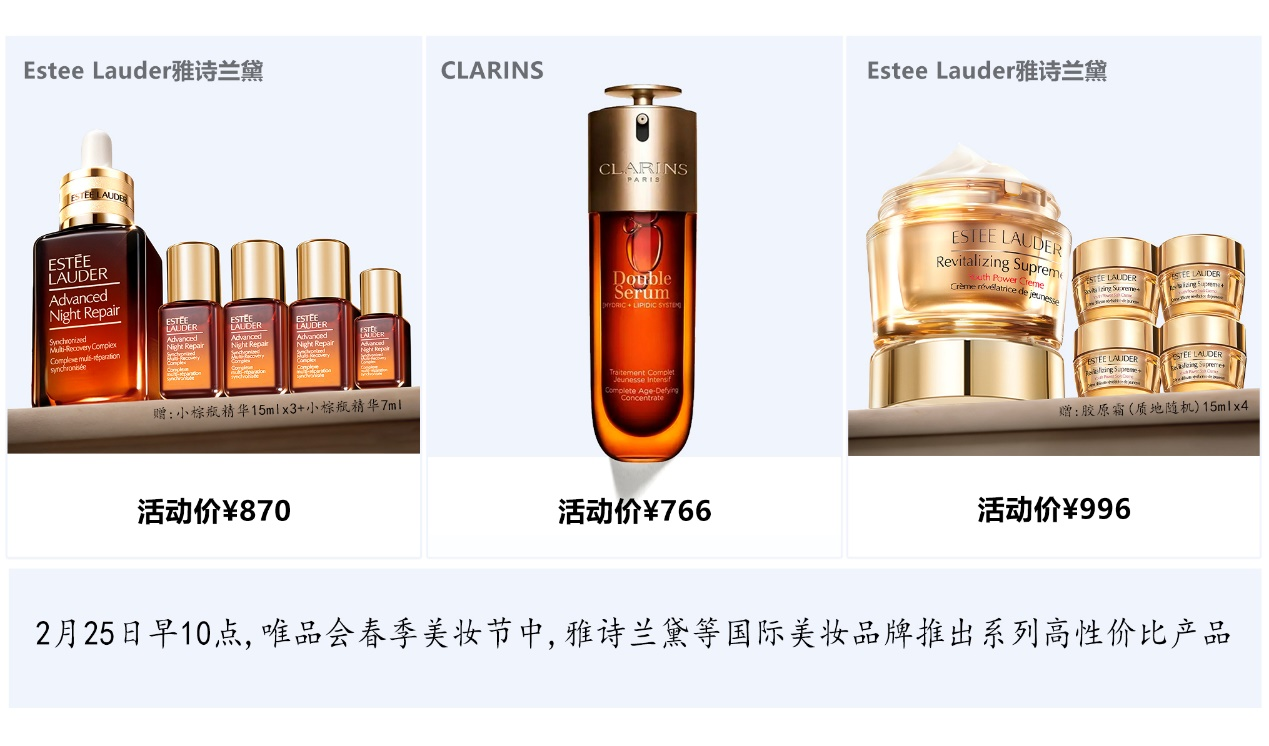
美妆大牌加码唯品会:雅诗兰黛官宣入驻,多个大牌参与春季美妆节
Jin Rong Jie· 2026-02-26 04:34
Core Insights - Estee Lauder has announced its official flagship store will join the discount e-commerce platform Vipshop, launching several competitively priced products for the Spring Beauty Festival on February 25 [1] - Estee Lauder ranks 169th in the 2022 Hurun Global 500 and 230th in the 2023 Fortune 500 list, with popular products like the classic little brown bottle and pomegranate essence [1] - The partnership with Vipshop enhances the availability of Estee Lauder's popular products and provides consumers with a sense of assurance regarding product authenticity [1] Group 1 - Estee Lauder's flagship store will offer products such as the Advanced Night Repair Cream 75ml for 996 yuan and the little brown bottle serum 50ml with additional samples for 870 yuan [1] - Other major beauty brands are also experiencing price reductions post-Spring Festival, with products like L'Oreal's eye cream priced at 107 yuan and Clarins' double serum at 766 yuan [2] - The Spring Beauty Festival on Vipshop includes a beauty coupon package worth 180 yuan and official subsidies for popular products [2] Group 2 - The move by Estee Lauder and other major brands to increase their presence on discount e-commerce platforms reflects the importance of the limited-time discount market [4] - This trend allows consumers to access high-quality beauty products at competitive prices, potentially boosting the overall beauty consumption market [4]


真实即底气,SK-II与消费者共筑“做自己”的长期价值
FBeauty未来迹· 2026-02-26 03:30
Core Viewpoint - The article emphasizes a shift in societal values towards self-acceptance and authenticity, urging brands to resonate emotionally with consumers and support them in being their true selves [2][3][21]. Brand Insights - SK-II's new themes "Not Just Happy" and "Pure Freedom" reflect a deep understanding of women's struggles with societal expectations and emotional expression, encouraging acceptance of all aspects of oneself, including imperfections [5][6][19]. - The brand's approach is based on extensive interviews with thousands of women, revealing common emotional challenges and the pressure to maintain a stable image while suppressing true feelings [5][19]. Emotional Connection - SK-II aims to establish a long-term emotional connection with consumers by centering its communications around the core value of "becoming one's true self," moving beyond superficial emotional resonance [4][19]. - The brand's marketing strategy includes relatable narratives that showcase the multifaceted nature of women's lives, allowing for a deeper emotional engagement [10][12]. Marketing Strategy - The collaboration between actress Jin Jing and media personality Lu Yu serves as a pivotal element in SK-II's marketing, highlighting the importance of discussing emotions and self-identity in a relatable manner [12][18]. - The campaign encourages women to share their personal stories, fostering a community of support and understanding, which enhances brand loyalty and trust [18][19]. Evolution of Brand Positioning - Over the past decade, SK-II has evolved from an observer to a companion in women's journeys, consistently aligning its messaging with the changing societal attitudes towards self-acceptance and authenticity [24][25]. - The brand's narrative has shifted from addressing external pressures to focusing on internal acceptance, reflecting a broader cultural movement towards embracing one's true self [21][25]. Future Implications - The article suggests that successful brands in the high-end beauty sector will need to prioritize authentic storytelling and emotional resonance, moving away from idealized portrayals of beauty [26]. - As the industry evolves, brands that can effectively communicate real human experiences and emotions will build stronger connections with consumers, establishing a lasting emotional bond [26].


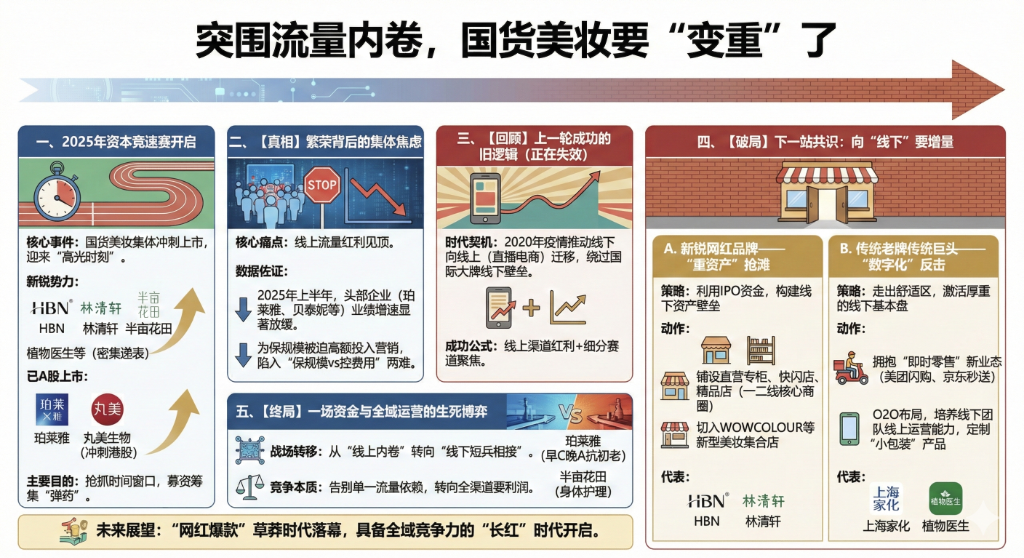
从双11霸榜到扎堆开店,国货美妆为何突然变“重”了?
Hua Er Jie Jian Wen· 2026-02-25 13:49
Core Insights - The Chinese beauty industry has entered a capital race since 2025, with numerous domestic brands filing for IPOs, including Lin Qingxuan, HBN, and others [1][2] - Despite the apparent boom, there is significant industry anxiety due to the saturation of online traffic and diminishing returns from traditional growth strategies [2][14] - The consensus among brands is to seek growth through offline retail, with new brands aggressively expanding their physical presence to build asset barriers [2][18] Industry Dynamics - The current wave of domestic brands represents a channel battle, as they seek to break through the dominance of international brands that have historically controlled retail spaces [4][5] - The COVID-19 pandemic in 2020 marked a turning point, shifting consumer habits and enabling domestic brands to leverage online platforms for growth [6][7] - Brands like HBN have rapidly grown, achieving over 2 billion yuan in annual revenue within seven years, while others like Winona have captured significant market share [6][7] Brand Strategies - Emerging brands are adopting differentiated strategies, focusing on niche markets rather than broad brand narratives [8] - For instance, HBN targets the "night owl" lifestyle, while other brands focus on specific skincare needs, allowing them to avoid competition in saturated markets [8][9] - Established brands like Proya and Shiseido have also found renewed success by targeting specific segments and enhancing their online presence [9][10] Financial Performance - The financial performance of major brands has shown signs of slowing growth, with Proya and others experiencing significant declines in revenue growth rates [13][14] - New brands aiming for IPOs have also reported modest growth, with a median revenue increase of 23% in 2024 [13] Offline Expansion - Many new brands are prioritizing offline expansion to counteract the challenges of online marketing, with plans to open stores in key urban areas [18][19] - The need for substantial funding for these offline initiatives highlights the urgency for brands to secure IPOs to support their growth strategies [20][21] Competitive Landscape - The rise of new beauty brands is putting pressure on established players, who must adapt to the changing landscape by enhancing their online and offline strategies [23][29] - Traditional brands are increasingly investing in instant retail and digital transformation to maintain their market positions [29][30] Future Outlook - The current IPO rush reflects a critical phase in the evolution of the beauty industry, marking both an assessment of past strategies and the beginning of a new competitive era [12][33] - The transition from a focus on online sales to a more integrated approach involving both online and offline channels will be crucial for long-term success [32][33]


LVMH考虑出售旗下大众品牌
Guan Cha Zhe Wang· 2026-02-25 10:31
Core Insights - LVMH is undergoing a strategic adjustment in its beauty business, considering the sale of its makeup brand Make Up For Ever and evaluating stakes in skincare brand Fresh and Fenty Beauty [1][5][13] Group 1: Make Up For Ever - Make Up For Ever, founded in 1984 and acquired by LVMH in 1999, has been struggling with a positioning mismatch, focusing too much on the mass market rather than LVMH's luxury brand identity [1][5] - The brand has reported losses for eight consecutive years, with annual net revenue around €300 million, making it a burden for LVMH's beauty segment [5][6] Group 2: Fresh - Fresh, established in 1991, has seen a slowdown in its expansion in China, closing several stores while maintaining around 70 counters in major cities [3][5] - The brand has failed to establish a clear competitive advantage in a market increasingly focused on efficacy and transparency, leading to a decline in growth [3][5] Group 3: Fenty Beauty - Fenty Beauty, co-founded by Rihanna in 2017, is also under evaluation for potential stake sales, with estimated brand valuation between $1 billion and $2 billion [6][9] - The brand's performance in China has been disappointing, with initial sales figures indicating a lack of traction despite some promotional successes [6][9] Group 4: Overall Beauty Business Performance - Despite the challenges faced by specific brands, LVMH's overall beauty business remains resilient, with total revenue for perfumes and cosmetics at €8.174 billion in FY2025, although down 3% from the previous year [9][12] - The strong performance of luxury brands like Dior and Givenchy has supported profitability, with operating profit increasing by 8% [9][12] Group 5: Louis Vuitton's Entry into Beauty - Louis Vuitton has launched its beauty line, La Beauté Louis Vuitton, with a focus on high-margin products to attract younger consumers and enhance customer loyalty [10][12] - The pricing strategy for Louis Vuitton's products, such as a lipstick priced at 1,200 RMB, aims to position the brand within the luxury segment, targeting LVMH's loyal customer base rather than the mass market [12][13] Group 6: Market Trends - The luxury goods market in China is entering a phase of cautious recovery, with consumer spending on luxury items expected to decrease slightly [12][13] - Consumers are becoming more value-conscious, emphasizing the importance of perceived value in their purchasing decisions [12][13]
