货币金融服务

Search documents
大利好!刚刚发布
中国基金报· 2025-12-31 02:27
Core Viewpoint - The Purchasing Managers' Index (PMI) for December 2025 indicates a recovery in China's economic activity, with both manufacturing and non-manufacturing sectors showing expansion, as all three key indices rose above the critical 50% mark [2][5]. Manufacturing PMI Summary - The manufacturing PMI reached 50.1%, marking its first rise above the expansion threshold since April, with 16 out of 21 surveyed industries reporting improved conditions [2][7]. - Production index and new orders index increased to 51.7% and 50.8%, respectively, indicating significant expansion in both production and demand, with new orders surpassing the critical point for the first time since the second half of the year [3][10]. - Large enterprises reported a PMI of 50.8%, while medium and small enterprises showed PMIs of 49.8% and 48.6%, respectively, indicating a mixed recovery across different enterprise sizes [4][9]. Non-Manufacturing PMI Summary - The non-manufacturing business activity index rose to 50.2%, reflecting an improvement in the non-manufacturing sector's economic conditions [5][12]. - The service sector's business activity index was at 49.7%, with certain industries like telecommunications and financial services showing strong growth, while retail and catering remained in contraction [6][14]. - The construction sector saw a notable increase in its business activity index to 52.8%, driven by favorable weather conditions and pre-holiday construction activities [6][14]. Comprehensive PMI Output Index Summary - The comprehensive PMI output index reached 50.7%, indicating overall expansion in production and business activities compared to the previous month [5][12]. - The manufacturing production index and non-manufacturing business activity index were reported at 51.7% and 50.2%, respectively, contributing to the overall positive trend [5][12].


12月份中国采购经理指数均升至扩张区间
Guo Jia Tong Ji Ju· 2025-12-31 02:21
Group 1: Manufacturing Sector - The manufacturing Purchasing Managers' Index (PMI) rose to 50.1% in December, marking the first time it has entered the expansion zone since April [2] - Production index and new orders index increased to 51.7% and 50.8% respectively, indicating significant recovery in both production and demand [2] - Large enterprises' PMI returned to the expansion zone at 50.8%, while medium-sized enterprises' PMI was at 49.8%, and small enterprises' PMI decreased to 48.6% [2] Group 2: Key Industries - High-tech manufacturing PMI reached 52.5%, showing positive growth trends, while equipment manufacturing and consumer goods industries both recorded PMIs of 50.4% [3] - The agricultural and food processing sectors showed strong performance with production and new orders indices above 53.0%, while non-metallic mineral products and black metal industries remained under pressure [2][3] Group 3: Non-Manufacturing Sector - The non-manufacturing business activity index increased to 50.2%, indicating an improvement in the non-manufacturing sector's economic climate [4] - The construction industry saw a significant rise in its business activity index to 52.8%, driven by favorable weather conditions and pre-holiday construction activities [4] Group 4: Overall Economic Outlook - The comprehensive PMI output index rose to 50.7%, reflecting overall expansion in production and business activities across sectors [5] - The production and business activity expectation index for manufacturing reached 55.5%, indicating increased confidence among manufacturers regarding market development [3]
国家统计局解读2025年12月中国采购经理指数
Guo Jia Tong Ji Ju· 2025-12-31 01:47
Group 1: Manufacturing PMI Insights - The manufacturing PMI for December is 50.1%, marking the first time it has risen above the expansion threshold since April [2] - Among the 21 surveyed industries, 16 reported an increase in PMI compared to the previous month, indicating improved production and operational conditions [2] - The production index and new orders index are at 51.7% and 50.8%, respectively, both showing significant increases of 1.7 and 1.6 percentage points from last month [2] - Large enterprises' PMI has returned to the expansion zone at 50.8%, while medium and small enterprises show mixed results with PMIs of 49.8% and 48.6% respectively [2][3] Group 2: Sector-Specific Performance - High-tech manufacturing PMI is at 52.5%, reflecting a positive growth trend, while equipment manufacturing and consumer goods sectors also show PMIs of 50.4% [3] - The service sector's business activity index is at 50.2%, indicating an improvement in non-manufacturing sector conditions [4] - The construction sector's business activity index has significantly improved to 52.8%, driven by favorable weather conditions and increased construction activity ahead of the holidays [4] Group 3: Overall Economic Outlook - The comprehensive PMI output index stands at 50.7%, indicating overall expansion in production and business activities compared to the previous month [5] - The production and non-manufacturing business activity indices contributing to the comprehensive PMI are 51.7% and 50.2%, respectively [5] - The business activity expectation index for the service sector is at 56.4%, suggesting increased confidence among service sector enterprises regarding future market developments [4]
国家统计局:16个行业PMI较上月回升,相关企业生产经营情况有所改善
Guo Jia Tong Ji Ju· 2025-12-31 01:40
Core Viewpoint - In December 2025, China's Purchasing Managers' Index (PMI) for manufacturing, non-manufacturing, and composite output all rose above the expansion threshold, indicating an overall improvement in the economic climate [2][3]. Group 1: Manufacturing PMI - The manufacturing PMI reached 50.1%, marking the first time it has entered the expansion zone since April [3]. - Production index and new orders index were at 51.7% and 50.8%, respectively, both showing significant increases of 1.7 and 1.6 percentage points from the previous month [3]. - Sixteen out of twenty-one surveyed industries reported a rise in PMI compared to the previous month, indicating improved production and operational conditions [3]. - Large enterprises' PMI returned to the expansion zone at 50.8%, while medium-sized enterprises were at 49.8%, and small enterprises fell to 48.6% [3][4]. Group 2: Non-Manufacturing PMI - The non-manufacturing business activity index was 50.2%, up 0.7 percentage points from the previous month, reflecting an improvement in the non-manufacturing sector [5]. - The service sector's business activity index was 49.7%, with certain industries like telecommunications and financial services showing strong growth [5]. - The construction sector saw a significant increase in its business activity index to 52.8%, driven by favorable weather conditions and pre-holiday construction activities [5]. Group 3: Composite PMI - The composite PMI output index reached 50.7%, an increase of 1.0 percentage point from the previous month, indicating overall expansion in production and business activities [7]. - The manufacturing production index and non-manufacturing business activity index contributed to this composite index, standing at 51.7% and 50.2%, respectively [7].
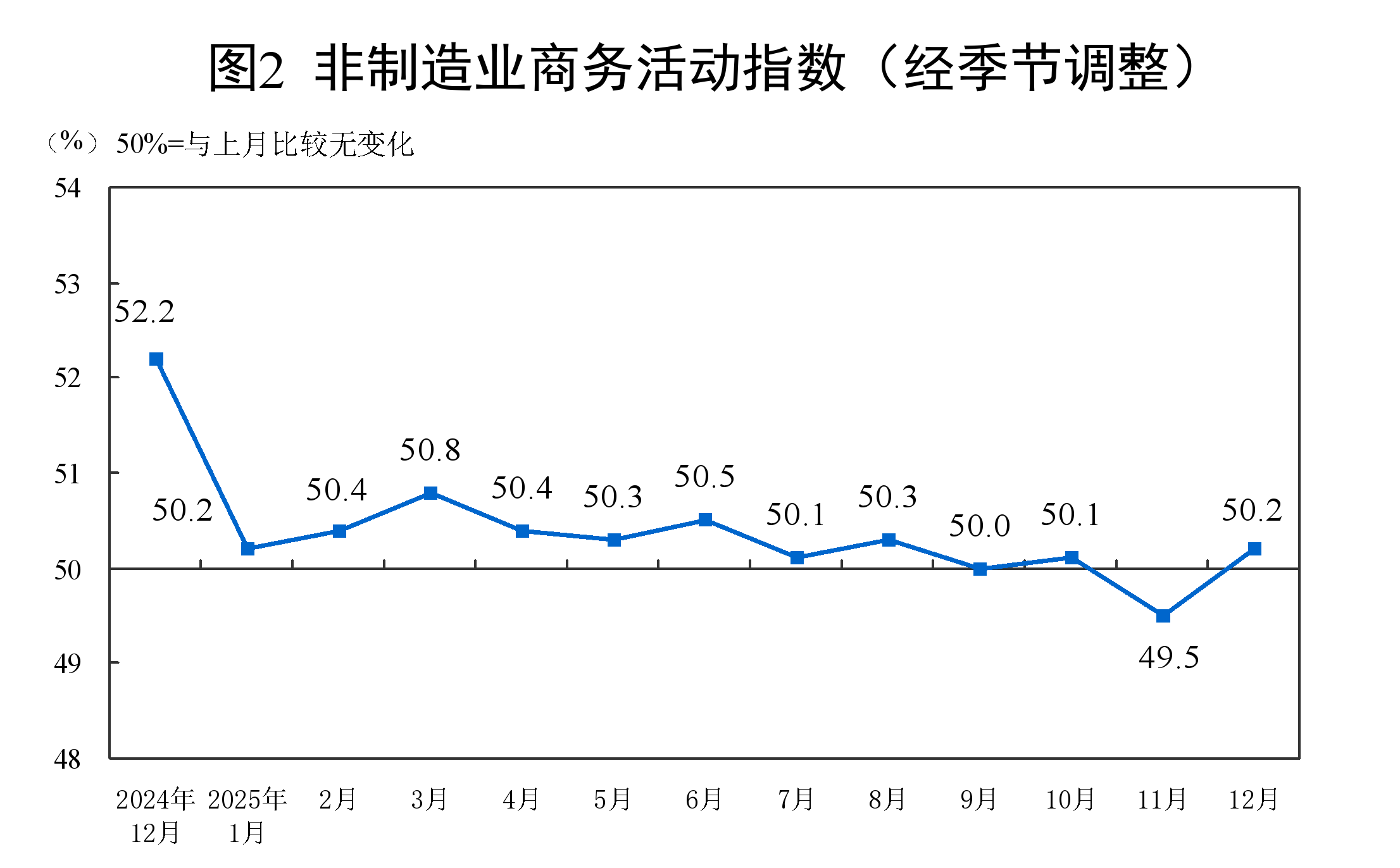
国家统计局:12月份非制造业商务活动指数为50.2% 重返扩张区间
Guo Jia Tong Ji Ju· 2025-12-31 01:36
Core Viewpoint - The non-manufacturing business activity index in December rose to 50.2%, indicating a return to the expansion zone with a month-on-month increase of 0.7 percentage points [1] Industry Summary - The construction industry business activity index reached 52.8%, up by 3.2 percentage points from the previous month, signaling strong growth [1] - The service industry business activity index was at 49.7%, showing a slight increase of 0.2 percentage points compared to last month, but still below the expansion threshold [1] Sector Performance - Within the service sector, industries such as telecommunications, broadcasting, television, and satellite transmission services, monetary financial services, and capital market services reported business activity indices above 60.0%, indicating a high level of economic activity [1] - Conversely, retail and catering industries had business activity indices below the critical point, suggesting weaker performance in these areas [1]
明明是发达国家,为啥韩元日元却“不值钱”?真是国家实力虚吗?
Sou Hu Cai Jing· 2025-12-28 15:11
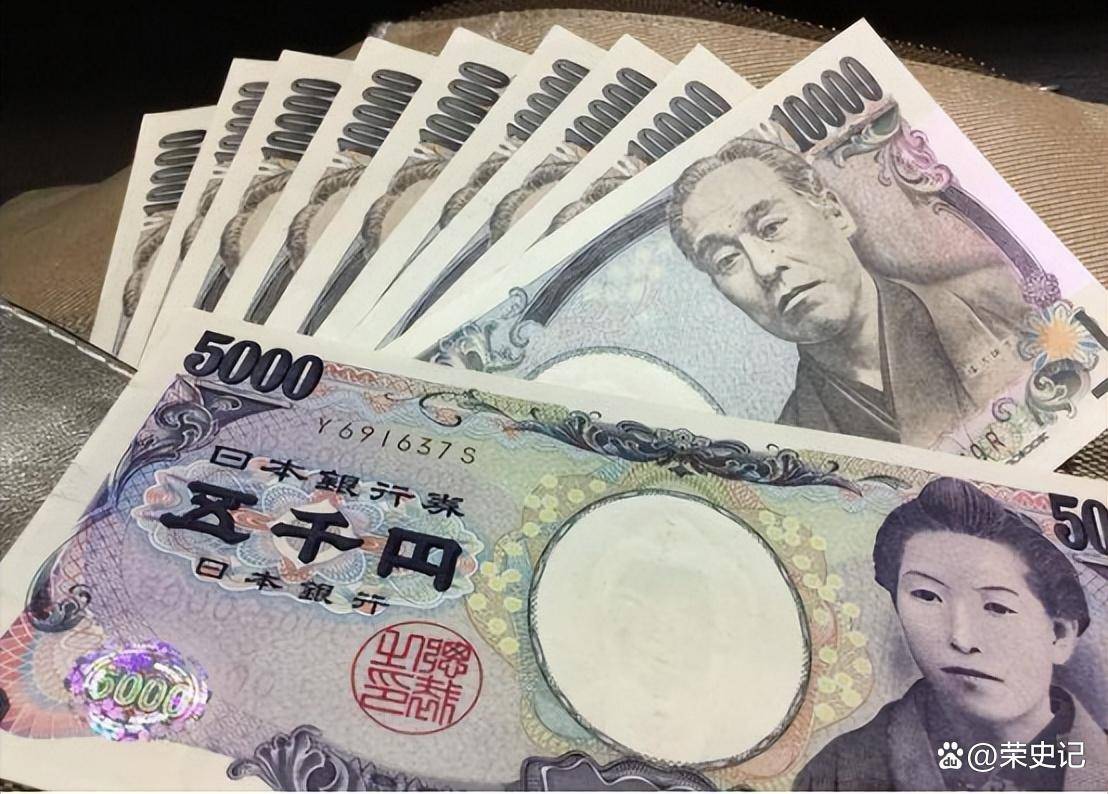
日本和韩国明明是发达国家,可是他们的货币怎么动不动就是成千上万的面值? 这看起来好像他们的货币很不值钱的样子。 去过日本旅游的人都知道,日本一个普通的饭团就要卖200日元,韩国就更离谱了,一杯普通的咖啡竟然高达四五千韩元。 所以,就很容易给人造成一种错觉,出国去日韩走了一圈,发现自己成了身价百万的土豪,随随便便就花掉好几万日元。 这里面究竟有什么门道?难道他们发达国家的头衔是虚的吗? 01 不要被数字骗了 首先我们可以肯定的是,日韩的货币面值大是真的,但是也挺值钱的,这并不妨碍他们是发达国家的事实。 打个比方,在卖鸡蛋时,有人是按"个"去卖,也有人按"斤"来卖,一个鸡蛋1块钱,一斤鸡蛋10块钱,但是你能说一斤鸡蛋比一个鸡蛋卖得更贵吗? 当然不能,因为它们俩的计价单位完全不同。 其实,当初韩国和日本设计货币的时候,并没有成千上万的面额,比如日本在二战之前,他们最大面额也只有100日元,而当时1日元约等于2.3美元。 然而,二战战败后,日本经济遭到了重创,工业生产力急速萎缩,这就导致日本国内物价飞升。 而日本政府为了应对经济危机,只好不断地超发货币,这又进一步加剧了日本的通货膨胀。 那个时候的日本经济有多乱?有时 ...
人民币汇率“破7”背后
Guo Ji Jin Rong Bao· 2025-12-26 10:08
Core Viewpoint - The offshore RMB exchange rate against the US dollar breaking the 7.0 mark is a significant signal of structural changes in the international financial system, indicating a profound reshaping of the dollar-centric international monetary order [1]. Group 1: Dollar Dominance and Its Challenges - The dollar-dominated international monetary system, established post-World War II, is experiencing a decline, with its share in global foreign exchange reserves dropping from 72% at the beginning of the century to 58% by Q3 2025 [3]. - The dollar's influence is maintained through three core mechanisms: pricing of commodities in dollars, dollar settlements in global trade, and dollar valuation of financial assets. Despite a decrease from approximately 55% in 2015, the dollar still accounted for 46% of global trade settlements in 2024 [3]. - The dollar index has fallen over 10% since 2025, marking its worst performance since 1973, highlighting the structural pressures facing the dollar system [3]. Group 2: Political and Economic Factors - The politicization of dollar credit, particularly through direct interventions in monetary policy, has undermined confidence in the independence of the US Federal Reserve, prompting a reassessment of the safety and reliability of dollar assets [4]. - The restructuring of global supply chains is diminishing the material foundation of the dollar system, with the proportion of intra-ASEAN trade settled in local currencies rising from 23% in 2018 to 34% in 2024 [4]. - Central banks are increasing their gold reserves to the highest levels since 1990, and the share of RMB loans from the New Development Bank has risen to 38%, indicating a search for alternatives to the dollar [4]. Group 3: RMB Internationalization - The RMB's exchange rate breaking the 7.0 mark reflects a significant step in its internationalization, supported by ongoing reforms in the RMB exchange rate formation mechanism since the 2015 reform [6]. - The share of RMB in global payments reached 4.5% in 2023, nearly tripling over five years, while China has signed bilateral currency swap agreements with over 40 countries, totaling more than 4 trillion RMB [6]. - The initial formation of a "petro-RMB" system is changing the pricing and settlement landscape for global commodities, with approximately 18% of China's crude oil imports settled in RMB in 2023, up from less than 5% in 2020 [6]. Group 4: Shift Towards Multipolar Currency System - The global trade settlement system is transitioning from a "dollar monopoly" to a "multilateral coexistence" model, with the proportion of intra-BRIC trade settled in local currencies increasing from 19% in 2017 to 35% in 2024 [7]. - Adjustments in the Special Drawing Rights (SDR) currency basket reflect structural changes in the international monetary system, with the RMB's weight in the SDR increasing from 10.92% to 12.28% in 2022, making it the third-largest currency [7]. - Emerging multilateral development institutions are increasing local currency financing, reducing reliance on the dollar, and promoting financial cooperation models that favor de-dollarization [7]. Group 5: Broader Implications - The RMB's exchange rate breaking the 7.0 mark is merely an external manifestation of deeper changes occurring in international settlement systems, reserve asset structures, and financial infrastructure [8]. - As a multipolar currency system gradually replaces the unipolar dominance, the global economy is expected to gain a more stable institutional foundation, with the direction of this structural change becoming increasingly clear [8].
稳中求进、行稳致远的中国宏观经济
2025-12-24 12:57
Summary of Key Points from Conference Call Records Industry Overview - The macroeconomic environment in China for 2025 shows a mix of supply-side strengths and weak domestic demand, with industrial value added expected to grow by 6.0% and retail sales by 4.0%, while fixed asset investment is projected to decline by 2.6% [1][17] - The GDP growth rate for the fourth quarter is anticipated to be 4.4%, leading to an annual GDP growth of 4.9%, slightly below the target of 5% [1][17] - Inflation is expected to be around -1% [1][17] Key Economic Indicators - In November, the total social financing increased by 416.9 billion yuan, driven mainly by corporate bond issuance, while government bond issuance decreased [1][8] - The Consumer Price Index (CPI) rose by 0.7% year-on-year, marking the highest increase of the year, primarily due to rising food prices [1][8] - The Producer Price Index (PPI) fell by 2.2% year-on-year, influenced by a high base from the previous year [1][8] Industrial Performance - In November, industrial production showed a year-on-year increase of 4.8%, with mining, manufacturing, and utilities growing by 6.3%, 4.6%, and 4.3% respectively [2][3] - The manufacturing PMI slightly rebounded to 49.2, indicating a modest recovery in manufacturing activity [11] Investment Trends - Fixed asset investment continued to decline, with a 2.6% year-on-year drop for the first ten months of 2025 [4] - Infrastructure investment saw a slight increase of 0.13%, while real estate investment faced a significant decline of 15.9% [4] Consumer Market Insights - Retail sales in November grew by 1.3% year-on-year, but the growth rate decreased by 1.6 percentage points [5][6] - Online retail sales increased by 9% year-on-year, indicating a shift towards e-commerce [6] Trade Performance - In October, China's total imports and exports reached $549 billion, with exports growing by 5% and imports by 19% [7] - Exports to ASEAN countries surged by 82%, while exports to the U.S. declined by 18% [7] Macroeconomic Challenges - Key challenges include insufficient domestic demand, declining optimism regarding income, and the impact of new consumption policies on prices [14][20] - The government is advised to focus on enhancing traditional industries, expanding effective investment, and improving consumer capacity [15][20] Policy Recommendations - Emphasis on optimizing traditional industries and fostering emerging sectors to enhance industrial quality [15] - Recommendations for fiscal policy include maintaining a reasonable deficit and optimizing expenditure structures to stimulate economic growth [21][40] Future Economic Outlook - The global economic growth rate for 2026 is expected to remain stable at 3.4%, with potential risks from geopolitical tensions and trade uncertainties [18] - The Chinese economy is projected to grow between 4.5% and 5.0% in 2026, with a focus on innovation and deep integration of technology and industry [20][27] Conclusion - The current economic landscape in China reflects a complex interplay of growth opportunities and challenges, necessitating targeted policy interventions to stimulate demand and investment while navigating external uncertainties.
中国联通取得数据溯源方法和装置专利
Sou Hu Cai Jing· 2025-12-23 03:56
Group 1 - The State Intellectual Property Office of China has granted a patent titled "A Data Traceability Method and Device" to China United Network Communications Group Co., Ltd. and Unicom Group Financial Co., Ltd., with the patent announcement number CN116088874B and an application date of December 2022 [1] - China United Network Communications Group Co., Ltd. was established in 1994 and is based in Beijing, primarily engaged in telecommunications, broadcasting, television, and satellite transmission services. The company has a registered capital of 10,481,551,957.532 RMB [1] - The company has invested in 35 enterprises, participated in 3,322 bidding projects, and holds 3,738 trademark records and 5,000 patent records, along with 11 administrative licenses [1] Group 2 - Unicom Group Financial Co., Ltd. was established in 2016 and is also based in Beijing, focusing on monetary financial services. The company has a registered capital of 300,000,000 RMB [1] - The financial company has participated in 297 bidding projects, holds 6 patent records, and possesses 4 administrative licenses [1]

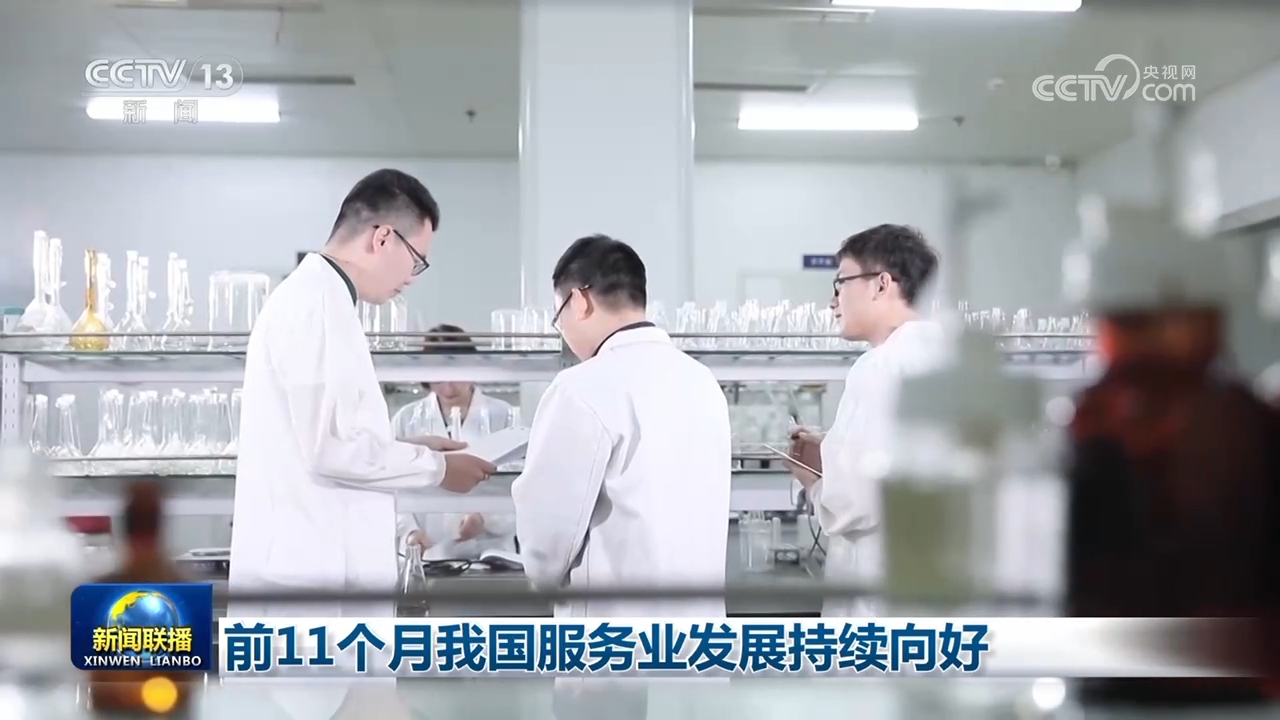
前11个月我国服务业发展持续向好
Yang Shi Wang· 2025-12-17 12:25
Group 1 - The core viewpoint of the articles indicates that China's service industry has shown continuous improvement in the first 11 months of the year, with a significant contribution to economic growth [1] - The national service production index increased by 5.6% year-on-year, with the business activity index for railway transportation and monetary financial services remaining above 55.0%, indicating a high level of economic activity [1] Group 2 - Investment in high-tech services has been increasing, with a year-on-year growth of 4.1% in the first 11 months, which is an increase of 0.6 percentage points compared to the same period last year [3] - Investment in information services has seen a remarkable growth of 29.6% [3] Group 3 - Service consumption potential is being released more rapidly, with service retail sales increasing by 5.4% year-on-year, marking a continuous recovery over three months and outpacing the growth rate of goods retail sales [5] - Retail sales in cultural, sports, and leisure services, as well as communication and information services, have both exceeded 10% year-on-year growth [5]