
资讯科技业

Search documents
中金 | “资产+资金”共振:港股业务迈入新时代
中金点睛· 2025-07-07 23:31
Core Viewpoint - The article emphasizes that the transformation of asset and funding structures in the Hong Kong stock market is expected to enhance trading activity and liquidity, leading to long-term growth opportunities for capital market institutions with high business exposure and competitive advantages [1]. Group 1: Changes in Assets - The "A+H" listing and potential return of Chinese concept stocks are expected to inject quality assets into the Hong Kong market, enhancing valuation and trading turnover [3]. - The market is witnessing an increase in new economy companies, with their market capitalization share projected to rise from 27% in 2015 to 51% by the end of 2024, and trading volume share from 30% to 59% [21][24]. - The average turnover rate for new economy stocks is estimated to be 1.3 times that of traditional assets, with a projected price-to-earnings (P/E) ratio of 4.3 times higher than traditional sectors [25][28]. Group 2: Changes in Funding - The influx of southbound capital and increased retail trading are expected to drive the turnover rate higher, with southbound trading turnover averaging 2.4 times that of non-southbound trading [4][30]. - The share of southbound capital in the Hong Kong market has increased from 1.8% in March 2017 to 12.0% by June 2025, indicating a growing trend in high-frequency trading [30][31]. - Retail investor participation is on the rise, with internet brokerage firms' market share increasing from 4.5% in 2023 to 5.1% in 2025, suggesting a shift towards more active trading behavior among individual investors [36][41]. Group 3: Market Liquidity and Valuation - The average daily trading volume (ADT) in the Hong Kong market is projected to grow at a compound annual growth rate (CAGR) of 14% over the next decade, driven by both asset and funding transformations [41]. - The total market capitalization is expected to increase due to both existing companies' performance and new listings, with a historical average of IPO financing accounting for 1.9% of the total market capitalization [6][12]. - The article highlights that the ongoing optimization of listing mechanisms and the influx of new economy companies will further support the upward movement of the valuation and trading activity in the Hong Kong market [21][24].

港股市场策略周报2024.1.22-2024.1.28-20250623
Zhe Shang Guo Ji Jin Rong Kong Gu· 2025-06-23 08:50
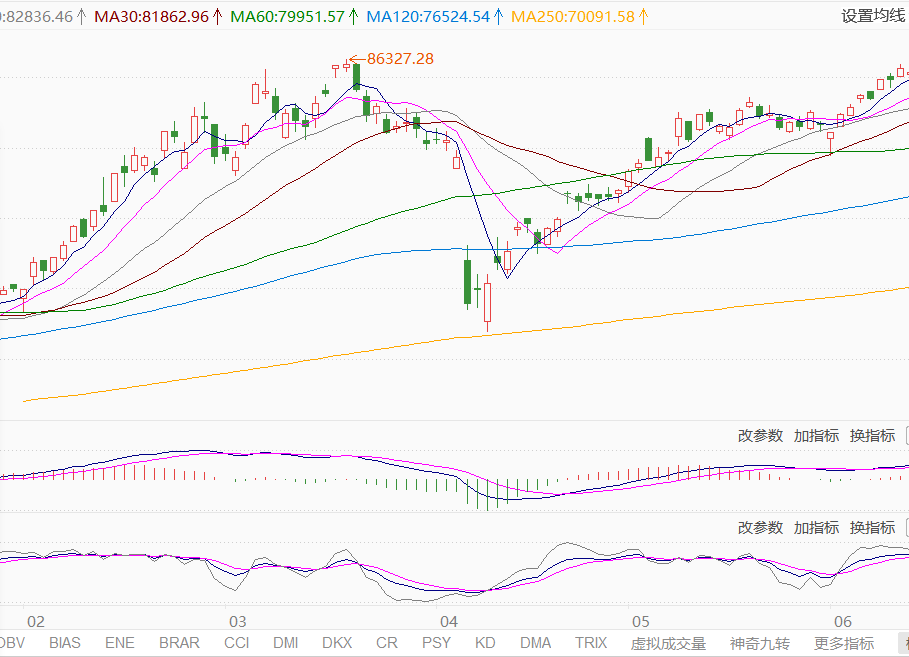
Group 1: Market Performance Review - The Hong Kong stock market experienced a significant pullback this week due to escalating geopolitical conflicts and the Hong Kong dollar approaching the weak side guarantee, with the Hang Seng Index, Hang Seng Composite Index, and Hang Seng Tech Index declining by -1.70%, -1.52%, and -2.03% respectively [3][13] - Most primary industry sectors saw declines, with the healthcare sector experiencing a substantial drop of nearly 8%, the largest among all sectors, while only the information technology sector saw a slight increase of 0.2% [3][13] - As of the end of this week, the 5-year PE (TTM) valuation percentile of the Hang Seng Composite Index rose to 72%, exceeding the 5-year average [3] Group 2: Macroeconomic Environment - The macroeconomic environment indicates that economic activity data for May continued to weaken, with consumption performance exceeding expectations mainly due to shopping festival timing and subsidies, raising questions about sustainability [3][48] - The Federal Reserve's June meeting maintained the benchmark interest rate, aligning with expectations, but conveyed a hawkish tone emphasizing the impact of tariffs on U.S. inflation [3][46] Group 3: Sector Outlook - The report suggests a favorable outlook for sectors that are relatively prosperous and benefit from policy support, including automotive, new consumption, innovative pharmaceuticals, and technology [3][48] - It also highlights the importance of low-valuation state-owned enterprises that are stable in performance and stock price, as well as local Hong Kong banks, telecommunications, and utility dividend stocks that are relatively independent and benefit from the interest rate cut cycle [3][48] Group 4: Buyback Statistics - The buyback market showed improvement this week, with 55 companies participating, up from 53 the previous week, and total buyback amounts reaching 6.61 billion HKD, a significant increase from 3.96 billion HKD last week [3][27] - Tencent Holdings (0700.HK) led the buybacks with 2.5 billion HKD, followed by Chow Tai Fook (1929.HK) with 1.57 billion HKD, and AIA Group (1299.HK) with 1.15 billion HKD [3][27] Group 5: Southbound Capital Flow - The top net buying companies through the Southbound Stock Connect included China Construction Bank (0939.HK) with a net buy of 3.48 billion HKD, Meituan-W (3690.HK) with 2.49 billion HKD, and China Merchants Bank (3968.HK) with 2.23 billion HKD [3][34] - Conversely, the top net selling companies included Tencent Holdings (0700.HK) with a net sell of 4.81 billion HKD and Alibaba-W (9988.HK) with 4.38 billion HKD [3][35]
调查:33%香港雇主计划第三季增加人手 招聘意欲趋保守
Zhi Tong Cai Jing· 2025-06-17 07:23
Group 1 - The ManpowerGroup's employment outlook survey for Q3 2025 indicates a cautious but positive hiring intention among Hong Kong employers, with 33% planning to increase staff and 25% intending to reduce staff, while 41% have no plans to adjust current employee numbers [1] - The seasonally adjusted employment outlook index for Hong Kong stands at +8%, reflecting a quarterly decline of 3 percentage points, which is significantly lower than the global average of +24% [1][2] - Among the seven major industries in Hong Kong, all except transportation and logistics show positive employment outlook indices, with healthcare and life sciences leading at +31% due to aging population and policy support [1][2] Group 2 - The transportation and logistics sector has the lowest employment outlook index at -26%, attributed to fluctuations in the international trade environment [2] - The overall unemployment rate in Hong Kong is recorded at 3.4%, a slight increase of 0.2% from the previous quarter, but still considered low and stable [2] - Future economic prospects for Hong Kong's job market are expected to improve gradually, influenced by the growth of the mainland Chinese economy and local government initiatives [2]
港股“狂飙”:南向资金创纪录涌入,机构押注科技、消费与红利资产
Huan Qiu Wang· 2025-06-12 03:08
Market Performance - The Hong Kong stock market has outperformed major global markets since 2025, with the Hang Seng Index and Hang Seng Tech Index both showing over 21% cumulative gains as of June 11, 2023 [1] - The net inflow of southbound funds has exceeded 670 billion HKD this year, setting a historical record for the same period, significantly boosting the market's performance [1] - Nearly 80% of the stocks in the Hang Seng Index have risen, with BYD leading the charge with over 60% growth [1] Sector Performance - The healthcare, materials, and information technology sectors have led the market, with gains of 50.54%, 36.41%, and 28.32% respectively [1] - The financial and discretionary consumer sectors have also recorded gains exceeding 22% [1] Investment Outlook - Analysts from CICC highlight structural advantages in the Chinese macro and market environment, such as stable dividend returns and growth lines in new consumption, AI technology, and innovative pharmaceuticals, making Hong Kong stocks more attractive compared to other markets [3] - Multiple brokerage firms maintain an optimistic outlook for the second half of the year, with expectations of a rebound in valuations and earnings in the fourth quarter [3] - Predictions suggest that southbound capital inflows could reach between 200 billion to 300 billion HKD in the second half, with total annual inflows potentially exceeding 1 trillion HKD [3] Investment Recommendations - CICC recommends focusing on stable returns (like deposits, government bonds, and dividend assets) and growth returns (such as technology, new consumption, and innovative pharmaceuticals) [4] - Huatai Securities identifies consumption and technology as key investment themes, favoring internet consumption, pharmaceuticals, personal care products, and hard tech sectors [4] - The primary market for Hong Kong stocks is showing signs of recovery, with opportunities in the brokerage sector due to increased demand for cross-border wealth management [4]


港股通科技ETF(159262)今日首发!聚焦TMT行业,小米、腾讯、阿里巴巴等前十大成份股占比超76%
Xin Lang Cai Jing· 2025-06-09 03:48
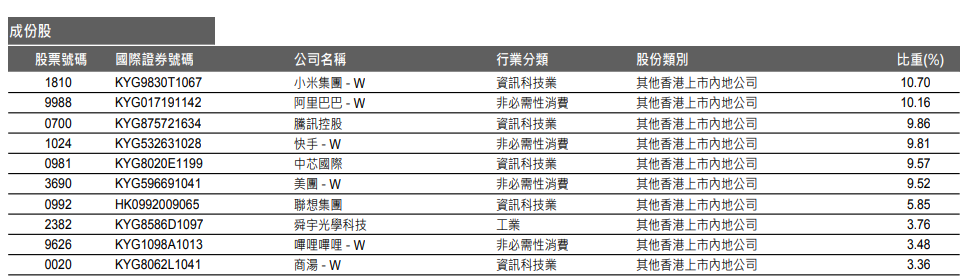
Group 1 - The core viewpoint of the news is the upcoming public offering of the Guangfa Hengsheng Hong Kong Stock Connect Technology Themed ETF, which aims to raise up to 3 billion RMB and will be available for subscription from June 9 to June 20, 2025 [1] - The ETF closely tracks the Hang Seng Hong Kong Stock Connect Technology Themed Index, which focuses on 30 pure technology companies listed in Hong Kong, covering key sectors such as software services, semiconductors, and professional retail [1] - The top ten weighted stocks in the index, including Xiaomi, Tencent, and Alibaba, account for over 76% of the index, indicating high concentration and growth potential [1] Group 2 - The Hang Seng Hong Kong Stock Connect Technology Themed Index has recorded a 28.91% increase over the past three years, significantly outperforming the Hang Seng Index (+9.88%) and the Hang Seng Technology Index (+14.88%) [2] - Guangfa Securities notes that as the dividend sector adjusts, funds are moving away from defensive assets, which could benefit the technology sector with potential incremental capital inflow [3] - Key catalysts in the technology industry for June include the conclusion of the 232 investigation and significant developments in consumer electronics, AI domestic models, and commercial aerospace, which are expected to create at least pulse-level opportunities [3] Group 3 - Guotai Junan Securities highlights that each market cycle has a leading industry, with the current AI industry cycle potentially driving the Hong Kong stock market upward [4] - The fundamentals indicate high capital expenditure growth and the gathering of scarce assets in Hong Kong's technology sector, which is expected to benefit from the AI narrative and accelerate earnings release [4] - Despite potential disruptions from the trade environment, policy efforts are expected to drive fundamental recovery, with continued optimism for the Hong Kong stock market, particularly in the technology sector [4]
国泰海通:港股美股科技盈利预期上修
Ge Long Hui· 2025-06-04 01:36
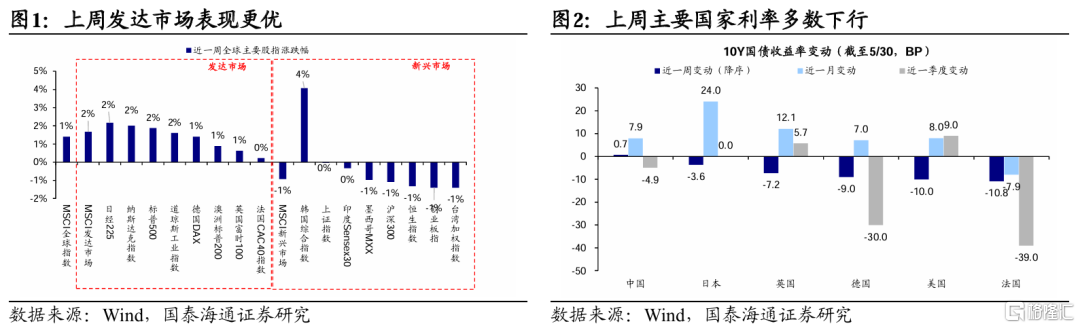
Market Performance - Developed markets outperformed last week, with MSCI Global Index up by 1.4%, MSCI Developed Markets up by 1.7%, and MSCI Emerging Markets down by 0.9% [3] - In developed markets, the strongest performer was Nikkei 225 (+2.2%), while the weakest was France's CAC40 (+0.2%) [3] - Emerging markets saw the best performance from the Korean Composite Index (+4.1%) and the worst from Taiwan Weighted Index (-1.4%) [3] Sector Performance - In the US stock market, real estate and information technology sectors led with gains of 2.7% and 2.4% respectively, while energy and materials lagged [9] - In the Hong Kong market, healthcare and real estate sectors performed well, with increases of 3.4% and 1.4% respectively [9] - European stocks saw energy and information technology sectors leading with gains of 1.4% each, while materials and communication services lagged [9] Valuation Trends - As of May 30, 2025, developed markets' PE and PB ratios were 22.3x and 3.6x, respectively, indicating high valuation levels [23] - The Nasdaq and Dow Jones Industrial Average had the highest PE ratios at 39.7x and 28.8x, respectively [23] - Emerging markets' PE and PB ratios were 14.9x and 1.9x, with the highest valuations seen in the ChiNext Index and India's Sensex30 [24] Earnings Expectations - In the Hong Kong market, the earnings forecast for the Hang Seng Index for 2025 was slightly revised down from 2223 to 2219 [31] - The US market maintained its earnings expectations for the S&P 500 Index at 263, with the information technology sector seeing a slight increase [31] - European earnings expectations remained stable, with the Eurozone STOXX50 Index holding at 347 [31] Liquidity Conditions - Global liquidity conditions turned more accommodative last week, with declines in benchmark interest rates in the US and China [34] - The market is anticipating potential interest rate cuts from the Federal Reserve, with expectations of 2.2 cuts this year [34] - Long-term interest rates in major economies like France, Germany, and the US saw significant declines, exceeding 10 basis points [34] Economic Outlook - US economic expectations have improved, with the Citigroup Economic Surprise Index rising from 6.0 to 11.5 [43] - European economic expectations also increased, with the Eurozone Economic Surprise Index rising from 12.5 to 17.7 [43] - China's Economic Surprise Index decreased slightly but remains at a historically high level, reflecting strong policy expectations [43]

每周报告汇总-20250529
Guotai Junan Securities (Hong Kong)· 2025-05-29 12:35
Group 1: USD Outlook - The USD index has shown a downward trend since the beginning of the year, primarily influenced by tariff policies, with a peak at 109 in early 2025 and a drop below 100 in April[1][7]. - Short-term fluctuations in the USD index are expected, with limited downward space before potential Fed rate cuts, while medium to long-term pressures include ongoing US debt issues, recession risks, and de-dollarization narratives[1][7]. - Key factors suppressing the USD include the continuous evolution of US debt issues, recession risks compounded by high interest rates, and the narrative of de-dollarization[1][7]. Group 2: HK Stock Market Strategy - Following a joint statement from China and the US on May 12, the Hang Seng Index rose nearly 3%, but the upward trend did not sustain, leading to a "wait and see" market attitude[2][10]. - Southbound capital inflows continue but at a slower pace, with over HKD 16.5 billion net inflow into the banking sector, while the technology sector faced a net outflow exceeding HKD 20.5 billion[2][10]. - The current valuation of the Hang Seng Index is slightly below pre-tariff levels, indicating a gradual recovery in market sentiment[2][10]. Group 3: US Economic Outlook - The outlook for the US economy remains unclear due to fluctuating tariff policies and their impact on inflation, with a potential rise in overall inflation post-tariff implementation[3][14]. - The US federal budget deficit for the first half of 2025 has exceeded USD 1.3 trillion, marking the second-highest deficit for a half-year period in history[3][14]. - The combination of rising interest rates and upcoming debt ceiling negotiations presents significant challenges for US fiscal policy in the latter half of 2025[3][14]. Group 4: US Stock Market Outlook - Major US indices have recovered from significant declines, reflecting investor confidence in the US economic fundamentals and policy adjustments[4][17]. - The anticipated tax cuts from the "Beautiful America Act" are expected to create structural opportunities in the US stock market, particularly benefiting traditional energy and local automotive sectors[4][17]. - Despite the challenges posed by fluctuating tariff policies, the US stock market is projected to exhibit a volatile upward trend in the second half of 2025[4][17]. Group 5: US Treasury Yield Trends - US long-term treasury yields have risen above 5%, with the 20-year and 30-year yields maintaining levels above 5.0% since late May[5][21]. - The increase in yields is attributed to the downgrade of the US credit rating by Moody's and concerns over the debt ceiling, which may lead to increased treasury supply and liquidity withdrawal[5][21]. - The expectation of delayed Fed rate cuts due to inflation concerns is likely to keep treasury yields elevated for an extended period[5][21].
港股交易热度持续高涨,业绩关注度逐渐提升
Yin He Zheng Quan· 2025-02-25 05:09
Group 1 - The Hong Kong stock market continues to show strong upward momentum, with the Hang Seng Index, Hang Seng Tech Index, and the China Enterprises Index rising by 3.79%, 6.03%, and 4.02% respectively during the week from February 17 to February 21, 2025 [5][8] - The technology, healthcare, and telecommunications sectors led the gains, with increases of 10.34%, 8.81%, and 6.01% respectively, while materials, energy, and real estate sectors experienced declines of 3.07%, 2.45%, and 0.53% [8][11] - The average daily trading volume on the Hong Kong Stock Exchange increased to HKD 335.88 billion, up HKD 37.15 billion from the previous week, indicating heightened trading activity [11][12] Group 2 - Recent performance of the Hang Seng Index shows a PE ratio of 10.33, which is a 1.75% increase from the previous week and is at the 59th percentile level since 2010 [16][24] - The risk premium of the Hang Seng Index relative to the 10-year US Treasury yield is 5.26%, which is at the 12th percentile level since 2010, indicating a relatively low attractiveness for overseas investors [16][24] - The AH premium index decreased by 1.54 points to 133.72, which is at the 52nd percentile level since 2014, suggesting a moderate valuation gap between A-shares and H-shares [27][29] Group 3 - The investment outlook for the Hong Kong stock market suggests that the technology sector remains a high-investment opportunity due to policy support and rapid AI application development [45] - Consumer stocks are expected to see significant performance improvements due to domestic policies aimed at boosting consumption [45] - High dividend strategies in the Hong Kong market are still attractive, particularly for state-owned enterprises actively managing their market capitalization [45]