医药生物

Search documents
世界银行上调2025年中国经济增速预期,上证180ETF指数基金(530280)多股飘红
Xin Lang Cai Jing· 2025-12-11 02:42
Group 1 - The World Bank has raised its economic growth forecast for China in 2025, attributing this to more proactive fiscal policies and moderately loose monetary policies that support domestic consumption and investment [1] - The diversification of China's export markets is expected to enhance export resilience, with future economic growth increasingly relying on domestic demand [1] - The head of the World Bank's China office emphasized that structural reforms and a more predictable business environment will boost confidence and lay the foundation for resilient and sustainable growth [1] Group 2 - The Shanghai 180 Index (000010) includes 180 large-cap, liquid securities from the Shanghai stock market, reflecting the overall performance of core listed companies [2] - As of November 28, 2025, the top ten weighted stocks in the Shanghai 180 Index account for 26.13% of the index, with notable companies including Kweichow Moutai (600519) and Zijin Mining (601899) [2] - The Shanghai 180 ETF (530280) closely tracks the Shanghai 180 Index, with various connection funds available for investors [2]




博时基金唐屹兵:科创板震荡加剧!如何捕捉布局良机?
Zhong Guo Jing Ji Wang· 2025-12-11 02:27
Group 1 - The overall performance of the Sci-Tech Innovation Board (STAR Market) in 2025 is impressive, with major indices like the Sci-Tech 200, Sci-Tech 100, and Sci-Tech Composite Index showing gains exceeding 40%, while the Sci-Tech 50 Index has risen over 30% [1] - Key sectors leading the gains include hard technology areas such as Sci-Tech chips and Sci-Tech AI, reflecting a structural market driven by technological innovation [1] - Recent volatility in the STAR Market is attributed to three main factors: profit-taking by investors as year-end approaches, limited new changes in the industry, and debates in overseas markets regarding AI bubbles affecting investor sentiment [2] Group 2 - The long-term investment logic for the STAR Market remains unchanged, as the technology industry is crucial for national competitiveness, and the emergence of AI technology has initiated a new global tech cycle [2] - Key macro factors influencing the STAR Market include liquidity conditions, geopolitical factors accelerating domestic semiconductor and software sectors, global AI demand driving various industry chains, and comprehensive policy support from the government [2] - The "1+6" reform policy for the STAR Market aims to energize companies by creating a full lifecycle financing ecosystem, optimizing funding structures, and enhancing financing efficiency while protecting innovation [2] Group 3 - The Sci-Tech 100 Index represents "new quality productivity" in the capital market, focusing on mid-cap companies in critical phases of technology maturity and commercialization [3] - The index has a high concentration in sectors like electronics, biomedicine, and power equipment, which are driven by technological innovation and high added value [3] - The Sci-Tech 100 Index ETF and linked funds offer significant advantages, including risk diversification, low management fees, and real-time trading capabilities, making them attractive tools for investing in mid-cap growth companies on the STAR Market [4] Group 4 - The Sci-Tech AI Index differs from broader indices like Sci-Tech 50 and Sci-Tech 100 by focusing on approximately 30 companies directly related to AI, emphasizing a more aggressive and flexible investment approach [5] - Investors are advised to balance risk and return in a volatile environment by employing asset allocation strategies and utilizing systematic investment methods like dollar-cost averaging [6] - Common investment misconceptions include neglecting short-term volatility in favor of long-term prospects and blindly following market trends, highlighting the need for independent decision-making based on individual risk tolerance [7]
财信证券晨会纪要-20251211
Caixin Securities· 2025-12-10 23:30
Market Strategy - The market continues to experience a shrinking volume and fluctuating trend, with the Hainan Free Trade Zone concept leading the gains [6][8] - The overall performance of the market is mixed, with the Shanghai Composite Index down 0.23% and the Shenzhen Component Index up 0.29% [8][9] - The retail sector remains strong, supported by a 0.7% year-on-year increase in the Consumer Price Index (CPI) for November, the highest since March 2024 [10][11] Economic Insights - The International Monetary Fund (IMF) has raised its growth forecast for China's economy to 5.0% and 4.5% for 2025 and 2026, respectively, due to effective macroeconomic stimulus measures [16][17] - In November, the Producer Price Index (PPI) decreased by 2.2% year-on-year, while the CPI increased by 0.7% [18][21] - The People's Bank of China conducted a 189.8 billion yuan reverse repurchase operation, indicating ongoing liquidity management in the market [22][23] Industry Dynamics - Eni and Thailand's Gulf signed a ten-year LNG supply agreement, marking Eni's first long-term LNG contract in Thailand, reflecting the growing demand for imported natural gas [27][28] - The domestic electric bicycle market saw a significant decline, with November's internal sales volume dropping by 28.7% year-on-year, attributed to the impact of new national standards [29][30] - The projection for China's projector market indicates a decline to below 600,000 units in 2025, a 15% decrease from previous years, driven by weak demand and increased competition from alternative display technologies [31][32] Company Updates - Fosun Pharma signed a licensing agreement with Pfizer for the oral GLP-1 receptor agonist YP05002, with potential milestone payments totaling up to $350 million [37][38] - China Railway Construction Heavy Industry launched the "Canghe No. 1" shield machine, which will be used in a significant energy project in Zhejiang, showcasing advancements in construction technology [40][41] - Shaoyang Hydraulic plans to acquire 100% of Xincheng Hangrui's shares for 600 million yuan, indicating strategic expansion efforts [43][44]
提升A股配置 基金“专业买手”布局跨年行情
Shang Hai Zheng Quan Bao· 2025-12-10 17:57
Group 1 - The core viewpoint is that despite increased volatility in the A-share market in November, fund advisors are increasing their allocation to A-share assets, indicating a preparation for the year-end market rally [1] - In November, 131 fund advisor portfolios adjusted their allocations, with A-share assets receiving the largest increase compared to other asset types, as many fund managers begin to position for the year-end market trend [1] - The "year-end market rally" typically occurs from November to March, driven by positive expectations for policies, economy, and earnings for the following year, with historical data suggesting a high probability of such rallies [1] Group 2 - The Yingmi Fund's strategy for December indicates that the market is preparing for a spring rally in 2026, with a neutral short-term allocation value for domestic stocks but a potential for medium to long-term recovery [2] - Industry consensus suggests that despite short-term volatility in A-shares, declines present better buying opportunities, with optimism regarding overseas risk appetite and domestic liquidity expectations [2] Group 3 - Fund advisors are accelerating their adjustment pace, with cyclical industries such as coal, electric equipment, basic chemicals, and food and beverage receiving increased allocations in November, while some technology assets saw reduced allocations [3] - In December, fund advisors are refocusing on technology growth assets, anticipating early market speculation on improving economic conditions for the coming year [3] - Specific fund portfolios, such as Wanji Fund's "Wanji Extraordinary New Quality Drive," increased their mixed fund allocation from 54.6% to 64.1%, optimizing holdings in AI computing and innovative pharmaceuticals [3] Group 4 - Recent positive signals in the broader technology sector include improvements in lithium battery supply and sustained high demand in the optical module industry, which are areas of mid-term focus [4] - However, short-term trading in popular areas like AI computing chips and energy storage remains crowded, requiring time for market digestion, while lower-crowded areas like AI applications and robotics lack incremental funding and fundamental catalysts [4]
量化赋能,专业护航,建信创业板综增强ETF来了!
Xin Lang Cai Jing· 2025-12-10 13:56
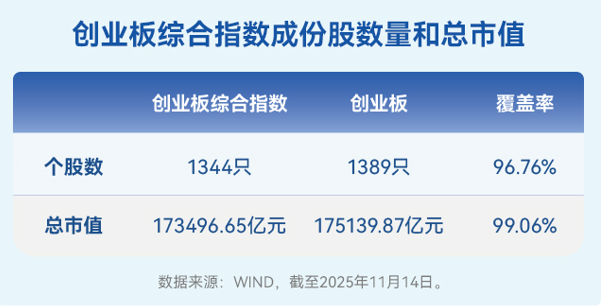
Core Viewpoint - The A-share market has shown strong performance this year, with major indices experiencing varying degrees of increase, reflecting an enhancement in market risk appetite and active structural opportunities [1][18] Index Overview - The ChiNext Composite Index (399102.SZ) covers over 1,300 listed companies on the ChiNext board, with a total market capitalization coverage of 98% [1][19] - The index has a base point of 1,000 and was established on May 31, 2010 [1] | | ChiNext Composite Index | ChiNext | Coverage Rate | | --- | --- | --- | --- | | Number of Stocks | 1344 | 1389 | 96.76% | | Total Market Value | 173,496.65 billion | 175,139.87 billion | 99.06% | Historical Performance - Since its inception on May 31, 2010, the ChiNext Composite Index has increased by 285.29%, significantly outperforming the Shanghai Composite Index and Shenzhen Component Index during the same period [2][19] Industry Distribution - The ChiNext Composite Index has a high concentration in technology sectors, covering industries such as power equipment, electronics, biomedicine, communications, and computers, which helps capture investment opportunities in various high-tech fields [4][21] - The top five industries by weight are: - Power Equipment (23.5%) - Electronics (13.7%) - Biomedicine (10.4%) - Communications (9.7%) - Computers (9.5%) - These five industries collectively account for approximately 66.8% of the index [4][21] Valuation - The current Price-to-Earnings (PE) ratio (TTM) of the ChiNext Composite Index is 66.75, which is within a reasonable range of around 57% over the past decade, indicating potential for upward adjustment compared to other major A-share indices [7][24] | | PE (TTM) | PE Percentile | | --- | --- | --- | | ChiNext Composite | 66.75 | 57.04% | | Shanghai Composite | 16.64 | 97.53% | | Shenzhen Component | 30.56 | 80.70% | | Wind All A | 22.20 | 89.96% | Investment Strategy - The enhanced strategy ETF aims to outperform the benchmark index by closely tracking the ChiNext Composite Index while employing quantitative management strategies to optimize portfolio holdings [8][25] - The investment model emphasizes consistent performance and aims to adapt to different market conditions to achieve better investment outcomes [10][27] Management Expertise - The management team at Jianxin Fund has extensive experience in index product investment management, with members possessing diverse academic backgrounds in mathematics, computer science, and finance [11][28]


12月10日深港通医疗(港币)(983036)指数跌0.28%,成份股先健科技(01302)领跌
Sou Hu Cai Jing· 2025-12-10 11:19
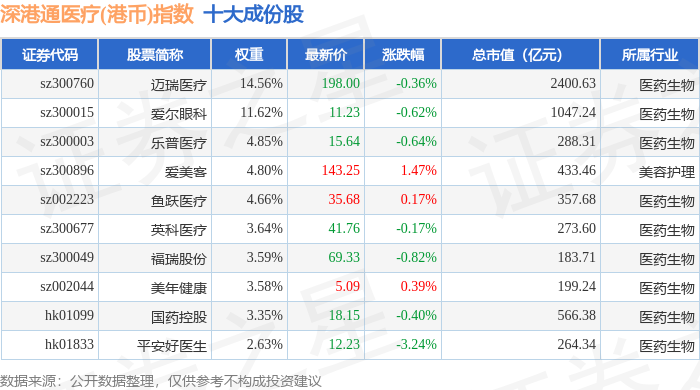
Core Points - The Shenzhen-Hong Kong Stock Connect Medical Index (983036) closed at 4327.65 points, down 0.28%, with a trading volume of HKD 7.682 billion and a turnover rate of 0.9% [1] - Among the index constituents, 21 stocks rose while 36 stocks fell, with Kewei Medical leading the gainers at a 4.14% increase and Xianjian Technology leading the decliners at a 9.14% decrease [1] Index Constituents Summary - The top ten constituents of the Shenzhen-Hong Kong Stock Connect Medical Index include: - Mindray Medical (sz300760) with a weight of 14.56%, latest price at HKD 198.00, and a market cap of HKD 240.063 billion, down 0.36% [1] - Yier Eye Hospital (sz300015) with a weight of 11.62%, latest price at HKD 11.23, and a market cap of HKD 104.724 billion, down 0.62% [1] - Lejin Medical (sz300003) with a weight of 4.85%, latest price at HKD 15.64, and a market cap of HKD 28.831 billion, down 0.64% [1] - Aimeike (sz300896) with a weight of 4.80%, latest price at HKD 143.25, and a market cap of HKD 43.346 billion, up 1.47% [1] - Yuyue Medical (sz002223) with a weight of 4.66%, latest price at HKD 35.68, and a market cap of HKD 35.768 billion, up 0.17% [1] - Yingke Medical (sz300677) with a weight of 3.64%, latest price at HKD 41.76, and a market cap of HKD 27.360 billion, down 0.17% [1] - Furuijia (sz300049) with a weight of 3.59%, latest price at HKD 69.33, and a market cap of HKD 18.371 billion, down 0.82% [1] - Meinian Health (sz002044) with a weight of 3.58%, latest price at HKD 5.09, and a market cap of HKD 19.924 billion, up 0.39% [1] - Sinopharm Holdings (hk01099) with a weight of 3.35%, latest price at HKD 18.15, and a market cap of HKD 56.638 billion, down 0.40% [1] - Ping An Good Doctor (hk01833) with a weight of 2.63%, latest price at HKD 12.23, and a market cap of HKD 26.434 billion, down 3.24% [1] Capital Flow Analysis - The index constituents experienced a net outflow of HKD 382 million from institutional investors, while retail investors saw a net inflow of HKD 329 million [1] - Notable individual stock capital flows include: - Meinian Health (sz002044) with a net inflow of HKD 23.6308 million from institutional investors [2] - Aimeike (sz300896) with a net inflow of HKD 5.8353 million from institutional investors [2] - Yier Eye Hospital (sz300015) with a net outflow of HKD 20.7620 million from retail investors [2]



1021家公司公布最新股东户数
Zheng Quan Shi Bao Wang· 2025-12-10 10:05
上期股东户数降逾一成个股中,绿岛风涨幅最高,11月11日以来累计上涨41.70%,涨幅居前的还有常 山药业、普路通等。 26股最新股东户数降逾一成 证券时报·数据宝统计显示,共有1021只个股公布了11月30日股东户数,与上期(11月20日)相比,股 东户数下降的有481只。其中股东户数降幅超一成的有26只。 股东户数降幅最多的是华英农业,截至11月30日最新股东户数为50981户,较11月20日下降25.80%,筹 码集中以来该股累计下跌28.89%,累计换手率为56.09%,其间主力资金净流出2.13亿元。 其次是红相股份,截至11月30日最新股东户数为51410户,较11月20日下降19.50%,筹码集中以来该股 累计上涨39.30%,累计换手率为361.45%,其间主力资金净流出1.19亿元。 1021只股公布截至11月30日最新股东户数,相比上期股东户数下降的有481只,降幅居前的是华英农 业、红相股份、海马汽车等。 投资者除了在定期报告中获得股东信息数据外,还可以在交易所互动平台上通过提问方式了解部分公司 更及时(每月10日、20日、月末)的股东户数信息。以往3期分别有954家、957家、1053 ...


科创板平均股价41.30元 8股股价超300元
Zheng Quan Shi Bao Wang· 2025-12-10 09:47
科创板百元股中,今日平均上涨0.59%,具体来看,今日上涨的有39只,涨幅居前的有C摩尔-U、长光 华芯、华盛锂电等。下跌的有32只,跌幅居前的有海博思创、聚辰股份、普冉股份等。 资金流向方面,科创板百元股今日主力资金合计净流出24.31亿元,净流入资金居前的有华盛锂电、长 光华芯、思瑞浦等,净流入资金分别为17170.58万元、14485.21万元、7247.72万元;净流出资金居前的 有寒武纪-U、中芯国际、德科立等,净流出资金分别为38522.97万元、26568.09万元、23367.00万元。 以最新收盘价计算,科创板平均股价为41.30元,其中股价超100元的有71只,股价最高的是寒武纪-U。 融资融券方面,百元股最新(12月9日)融资余额合计988.30亿元,融资余额居前的有寒武纪-U、中芯 国际、海光信息等,最新融资余额分别为149.60亿元、130.82亿元、80.90亿元。最新融券余额合计为 4.20亿元,融券余额居前的有海光信息、寒武纪-U、中芯国际等,最新融券余额分别为0.47亿元、0.44 亿元、0.25亿元。(数据宝) 证券时报·数据宝统计显示,科创板股今日上涨的有246只,下跌的 ...

港股市场下跌点评
GF SECURITIES· 2025-12-10 08:47
Market Overview - The report indicates that the Hong Kong stock market is facing significant downward pressure due to the hawkish statements from the anticipated next Federal Reserve Chair, Hassett, and the upcoming peak of lock-up stock releases in December, which is expected to exacerbate liquidity issues [1][12] - The potential rebound points are highlighted for mid to late December and early January, with technical analysis suggesting that the Hang Seng Technology Index has sufficient downward momentum after breaking below the 120-day moving average [1][12] Reasons for Recent Decline - The sharp decline in the Hong Kong stock market is attributed to dissatisfaction from Trump regarding Powell's interest rate comments, leading to a shift in market expectations towards a dovish stance for the next Fed Chair, Hassett, who emphasized a cautious approach to rate adjustments [2][13] - The Hong Kong market is particularly sensitive to external factors, as it combines negative influences from both domestic fundamentals and overseas liquidity, with a significant lock-up stock release pressure of HKD 126 billion in December [3][17] Potential Rebound Timing - Key dates for potential market recovery include mid to late December, where fiscal policy announcements and the Bank of Japan's interest rate comments could provide positive signals [4][22] - Early January is also noted as a critical time as the peak of stock lock-up releases concludes, coinciding with the release of the latest Federal Reserve meeting minutes, which could favor liquidity if the interest rate path appears dovish [4][23] - The report emphasizes that the Hang Seng Technology Index is currently positioned between the 120-day and 250-day moving averages, indicating a possible rebound if it approaches the 250-day support line [4][23]
从688元到797.97元 “国产GPU第一股”股价狂飙!A股历史高价股还有哪些?
天天基金网· 2025-12-10 08:43
Core Viewpoint - The article highlights the significant rise in the stock price of Moer Thread, marking it as the "first domestic GPU stock" in China, with a peak price of 797.97 yuan, indicating a strong market performance and investor interest in high-priced stocks within specific sectors [4]. Group 1: Stock Performance - On December 10, Moer Thread's stock surged by 16.98%, reaching a peak of 797.97 yuan per share, with a closing price of 735 yuan and a total market capitalization exceeding 340 billion yuan [4]. - Historically, only 13 stocks in the A-share market have surpassed the price of Moer Thread, including notable companies like Zhong An Ke, Guizhou Moutai, and Yun Sai Zhi Lian, with Zhong An Ke holding the highest price at 3,550 yuan [4][5]. Group 2: Industry Distribution - High-priced stocks are primarily concentrated in a few sectors, notably electronics, electric power equipment, and biomedicine, which collectively account for the majority of these stocks [5]. - The electronics sector features five stocks, while electric power equipment and biomedicine each have four stocks represented among the high-priced shares [5].