汽车制造

Search documents
闪电快讯|比亚迪发布第二代刀片电池及“闪充中国”战略,首批搭载10款车型
Xin Lang Cai Jing· 2026-03-06 03:07
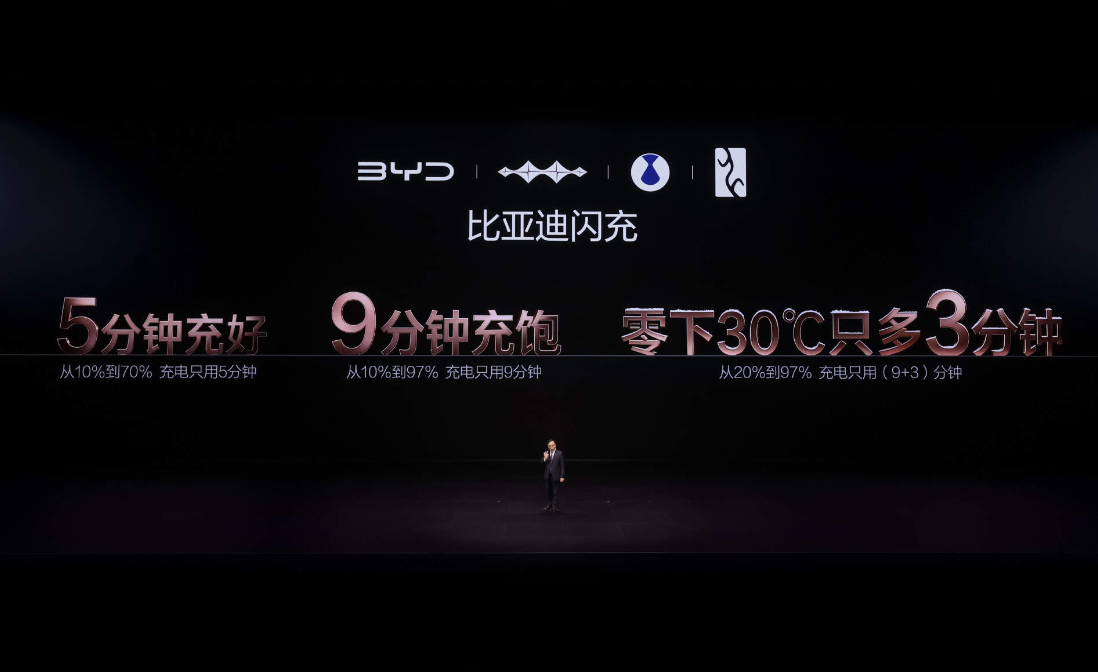
Core Insights - BYD launched its second-generation blade battery and flash charging technology, addressing global challenges of slow charging and low-temperature charging, marking the completion of the "first half" of electric vehicle electrification [1] Group 1: Product Launch - The second-generation blade battery allows charging from 10% to 70% in just 5 minutes and from 10% to 97% in 9 minutes under normal conditions, setting a new record for the fastest charging speed in mass production [1] - In extreme cold conditions (minus 30 degrees Celsius), the battery can charge from 20% to 97% in 12 minutes, only 3 minutes longer than at normal temperatures [1] - BYD introduced 10 new models equipped with the second-generation blade battery and flash charging technology, including Song Ultra and 2026 models of various vehicles [1] Group 2: Charging Infrastructure - BYD unveiled a 1500kW flash charging pile, claimed to be the highest power single-gun charging pile in mass production, designed to prevent grid impact and support simultaneous charging for multiple vehicles [3] - The company plans to build 20,000 flash charging stations across China by the end of 2026, including 18,000 urban stations and 2,000 highway stations, aiming for 90% urban coverage within 5 kilometers [3] - The first 1,000 highway flash charging stations are expected to be completed before the May Day holiday this year [3] Group 3: Customer Incentives - All owners of vehicles equipped with the second-generation blade battery will receive one year of free flash charging service at nationwide stations, with post-free period charges aligning with industry standards [5] - BYD will initiate a "Dream Station Construction" plan to build flash charging stations based on customer demand, open to all vehicle owners [5]


多项技术助力驾乘体验升级,广汽集团推出昊铂A800
Zhong Guo Qing Nian Bao· 2026-03-06 03:00
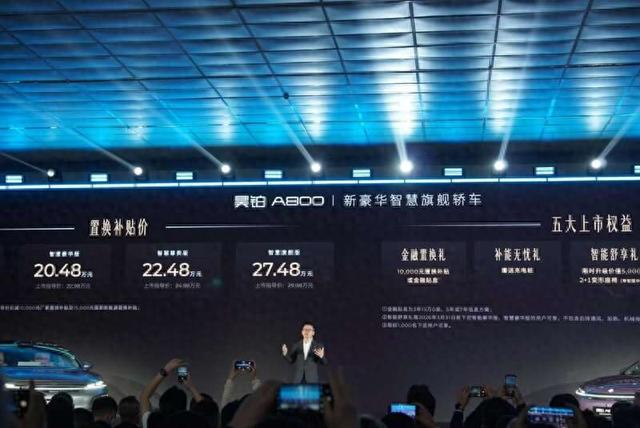
Core Viewpoint - GAC Group has launched the Haobo A800, a new luxury smart flagship sedan, featuring advanced technology and optimizations in various aspects such as chassis, safety, and intelligence [2]. Group 1: Vehicle Technology and Features - The Haobo A800 is equipped with a three-motor four-wheel drive smart digital chassis that can adjust power distribution to the left, right, front, and rear wheels in real-time, with a response time as fast as 10 milliseconds [2]. - The vehicle includes a "negative torque output" feature that enhances cornering precision, along with hardware configurations like dual-chamber air springs, SDC shock absorbers, and high-performance multi-link rear suspension [2]. - It incorporates high-speed blowout prevention technology and intelligent anti-motion sickness functions, balancing vehicle handling and passenger comfort through calibration testing and digital technology [2]. Group 2: Safety Features - The Haobo A800 is equipped with 14 safety airbags and utilizes the latest magazine battery 2.0 technology, successfully passing more stringent shooting tests than the new national standard puncture test [2]. - To ensure the stable operation of the four-laser radar intelligent driving assistance system, the vehicle features redundant designs for positioning, perception, computation, and power systems, enhancing overall travel safety [2]. Group 3: Intelligent Driving System - The vehicle is equipped with Huawei's Qian Kun intelligent driving ADS 4.1 system and features 896-line laser radar, with new urban navigation functions including three-point turns and park navigation assistance [2]. - The interior features the HarmonyOS cockpit 5, which integrates five major intelligent entities and a universal large model, enabling functions such as navigation error correction and fuzzy semantic vehicle control [2].

大行评级丨花旗:重申比亚迪“买入”评级,第二代刀片电池为量产电池充电速度树立新全球标竿
Ge Long Hui· 2026-03-06 02:36
Core Viewpoint - Citigroup's report indicates that BYD has launched its second-generation blade battery, setting a new global benchmark for battery charging speed in mass production [1] Group 1: Battery Technology and Market Position - BYD's new battery and charging technology are currently at least one year ahead of the market, making it difficult for competitors to replicate [1] - The new battery demonstrates strong charging performance even in low-temperature environments, allowing BYD to penetrate the northern Chinese market and capture market share from traditional fuel vehicles [1] Group 2: Business Strategy and Financial Outlook - BYD's strategy will unify its electric vehicle battery and energy storage system battery businesses, creating a complementary relationship that is expected to enhance long-term operational leverage in battery production and potentially lower cost curves [1] - The second-generation blade battery establishes new safety standards and limits for battery capacity degradation [1] Group 3: Investment Rating and Catalysts - Citigroup reaffirms a "Buy" rating for BYD with a target price of HKD 174, anticipating inventory destocking in March, the rollout of new models from now until the second quarter, and monthly export growth momentum in March and April as potential catalysts [1]
比亚迪(002594):动态点评:闪充进阶,万站可期
HTSC· 2026-03-06 02:28
Investment Rating - The report maintains a "Buy" rating for BYD with a target price of RMB 130.63 [6][11]. Core Insights - BYD has made significant advancements in battery technology with the launch of the second-generation blade battery, achieving industry-leading performance in fast charging, low-temperature charging, and safety [2][3]. - The company plans to establish 20,000 fast charging stations by the end of 2026, enhancing user experience and alleviating charging anxiety [3]. - BYD's overseas sales are expected to grow significantly, with a projected 49% year-on-year increase in 2026, driven by compliance with EU carbon emission regulations and local production capabilities [4]. Summary by Sections Battery Technology - The second-generation blade battery can charge from 10% to 70% in just 5 minutes and from 10% to 97% in 9 minutes, setting a new global record for mass-produced batteries [2]. - In extreme cold conditions (-30°C), the battery can charge from 20% to 97% in 12 minutes, addressing a major industry challenge [2]. - The energy density of the new battery is improved by 5%, with a maximum range of 1,036 km for equipped vehicles [2]. Charging Infrastructure - BYD's "Fast Charging China" strategy aims to build 20,000 fast charging stations by the end of 2026, with 4,239 already completed [3]. - The urban stations will cover 90% of city areas within 5 km, while highway stations will cover nearly one-third of the national highway network [3]. - New car owners will enjoy one year of free charging, providing an estimated RMB 5,000 in perceived savings [3]. Sales and Market Expansion - BYD has exported over 100,000 vehicles for four consecutive months, maintaining strong growth momentum [4]. - The company is well-positioned to benefit from EU carbon emission policies, with plans to launch new models in Europe [4]. - BYD's overseas production facilities in Thailand, Brazil, and Hungary will support its market penetration in Europe and South America [4]. Financial Projections - Revenue forecasts for 2025-2027 are RMB 820 billion, RMB 955 billion, and RMB 1,110 billion, respectively, with net profit estimates of RMB 350 billion, RMB 466 billion, and RMB 567 billion [5][10]. - The valuation approach includes a 60% premium on the automotive business compared to peers, resulting in a 25x PE for 2026 [11].
比亚迪:动态点评闪充进阶,万站可期-20260306
HTSC· 2026-03-06 02:25
Investment Rating - The report maintains a "Buy" rating for BYD with a target price of 130.63 RMB [6][11]. Core Insights - BYD has made significant advancements in battery technology with the launch of the second-generation blade battery, achieving industry-leading performance in fast charging, low-temperature charging, and safety [2][3]. - The company plans to establish 20,000 fast charging stations by the end of 2026, enhancing user experience and alleviating charging anxiety [3]. - BYD's sales are expected to benefit from favorable EU carbon emission policies, with projected overseas sales reaching 1.4 million units in 2026, a year-on-year increase of 49% [4]. Summary by Sections Battery Technology - The second-generation blade battery can charge from 10% to 70% in just 5 minutes and from 10% to 97% in 9 minutes, setting a new global record for mass-produced batteries [2]. - In extreme cold conditions (-30°C), the battery can charge from 20% to 97% in 12 minutes, addressing a significant industry challenge [2]. - The energy density of the new battery is improved by 5%, with a maximum range of 1036 km for equipped vehicles [2]. Charging Infrastructure - BYD's "Fast Charging China" strategy aims to build 20,000 fast charging stations by the end of 2026, with 4,239 already completed [3]. - The urban stations will cover 90% of city areas within 5 km, while highway stations will cover nearly one-third of the national highway network [3]. - New fast charging vehicle owners will enjoy one year of free charging, valued at approximately 5,000 RMB [3]. Sales and Market Expansion - BYD's exports have exceeded 100,000 units for four consecutive months, indicating strong growth momentum [4]. - The company is well-positioned to meet EU carbon emission standards, with plans for localized production in Thailand, Brazil, and Hungary to support market penetration in Europe and South America [4]. - The report anticipates a 15% year-on-year increase in sales in northern cold regions due to improved battery performance [2]. Financial Projections - Revenue forecasts for 2025-2027 are set at 820 billion, 955.3 billion, and 1,109.8 billion RMB, respectively, with net profit estimates of 35 billion, 46.6 billion, and 56.7 billion RMB [5][10]. - The valuation method applied suggests a total market value of 11.91 trillion RMB, with a price-to-earnings ratio of 25x for the automotive business and 28x for mobile components and assembly [11].
终端探需-如何看待当前车市热度和后续景气拐点
2026-03-06 02:02
Summary of Conference Call Records Industry Overview - The records focus on the automotive industry, particularly the electric vehicle (EV) market in China, with specific mentions of brands like BYD, NIO, and others. The discussion revolves around market trends, consumer behavior, and pricing strategies in the context of new policies and economic conditions. Key Points Market Recovery and Consumer Demand - Since late February, the automotive market has seen a better-than-expected recovery in orders, with brands like BYD, Aito, and NIO using cash discounts and financial incentives to stimulate demand, resulting in a year-on-year decline in orders narrowing to 10%-15% [1][2] - The "trade-in" policy has been implemented across 31 provinces, with orders involving purchase subsidies accounting for 70%-80%, significantly improving transaction conversion rates [1][5] - The overall order levels in February were higher than in January, although still down approximately 10%-15% year-on-year [2][3] Pricing Strategies and Brand Competition - Luxury brands like BMW, Mercedes-Benz, and Audi have adopted a "one-price" model by lowering their guide prices to eliminate price bubbles, which is expected to improve single-vehicle gross margins from a loss of 20,000 yuan to a profit of 5,000-8,000 yuan [1][8][9] - BYD's upcoming technology release is anticipated to impact the market significantly, especially in the 100,000-150,000 yuan segment, potentially exerting pressure on joint venture and competing products [1][3][20] Future Market Predictions - The forecast for the total automotive market in 2026 is cautious, with expectations of slower growth in new energy vehicles (NEVs) and a structural replacement of 10%-20% market share from joint ventures to domestic brands in the 100,000-150,000 yuan price range [1][6] - The overall sentiment for March remains optimistic, with expectations of a "small spring" in demand, but the sustainability of this recovery will depend on the performance in April and May [4][6] Regulatory Environment - The automotive industry is facing stricter price compliance regulations starting in March, which will enforce that dealers cannot sell below cost, shifting the competitive logic from "price for volume" to "stable prices with reduced volume" [2][15][19] - The implementation of the "Automotive Industry Price Compliance Guidelines" is expected to significantly impact dealer operations and profitability, with a focus on ensuring that new car sales margins are positive [17][18] Brand-Specific Insights - BYD is expected to launch several new models in March, focusing on pure electric vehicles and advanced technology features, which could reshape the competitive landscape in the 100,000-150,000 yuan segment [21][22] - Traditional luxury brands are adjusting their pricing strategies to maintain competitiveness, with significant price adjustments observed in models like the Mercedes-Benz GLC, which has shifted from a loss to a profit margin post-adjustment [9][14] Conclusion - The automotive industry is navigating a complex landscape of recovering demand, regulatory changes, and competitive pressures. Brands are adapting their strategies to maintain market share and profitability, particularly in the growing EV segment. The upcoming months will be critical in determining the sustainability of the current recovery trends and the overall health of the market.
两会政府工作报告学习解读与投资看点
2026-03-06 02:02
Summary of Key Points from the Conference Call Industry Overview - The conference call primarily discusses the macroeconomic outlook and government policies impacting various sectors, particularly focusing on the construction, energy, and real estate industries. Core Insights and Arguments 1. **GDP Growth Target**: The GDP growth target for 2026 is set at 4.5%-5.0%, aligning with expectations. However, there is a notable gap in fiscal spending versus debt increase, necessitating reliance on tax revenue recovery and central government support for local tax sources [1][2][3]. 2. **Dual Carbon Policy**: The dual carbon policy has shifted from "energy consumption control" to "carbon emission control," enhancing quantitative constraints. This is expected to benefit sectors like carbon accounting software, carbon trading, smart grids, and hydrogen energy [1][4]. 3. **Coal Sector Outlook**: The coal sector is viewed as having a "second growth curve," driven by AI-related electricity demand growth, which offsets dual carbon pressures. Domestic and import supply reductions are anticipated, with coal prices expected to rise from a bottoming phase, suggesting over 50% upside potential for coal stocks [1][20][21]. 4. **Debt Market Expectations**: The bond market has already priced in the subdued fiscal expectations, with a short-term forecast for 10-year government bond yields to retreat to 1.85%-1.9%. There remains room for interest rate cuts throughout the year [1][12][14]. 5. **Construction and Building Materials**: The focus is on major projects under the "15th Five-Year Plan," with significant investment opportunities in western development, major canals, and high-standard farmland construction. The construction materials sector is nearing a profitability inflection point, with leading companies like Oriental Yuhong expected to benefit [1][22][26]. 6. **Consumer Sector Trends**: Consumer spending is expected to show a "high-low" rhythm, with potential weakness in Q2. Opportunities in high-end travel and service consumption are highlighted, particularly with the expansion of spring break trials [2][15]. 7. **Investment Directions**: The report emphasizes investment in new infrastructure, urbanization, and livelihood improvements, with a focus on projects like major railways and hydropower. The total investment in these areas is projected to exceed 8 trillion yuan [22][24]. 8. **Real Estate Policy Changes**: The real estate sector's focus has shifted from risk prevention to stabilizing the market, with a new emphasis on a "people-centered" approach. The reform of housing provident funds is highlighted as a key support mechanism [27][30][31]. Other Important but Potentially Overlooked Content 1. **Tax Revenue Recovery**: The anticipated recovery in tax revenue due to price increases and economic expansion is crucial for addressing the fiscal gap [2][3]. 2. **AI and Energy Demand**: The demand for coal is expected to increase due to AI-driven electricity needs, indicating a shift in energy consumption patterns [20]. 3. **Urban Renewal Initiatives**: The report outlines significant urban renewal projects, with a focus on old neighborhood renovations and infrastructure safety, potentially driving demand for construction materials [23][34]. 4. **Green Energy Initiatives**: The introduction of "green fuels" and a multi-energy approach is noted, with major state-owned enterprises involved in clean energy projects [24]. 5. **Market Sentiment**: The overall market sentiment reflects cautious optimism, with expectations for gradual recovery in various sectors, particularly in construction and real estate [1][10][12]. This summary encapsulates the key points discussed in the conference call, providing insights into the macroeconomic environment and sector-specific developments that may influence investment strategies moving forward.





比亚迪王传福:要在不到一年时间里,把充电站数量做到中国车企第一
Guo Ji Jin Rong Bao· 2026-03-06 01:31
Group 1 - The core viewpoint of the article is that BYD aims to establish 20,000 charging stations by the end of this year, positioning itself as the leader among Chinese automotive companies in terms of charging station quantity [1] Group 2 - BYD's Chairman and President, Wang Chuanfu, announced the ambitious goal during the launch of the second-generation blade battery and fast-charging technology [1]
火速捡漏?阿里正式批准林俊旸辞职,谷歌DeepMind立刻抛橄榄枝;某车CEO头戴摄像头炮轰激光雷达:放在车顶不好看;OpenAI深夜祭出GPT-5.4
雷峰网· 2026-03-06 00:47
Key Insights - Lotus CEO criticizes the aesthetic impact of LiDAR on vehicles, advocating for a retractable design that maintains the car's sleek appearance [4][5] - Alibaba's CEO confirms the resignation of Lin Junyang, emphasizing continued investment in AI and open-source model strategies [8][9] - Tiger Whale Entertainment announces organizational upgrades to embrace AI and enhance the integration of online and offline entertainment [10] - BYD unveils the Seal 08, featuring advanced technologies like the second-generation blade battery and rear-wheel steering, set to launch in Q2 [17] - Chery's high-end brand, Exeed, announces a price increase of 5,000 yuan for its ET5 model, citing rising chip costs and a long-term strategic choice [14][15] - AI technology company Jiga Vision secures nearly 1 billion yuan in Pre-B round financing to develop embodied AI models [19][20] - Autonomous driving company Momenta secretly submits an IPO application in Hong Kong, aiming to raise at least 1 billion USD [21][22] - Bilibili reports a significant increase in revenue and net profit for 2025, marking its first year of profitability [30][31] - JD.com announces a 13% revenue growth for 2025, with over 700 million active users [32] - OpenAI launches GPT-5.4, enhancing its capabilities in reasoning, programming, and office tasks, while reducing the error rate of factual statements [39][40] - The U.S. plans to expand AI chip export controls globally, requiring companies like NVIDIA and AMD to obtain licenses for exports [41][42]



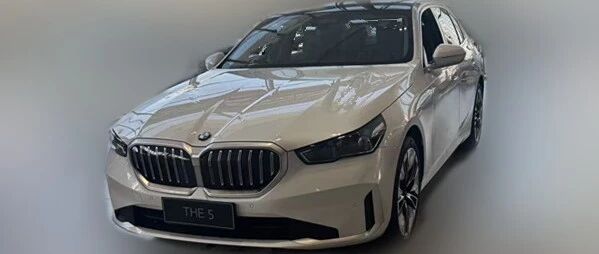
宝马5系:官降后还能优惠6万+,来看车的客户变多了
车fans· 2026-03-06 00:30
Core Insights - The article discusses the current sales performance and customer preferences for the BMW 5 Series, highlighting a positive trend in customer traffic and sales following a price adjustment by the manufacturer [1] Sales Performance - The local BMW dealership has three stores, with an average of 20 customer groups per day, of which 3-4 are interested in the 5 Series [2] - Last month, approximately 60 units were ordered, with 20 being the 5 Series, and the author personally delivered 5 units [2] - The most popular model is the 530Li Leading M Sport Package, accounting for 50% of sales, with the most common colors being black and white [2] Customer Demographics - Customers are primarily aged 32-45, with over 75% being married, and 60% belonging to families with two children or elderly care needs [3] - The majority of buyers are professionals from finance, corporate management, and IT, with a focus on brand and practicality rather than excessive luxury [4] Customer Preferences - Customers prioritize the availability of vehicles, value for configuration, and maintenance costs, with a particular emphasis on winter driving stability in northern regions [5] - A typical customer profile includes a 38-year-old software company middle manager with an annual family income of over 400,000, looking for a vehicle that balances daily commuting and family outings [5] Competitive Analysis - The 2026 model of the 5 Series has seen a price drop of 70,000 to 90,000 yuan, making it more competitive compared to rivals like the Mercedes E-Class and Audi A6L, which lack certain features [6] - A customer who initially considered the Mercedes E 300 L ultimately chose the 530Li xDrive M Sport Package due to price and feature advantages [8][9] Market Trends - Customers are increasingly comparing a wider range of vehicles, including traditional luxury brands and newer models, with a significant focus still on the BBA (BMW, Benz, Audi) trio [12] - The most compared models remain the E 260 and A6L, with price sensitivity influencing decisions [13] Configuration and Financing - The most popular configurations are the 525Li Sport and 530Li Luxury, with a notable preference for white vehicles [15] - Financing options are being promoted with a low official interest rate of 2.1%, allowing for a minimum down payment of 45,000 yuan [16] Customer Feedback - Common complaints include the low power of the 525 model, which some customers find inadequate for high-speed overtaking, and occasional issues with the vehicle's infotainment system [17] - Maintenance costs are reported to be around 1,500 yuan for minor services and 2,500-3,000 yuan for medium services [19] Current Market Conditions - Despite a lack of available stock, customer traffic remains steady, and the dealership is optimistic about future sales as interest in the 5 Series increases [20]