债券

Search documents
日本20年期债券发售需求达2020年以来最高水平
Xin Lang Cai Jing· 2025-12-11 04:00
据报道,日本20年期债券发售需求达到2020年以来最高水平。 据报道,日本20年期债券发售需求达到2020年以来最高水平。 ...
固收|当资产荒遇上需求重塑——2026年信用债年度策略
2025-12-11 02:16
Summary of Conference Call on Credit Bond Market Outlook for 2026 Industry Overview - The conference call focused on the credit bond market outlook for 2026, indicating a neutral to bearish sentiment with expectations of rising interest rates. The ten-year government bond yield is projected to range between 1.7% and 2.1% [1][3][18]. Key Points and Arguments Market Environment - The credit bond market is expected to face a structural asset shortage, with demand dynamics potentially reshaped by new fee regulations. The net supply in the primary market is anticipated to remain high, particularly with significant issuance of technology innovation bonds and positive net financing for private enterprises [2][3][6]. - The overall credit risk is manageable despite some localized risk events, such as defaults and extensions in the real estate sector. The impact of these events on the broader credit bond market is considered limited [5][22]. Supply and Demand Dynamics - The net supply of industrial bonds is expected to remain elevated due to improved corporate profitability and capital expenditure needs. Conversely, the net supply of urban investment bonds may slightly turn negative [1][4]. - Public fund structures are shifting, with an increase in the burden on market value-based bond funds, potentially leading to a diversion of funds to ETFs or separate accounts, which will affect demand for various bond types [6][7]. Institutional Preferences - Public funds, particularly market value-based funds, are facing increased burdens, with a total scale of 8.6 trillion yuan as of Q3 2025. This may lead to significant impacts on the demand for certain bond types, especially those with lower credit ratings [7][12]. - Insurance companies are expected to reduce their allocation to credit bonds, favoring equity investments instead. The expansion of the southbound trading channel may also reduce demand for long-term domestic bonds [14][15]. Investment Strategy - The focus for 2026 should be on the certainty of coupon payments rather than capital gains, with a preference for short to medium-term bonds (especially those with maturities of three years or less) [20][22]. - There are opportunities in medium-term, high-grade credit bonds, particularly in the wake of new fee regulations and potential interest rate cuts, which could create short-term trading opportunities [20][19]. Risk Assessment - The overall sentiment towards credit risk remains cautious, with a need to monitor potential localized risk exposures and their implications for the broader market [5][16]. - The credit spread for bonds is currently low, with limited room for compression in the medium term. Long-term bonds may face widening pressures due to shifts in market dynamics and reduced insurance capital allocation [18][19]. Other Important Insights - The carbon bond fund's entry into the open market is expected to significantly impact the credit bond market, potentially leading to increased inflows and enhanced credit performance [10]. - The current landscape for credit ETFs is around 500 billion yuan, with expectations for continued growth driven by policy support and increased participation from various institutional investors [11]. - The anticipated expansion of the wealth management market, driven by changes in bank deposit rates and fee regulations, is expected to support growth in credit investments, particularly in high-grade, short-duration assets [12][13]. Conclusion - The overall outlook for the credit bond market in 2026 is cautious, with expectations of high supply and a shift in demand dynamics. The focus should be on identifying structural opportunities and adapting strategies to the evolving market landscape [22][23].
国债期货:资金面延续宽松 期债震荡回升
Jin Tou Wang· 2025-12-11 02:12
Market Performance - Government bond futures closed higher across the board, with the 30-year main contract rising by 0.30% to 112.790, the 10-year main contract up by 0.06% to 108.030, the 5-year main contract increasing by 0.06% to 105.825, and the 2-year main contract gaining 0.04% to 102.456 [1] - The yields on major interbank bonds mostly declined, with the 10-year China Development Bank bond "25国开15" yield down by 1.10 basis points to 1.9050%, while the 10-year government bond "25附息国债16" yield increased by 0.1 basis points to 1.8360%, and the 30-year government bond "25超长特别国债06" yield decreased by 1.25 basis points to 2.2410% [1] Funding Conditions - The central bank announced a 1,898 billion yuan 7-day reverse repo operation on December 10, with a fixed rate of 1.40%, and the full bid amount was accepted [2] - On the same day, 793 billion yuan of reverse repos matured, resulting in a net injection of 1,105 billion yuan [2] - The interbank market liquidity is more abundant, with the weighted average rate of DR001 dropping by 1 basis point to below 1.29%, and overnight quotes for anonymous (X-REPO) falling to 1.25% [2] Economic Fundamentals - China's November CPI rose by 0.7% year-on-year, matching expectations, and up from 0.2% in the previous month; the PPI fell by 2.2% year-on-year, slightly worse than the expected decline of 2% [3] - The increase in CPI is primarily driven by a turnaround in food prices, with the core CPI (excluding food and energy) rising by 1.2% year-on-year [3] - The PPI's year-on-year decline is influenced by domestic supply-demand structure optimization and international commodity price transmission, with a month-on-month increase of 0.1% [3] Operational Recommendations - The December Politburo meeting emphasized "quality and efficiency" and "counter-cyclical and cross-cycle policies," indicating that there may not be significant increases in counter-cyclical policies, and total policies like rate cuts may be cautious [4] - The current 10-year government bond faces resistance around the 1.85% level, while the T2603 contract may find support near 107.6 [4] - The market sentiment has stabilized, and the pressure on the bond market may have passed; if year-end institutional rebalancing concludes and incremental policies do not meet expectations, a rebound in the bond market may occur [4]
两年期德债收益率涨超2个基点,投资者静候美联储决议声明
Sou Hu Cai Jing· 2025-12-10 17:26
Group 1 - The German 10-year government bond yield increased by 0.1 basis points, reaching 2.851%, with intraday trading between 2.895% and 2.851% [1] - The 2-year German bond yield rose by 2.4 basis points, reported at 2.177%, and experienced high-level fluctuations after reaching a daily high [1] - The 30-year German bond yield decreased by 0.6 basis points, reported at 3.453% [1] Group 2 - The yield spread between the 2-year and 10-year German bonds decreased by 2.237 basis points, reported at +67.104 basis points, continuing to decline throughout the day [1]
法意西希四国主权债收益率冲高回落
Sou Hu Cai Jing· 2025-12-10 16:53
Group 1 - The yield on French 10-year government bonds increased by 1.8 basis points, reaching 3.573%, with a daily high of 3.614% [1] - The yield on Italian 10-year government bonds rose by 1.1 basis points to 3.557%, having peaked at 3.606% [1] - The yield on Spanish 10-year government bonds went up by 0.9 basis points, settling at 3.320% [1] - The yield on Greek 10-year government bonds increased by 1.4 basis points, reaching 3.470% [1]
财政部发7500亿元特别国债“借新还旧”,个人不能买
第一财经· 2025-12-10 16:01
Core Viewpoint - The Ministry of Finance will issue a total of 750 billion yuan in special government bonds on December 12, 2025, to repay maturing debt, following a "borrow new to repay old" strategy, which does not involve social investors and does not increase the fiscal deficit [3][5]. Group 1: Bond Issuance Details - The issuance consists of two phases: a 10-year bond of 400 billion yuan and a 15-year bond of 350 billion yuan, totaling 750 billion yuan [4][6]. - This issuance is a continuation of the practice established in previous years, aimed at rolling over the debt that is due [5][6]. Group 2: Historical Context - Since the 21st century, China has maintained a continuous current account surplus and rising foreign exchange reserves, leading to issues such as excess liquidity and asset price bubbles [3]. - In 2007, the Ministry of Finance issued 1.55 trillion yuan in special government bonds to manage foreign exchange reserves and establish the China Investment Corporation [3]. Group 3: Financial Performance Indicators - For the first ten months of the year, the central government's general public budget revenue was 81,856 billion yuan, a year-on-year decrease of 0.8%, while expenditures increased by 6.3% to 34,727 billion yuan [6].


深度专题 | 债市的“盲点”:警惕低利率环境下“高波动”陷阱(申万宏观·赵伟团队)
赵伟宏观探索· 2025-12-10 14:33
Group 1 - The article highlights that low interest rates do not guarantee low volatility in the bond market, as evidenced by overseas experiences where significant adjustments occur even in low-rate environments [1][6][11] - In the context of low interest rates, the bond market often experiences rapid and substantial adjustments characterized by three main features: large adjustment amplitudes (average adjustments of 81bp for the US, 53bp for Germany, 59bp for France, and 74bp for Japan), quick adjustment speeds (typically occurring within 1-2 months), and adjustments that are often accompanied by rising term premiums [1][17][24] - The concept of "convexity" in bonds amplifies market volatility in low interest rate environments, leading to a non-linear increase in duration and significant sensitivity to price changes, resulting in greater capital losses during interest rate rebounds compared to high-rate environments [1][24][28] Group 2 - The article discusses that the micro-foundations of bond market vulnerability in low interest rate environments stem from homogenized strategies and crowded trading behaviors among institutions, which can lead to increased fragility [2][34][46] - A reversal in macroeconomic expectations often serves as a direct trigger for breaking market consensus and inducing high volatility in the bond market, with historical instances showing that significant market adjustments can occur even without tightening monetary policy [2][46][57] - The anticipated economic recovery in 2026 is expected to shift from a confidence-building phase to a "non-typical" recovery, with monetary policy becoming more cautious regarding interest rate cuts, which may lead to increased volatility in the bond market due to the rebalancing of funds [3][79][88]

科创债的压力测试
SINOLINK SECURITIES· 2025-12-10 14:20
Report Industry Investment Rating - Not provided in the content Core Viewpoints - The subscription sentiment for new science and technology innovation bonds has cooled. The supply scale of the primary market has decreased, and its anti - decline ability is being tested. When selecting bonds, it is advisable to choose individual bonds with high liquidity and strong credit support and wait for more attractive valuation points [2][4] Summary by Directory 1. Primary Issuance Scale and Structure - The subscription sentiment for new science and technology innovation bonds has cooled. Due to the rise in bond market interest rates, the financing cost of issuance subjects has increased. This week (December 1 - 5, 2025), the primary market supply scale reached 45.54 billion yuan, a significant decline from the previous two weeks. Affected by specific risk events and year - end market caution, the subscription sentiment has continued to cool, but the reading is still higher than that of non - science and technology general credit bonds [2][12] 2. Secondary Trading Activity and Pricing - **Rating and Industry Distribution**: The ratings of outstanding science and technology innovation bonds are highly concentrated. Bonds with an implied rating of AA+ and above account for 72.6%, and AA - rated medium - quality individual bonds account for 23.1%, reflecting the financing needs of some small and medium - sized science and technology innovation entities. The industry distribution is dominated by traditional industries, with the bond quantity of industries such as building decoration, public utilities, and comprehensive accounting for 37.4%. Textile and apparel, pharmaceutical biology, power equipment, and communication industries have an excess spread of over 13bp compared to the overall credit bonds of the industry [3][19] - **Liquidity**: Driven by the active trading of science and technology innovation bond ETFs this week, the number of transactions of science and technology innovation bonds has increased to 724, far exceeding the weekly average of 400 since November. However, the weekly turnover rate of science and technology innovation bonds has dropped to 1.2%, and the liquidity is weaker than the overall general credit bonds [3][28] - **Yield and Price Comparison**: The anti - decline ability of science and technology innovation bonds is being tested. Last week, the average weekly trading yield of 1 - 3 - year exchange - traded science and technology innovation bonds increased by 6.8bp compared to the previous week, with a stronger adjustment amplitude than general credit bonds of the same term. The reasons for the large retracement are the weakening of demand - side support and the partial erasure of the premium advantage. In terms of the internal price comparison of science and technology innovation bonds, the spread between the index component bonds and non - component bonds has been stable at 10 - 15bp in the past two weeks, and the spread between the inter - bank variety and the component bonds is basically within 5bp. For the 1 - 3 - year variety, there is still a compression space of 24bp [4][34]
股债汇下跌,“抛售日本”开始了?自民党开会反思,高市还未醒悟
Sou Hu Cai Jing· 2025-12-10 12:29
Group 1 - The core issue is the escalating "sell-off of Japan" triggered by controversial remarks from Japanese Prime Minister Kishi Sanae regarding Taiwan, leading to a series of retaliatory measures from China and travel warnings from multiple countries [1][3][5] - The Japanese stock market has experienced a significant decline, with an average daily index drop of 2.40%, and a substantial sell-off of Japanese government bonds, indicating a broader financial crisis [1][3] - The depreciation of the yen and rising yields on Japanese government bonds suggest that capital is fleeing Japan, as investors perceive the country as increasingly risky [3][5] Group 2 - The ruling Liberal Democratic Party (LDP) in Japan is beginning to acknowledge the need for improved communication with China, reflecting a shift in their approach after initially adopting a hardline stance [5][7] - There is a growing sentiment of regret among the Japanese public regarding the government's hardline rhetoric towards China, as the repercussions are felt in various sectors such as tourism and education [7][9] - Prime Minister Kishi Sanae's strategy to leverage the Taiwan issue for political gain may backfire, as public support for military intervention in Taiwan has significantly decreased following China's retaliatory actions [9]

加仓!资金持续涌入
Zhong Guo Zheng Quan Bao· 2025-12-10 12:20
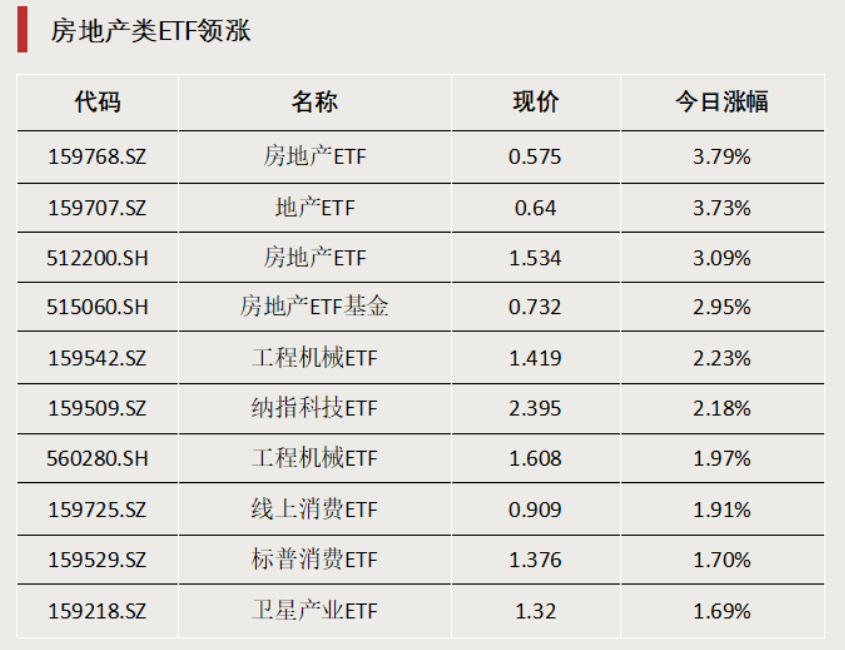
Group 1: Real Estate Sector - The real estate sector showed strong performance on December 10, with multiple stocks hitting the daily limit, leading real estate ETFs to rank high in the ETF market's gainers list [1][3] - Notable real estate ETFs included: - 159768.SZ Real Estate ETF with a price of 0.575 and a daily increase of 3.79% - 159707.SZ Real Estate ETF with a price of 0.64 and a daily increase of 3.73% - 512200.SH Real Estate ETF with a price of 1.534 and a daily increase of 3.09% [4] Group 2: Agriculture Sector - The agriculture sector performed well, with themes such as seed industry, land transfer, and aquatic products showing strong performance, leading agriculture-related ETFs to rank among the top gainers [2][5] - The sentiment in the seed industry has been notably boosted, with ongoing commercialization of biological breeding benefiting leading companies [5] Group 3: Technology Sector - Technology ETFs experienced significant inflows, with several ETFs seeing net inflows exceeding 1 billion yuan last week, and continued inflows in the first two trading days of this week [2][9] - The top net inflows for technology ETFs included: - 159352.OF Southern CSI A500 ETF with a net inflow of 15.66 billion yuan - 159600.OF Harvest CSI AAA Technology Innovation Corporate Bond ETF with a net inflow of 10.95 billion yuan [10] Group 4: Bond ETFs - Bond ETFs were actively traded, with several types such as Short-term Bond ETF, Benchmark Treasury Bond ETF, and Yinhua Daily Benefit ETF seeing transaction amounts exceeding 10 billion yuan [7][8] - The Short-term Bond ETF had a transaction amount of 401.12 billion yuan and a turnover rate of 54.79% [8] Group 5: Investment Recommendations - Institutions suggest focusing on gold and innovative pharmaceuticals as key investment directions, with gold expected to benefit from potential monetary easing and a shift in global credit dynamics [11] - The release of China's first commercial insurance innovative drug catalog is seen as a significant step for the innovative drug industry, potentially enhancing investment opportunities in the healthcare sector [11]