饮料

Search documents
华润饮料(02460):业绩阶段性承压,看好饮料第二成长曲线
Guotou Securities· 2025-12-09 07:57
Investment Rating - The investment rating for the company is "Buy-A" with a target price of 13.86 CNY over the next six months [7][9]. Core Insights - The report highlights that the bottled water market in China is expected to grow steadily, with a projected market size of 251.7 billion CNY in 2025, reflecting a year-on-year increase of 2.75% [1]. - The company has faced short-term performance pressure due to intensified competition in the bottled water sector, but it is well-positioned to benefit from long-term demand stability in essential products like packaged water [4]. - The beverage segment is seen as a second growth curve for the company, with a 21.28% increase in revenue from beverages in the first half of 2025 [2]. Financial Performance Summary - In the first half of 2025, the company reported a revenue of 6.206 billion CNY, a decrease of 18.52% year-on-year, with a net profit of 0.805 billion CNY, down 28.63% [2]. - The gross margin for the first half of 2025 was 46.7%, a decline of 2.6 percentage points compared to the previous year, primarily due to revenue decline and a shift in sales structure towards lower-margin beverage products [3]. - The company plans to enhance production efficiency by establishing two new factories, with one expected to commence operations in Q4 2025 [4]. Market and Competitive Landscape - The bottled water industry is experiencing increased competition, leading to significant revenue declines in small and medium-sized bottled water segments [2]. - The company has launched 14 new beverage SKUs in the first half of 2025, contributing to a revenue share increase to 15.4% from the beverage segment [2]. - The company is leveraging its brand recognition through partnerships with international sports events, enhancing its market presence [2]. Future Projections - Revenue growth projections for the company are -11.97% in 2025, followed by 6.61% in 2026 and 8.64% in 2027 [9]. - Net profit growth is expected to be -7.10% in 2025, with subsequent increases of 9.32% in 2026 and 5.49% in 2027 [9].
2025饮料新品TOP100:元气森林、农夫山泉、康师傅、统一激战新品、乳饮退潮谁来补位?
Tai Mei Ti A P P· 2025-12-09 07:09
Core Insights - The beverage market is undergoing significant changes, with a focus on new product trends and market share dynamics as the year-end approaches [1][4] - The analysis will cover the top 100 new beverage products from December 2024 to November 2025, comparing them with the previous year's data to identify trends and shifts in consumer preferences [1][4] Market Overview - The beverage market is categorized into ten subcategories, including packaged water, functional drinks, dairy beverages, ready-to-drink tea and milk tea, ready-to-drink juice, ready-to-drink coffee, soda, rice beverages, Asian traditional drinks, and plant-based protein drinks [4][5] - The only subcategory exceeding 20% market share is dairy beverages, while ready-to-drink tea and milk tea, functional drinks, soda, and ready-to-drink juice each hold over 10% [8][10] Category Performance - Dairy beverages experienced a decline of approximately 2% in market share, with a year-on-year sales growth drop of over 13%, indicating a significant downturn [10] - Functional drinks and ready-to-drink juices saw positive growth, with sales increasing by around 4%, while ready-to-drink tea and milk tea, along with packaged water, showed slight declines in sales growth [10][11] - Plant-based protein drinks also faced a decline in market share and sales growth, attributed to a lack of new consumer interest [10] New Product Trends - The number of new products in the top 100 list has shifted, with non-refrigerated ready-to-drink juices and sugary ready-to-drink teas seeing significant increases in new product entries [17][20] - Conversely, categories like no-sugar ready-to-drink tea and sports drinks have seen a reduction in new product numbers, despite overall sales growth in the latter category [17][20] Group Distribution - Leading brands such as Yuanqi Forest and Kang Shifu each had nine products in the top 100, indicating strong market presence and product diversification [20][22] - Other notable brands include Nongfu Spring and Uni-President, each contributing several new products to the top 100 list [20][22] Pricing and Specifications - The average price per 100ml for new products varies across categories, with non-refrigerated ready-to-drink juices and sugary ready-to-drink teas generally priced higher than their no-sugar counterparts [29][31] - The trend towards larger packaging sizes is evident, with a threefold increase in the number of large-sized products (1000ml-1999ml) in the top 100, reflecting consumer preferences for value and sharing [26][29] Launch Timing - The timing of new product launches has shifted, with a noticeable increase in products launched in February and March 2025 compared to the previous year, indicating a trend towards earlier product introductions [31]




困在“舒适区”的日系饮料,如何错失中国饮料市场?
Xin Lang Cai Jing· 2025-12-09 05:39
Core Insights - Japanese beverage brands are facing stagnation in growth and declining market share in China due to the rise of local brands that leverage rapid innovation and targeted marketing strategies [1][5][11] Group 1: Market Dynamics - Japanese beverages like Suntory's Oolong tea and Yakult have dominated niche categories in China but are now losing ground to local brands [1] - The Chinese beverage market has become highly competitive, with local brands rapidly innovating and expanding their distribution channels [1][5] Group 2: Localization Strategies - Japanese brands initially adopted localization strategies to resonate with Chinese consumers, incorporating cultural symbols and local language in branding [2][4] - However, the superficial approach to localization has led to consumer skepticism, as many now perceive these brands as "disguised" rather than genuinely integrated [4] Group 3: Product Innovation - Japanese brands have been slow to innovate, with Yakult only introducing a few product variations since its entry into China in 2002, while local brands rapidly launch new products [5][6] - The average R&D investment for Japanese beverage brands is less than 2%, compared to 5.8% and 3.5% for local brands like Yuanqi Forest and Nongfu Spring, respectively [6] Group 4: Supply Chain Efficiency - Japanese brands face higher production costs, estimated to be 15%-20% more than local competitors, due to reliance on imported materials and inefficient supply chain management [11][12] - Local brands have developed efficient supply chains that allow for lower prices and faster market response, further eroding the competitive edge of Japanese brands [12] Group 5: Channel Strategy - Japanese brands have become overly reliant on convenience stores, which has limited their market reach and adaptability to changing consumer preferences [8][9] - Local brands are adopting a multi-channel strategy, expanding into various retail formats and rural markets, which has proven more effective in capturing market share [8][9] Group 6: Consumer Trust and Health Narratives - Japanese brands have struggled to maintain consumer trust as health narratives based on scientific claims have been challenged by consumers' increasing focus on ingredient transparency [10][13] - Instances of product quality issues have further damaged the reputation of Japanese brands, leading to a decline in perceived quality and trust [15][16] Group 7: Future Outlook - For Japanese brands to regain growth in China, they must either fully localize their operations or focus on creating unique value propositions in niche markets [17]

Goodai融资;联合利华冰淇淋业务将上市;香奈儿投资建设香水基地
Sou Hu Cai Jing· 2025-12-09 03:31
Investment Dynamics - Iris Ventures led a $15 million investment in skincare brand Innerskin, which will be used to expand its clinic network in Europe and launch new skincare products [3] - Goodai Global Inc, a South Korean beauty unicorn, completed a funding round of 800 billion KRW (approximately $600 million), with a valuation of 4 trillion KRW (approximately $3.1 billion), to acquire two independent cosmetic brands [6] - Chanel is investing approximately €150 million to build a new perfume production facility in northern France, expected to create around 300 jobs [9][10] Listing Dynamics - Unilever's ice cream business, now named Magnum Ice Cream Company N.V., is set to complete its IPO on the Amsterdam, London, and New York stock exchanges, marking a record for global ice cream IPOs [11][13] Acquisition Dynamics - BasicNet Group announced the acquisition of beachwear brand Sundek, enhancing its brand portfolio in the beachwear segment [16] - Sequoia China is in talks to acquire Italian luxury sneaker manufacturer Golden Goose for €2.5 billion (approximately 20.6 billion RMB), aiming to finalize the deal before Christmas [19] - Firmenich completed the acquisition of fragrance manufacturer Belle Aire Creations, reinforcing its commitment to the North American market [22] Franchise and Expansion Dynamics - The fresh beer brand "Xianpi Fulu Jia" announced a new franchise policy, aiming to open over 1,000 locations by December 2025 [25] - Zhou Hei Ya opened its first overseas store in Malaysia, employing a dual strategy of "store + channel" for market expansion [28]


国信证券晨会纪要-20251209
Guoxin Securities· 2025-12-09 01:01
Macro and Strategy - The Federal Open Market Committee (FOMC) is facing a personnel change that will influence future policy direction and independence boundaries, with a key focus on the upcoming 2026 board member replacements [7][8] - The current structure of the FOMC, with a mix of "core dependent" and "institutional defense" members, will determine the continuation of its independence, with potential shifts in policy power dynamics anticipated [8] - The report predicts that the Federal Reserve is likely to enter a phase of "political rate cuts," with increased uncertainty in decision-making frameworks [9] Industry and Company Agriculture, Forestry, Animal Husbandry, and Fishery - The investment strategy for December 2025 highlights an expected reversal in the livestock cycle, recommending key stocks in the dairy farming sector such as Yuran Agriculture and Modern Farming [13] - The report emphasizes the potential for a rebound in meat and milk prices, driven by a synchronized recovery in the livestock sector, with leading companies expected to experience significant earnings recovery [13][14] - Recommendations include leading companies in various segments: livestock (Yuran Agriculture, Modern Farming), pork (Hua Tong, De Kang), and pet food (Guaibao Pet) [15][17] Food and Beverage - The food and beverage sector has seen a decline of 1.80% recently, with A-share food and beverage indices underperforming the broader market [18][19] - The report identifies a divergence in performance across categories, with alcoholic beverages facing supply-demand imbalances, while dairy products are expected to see gradual recovery [19][20] - Investment recommendations focus on high-potential companies in the beverage sector, such as Nongfu Spring and East Peak Beverage, as well as premium liquor brands like Luzhou Laojiao and Moutai [19][20] Real Estate - The real estate market is experiencing significant pressure, with a 9.6% year-on-year decline in sales volume and a 6.8% drop in sales area from January to October 2025 [25][26] - The report notes that while non-popular cities are seeing population outflows, local residents still have improvement-driven housing demands, which could stabilize the market [26][28] - Recommendations include focusing on companies that are well-positioned in non-popular cities, such as China Overseas Land & Investment, which can leverage local demand for housing improvements [28] Internet and AI - The report highlights advancements in AI technology, with significant product launches from companies like OpenAI and Tencent, indicating a growing trend in AI applications across various sectors [29][30] - Investment strategies suggest focusing on internet giants that are leveraging AI for growth, with recommendations for Alibaba and Tencent as key players benefiting from AI integration [30] - The report also notes the potential for AI to enhance advertising and cloud service revenues for these companies, suggesting a positive outlook for their financial performance [30]
河北锐淳饮料有限公司成立 注册资本160万人民币
Sou Hu Cai Jing· 2025-12-08 23:19
天眼查App显示,近日,河北锐淳饮料有限公司成立,法定代表人为吕建利,注册资本160万人民币, 经营范围为许可项目:饮料生产;食品销售(依法须经批准的项目,经相关部门批准后方可开展经营活 动,具体经营项目以批准文件或许可证件为准)一般项目:食品销售(仅销售预包装食品);保健食品 (预包装)销售;食品互联网销售(仅销售预包装食品)(除依法须经批准的项目外,凭营业执照依法 自主开展经营活动)。 ...
儿童饮料,一门持久而暴利的生意?
3 6 Ke· 2025-12-08 12:07
Core Insights - The children's beverage market is experiencing significant growth and diversification, with new products and brands emerging alongside established players [1][11] - The market is driven by parents' willingness to spend on children's health, with children's food and beverage expenditures accounting for 24% of total family spending on children [12] - The trend towards healthier options is reshaping the market, with a focus on "clean labels" and functional ingredients [8][16] Market Dynamics - The children's beverage category has evolved from traditional products like milk to a wide range of options including sports drinks, flavored beverages, and probiotic drinks [1][2] - New brands are entering the market, while traditional brands like Wahaha and Wangwang maintain strong positions through iconic products [5][6] - The success of products like Jin Yin Hua grapefruit juice, which achieved sales of over 1 billion bags in six months, highlights the potential for rapid growth in this sector [1] Consumer Behavior - Parents are increasingly scrutinizing beverage ingredients, leading to a demand for products with no artificial additives and enhanced nutritional profiles [8][12] - The dual decision-making process in purchasing—children as consumers and parents as decision-makers—requires brands to appeal to both groups [12][16] - Innovative marketing strategies, such as leveraging social media and unique packaging, are crucial for capturing consumer attention [13] Product Innovation - The market is seeing a rise in products that cater to specific health needs, such as those fortified with probiotics, DHA, and dietary fiber [8][16] - New brands are establishing clear identities focused on children's health, differentiating themselves from traditional beverage giants [9][11] - The introduction of functional beverages and plant-based options is further diversifying the market landscape [16] Competitive Landscape - Established brands like Coca-Cola's Qoo have successfully penetrated the market with minimal marketing costs, demonstrating the profitability of children's beverages [6] - The competitive environment is shifting as new entrants challenge the dominance of traditional players, leading to a more dynamic market [11][16] - Brands must build trust through transparency in ingredients and nutritional benefits to succeed in this evolving landscape [15]

香飘飘:大股东杨冬云拟减持不超0.10%公司股份
Xin Lang Cai Jing· 2025-12-08 10:40
香飘飘12月8日公告,公司持股5%以上大股东杨冬云计划自公告披露之日起15个交易日后的3个月内, 通过集中竞价方式减持公司股份不超过41.99万股,即不超过公司总股本的0.10%。减持期间为2025年12 月31日至2026年3月30日,减持原因为自身资金需要。本次减持不设价格区间。 ...

香飘飘:持股5%以上股东拟减持不超0.10%股份
Xin Lang Cai Jing· 2025-12-08 10:33
香飘飘公告称,截至公告披露日,持股5%以上大股东杨冬云持有公司股份21,527,361股,占总股本的 5.21%。其拟自公告披露之日起15个交易日后的3个月内(2025年12月31日~2026年3月30日),通过集 中竞价方式减持不超419,864股,即不超总股本的0.10%,减持原因为自身资金需要。 ...
可口可乐的AI豪赌:看似抛弃“创意神话”,实则押注万亿增长
Tai Mei Ti A P P· 2025-12-08 09:37
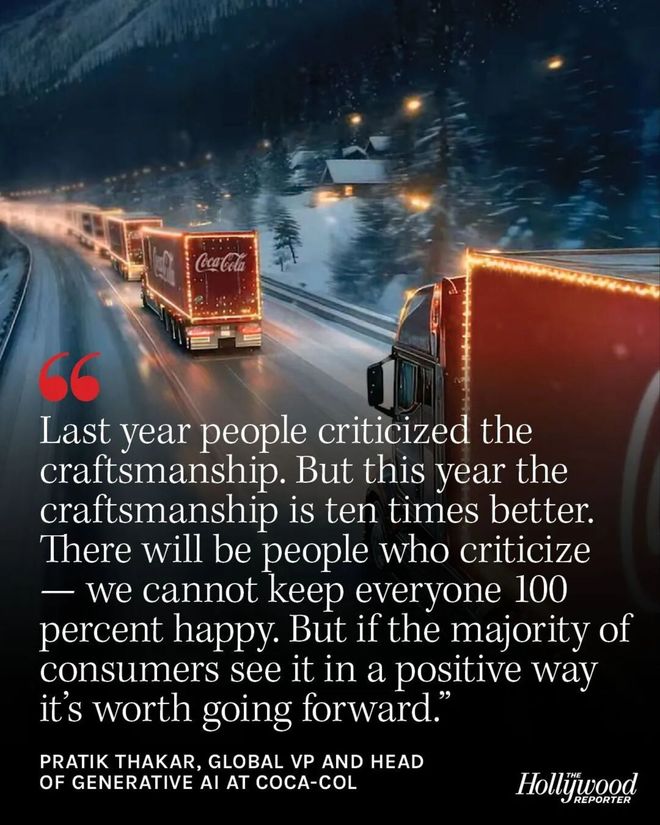
Core Viewpoint - Coca-Cola is leveraging AI in its marketing strategy, particularly in its holiday advertising, despite facing criticism for the lack of creativity and emotional depth in its AI-generated content [2][5][10]. Group 1: AI Advertising Strategy - Coca-Cola's 2023 holiday advertisement utilized AI to recreate the classic 1995 ad "Holidays Are Coming," featuring animated characters like polar bears and sloths to avoid the "uncanny valley" effect [2][3]. - The production process involved a small team generating 70,000 video segments, with a final production time of only 30 days, showcasing advancements in AI technology [3][4]. - Despite the technical improvements, the ad received significant backlash for being perceived as lacking originality and depth, with critics suggesting it was a mere rehash of past content [5][8]. Group 2: Strategic Shift in Advertising - In 2023, Coca-Cola made a significant move by cutting ties with over 6,000 advertising agencies and establishing "Studio X," a global digital marketing ecosystem aimed at consolidating creative control [6][7]. - This shift signals Coca-Cola's intent to internalize creative processes and reduce reliance on traditional advertising agencies, which they view as costly [7][8]. - The company has produced three AI-driven ads, indicating a commitment to integrating AI into its marketing strategy despite initial controversies [8]. Group 3: Revenue Growth Management (RGM) - Coca-Cola's push for AI in advertising is part of a broader strategy focused on Revenue Growth Management (RGM), which aims to optimize pricing, product offerings, and marketing strategies [11][12]. - The company has streamlined its brand portfolio from over 400 to around 200, focusing on high-margin categories and adjusting pricing strategies based on market sensitivity [12][13]. - Recent financial reports indicate a 5% revenue growth to $12.455 billion in Q3 2025, with a 6% organic revenue increase and a 29% rise in net profit, reflecting the effectiveness of its RGM strategy [17]. Group 4: AI's Role in Future Growth - Coca-Cola views AI as a critical component in enhancing its operational efficiency and marketing effectiveness, aiming to create a consumer-centric growth system [10][18]. - The company has established a comprehensive digital infrastructure that allows for real-time data analysis across its supply chain and marketing efforts, facilitating agile decision-making [20][22]. - AI is expected to play a central role in automating and personalizing marketing strategies, ultimately driving revenue growth and reshaping the marketing landscape in the consumer goods industry [22][23].