
非银金融

Search documents
【17日资金路线图】两市主力资金净流出近170亿元 计算机等行业实现净流入
证券时报· 2025-11-17 11:02
盘后数据出炉。 今日(11月17日),A股市场整体下跌。截至收盘,上证指数报3972.03点,下跌0.46%;深证成指报13202点,下跌0.11%;创业板指报3105.2点,下跌0.2%。两市合 计成交19107.91亿元,较上一交易日减少472.88亿元。 1.两市主力资金净流出近170亿元 今日沪深两市主力资金开盘净流出58.8亿元,尾盘净流入2.96亿元,两市全天主力资金净流出168.44亿元。 | | | 沪深两市最近五个交易日主力资金流向情况(亿元) | | | | --- | --- | --- | --- | --- | | 日期 | | 净流入金额 开盘净流入 | 尾盘净流入 | 超大单净买入 | | 2025- 11- 17 | - 168. 44 | - 58. 80 | 2. 96 | - 47. 20 | | 2025- 11- 14 | -620. 11 | - 288. 55 | - 136. 66 | - 379. 04 | | 2025- 11- 13 | 124. 70 | - 31. 11 | 43. 73 | 177. 50 | | 2025- 11- 12 | - 4 ...


非银金融行业11月17日资金流向日报
Zheng Quan Shi Bao Wang· 2025-11-17 10:08
沪指11月17日下跌0.46%,申万所属行业中,今日上涨的有17个,涨幅居前的行业为计算机、国防军 工,涨幅分别为1.67%、1.59%。跌幅居前的行业为医药生物、银行,跌幅分别为1.73%、1.31%。非银 金融行业位居今日跌幅榜第三。 | 000750 | 国海证券 | -0.89 | 0.99 | -5149.32 | | --- | --- | --- | --- | --- | | 002670 | 国盛证券 | -3.16 | 2.42 | -4943.23 | | 600390 | 五矿资本 | -0.84 | 0.70 | -4475.33 | | 600155 | 华创云信 | 0.52 | 2.55 | -4393.14 | | 601995 | 中金公司 | -0.88 | 0.54 | -4357.71 | | 002939 | 长城证券 | -0.38 | 0.66 | -4335.29 | | 601878 | 浙商证券 | -0.44 | 0.55 | -3897.56 | | 601059 | 信达证券 | -0.96 | 2.14 | -3824.15 | | 601099 ...




创业板成长ETF逆市翻红,近期连续获资金关注
Mei Ri Jing Ji Xin Wen· 2025-11-17 06:37
Core Points - The A-share market experienced a collective adjustment with the Shanghai Composite Index down by 0.54%, the Shenzhen Component Index down by 0.19%, and the ChiNext Index down by 0.33% [1] - The ChiNext Growth ETF (159967) saw an increase of 0.35%, with the latest price at 0.575 yuan and a trading volume of 1.28 billion yuan, resulting in a turnover rate of 4.08% [1] - Among the constituent stocks, high performers included Gao Weida with a rise of 9.23%, Changxin Bochuang up by 5.49%, and Guangku Technology up by 4.88%, while leading decliners included Kanglong Huacheng down by 6.00% and Ningde Times down by 3.37% [1] Fund Flow - The ChiNext Growth ETF recorded net inflows in 8 out of the last 10 trading days, totaling 199 million yuan [1] Valuation - The latest price-to-earnings ratio (PE-TTM) for the ChiNext Growth ETF is 38.34 times [1] Sector Weighting - The index tracked by the ChiNext Growth ETF is heavily weighted in the following sectors: Communication (36.69%), Power Equipment (20.11%), Electronics (12.66%), Non-bank Financials (10.96%), and Computers (9.05%) [1]

股市面面观|11月杠杆资金入市节奏放缓 电力设备等多个行业获融资客大幅净买入
Xin Hua Cai Jing· 2025-11-17 05:18
Market Overview - The A-share market has been in a sideways consolidation phase, with the Shanghai Composite Index hovering around the 4000-point mark for half a month [2] - As of November 14, the financing balance in the A-share market was reported at 2.475 trillion yuan, showing a decrease of 134.6 billion yuan from the previous trading day [3] Financing Trends - The financing balance has decreased slightly since the beginning of November, contrasting with the previous upward trend observed in October [3] - The financing balance on November 3 was 2.477 trillion yuan, indicating a decline of 0.002 trillion yuan by mid-November [3] Industry Performance - The electric power equipment industry recorded the highest net financing inflow of 152.29 billion yuan, followed by the basic chemical and pharmaceutical industries with net inflows of 46.2 billion yuan and 27.53 billion yuan, respectively [4] - A total of 15 out of 31 industries experienced net financing inflows, while 16 industries faced net outflows [4] Individual Stock Performance - Notable stocks with significant net financing inflows include Ningde Times, Dongshan Precision, and Jiangbolong, each exceeding 10 billion yuan in net inflows [6] - Conversely, stocks like Shenghong Technology and Guiding Compass saw substantial net outflows, with Shenghong Technology exceeding 20 billion yuan [6][7] Market Sentiment and Future Outlook - The current market sentiment indicates a decrease in the enthusiasm of leveraged funds, with a focus on sectors like lithium batteries and electrolyte themes [8] - Analysts suggest maintaining a positive position but caution against chasing high valuations, especially as the market remains in a consolidation phase around the 4000-point level [9]






突然,这一股暴涨超80%
Zheng Quan Shi Bao· 2025-11-17 05:01
Group 1: Market Overview - The Hong Kong stock market experienced a decline this morning, with the Hang Seng Index dropping over 0.8% at one point [1][7] - In contrast, the A-share market saw a surge in multiple sectors, particularly in defense and military, which rose over 2.5% [2] - The lithium mining concept also saw significant gains, with related stocks experiencing a surge [5][6] Group 2: Notable Stocks - Jiangyang Group in the Hong Kong market saw a dramatic increase, with its stock price rising over 80% during trading [9] - In the A-share market, Jianglong Shipbuilding hit the "20cm" limit up, while several other stocks in the defense sector also saw gains exceeding 10% [2] - The computer sector also witnessed a surge, with stocks like Borui Data hitting the "20cm" limit up [2] Group 3: Company Announcements - Jiangyang Group announced plans for privatization, proposing to cancel all planned shares at a price of HKD 0.245 per share, which represents an approximately 87% premium over the last trading price of HKD 0.131 [11] - The company has 1 billion shares issued and intends to use internal cash resources to cover the maximum cash consideration of HKD 245 million for the plan [11]

突然 这一股暴涨超80%!
Zheng Quan Shi Bao· 2025-11-17 04:57
石油石化、煤炭、房地产等板块盘中涨幅也居于前列。 医药生物、电力设备、银行、非银金融等板块跌幅居前。 A股市场今天(11月17日)上午整体窄幅震荡。包括国防军工、计算机板块、锂矿概念等在内的多个板块掀起涨停潮,表现较好。 港股市场今天上午整体走低,恒生指数盘中跌幅一度超过0.8%。港股靖洋集团盘中一度大涨超过80%。 A股多个板块掀起涨停潮 A股市场今天上午整体窄幅震荡,主要指数不同程度走低。 主要行业板块和赛道方面,若按照申万一级行业划分,国防军工板块大涨,板块盘中涨幅一度超过2.5%。江龙船艇盘中触及"20cm"涨停,晨曦航空、天 和防务盘中涨幅超过10%。长城军工、航天发展盘中触及涨停。 计算机板块也掀起涨停潮,板块盘中涨幅一度接近2%。博睿数据盘中"20cm"涨停,海峡创新、东方国信、高伟达等多股盘中涨幅超过10%。达华智能、 华胜天成、三六零、直真科技、格尔软件、浪潮软件、榕基软件等多股盘中触及涨停。 概念板块方面,锂矿概念大涨,相关概念也掀起涨停潮。天华新能大涨15.06%,盛新锂能、融捷股份、大中矿业、金圆股份等多股涨停。 消息面上,今天上午碳酸锂期货暴涨,国内碳酸锂期货主力合约盘中涨超8%,创 ...
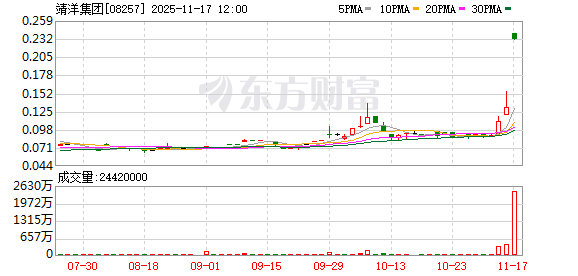
突然,这一股暴涨超80%!
Zheng Quan Shi Bao· 2025-11-17 04:39
消息面上,今天上午碳酸锂期货暴涨,国内碳酸锂期货主力合约盘中涨超8%,创出年内新高,盘中突破90000元/吨关口。 A股市场今天(11月17日)上午整体窄幅震荡。包括国防军工、计算机板块、锂矿概念等在内的多个板块掀起涨停潮,表现较好。 港股市场今天上午整体走低,恒生指数盘中跌幅一度超过0.8%。港股靖洋集团盘中一度大涨超过80%。 A股多个板块掀起涨停潮 A股市场今天上午整体窄幅震荡,主要指数不同程度走低。 主要行业板块和赛道方面,若按照申万一级行业划分,国防军工板块大涨,板块盘中涨幅一度超过2.5%。江龙船艇(300589)盘中触及"20cm"涨停,晨 曦航空(300581)、天和防务(300397)盘中涨幅超过10%。长城军工(601606)、航天发展(000547)盘中触及涨停。 计算机板块也掀起涨停潮,板块盘中涨幅一度接近2%。博睿数据盘中"20cm"涨停,海峡创新(300300)、东方国信(300166)、高伟达(300465)等多 股盘中涨幅超过10%。达华智能(002512)、华胜天成(600410)、三六零(601360)、直真科技(003007)、格尔软件(603232)、浪潮软件 (600 ...

26年美联储“鹰”与“鸽”的节奏及对市场的影响
2025-11-16 15:36
Summary of Conference Call Notes Industry or Company Involved - The notes primarily discuss the impact of U.S. Federal Reserve policies on the market, the domestic policy environment in China, and the performance of various sectors in the A-share market. Core Points and Arguments Federal Reserve Policy Impact - The Federal Reserve's policy is influenced by the chairman's desire for reappointment, with Powell likely to maintain a hawkish stance until 2026, after which a dovish shift may occur, benefiting U.S. stocks and global tech stocks in the long term [1][3] - Current Nasdaq valuations are significantly lower than historical highs, with stronger profitability, indicating limited long-term risk despite short-term volatility due to hawkish policies [1][6] Domestic Policy and Market Dynamics - China's anti-involution policies aim to increase industry concentration and promote leading enterprises, with a higher likelihood of successful implementation if led by top companies [1][5] - The focus on major power dynamics and the potential for increased fiscal deficit rates may create consumption opportunities in strategic sectors like computing power, military, and energy [1][8] A-Share Market Performance - A-shares showed significant improvement in Q3, with overall revenue growth of 1.16% and net profit growth of 5.34%, indicating a robust recovery [1][10] - There is notable performance divergence among sectors, with steel, non-ferrous metals, and non-bank financials showing high net profit growth, while real estate and retail sectors faced declines [1][12] Sector-Specific Insights - The technology and high-end manufacturing sectors maintained high growth, driven by AI and digital content demand, with significant profit increases in electronics and communications [1][13] - The cyclical industries showed mixed results, with steel profits rising significantly due to low base effects, while coal profits declined due to falling prices [1][15][18] - The renewable energy sector remains a key investment area, although high trading concentration in solar energy suggests caution in the short term [1][7] Consumer Sector Trends - Traditional consumer sectors are generally weak, with significant declines in net profits for food and beverage, textiles, and retail, while emerging sectors like pet economy and gaming show structural opportunities [2][22] Other Important but Possibly Overlooked Content - The anticipated increase in the central government's fiscal deficit rate in 2026 may provide a temporary boost to consumer stocks [1][8] - The ongoing rotation within the market indicates a shift towards emerging technology sectors, which continue to attract capital inflows despite overall market caution [1][9]
【十大券商一周策略】短期或进入宽幅震荡阶段,中长期向好趋势不改
券商中国· 2025-11-16 14:54
Group 1 - The market is expected to continue showing a rotation between technology and cyclical sectors, despite a marginal weakening of macro liquidity drivers in the domestic market [2] - The current market is in a "bull market 1.0" phase, with high volatility expected in the near term, particularly in technology growth stocks, which may have limited short-term adjustment space [3] - A structural "rebalancing" is occurring globally, with funds rotating from previously leading technology sectors to lower-valued sectors such as resources, consumption, and pharmaceuticals [4] Group 2 - The A-share market is in a consolidation phase, with rapid sector rotation and a focus on lithium battery and consumer sectors benefiting from policy support [5] - The current style expansion is driven by valuation, expectations, and capital, with value stocks benefiting from economic stabilization and performance verification [6] - The market may enter a wide fluctuation phase in the short term, with a focus on defensive and consumer sectors, while TMT and advanced manufacturing sectors are expected to perform better in the medium term [7] Group 3 - The "small and mid-cap + thematic investment" strategy remains a core focus for November, with attention on themes related to the 14th Five-Year Plan, such as energy storage and domestic substitution [8] - The current economic environment is characterized by a divergence between investment and consumption, with a focus on power-related assets as a key investment theme [9] - The A-share market's high-cut low trend is expected to continue until the end of the year, with a focus on strong fundamentals supporting technology stocks [10] Group 4 - The market is anticipated to maintain a short-term oscillation around the 4000-point level, with limited directional breakthroughs expected [12] - The upcoming economic data and Federal Reserve policy expectations are critical variables that will influence market dynamics and sector performance [12]

策略周聚焦:高低切背后的反内卷牛市
Huachuang Securities· 2025-11-16 14:12
Group 1 - The market is experiencing a high volatility phase driven by three main factors: profit-taking by funds, weakening economic data, and declining remaining liquidity. The trend is shifting towards large-cap stocks [1][10][12] - The current market environment reflects a "time for space" approach, lacking event catalysts for immediate pricing adjustments. The degree of industry differentiation reached a 10-year high of 69% on October 9, but has since narrowed to 53% [2][21][27] - Market transaction volume has significantly decreased since September, with the average daily trading volume dropping from approximately 3 trillion yuan to 2 trillion yuan, indicating a divergence between price increases and trading activity [3][19][30] Group 2 - The "anti-involution bull market" is characterized by a shift in valuation models, with a focus on sectors with low earnings bases. Industries such as steel, new energy, and light industry are highlighted for their cost-effectiveness [4][27][40] - Investment direction should focus on supply-tight cyclical industries, including non-ferrous metals, steel, coal, and aquaculture, as well as identifying new core assets among high-quality large-cap growth companies [5][28][29]