
汽车

Search documents
2026年2月PMI分析:PMI季节性回落,一季度力争开门稳
Yin He Zheng Quan· 2026-03-04 07:37
Group 1: PMI Overview - In February 2026, the Manufacturing Purchasing Managers' Index (PMI) was 49.0%, a decrease of 0.3 percentage points from the previous month[1] - The Construction Business Activity Index was 48.2%, down from 48.8%[1] - The Services Business Activity Index was 49.7%, slightly up from 49.5%[1] Group 2: Seasonal Factors and Trends - The decline in PMI is attributed to seasonal factors such as the Spring Festival, with both supply and demand showing temporary slowdowns[2] - The production index fell to 49.6% from 50.6%, and the new orders index dropped to 48.6% from 49.2%[3] - The operating rate decreased by 3.49 percentage points to 39.51%, while the electric furnace capacity utilization rate fell by 17.41 percentage points to 36.34%[3] Group 3: Price and Inventory Dynamics - The factory price index remained stable at 50.6%, while the purchasing price index decreased by 1.3 percentage points to 54.8%[4] - The gap between purchasing prices and factory prices narrowed to 4.2 percentage points, indicating some relief in cost pressures for enterprises[4] - Finished goods inventory index decreased by 2.8 percentage points to 45.8%, while raw materials inventory increased slightly by 0.1 percentage points to 47.5%[4] Group 4: Future Outlook - Manufacturing production activity is expected to recover in March as the effects of the Spring Festival dissipate, with production and new orders indices anticipated to rise[2] - External demand remains resilient, supported by OECD leading indicators pointing to a mild upward trend in exports through June[2] - Domestic demand relies on further policy support and improvements in terminal consumption and investment needs[2]
日韩股市双双收跌,韩国综指跌超12%
第一财经· 2026-03-04 07:06
Group 1 - Hyundai Motor experienced a decline of nearly 16% [1] - Samsung Electronics saw a drop of nearly 12% [1] - The Nikkei 225 index closed down over 3% [1]

何小鹏两会建言:推动自动驾驶跳过L3直接到L4
第一财经· 2026-03-04 06:35
Core Viewpoint - The article discusses the urgent need for advancements in autonomous driving regulations in China, emphasizing the transition from L2 to L4 levels of automation as a strategic necessity for global competitiveness in the industry [3][4]. Group 1: Current Challenges and Opportunities - The existing "gradual progression" management framework for autonomous driving faces new challenges as the global regulatory window for L3 and above is rapidly closing [3]. - China has a first-mover advantage in developing L2-level assisted driving applications and is making progress in smart connected vehicle access and road testing [3][4]. Group 2: Recommendations by He Xiaopeng - Maintain the stability of the L2 safety regulatory system while promoting the transition of autonomous driving policies from L2 to L4, simplifying the L3 intermediate stage [4]. - Gradually clarify the registration and traffic management system for L4 autonomous vehicles, facilitating their compliant operation nationwide [5]. - Conduct adaptability assessments of traffic regulations to optimize traffic behavior norms for both human and machine driving, ensuring safety [5]. - Empower local pilot management for L4-level unmanned driving applications in specific low-risk scenarios, allowing mature cities to conduct L4 application trials and create replicable experiences [5].


【中国银河宏观】PMI季节性回落,一季度力争开门稳——2026年2月PMI分析
Xin Lang Cai Jing· 2026-03-04 06:33
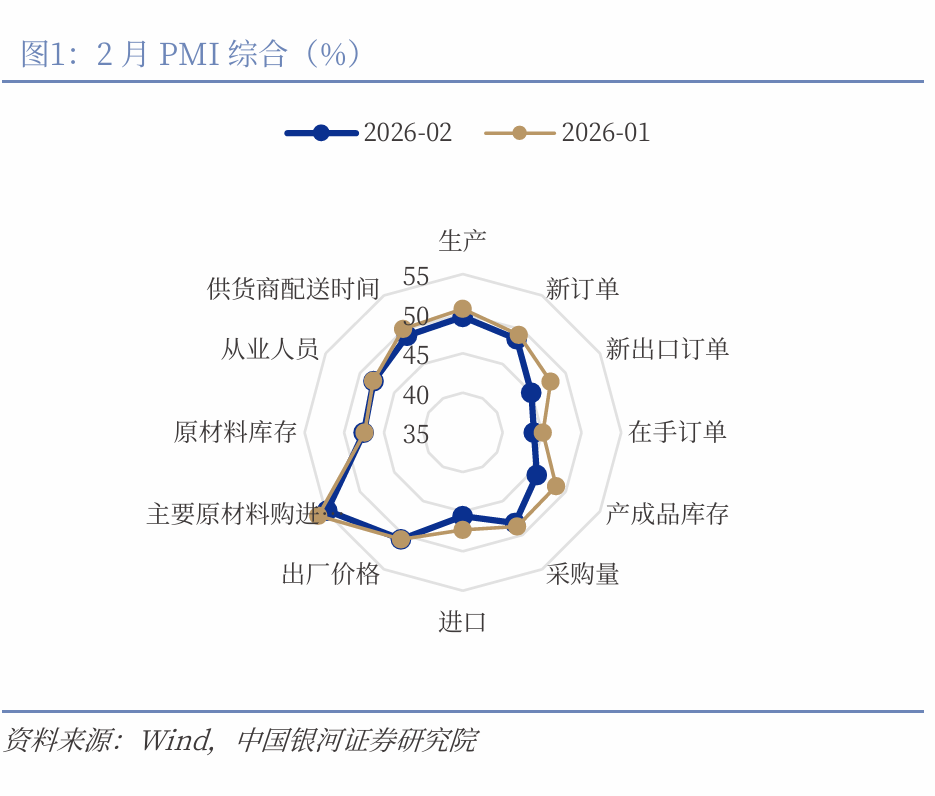
Core Viewpoint - The overall decline in February PMI is primarily influenced by seasonal factors such as the Spring Festival holiday, with both supply and demand experiencing a temporary slowdown. Production activities and order indicators have declined in tandem, but the extent of the decline is consistent with historical seasonal patterns. [2] Group 1: PMI and Economic Activity - The manufacturing PMI for February is reported at 49.0%, a decrease of 0.3 percentage points from the previous month. The construction business activity index is at 48.2% (previously 48.8%), and the service business activity index is at 49.7% (previously 49.5%) [1] - The production index for February is at 49.6% (previously 50.6%), and the new orders index is at 48.6% (previously 49.2%), indicating a decline in both supply and demand [3] - The operating rate has decreased due to the holiday impact, with the high-frequency data showing a drop in the rebar operating rate by 3.49 percentage points to 39.51%, and the electric furnace capacity utilization rate declining by 17.41 percentage points to 36.34% [3] Group 2: Price and Cost Dynamics - The factory price index remains unchanged at 50.6%, while the raw material purchase price has decreased by 1.3 percentage points to 54.8%, indicating a reduction in upstream cost pressures [4] - The gap between purchase prices and factory prices is currently 4.2 percentage points, suggesting that corporate profits are still under some cost pressure, although this gap has shown signs of narrowing [4] Group 3: Inventory Trends - The finished goods inventory index has decreased by 2.8 percentage points to 45.8%, while the raw material inventory has increased slightly by 0.1 percentage points to 47.5%. The purchasing index has declined by 0.5 percentage points to 48.2% [4] - Companies are adopting a cautious "production based on sales" strategy, leading to a relatively tight balance in overall inventory levels [4] Group 4: Future Outlook - As the effects of the Spring Festival gradually dissipate, manufacturing production activities are expected to recover in March, with both the production index and new orders index anticipated to rise [2] - External demand remains resilient, as indicated by the OECD composite leading indicators pointing towards a mild upward trend in exports year-on-year until June [2]

小米集团-W:25Q4 业绩前瞻:汽车全年经营层面盈利,存储成本压力逐步体现-20260304
GUOTAI HAITONG SECURITIES· 2026-03-04 05:45
Investment Rating - The report maintains a "Buy" rating for Xiaomi Group (1810.HK) with a target price adjusted to HKD 42.7 [7][15]. Core Insights - The report highlights that the storage price surge is currently impacting Xiaomi's short-term profitability, but the long-term ecosystem value driven by multi-device synergy is promising [3]. - The financial forecasts for Xiaomi's revenue and adjusted net profit have been revised downwards for FY2025E-FY2027E, reflecting a more cautious outlook due to market conditions [15]. Financial Summary - **Revenue Forecast (in million RMB)**: - 2023: 270,971 - 2024: 365,932 (+35.0%) - 2025E: 457,062 (+24.9%) - 2026E: 511,216 (+11.8%) - 2027E: 595,885 (+16.6%) [5] - **Gross Profit and Margin**: - 2023: Gross Profit 57,477, Margin 21.2% - 2024: Gross Profit 76,564, Margin 20.9% - 2025E: Gross Profit 101,281, Margin 22.2% - 2026E: Gross Profit 107,773, Margin 21.1% - 2027E: Gross Profit 131,879, Margin 22.1% [5] - **Adjusted Net Profit**: - 2023: 19,273 (+126.3%) - 2024: 27,235 (+41.3%) - 2025E: 38,186 (+40.2%) - 2026E: 34,040 (-10.9%) - 2027E: 46,178 (+35.7%) [5] Business Segments Overview - **Smartphones**: The report anticipates a decline in smartphone shipments in Q4 2025, with an expected volume of 37.8 million units, down 11.4% year-on-year, primarily due to a contraction in the Indian market [15]. - **Automotive**: Xiaomi's automotive segment is projected to achieve operational profitability in 2025, with Q4 deliveries exceeding 140,000 units. The report notes a slight decline in average selling price (ASP) due to promotional activities [15]. - **IOT and Internet Services**: IOT revenue is expected to decline by 26% year-on-year in Q4 2025, while internet services are projected to grow by 4.7% [15]. Valuation Methodology - The report employs a Sum-of-the-Parts (SOTP) valuation method, assigning a PE of 20x for core businesses (smartphones, IOT, internet) and a PS of 2.4x for the automotive segment, reflecting Xiaomi's competitive advantages in supply chain management and brand strength [15][19].

解析理想汽车“软硬协同设计定律”:如何用数学语言打通芯片与算法的任督二脉?
Ge Long Hui· 2026-03-04 05:12
Core Insights - The article discusses a fundamental paradox in the automotive industry regarding the relationship between computing power and actual performance, questioning whether higher computing power truly translates to better efficiency [1][2][10] - It highlights the introduction of the "Soft-Hardware Collaborative Design Law" by Li Auto, which represents a significant technological breakthrough and a paradigm shift in AI foundational logic [1][4] Group 1: Computing Power Paradox - The automotive industry's past decade has been characterized by a worship of computing power, with metrics like TOPS becoming more fashionable than horsepower [2] - Li Auto's early experiences with top-tier vehicle chips revealed that the actual performance often falls short of expectations, even with high-end hardware [3][4] - Major tech companies, including NVIDIA and Apple, face similar challenges due to a traditional development model that separates hardware and software, leading to wasted computing power and inefficiencies [4] Group 2: Collaborative Design Framework - Li Auto's MindVLA team, in collaboration with the National Innovation Decision Intelligence Research Institute, developed a mathematical framework to optimize the collaboration between chips and algorithms [4][5] - This framework combines loss function expansion and Roofline performance modeling, allowing for a quantifiable and predictable approach to soft-hardware collaboration [5] - Key findings from this research indicate that optimal chip architecture is highly dependent on specific hardware parameters, emphasizing the necessity for algorithms to define chip design [5][6] Group 3: Practical Applications and Industry Impact - The launch of the new Li Auto L9, equipped with the Mach 100 chip, showcases a significant increase in effective computing power, achieving three to six times the effective performance of competitors [7][8] - Li Auto's commitment to R&D is evident, with projected investments reaching 12 billion yuan by 2025, and a cumulative R&D expenditure exceeding 46.8 billion yuan over eight years [8] - The company has published nearly 50 papers in relevant fields, contributing to a growing body of knowledge and open-source projects that foster a healthy technological ecosystem in the Chinese smart driving industry [8][9] Group 4: Open Source and Industry Collaboration - Li Auto's open-source initiative, including the Star Ring OS, aims to reduce redundant R&D costs across the automotive industry, potentially saving 10 to 20 billion yuan annually [9] - This collaborative approach reflects a strategic shift towards shared innovation, recognizing that no single company can monopolize all advancements in the complex smart vehicle sector [9] - The narrative of global AI competition is being reshaped as Chinese companies begin to contribute foundational methodologies and infrastructure, positioning themselves as co-creators of industry standards [9][10] Group 5: Conclusion and Future Implications - The article concludes that while computing power is essential, the true determinant of performance lies in the collaboration between hardware and software [10][11] - The Soft-Hardware Collaborative Design Law not only addresses current challenges in smart driving but also lays a theoretical foundation for future AI applications, such as embodied intelligence and spatial robotics [11] - The transition from follower to definitional leader in the industry signifies a profound shift in how Chinese tech companies approach innovation, showcasing their capability to contribute significantly to global AI discourse [11]

小米集团-W(01810):25Q4 业绩前瞻:汽车全年经营层面盈利,存储成本压力逐步体现
GUOTAI HAITONG SECURITIES· 2026-03-04 05:09
Investment Rating - The report maintains a "Buy" rating for Xiaomi Group (1810.HK) with a target price adjusted to HKD 42.7 [7][15]. Core Insights - The report highlights that the storage price surge is currently impacting Xiaomi's short-term profitability, but the long-term ecosystem value driven by multi-device synergy is promising [3]. - The financial forecast for Xiaomi shows a projected revenue increase from RMB 270.971 billion in 2023 to RMB 595.885 billion by 2027, with a compound annual growth rate (CAGR) of approximately 16.6% [5][15]. - Adjusted net profit is expected to rise from RMB 19.273 billion in 2023 to RMB 46.178 billion in 2027, reflecting a significant growth trajectory [5][15]. Financial Summary - **Revenue Forecast**: - 2023: RMB 270.971 billion - 2024: RMB 365.932 billion (+35.0%) - 2025E: RMB 457.062 billion (+24.9%) - 2026E: RMB 511.216 billion (+11.8%) - 2027E: RMB 595.885 billion (+16.6%) [5] - **Gross Profit**: - 2023: RMB 57.477 billion - 2024: RMB 76.564 billion - 2025E: RMB 101.281 billion - 2026E: RMB 107.773 billion - 2027E: RMB 131.879 billion [5] - **Adjusted Net Profit**: - 2023: RMB 19.273 billion - 2024: RMB 27.235 billion (+41.3%) - 2025E: RMB 38.186 billion (+40.2%) - 2026E: RMB 34.040 billion (-10.9%) - 2027E: RMB 46.178 billion (+35.7%) [5] Business Segments - **Smartphones**: - Expected shipment of 37.8 million units in Q4 2025, a year-on-year decrease of 11.4%, primarily due to a contraction in the Indian market [15]. - Anticipated gross margin decline to approximately 8.2% in Q4 2025 due to storage cost pressures [15]. - **Automotive**: - Q4 2025 deliveries are projected to exceed 140,000 units, with expectations of achieving operational profitability for the full year [15]. - The automotive segment is expected to see a significant product launch period in 2026, which may enhance demand [15]. - **IOT and Internet Services**: - IOT revenue is expected to decline by 26% year-on-year to RMB 23 billion in Q4 2025, while internet services are projected to grow by 4.7% to RMB 9.8 billion [15]. Valuation Methodology - The report employs a Sum-of-the-Parts (SOTP) valuation method, assigning a price-to-earnings (PE) ratio of 20x for core businesses (smartphones, IOT, internet) and a price-to-sales (PS) ratio of 2.4x for the automotive segment [15][19].
2025年比亚迪股份有限公司汽车产量为453.74万辆,汽车产量同比增长5.42%
Chan Ye Xin Xi Wang· 2026-03-04 03:57
Group 1 - BYD Company Limited is projected to produce 4.5374 million vehicles in 2025, representing a year-on-year production growth of 5.42% [1] - The expected sales volume for BYD in 2025 is 4.6024 million vehicles, with a year-on-year sales growth of 7.73% [1] - The production and sales rate for BYD's new energy vehicles in 2025 is estimated to be 101.43% [2] Group 2 - The data regarding BYD's automotive production and sales from 2020 to 2025 is sourced from the China Association of Automobile Manufacturers [1][2][3] - The statistics on different types of vehicles produced and sold by BYD from 2020 to 2025 are compiled by Zhiyan Consulting [1][2][3]


2025年长城汽车股份有限公司汽车产量为131.03万辆,汽车产量同比增长5.68%
Chan Ye Xin Xi Wang· 2026-03-04 03:51
Group 1 - The core viewpoint of the articles highlights the growth projections for Great Wall Motors, indicating an expected production of 1.3103 million vehicles and sales of 1.3232 million vehicles in 2025, representing year-on-year increases of 5.68% and 7.37% respectively [1][2] - The production and sales statistics for Great Wall Motors from 2020 to 2025 are compiled, showcasing the company's performance in the automotive market [1][2] - The data indicates that in 2025, Great Wall Motors is projected to produce 414,294 new energy vehicles (NEVs) with sales of 403,223 units, achieving a production-sales rate of 97.33% [2] Group 2 - The articles reference a report by Zhiyan Consulting, which provides insights into the operational status and investment potential of the Chinese automotive industry from 2026 to 2032 [1][3] - Zhiyan Consulting is recognized as a leading industry consulting firm in China, specializing in in-depth industry research and offering comprehensive consulting services for investment decisions [3]


港股 3 月投资策略:伊朗局势的演绎将对今年的经济周期引发重要影响
Guoxin Securities· 2026-03-04 03:29
Group 1: Economic Impact and Market Trends - The situation in Iran is expected to significantly influence the economic cycle this year, particularly through its effects on oil prices and inflation expectations [1][30][31] - The U.S. dollar remains strong due to ongoing geopolitical tensions, with the dollar index expected to show a "U" shaped trend throughout the year [10][25] - The domestic Producer Price Index (PPI) is showing stronger trends at the beginning of the year, indicating a mixed liquidity-driven and performance-driven market in A-shares [1][11] Group 2: Sector Analysis and Investment Opportunities - The report emphasizes the importance of closely monitoring the performance bottom of the Hang Seng Technology Index, as it is currently at a low valuation close to last year's starting point [2][18] - The energy and shipping sectors are highlighted as potential hedges against geopolitical risks, with expectations of strong performance in the first half of the year [2][18] - The report identifies several sectors with promising outlooks: - Energy and shipping due to geopolitical influences [2] - Materials and industrials benefiting from PPI elasticity [2] - AI sector showing long-term value, particularly in semiconductors and hardware [2] - Consumer sector with stable valuations and less sensitivity to international turmoil [2] - Innovative pharmaceuticals with upward earnings revisions and potential for growth [2] Group 3: Performance Metrics and Forecasts - The report notes that the earnings per share (EPS) for major indices like the S&P 500 and Nasdaq continue to reach new highs, indicating strong underlying performance [47] - The anticipated capital expenditure from major U.S. companies is projected to significantly boost GDP growth, particularly driven by investments in AI infrastructure [14][15] - The report provides a sensitivity analysis of oil prices on U.S. inflation, indicating that sustained high oil prices could lead to significant inflationary pressures [31][34]