
造纸

Search documents
博汇纸业:规划年产32万吨化学浆项目 项目总投资17.01亿元
Di Yi Cai Jing· 2025-12-03 10:03
(本文来自第一财经) 博汇纸业公告,公司决定在现有厂区内利用已有生产线,规划年产32万吨化学浆项目。在现有年产9.5 万吨化学木浆技改工程基础上进行改扩建,项目建成后,由原年产9.5万吨化学木浆技改工程扩建至32 万吨产能。项目总投资170066万元。该项目建设资金来源为公司自有资金及银行借款,不属于募集资 金。项目建设完成后不会新增关联交易、同业竞争、资金占用等情况。 ...

博汇纸业:拟17.01亿元投资化学木浆扩建项目
Zheng Quan Shi Bao Wang· 2025-12-03 09:55
Group 1 - The company, Bohui Paper (600966), announced on December 3 that it plans to utilize existing production lines within its current facility to develop a new project with an annual production capacity of 320,000 tons of chemical pulp [1] - This project will expand the existing annual production capacity of 95,000 tons of chemical wood pulp through technological upgrades and renovations [1] - The total investment for the project is set at 1.701 billion yuan [1]
纸浆涨超3%,连续两日大涨后怎么看?
对冲研投· 2025-12-03 07:41
Core Viewpoint - The recent surge in pulp futures prices is primarily driven by marginal improvements in the market fundamentals, following a period of decline due to oversupply and high inventory levels [4][17]. Supply Side - In October, China's pulp imports totaled 2.618 million tons, a year-on-year decrease of 1.95%. However, cumulative imports from January to October 2025 increased by 4.79% to 29.674 million tons [7]. - The average operating rate for broadleaf pulp in November was 62.5%, down 7.7 percentage points month-on-month, indicating some production adjustments in the industry [7]. Inventory Side - As of the end of November, the total pulp inventory at major Chinese ports was approximately 2.031 million tons, an increase of 6.17% from the previous month, reflecting a growing inventory pressure [9]. - The import volume of pulp is expected to see only a slight increase in December due to ongoing high inventory levels and weak external market performance [9]. Demand Side - The average operating rate for various paper types in November was 61.29%, showing a month-on-month increase of 1.78 percentage points. However, production levels for life paper decreased by 2.71% compared to the previous month [11]. - The overall price performance of different paper types in November was mixed, with life paper prices slightly rising while other types like double copper paper continued to decline [12]. Market Sentiment - Recent market analysis indicates that the pulp market is experiencing a rebound due to the digestion of previous negative factors and the emergence of new balance, with cost support and improved market sentiment driving prices upward [17][19]. - Despite the recent price increases, the market remains cautious due to high inventory levels and the need for substantial improvements in demand to sustain long-term price increases [18][19].


基本面边际改善信号提振市场积极情绪 纸浆连续两日减仓拉升
Xin Hua Cai Jing· 2025-12-03 07:07
分析认为,基本的边际改善成为短期刺激纸浆价格快速拉涨的主要驱动。 自11月中旬以来,纸浆期价受限于基本面的宽松压力,连续十个交易日下跌之后,又在11月最后一个交 易日盘中刷新了一个月新低。但进入12月,得益于基本面出现的边际改善信号,纸浆期价企稳获得动 力。 新华财经北京12月3日电(吴郑思)纸浆成为3日国内商品市场表现最为抢眼的品种。截至发稿时,纸浆 期货主力合约以3.15%的涨幅领涨市场,并连续第二个交易日大幅走高。若这一强势延续到收盘,意味 着纸浆期价有望在两个交易日内收复此前逾半个月的跌幅。 在期货盘面急涨的同时,纸浆现货也表现出积极态势。据隆众资讯观察,今日(12月3日)国内纸浆市 场呈现期现联动回暖的态势。纸浆期价的大幅走高带动现货市场情绪好转,询盘随之增加。不过,该机 构也表示,市场整体交投情绪改善有限,下游需求仅呈现边际改善,且尽管生活用纸价格有所上涨,但 多数纸种采购仍维持刚需模式。"从基本面看,纸浆市场核心矛盾并未发生根本性转变。预计纸浆市场 仍将维持区间内整理运行,建议关注港口库存变动及下游原纸厂家市场采购积极性变动。" 隆众资讯的数据显示,截至上周四(11月27日),中国纸浆主流港口样 ...
镇江经开区:“五大工程”谱写高质量发展新篇章
Xin Hua Ri Bao· 2025-12-03 06:29
Group 1: Economic Development and Investment - Zhenjiang Economic Development Zone has achieved high-quality development, ranking first in the city's evaluation for five consecutive years, with an average GDP growth rate of 7.0% since 2021, contributing significantly to the city's overall economic output [1] - The zone has attracted 231 industrial projects with investments exceeding 1 billion yuan, totaling 828.8 billion yuan from 2021 to 2024, indicating a strong focus on large-scale project investments [2] - Major projects include a 21 billion yuan special paper project and a 32.2 billion yuan vinyl acetate project, showcasing the zone's commitment to industrial growth and technological advancement [3] Group 2: Technological Innovation and Industry Upgrading - The zone emphasizes the integration of new technologies such as AI, big data, and 5G into manufacturing, with over 100 companies receiving support for digital transformation, resulting in 77 provincial-level demonstration enterprises [6] - Jiangsu Tian Nai Technology Co., Ltd. successfully completed an 800 million yuan financing plan to enhance its production capacity in nanomaterials, reflecting the zone's support for high-tech enterprises [8] - The establishment of a fully automated nickel-plated production line by Tean Lithium demonstrates the zone's focus on innovation in the new energy sector, breaking foreign technology monopolies [4][5] Group 3: Infrastructure and Public Services - The zone has implemented a three-year action plan for public welfare, improving living conditions by constructing parks and renovating old residential areas, benefiting over 5,300 households [11] - The "Heart of Service" brand has been created to enhance service efficiency and improve the business environment, indicating a commitment to fostering a conducive atmosphere for enterprises [3] - The zone is actively exploring innovative governance models to enhance community services and address local issues, ensuring a better quality of life for residents [12]
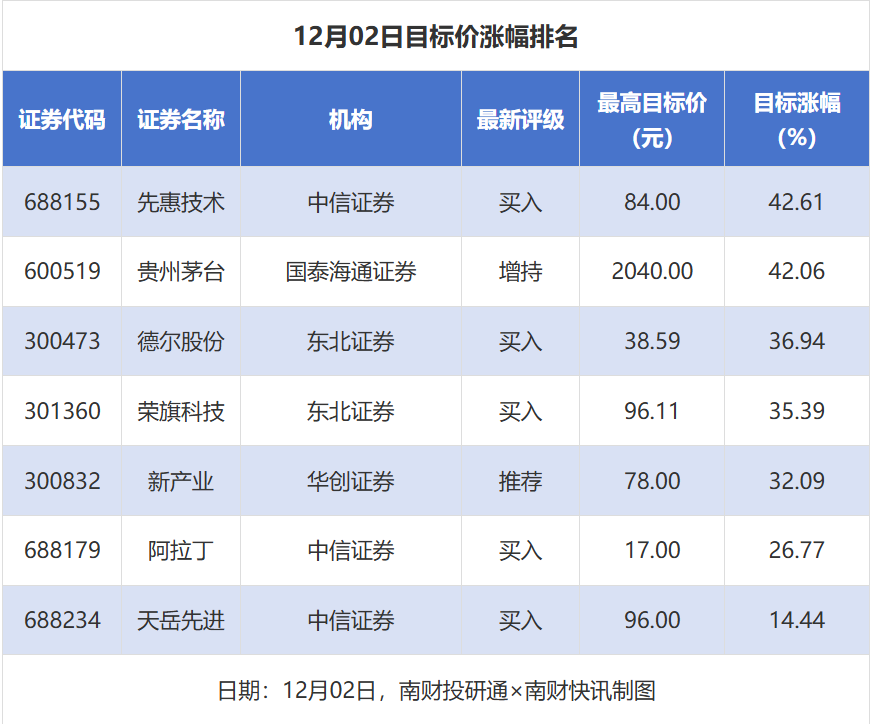
15股获推荐,贵州茅台目标价涨幅超42%
Xin Lang Cai Jing· 2025-12-03 06:25
Summary of Key Points Core Viewpoint - On December 2, various brokerages provided target prices for listed companies, with notable increases in target prices for companies in the battery, liquor, and automotive parts industries, indicating potential investment opportunities in these sectors [1][2]. Target Price Increases - The companies with the highest target price increases are: - Xianhui Technology: Target price increased by 42.61% to 84.00 CNY [2][6] - Guizhou Moutai: Target price increased by 42.06% to 2040.00 CNY [2][6] - Del's Shares: Target price increased by 36.94% to 38.59 CNY [2][6] - Other companies with significant target price increases include: - Rongqi Technology: 35.39% increase to 96.11 CNY [2][6] - New Industry: 32.09% increase to 78.00 CNY [2][6] - Aladdin: 26.77% increase to 17.00 CNY [2][6] - Tianyue Advanced: 14.44% increase to 96.00 CNY [2][6] Brokerage Recommendations - A total of 15 listed companies received brokerage recommendations on December 2, with companies like Mengbaihe, Aladdin, and Jiuzhou Pharmaceutical each receiving one recommendation [2][6]. - The companies receiving the highest number of recommendations include: - Mengbaihe: Rated "Increase" by Industrial Securities [4][8] - Jiuzhou Pharmaceutical: Rated "Buy" by Xiangcai Securities [4][8] - Del's Shares: Rated "Buy" by Northeast Securities [4][8] - Minshida: Rated "Increase" by Bohai Securities [4][8] Rating Adjustments - On December 2, one company had its rating upgraded: - China Resources Sanjiu: Rating upgraded from "Increase" to "Buy" by Western Securities [3][7]. - A total of 9 companies received first-time coverage from brokerages, indicating growing interest in these firms [3][7].



2025年1-9月中国机制纸及纸板(外购原纸加工除外)产量为12112.8万吨 累计增长3.4%
Chan Ye Xin Xi Wang· 2025-12-03 03:44
Core Viewpoint - The Chinese paper industry is projected to experience growth in production, with a notable increase in the output of mechanical paper and paperboard from 2020 to 2025, indicating a positive market outlook for the sector [1] Industry Summary - According to the National Bureau of Statistics, the production of mechanical paper and paperboard (excluding purchased raw paper processing) in September 2025 is expected to reach 14.26 million tons, reflecting a year-on-year growth of 6.3% [1] - From January to September 2025, the cumulative production of mechanical paper and paperboard (excluding purchased raw paper processing) is anticipated to be 121.128 million tons, with a cumulative growth of 3.4% [1] - The data indicates a steady increase in production capacity and market demand within the Chinese paper industry, suggesting a favorable environment for investment [1] Company Summary - Listed companies in the sector include Sun Paper Industry (002078), Chenming Paper (000488), Bohui Paper (600966), Yueyang Forest & Paper (600963), Shanying International (600567), and Hengfeng Paper (600356), which are key players in the Chinese paper market [1] - The report by Zhiyan Consulting provides insights into the market research and development prospects for the paper industry from 2025 to 2031, highlighting the importance of strategic planning for companies in this sector [1]

15股获推荐 贵州茅台目标价涨幅超42%丨券商评级观察
2 1 Shi Ji Jing Ji Bao Dao· 2025-12-03 01:56
Core Insights - On December 2, 2023, brokerage firms provided target prices for listed companies, with notable increases for Xianhui Technology, Kweichow Moutai, and Delong股份, showing target price increases of 42.61%, 42.06%, and 36.94% respectively, across the battery, liquor, and automotive parts industries [1][2]. Target Price Increases - The companies with the highest target price increases are: - Xianhui Technology (688155) with a target price of 84.00 and an increase of 42.61% [2] - Kweichow Moutai (600519) with a target price of 2040.00 and an increase of 42.06% [2] - Delong股份 (300473) with a target price of 38.59 and an increase of 36.94% [2] - A total of 15 listed companies received brokerage recommendations on December 2, with Mengbaihe, Aladdin, and Jiuzhou Pharmaceutical each receiving one recommendation [2]. Rating Adjustments - On December 2, one company had its rating upgraded, specifically China Resources Sanjiu (0009999), which was upgraded from "Hold" to "Buy" by Western Securities [3][4]. First-Time Coverage - Nine companies received first-time coverage from brokerages on December 2, including: - Mengbaihe (603313) rated "Hold" by Industrial Securities [5] - Jiuzhou Pharmaceutical (603456) rated "Buy" by Xiangcai Securities [5] - Delong股份 (300473) rated "Buy" by Northeast Securities [5] - Others include Minshida, Tongfu Microelectronics, Xianhui Technology, Rongqi Technology, Tianyue Advanced, and Beifang Huachuang, all receiving various ratings [5].


博汇纸业(600966)深度报告:背靠金光纸业 长期竞争力持续增强
Xin Lang Cai Jing· 2025-12-03 00:32
Core Viewpoint - Bohui Paper's operational efficiency and employee engagement are improving, supported by its partnership with Lee & Man Paper, enhancing its long-term competitiveness [1] Investment Highlights - The profit forecast has been adjusted, maintaining a "Buy" rating. Expected EPS for the company from 2025 to 2027 is projected at 0.19, 0.42, and 0.61 yuan respectively. The average PB of comparable companies is 1.40X, and considering the recovery in white card paper demand, a PB of 1.3X is assigned for 2025, leading to a target price of 7.28 yuan [2] - Bohui Paper has a total paper production capacity of 4.1 million tons across its Shandong and Jiangsu bases. The Shandong base primarily produces white card paper, box board, and cultural paper with a capacity of 2.1 million tons, while the Jiangsu base focuses on white card paper, with a capacity expansion to 2 million tons [2] Strategic Positioning - Bohui Paper and Lee & Man Paper have established a north-south production layout. Lee & Man's white card paper capacity is concentrated in Ningbo and Guangxi, coordinating national sales and improving production, sales, and logistics efficiency. In 2024, Lee & Man's white card paper revenue is expected to be approximately 22.1 billion yuan, with a sales volume of about 4.85 million tons [3] - The gross profit margin for Lee & Man's white card paper is projected to be over 4 percentage points higher than Bohui's, with margins of 14.9% and 9.4% respectively in 2024. Following recent price increases, Bohui's white card paper profitability is expected to improve slightly, with potential for further profit expansion if paper prices rise [3]
人民币走强有助提振资本市场信心 2026年有望继续呈现双向波动
Sou Hu Cai Jing· 2025-12-02 13:52
Core Viewpoint - The recent strengthening of the RMB against the USD has garnered significant market attention, attributed to a combination of domestic economic stability and external monetary policy shifts [1][3]. Group 1: RMB Exchange Rate Dynamics - On December 1, the People's Bank of China reported the RMB's central parity rate at 7.0759 against the USD, marking a 30 basis point increase from the previous trading day, reaching its highest level in over a year [1]. - In November, the RMB appreciated nearly 0.48% against the USD, with an intra-day peak of 7.0738, the highest since October of the previous year [1]. - Factors contributing to the RMB's strength include a solid domestic economic foundation, with a bank settlement surplus of USD 80.9 billion in the first ten months, and a resilient export sector driving continuous demand for currency exchange [1][3]. Group 2: Impact of US Monetary Policy - Recent statements from several Federal Reserve officials have reinforced expectations for policy easing, with an 80% probability of a 25 basis point rate cut in December [2][3]. - The Fed's dovish stance, including two rate cuts since September and expectations for further easing, supports the RMB's appreciation against the backdrop of a declining USD index [1][2]. Group 3: Implications for A-shares - The strengthening RMB is expected to positively impact A-shares by enhancing the attractiveness of RMB-denominated assets, potentially leading to increased foreign capital inflows [4]. - Historical data indicates that previous RMB appreciation cycles have coincided with bullish trends in A-shares, with the CSI 300 index showing a median annualized return of 29.8% during such periods [4]. - However, the relationship between stock and currency markets has weakened in recent years, with A-share performance increasingly dependent on economic fundamentals and industry competitiveness [4]. Group 4: Future Outlook for RMB and Economic Resilience - Short-term forecasts suggest the RMB will maintain a strong position, with limited likelihood of breaching the 7.0 mark before year-end, while medium to long-term trends may benefit from improved cross-border payment systems and accelerated de-dollarization [3][4]. - Analysts predict that by 2026, the RMB may experience a dual-directional fluctuation around a reasonable equilibrium level, supported by robust domestic economic fundamentals and effective regulatory measures [4].