银行等

Search documents
两市主力资金净流出835.79亿元,电子行业净流出居首
Zheng Quan Shi Bao Wang· 2025-09-26 09:43
Market Overview - On September 26, the Shanghai Composite Index fell by 0.65%, the Shenzhen Component Index decreased by 1.76%, the ChiNext Index dropped by 2.60%, and the CSI 300 Index declined by 0.95% [1] - Among the tradable A-shares, 1,804 stocks rose, accounting for 33.25%, while 3,414 stocks fell [1] Capital Flow - The main capital saw a net outflow of 83.579 billion yuan throughout the day [1] - The ChiNext experienced a net outflow of 29.851 billion yuan, while the STAR Market had a net outflow of 10.112 billion yuan, and the CSI 300 constituents saw a net outflow of 21.746 billion yuan [1] Industry Performance - In the Shenwan first-level industry classification, 10 industries rose, with the highest gains in the oil and petrochemical sector (1.17%) and environmental protection (0.38%) [1] - The industries with the largest declines were computer (down 3.26%) and electronics (down 2.75%) [1] Industry Capital Inflow and Outflow - The automotive industry had the largest net capital inflow of 0.882 billion yuan despite a decline of 0.56% [1] - The banking sector saw a slight increase of 0.08% with a net inflow of 0.566 billion yuan [1] - The electronics industry faced the largest net outflow of 29.836 billion yuan, with a decline of 2.75% [1] - The computer industry also experienced significant outflows, with a net outflow of 13.807 billion yuan and a drop of 3.26% [1] Individual Stock Performance - A total of 1,844 stocks had net capital inflows, with 612 stocks seeing inflows exceeding 10 million yuan, and 77 stocks with inflows over 100 million yuan [2] - The stock with the highest net inflow was Sairis, which rose by 5.77% with a net inflow of 0.685 billion yuan [2] - The stocks with the largest net outflows included Luxshare Precision, Shenghong Technology, and Industrial Fulian, with outflows of 2.260 billion yuan, 2.121 billion yuan, and 2.112 billion yuan respectively [2]
收评:沪指涨0.83% 半导体板块全天领涨
Zhong Guo Jing Ji Wang· 2025-09-24 07:12
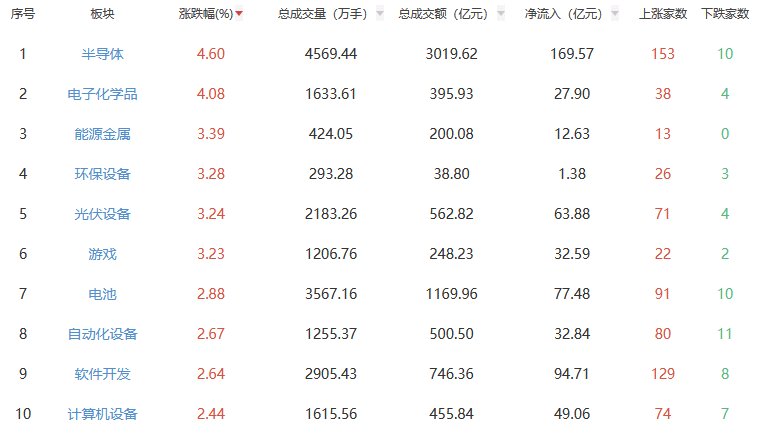
Market Overview - The A-share market saw all three major indices rise collectively, with the Shanghai Composite Index closing at 3853.64 points, up by 0.83%, and a total trading volume of 10,157.08 billion yuan [1] - The Shenzhen Component Index closed at 13,356.14 points, increasing by 1.80%, with a trading volume of 13,110.76 billion yuan [1] - The ChiNext Index ended at 3,185.57 points, up by 2.28%, with a trading volume of 6,285.21 billion yuan [1] Sector Performance - The semiconductor sector led the gains with a rise of 4.60%, totaling a trading volume of 4,569.44 million hands and a net inflow of 169.57 billion yuan [1] - The electronic chemicals sector increased by 4.08%, with a trading volume of 1,633.61 million hands and a net inflow of 27.90 billion yuan [1] - The energy metals sector rose by 3.39%, with a trading volume of 424.05 million hands and a net inflow of 12.63 billion yuan [1] - The tourism and hotel sector experienced a decline of 0.71%, with a trading volume of 1,121.43 million hands and a net outflow of 8.74 billion yuan [1] - The banking sector saw a slight decrease of 0.04%, with a trading volume of 4,355.52 million hands and a net outflow of 13.25 billion yuan [1]

36股受融资客青睐,净买入超亿元
Zheng Quan Shi Bao Wang· 2025-09-24 01:55
Summary of Key Points Core Viewpoint - As of September 23, the total market financing balance decreased slightly to 2.40 trillion yuan, indicating a mixed sentiment among investors with notable net purchases in specific sectors [1]. Group 1: Market Financing Overview - The total market financing balance is 2.40 trillion yuan, down by 8.02 million yuan from the previous trading day [1]. - Shanghai Stock Exchange financing balance is 12,165.74 billion yuan, down by 17.64 million yuan; Shenzhen Stock Exchange financing balance is 11,756.77 billion yuan, up by 9.81 million yuan; Beijing Stock Exchange financing balance is 77.90 billion yuan, down by 1.9193 million yuan [1]. Group 2: Individual Stock Performance - On September 23, 1,683 stocks received net financing purchases, with 478 stocks having net purchases exceeding 10 million yuan, and 36 stocks exceeding 100 million yuan [1]. - Leading the net purchases was Luxshare Precision, with a net purchase of 1.352 billion yuan, followed by Shenghong Technology and Zhongji Xuchuang with net purchases of 792.42 million yuan and 661.18 million yuan, respectively [2]. Group 3: Sector Analysis - The sectors with the highest concentration of stocks receiving net purchases over 100 million yuan include electronics (12 stocks), automotive (4 stocks), and power equipment (4 stocks) [1]. - Among the stocks with significant net purchases, the average financing balance as a percentage of market capitalization is 4.41%, with Guokewai having the highest at 10.30% [2]. Group 4: Detailed Stock Data - A detailed list of stocks with significant net purchases includes: - Luxshare Precision: net purchase of 1.352 billion yuan, with a market cap ratio of 1.59% [2]. - Shenghong Technology: net purchase of 792.42 million yuan, with a market cap ratio of 6.39% [2]. - Zhongji Xuchuang: net purchase of 661.18 million yuan, with a market cap ratio of 3.32% [2]. - Other notable stocks include Changchuan Technology, Sanhua Intelligent Control, and Xinyi Sheng, with net purchases of 502.73 million yuan, 461.88 million yuan, and 459.08 million yuan, respectively [2].



美联储降息“靴子落地”利好兑现? A股冲高跳水 成交额超三万亿元
Sou Hu Cai Jing· 2025-09-18 16:12
Group 1 - The A-share market experienced significant volatility, with the Shanghai Composite Index closing down 1.15% at 3831.66 points, the Shenzhen Component down 1.06% at 13075.66 points, and the ChiNext Index down 1.64% at 3095.85 points, despite a substantial trading volume of 31.352 billion yuan, an increase of 7.584 billion yuan from the previous day [1] - The Federal Reserve's decision to cut the federal funds rate by 25 basis points to a target range of 4.00%-4.25% was expected to provide liquidity support and lower corporate financing costs, typically benefiting the stock market [1] - The afternoon market drop may be attributed to profit-taking behavior following the rate cut announcement, as investors often sell off after a widely anticipated positive event materializes [1] Group 2 - Investors are advised to exercise caution in the current market environment, particularly regarding high-performing stocks that may face significant adjustment pressure due to profit-taking and shifts in market sentiment [2] - The technical analysis indicates that the Shanghai Composite Index has broken below the 5-day moving average, with the KD indicator forming a death cross, suggesting a potential short-term weakening [2] - Despite the recent market turbulence, there are still positive signals, and the market is likely to continue in a range-bound pattern, providing opportunities for structural investments amid rotating market hotspots [2]
午评:两市低开高走沪指涨0.45% 半导体板块强势
Zhong Guo Jing Ji Wang· 2025-09-18 03:43
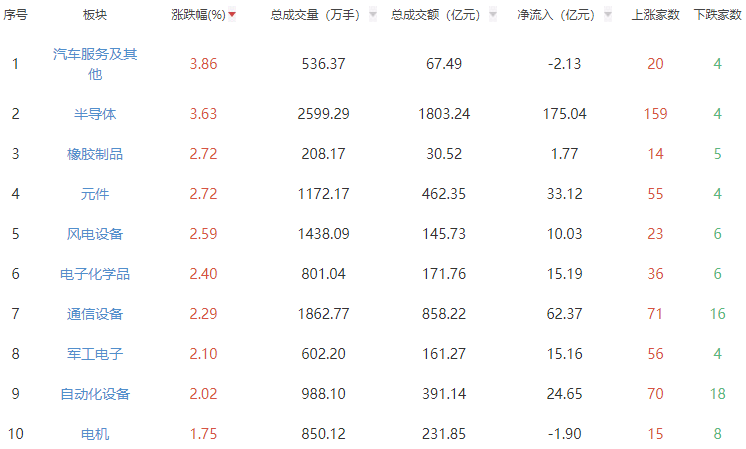
Market Overview - The three major indices in the A-share market opened lower but rose during the morning session, with the Shanghai Composite Index closing at 3893.95 points, up 0.45% [1] - The Shenzhen Component Index closed at 13319.70 points, up 0.79%, and the ChiNext Index closed at 3162.90 points, up 0.49% [1] Sector Performance - The top-performing sectors included Automotive Services and Others (up 3.86%), Semiconductors (up 3.63%), Rubber Products (up 2.72%), and Components (up 2.72%) [2] - The sectors with the largest declines were Precious Metals (down 2.31%), Insurance (down 1.45%), Industrial Metals (down 1.45%), and Securities (down 1.44%) [2] Trading Volume and Net Inflow - The Automotive Services sector had a total trading volume of 536.37 million hands and a net inflow of 67.49 billion [2] - The Semiconductor sector recorded a total trading volume of 2599.29 million hands with a net inflow of 175.04 billion [2] - In contrast, the Insurance sector had a total trading volume of 156.42 million hands and a net outflow of 9.32 billion [2]
国内主要股指再度上攻,券商、有色板块续获资金流入
Great Wall Securities· 2025-09-17 03:40
Report Industry Investment Rating No relevant content provided. Core View of the Report Last week, the major domestic stock indices rose across the board, with small and medium - cap indices outperforming large - cap indices. ETFs in different sectors showed mixed performance, and there were significant differences in capital flows among various sectors [1][8]. Summary According to the Table of Contents 1. Fund Market Overview 1.1 Stock Market Last week (2025/09/08 - 2025/09/12), major domestic stock indices all rose. Large - cap indices such as the CSI 300, SSE 50, and SSE Composite Index had weekly changes of 1.38%, 0.89%, and 1.52% respectively. Small and medium - cap indices like the CSI 500, CSI 1000, and ChiNext Index had changes of 3.38%, 2.45%, and 2.10% respectively. Style indices showed mixed performance, with the financial, cyclical, consumer, growth, and stable style indices changing by 0.24%, 1.87%, 0.88%, 3.56%, and 1.14% respectively. Among the growth style, the large - cap, mid - cap, and small - cap growth style indices changed by 2.30%, 2.26%, and - 1.20% respectively. The recent trading activity of A - shares has been oscillating upwards and is currently close to the level in December 2024 [1][8][9]. 1.2 Bond Market and Futures Market Last week, the SSE Convertible Bond Index changed by 0.33%. Pure - bond indices showed mixed performance, with the SSE Treasury Bond, SSE Corporate Bond, and Shenzhen Local Government Bond indices changing by - 0.19%, 0.03%, and - 0.18% respectively. The main contracts of major stock index futures all rose, with the CSI 300, SSE 50, and CSI 500 futures changing by 1.63%, 1.00%, and 3.83% respectively. The prices of 10 - year, 5 - year, and 2 - year Treasury bond futures changed by - 0.16%, 0.07%, and 0.01% respectively [15][16]. 1.3 Commodity Market In the past week, the commodity market showed mixed performance. The Nanhua Precious Metals Index, CRB Commodity Index, and CRB Metal Spot Index changed by 2.34%, 1.33%, and 1.17% respectively. The main contracts of domestic key commodity futures also showed mixed performance. For example, the SHFE Silver, SHFE Gold, and DCE Iron Ore main contracts changed by 2.79%, 2.41%, and 1.59% respectively [18][21]. 2. ETF Market行情统计 The report selects representative ETFs in different sectors of comprehensive and industry themes for long - term tracking. By classifying these ETFs into large - and small - cap styles and monitoring indicators such as changes in circulating shares, net buying funds, and trading volume, it can serve as a reference for market style switching and capital flows [23]. 2.1 Domestic Stock - Type ETF Trading Activity Ranking Using the weekly fund turnover rate as a measure of ETF trading activity, last week's trading hotspots were mainly concentrated in comprehensive indices such as ChiNext 50 and ChiNext, as well as sectors such as semiconductors, home appliances ETF, and bank ETF [24]. 3. Large - and Small - Cap Style Monitoring 3.1 Comprehensive Stock ETF As of last week, the trading volume of comprehensive ETF funds was 103.231 billion yuan, a change of - 29.2 billion yuan from the previous week. Among them, the trading volume of large - and mid - cap style comprehensive ETFs was 38.176 billion yuan, a change of - 10.858 billion yuan; the trading volume of small - and mid - cap comprehensive ETFs was 67.061 billion yuan, a change of - 18.634 billion yuan. The on - site share of comprehensive ETF funds was 352.087 billion shares, a change of - 16.62 billion shares from the previous week. Among them, the on - site share of large - and mid - cap style comprehensive ETFs was 239.009 billion shares, a change of - 7.75 billion shares; the on - site share of small - and mid - cap comprehensive ETFs was 113.078 billion shares, a change of - 8.87 billion shares [26]. 3.2 Theme Stock ETF As of last week, the average weekly change rate of 32 theme ETFs was 2.83%. The average weekly change rate of large - cap style ETFs was 1.55%, and that of small - and mid - cap style ETFs was 3.83%. The total trading volume of the tracked theme ETFs was 93.485 billion yuan, a change of - 28.186 billion yuan from the previous week. Among them, the trading volume of large - cap style ETFs was 52.494 billion yuan, a change of - 8.399 billion yuan; the trading volume of small - and mid - cap style ETFs was 40.992 billion yuan, a change of - 197.87 billion yuan. The on - site share of the tracked theme ETFs was 420.971 billion shares, an increase of 47.27 billion shares from the previous week. Among them, the on - site share of large - and mid - cap style theme ETFs was 212.673 billion shares, an increase of 78.16 billion shares; the on - site share of small - and mid - cap style theme ETFs was 208.298 billion shares, a change of - 30.89 billion shares [27]. 4. Sector Capital Flow Tracking As of last week, among comprehensive ETFs, the top three in terms of returns were the Innovation and Entrepreneurship 50 ETF, 500ETF, and 1000ETF, with changes of 3.91%, 3.29%, and 2.42% respectively. The last three were the 50ETF, ChiNext 50, and 300ETF, with changes of 1.04%, 1.43%, and 1.47% respectively. Among industry - theme ETFs, the top three were the Chip ETF, Semiconductor 50, and Electronic ETF, with changes of 7.79%, 7.62%, and 7.11% respectively. The last three were the Pharmaceutical ETF, Biomedical, and Bank ETF, with changes of - 1.12%, - 1.08%, and - 0.72% respectively. In terms of capital flow, among comprehensive ETFs, the important broad - based index CSI 300 had capital outflows, while the ChiNext and CSI 500ETF had capital inflows. In industry themes, multiple important sectors such as securities and non - ferrous metals had significant capital inflows, while semiconductor chips had capital outflows [31]. 5. Commodity ETF Last week, the tracked commodity ETF funds showed mixed performance. The Gold ETF, Boshi Gold, Soybean Meal ETF, Non - Ferrous Metals Futures, and Energy and Chemical ETF changed by 2.30%, 2.31%, 0.75%, 1.40%, and - 0.84% respectively. The overall on - site share of the tracked commodity ETFs increased by 278 million shares compared with the previous week, and the overall trading volume changed by - 5.371 billion yuan compared with the previous week [36]. 6. Overseas ETF Last week, among the tracked overseas ETF funds, the Nasdaq ETF, H - share ETF, and Hang Seng ETF changed by 0.63%, 3.40%, and 3.77% respectively. The overall on - site share of the tracked overseas ETF funds changed by - 124 million shares compared with the previous week, and the overall trading volume changed by - 1.175 billion yuan compared with the previous week [38]. 7. Money - Market ETF As of the end of last week, the overnight SHIBOR was 1.37%, an increase of 0.05% from the previous week; the one - week SHIBOR was 1.47%, an increase of 0.03% from the previous week. The seven - day annualized yield of Huabao Tianyi decreased by - 0.01% from the previous week, and that of Yinhua Rili decreased by - 0.14% from the previous week. In terms of on - site shares, the on - site share of Huabao Tianyi was 68.379 billion shares, a change of - 619 million shares from the previous week; the on - site share of Yinhua Rili was 70.266 billion shares, a change of - 7.967 billion shares from the previous week [42].
波动降低后是更好的参与时机
China Post Securities· 2025-09-15 11:38
Market Performance Review - The A-share market recovered from last week's decline, with significant volatility remaining a characteristic feature. Major indices mostly rose, with the ChiNext index rebounding by 5.48% after a previous drop of 5.42%. The CSI A50 and SSE 50, which are heavily weighted by large-cap stocks, lagged behind in terms of growth. Growth style stocks showed a strong rebound, while financial stocks had smaller gains. Small-cap stocks significantly outperformed large-cap stocks, with the Ning and Mao indices both rising, the Ning combination increasing by 1.95% and the Mao index slightly up by 0.40% [3][12][29]. Industry Overview - The industry saw a general rebound but lacked a clear leading theme. Among the Shenwan first-level industries, electronics (6.15%), real estate (5.98%), agriculture, forestry, animal husbandry, and fishery (4.81%), media (4.27%), and non-ferrous metals (3.76%) led the gains. Conversely, sectors like social services (-0.28%), pharmaceuticals and biology (-0.36%), oil and petrochemicals (-0.41%), banking (-0.66%), and comprehensive (-1.43%) performed poorly. The current market is still entangled in narratives around AI infrastructure investment, potential Fed rate cuts, and anti-involution policies [4][13][29]. Future Outlook and Investment Views - The report suggests that lower volatility presents better participation opportunities. Although there was a significant single-day rise in the A-share market, it does not imply that short-term downward volatility risks have been fully alleviated. Intense bull-bear battles are common at the tail end of a trend, indicating that time is needed for consolidation before the next upward phase. Future volatility in the A-share market is expected to be more influenced by overseas factors, particularly following disappointing U.S. non-farm payroll data in August, which solidifies expectations for a Fed rate cut in September. The A-share market will likely use the rate cut as a key pricing logic point after completing its adjustment [4][29]. Stock Selection Strategy - The report emphasizes that individual stock alpha logic is superior to industry beta logic, focusing on identifying "turnaround" opportunities in individual stocks. The TMT growth sectors, represented by AI applications, computing power chains, and optical modules, which have been adjusting since March, are expected to see valuation recovery opportunities. The report highlights that simply buying stocks with "earnings exceeding expectations" during the mid-year reporting season may not yield sustained relative returns. Instead, the "turnaround" strategy is deemed more effective for performance discovery during this period. The report constructs a portfolio of stocks expected to exceed earnings expectations for the mid-year report, aiming to capture excess returns from individual stock alpha in September and October [5][29].
【盘中播报】沪指涨0.21% 房地产行业涨幅最大
Zheng Quan Shi Bao Wang· 2025-09-12 06:19
Core Viewpoint - The Shanghai Composite Index increased by 0.21%, with the real estate sector showing the highest growth among various industries [2] Industry Performance Summary - Real Estate: Increased by 2.24%, with a transaction volume of 321.84 billion yuan, up 39.35% from the previous day; leading stock was Xiangjiang Holdings, up 10.11% [2] - Electronics: Also rose by 2.24%, with a transaction volume of 4171.71 billion yuan, up 7.99%; leading stock was Chipone Technology, up 20.00% [2] - Non-ferrous Metals: Increased by 2.10%, with a transaction volume of 1338.55 billion yuan, up 44.83%; leading stock was Electric Alloy, up 17.16% [2] - Steel: Increased by 2.05%, with a transaction volume of 142.50 billion yuan, up 87.19%; leading stock was Bayi Steel, up 10.02% [2] - Construction Decoration: Increased by 1.02%, with a transaction volume of 310.03 billion yuan, up 41.85%; leading stock was Roman Holdings, up 10.01% [2] - Computer: Increased by 0.82%, with a transaction volume of 1811.68 billion yuan, up 9.06%; leading stock was Kaipu Cloud, up 16.96% [2] - Pharmaceutical Biology: Increased by 0.62%, with a transaction volume of 1166.56 billion yuan, down 9.51%; leading stock was Haooubo, up 18.09% [2] - Defense Industry: Increased by 0.61%, with a transaction volume of 522.31 billion yuan, up 11.86%; leading stock was Jinxinno, up 13.19% [2] - Basic Chemicals: Increased by 0.30%, with a transaction volume of 807.35 billion yuan, up 14.40%; leading stock was Hangzhou High-tech, up 12.17% [2] - Power Equipment: Increased by 0.19%, with a transaction volume of 2285.83 billion yuan, up 4.86%; leading stock was Mengguli, up 14.48% [2] - Machinery: Increased by 0.06%, with a transaction volume of 1543.58 billion yuan, up 6.50%; leading stock was Jingzhida, up 20.00% [2] - Transportation: Increased by 0.03%, with a transaction volume of 223.88 billion yuan, up 17.79%; leading stock was Three Gorges Tourism, up 10.03% [2] Declining Industries Summary - Coal: Decreased by 0.05%, with a transaction volume of 77.64 billion yuan, up 54.93%; leading stock was New Dazhou A, down 2.11% [2] - Building Materials: Decreased by 0.06%, with a transaction volume of 158.26 billion yuan, up 3.91%; leading stock was Donghe New Materials, down 5.51% [2] - Textiles and Apparel: Decreased by 0.09%, with a transaction volume of 123.17 billion yuan, up 5.92%; leading stock was Aimer, down 8.97% [2] - Media: Decreased by 0.11%, with a transaction volume of 540.29 billion yuan, up 2.43%; leading stock was Youzu Network, down 4.76% [2] - Environmental Protection: Decreased by 0.13%, with a transaction volume of 157.17 billion yuan, up 3.33%; leading stock was Langkun Technology, down 4.11% [2] - Agriculture, Forestry, Animal Husbandry, and Fishery: Decreased by 0.18%, with a transaction volume of 208.90 billion yuan, down 20.91%; leading stock was Andeli, down 7.36% [2] - Retail: Decreased by 0.25%, with a transaction volume of 288.17 billion yuan, up 14.01%; leading stock was Maoye Commercial, down 2.98% [2] - Social Services: Decreased by 0.25%, with a transaction volume of 156.51 billion yuan, down 6.86%; leading stock was Shibai Testing, down 3.14% [2] - Public Utilities: Decreased by 0.27%, with a transaction volume of 307.20 billion yuan, up 9.24%; leading stock was Huaguang Huaneng, down 10.02% [2] - Automotive: Decreased by 0.32%, with a transaction volume of 948.70 billion yuan, up 3.92%; leading stock was Yapu, down 5.24% [2] - Light Industry Manufacturing: Decreased by 0.58%, with a transaction volume of 195.84 billion yuan, down 2.46%; leading stock was C Aifenda, down 7.71% [2] - Oil and Petrochemicals: Decreased by 0.59%, with a transaction volume of 80.04 billion yuan, down 19.85%; leading stock was Bohui, down 2.76% [2] - Beauty and Personal Care: Decreased by 0.71%, with a transaction volume of 47.25 billion yuan, up 9.02%; leading stock was Shanghai Jahwa, down 3.96% [2] - Home Appliances: Decreased by 0.72%, with a transaction volume of 287.54 billion yuan, up 7.46%; leading stock was Tongzhou Electronics, down 7.23% [2] - Food and Beverage: Decreased by 0.75%, with a transaction volume of 286.99 billion yuan, down 0.68%; leading stock was Jiu Gui Jiu, down 3.83% [2] - Non-bank Financials: Decreased by 0.90%, with a transaction volume of 566.03 billion yuan, down 22.64%; leading stock was Guohai Securities, down 2.65% [2] - Banking: Decreased by 1.05%, with a transaction volume of 254.33 billion yuan, down 0.58%; leading stock was Pudong Development Bank, down 3.97% [2] - Telecommunications: Decreased by 1.09%, with a transaction volume of 1285.91 billion yuan, down 14.30%; leading stock was Dingtong Technology, down 8.28% [2] - Comprehensive: Decreased by 1.57%, with a transaction volume of 62.17 billion yuan, down 10.93%; leading stock was Dongyangguang, down 5.01% [2]
量化行业配置:行业超预期增强策略8月收益达21.63%
SINOLINK SECURITIES· 2025-09-04 15:36
Market and Industry Overview - In the past month, major domestic market indices have risen, with the CSI 500, CSI 1000, National Index 2000, CSI 300, and SSE 50 increasing by 13.13%, 11.67%, 11.02%, 10.33%, and 7.22% respectively [2][12] - Almost all industry indices have risen, with 29 out of 31 sectors in the CITIC first-level industry index showing gains. The telecommunications sector had the highest increase at 33.78%, while construction, coal, and banking sectors lagged behind with monthly changes of 0.77%, 0.57%, and -1.67% respectively [2][12] Industry Rotation Strategy Performance - The August performance of the expected enhancement industry rotation strategy yielded a return of 21.63%, significantly outperforming the industry equal-weight benchmark return of 9.34%, resulting in an excess return of 12.33% [4][34] - The economic valuation industry rotation strategy achieved a return of 11.01%, with an excess return of 1.69% relative to the industry equal-weight benchmark [4][34] - The research industry selection strategy had a modest performance with a return of 6.71%, but an excess return of -2.61% [4][42] Factor Analysis and Performance - In August, six fundamental factors showed positive performance, with quality, valuation momentum, analyst expectations, and surprise factors being particularly notable, achieving IC averages of 46.31%, 23.89%, 43.35%, and 31.65% respectively [3][20] - All factors have positive IC values year-to-date, with quality, analyst expectations, and research activity factors standing out, achieving IC averages of 7.48%, 7.49%, and 10.92% respectively [21] - The multi-directional returns for quality, analyst expectations, and research activity factors reached 19.70%, 15.56%, and 11.56% respectively [21] Recommended Industries - For September, the expected enhancement industry rotation strategy recommends the electronics, media, non-bank financials, and computer sectors, with a shift from telecommunications to computers compared to the previous month [5][48] - The economic valuation industry rotation strategy recommends media, electronics, computers, retail, and real estate sectors, although real estate and retail did not receive recommendations from the expected enhancement strategy due to lower analyst expectations [5][48] - The research industry selection strategy for September includes construction, coal, steel, media, and retail sectors, with steel showing increased research activity and reduced crowding [5][53]
A股突然生变!手里的基金还没回本,该怎么办?
天天基金网· 2025-09-03 10:34
Core Viewpoint - The article discusses the current state of the A-share market, highlighting the divergence between index performance and individual stock experiences, suggesting a need for a more selective investment approach in a changing market environment [4][15]. Group 1: Market Overview - The A-share market has shown significant structural differentiation, with the Shanghai Composite Index reaching a ten-year high, yet many investors feel a disparity in their personal investment outcomes [3][15]. - Recent adjustments in the A-share market indicate a shift in pricing mechanisms, asset structures, and investor behaviors, leading to a more complex investment landscape [4][5]. Group 2: Market Dynamics - Market pricing tends to be forward-looking, often reflecting economic expectations before they are felt by the general public, emphasizing the importance of timely investment decisions [5][8]. - The economic structure in China is undergoing a profound transformation, with a widening gap between "new" and "old" economic drivers, resulting in varying cycles of prosperity across different sectors [5][8]. Group 3: Investment Strategies - The article suggests that for most investors, investing in index funds may be more beneficial than stock picking, especially in a structurally driven market where only a small percentage of stocks have surpassed previous highs [16][21]. - A diversified investment strategy is recommended, including a gradual approach to building positions in ETFs and focusing on sectors with strong fundamentals [26][29]. Group 4: Investor Behavior - Investors are encouraged to reassess their holdings and investment strategies based on current market conditions, emphasizing the importance of patience and adherence to personal investment principles [27][28]. - The article highlights the necessity of maintaining a balanced portfolio and avoiding emotional decision-making in response to market fluctuations [22][35].