零食

Search documents
红杉坐镇,中国最大零食IPO诞生:鸣鸣很忙市值900亿
Sou Hu Cai Jing· 2026-01-28 02:31
作为公司最大的外部机构股东,红杉中国团队见证了这家"国民零食"的成长轨迹。"鸣鸣很忙从社区烟火中读懂了中国家庭最朴素的消费渴望要的不是低 价,而是'值得';追求的不仅是折扣,而是轻松感的日常小确幸。"红杉中国合伙人苏凯感慨,今日的IPO将是更宏大的起点。 今日(1月28日),湖南鸣鸣很忙商业连锁股份有限公司(简称:鸣鸣很忙)正式挂牌上市,成为港股"量贩零食第一股"。本次IPO发行价每股236.6港 元,公开发售获认购超1500倍,开盘大涨88%,市值超900亿港元,缔造中国最大零食IPO。 这是中国消费行业一个标志性的整合案例。回想2023年11月,从湖南长沙起家的零食很忙与从江西宜春走出的赵一鸣零食完成战略合并,共同组建"鸣鸣 很忙",由零食很忙创始人晏周出任新集团董事长。 5年前,红杉团队出手 "当时晏周还没有对外融资。"红杉中国合伙人苏凯向投资界回忆当时景象,二人初次见面是在长沙一家酒店,这位创始人给人留下"清爽利落"的印象。交 流中,晏周深入阐述了对当下家庭消费趋势的洞察:零食如何成为习惯性消费,以及散装零食市场的广阔空间。 这些细致而精准的洞察,在日后公司发展中一一得到验证。 在苏凯看来,晏周是一位 ...

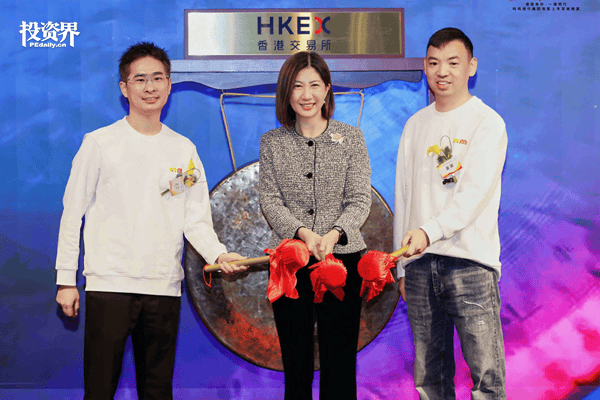
红杉坐镇,900亿IPO正式敲钟
投资界· 2026-01-28 02:11
中国最大零食IPO。 作者/周佳丽 今日(1月2 8日),湖南鸣鸣很忙商业连锁股份有限公司(简称:鸣鸣很忙)正式挂牌上市,成为港股"量贩零食第一股"。本次I PO 发行价每股 2 3 6 . 6港元 ,公开发售获认购超1 5 0 0倍, 开盘大涨8 8 %,市值超9 0 0亿港元 , 缔造中国最大零食I PO 。 这是中国消费行业一个标志性的整合案例。回想2 0 2 3年11月,从湖南长沙起家的零食很忙与从江西宜春走出的赵一鸣零食完成战略 合并,共同组建"鸣鸣很忙",由零食很忙创始人晏周出任新集团董事长。 作为公司最大的外部机构股东,红杉中国团队见证了这家"国民零食"的成长轨迹。"鸣鸣很忙 从社区烟火中读懂了中国家庭最朴素的 消费渴望 ——要的不是低价,而是'值得';追求的不仅是折扣,而是轻松感的日常小确幸。"红杉中国合伙人苏凯感慨,今日的I PO 将是更宏大的起点。 5年前,红杉团队出手 缔造市值900亿 从零食很忙的故事说起。 时间回到2 0 1 6年,湖南8 5后晏周已在房地产销售行业深耕多年。一次偶然的机会,他敏锐捕捉到零食赛道在下沉市场的爆发潜力, 毅然创立长沙零食很忙食品有限公司。 次年,晏周与几 ...

开年一个月,红杉迎来第五家IPO
投中网· 2026-01-28 02:09
将投中网设为"星标⭐",第一时间收获最新推送 又一个超900亿IPO诞生了。 作者丨 张楠 来源丨 投中网 2026年一开年,在芯片半导体、商业航天、AI等一众火热概念的"夹击"下,"量贩零食第一股"鸣鸣很忙跑出来了,于1月28日正式登陆港股, 发行价 236.6港元/股,开盘大涨88.08%,报445港元/股, 市值达959亿港元 。 此时距离鸣鸣很忙通过港交所聆讯,只过了半个多月。 1月6日,鸣鸣很忙通过港交所聆讯,计划融资5亿美元,其中1.95亿美元的基石投资来自8家顶级机构。 不光基石阵容配置豪华,而且在香港市场公开招股中,冻结资金超过5000亿港元,超购1900多倍,这一数据放在这两年上市的港股中也名列前茅。 堪称全球资本竞逐的一场IPO盛宴了。 受益最大的,自然是鸣鸣很忙的创始团队和早期股东们。据CVSource投中嘉川数据和鸣鸣很忙招股书显示,截至IPO,包括晏周、赵定在内的创始团 队以及员工持股平台,共计持有公司约半数股份,这部分股权按发行价计算市值超过200亿元。 而自2017年成立以来,鸣鸣很忙共获得来自红杉中国、高榕资本、GGV、启承资本、黑蚁资本、五源资本、好想你等多家机构和产业方的6 ...

港股科网股,集体走高
Di Yi Cai Jing Zi Xun· 2026-01-28 01:52
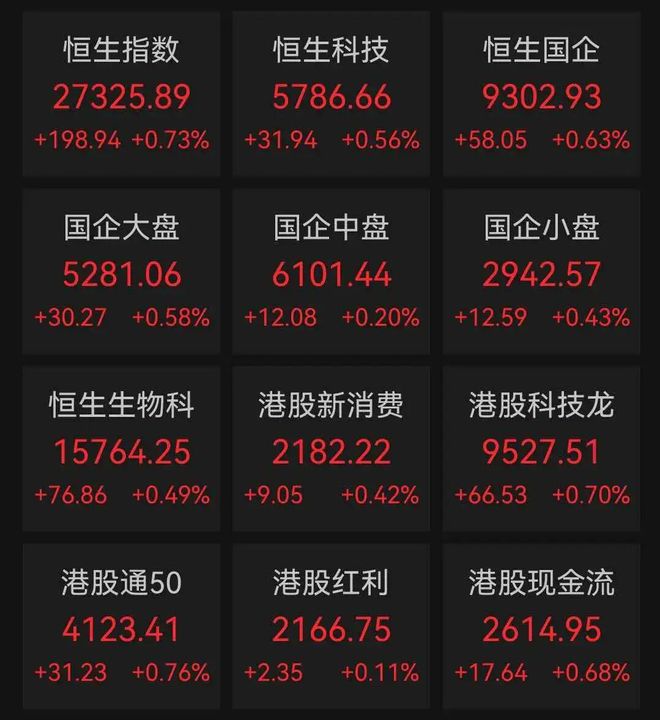
| 恒生指数 | 恒生科技 | 恒生国企 | | --- | --- | --- | | 27325.89 | 5786.66 | 9302.93 | | +198.94 +0.73% | | +31.94 +0.56% +58.05 +0.63% | | 国企大盘 | 国企中备 | 国企小盘 | | 5281.06 | 6101.44 | 2942.57 | | +30.27 +0.58% +12.08 +0.20% | | +12.59 +0.43% | | 恒生生物科 | 港股新消费 | 港股科技龙 | | 15764.25 | 2182.22 | 9527.51 | | +76.86 +0.49% | +9.05 +0.42% | +66.53 +0.70% | | 港股通50 | 港股红利 | 港股现金流 | | 4123.41 | 2166.75 | 2614.95 | | +31.23 +0.76% +2.35 +0.11% | | +17.64 +0.68% | 1月28日,香港恒生指数开盘涨0.73%,恒生科技指数涨0.56%。 科网股集体走高,京东集团、金山软件、比亚迪股份、联想集团涨超1 ...
开源证券:维持卫龙美味(09985)“增持”评级 旺季备货强势能
智通财经网· 2026-01-28 01:44
Core Viewpoint - The report from Kaiyuan Securities maintains a "Buy" rating for Weilong Delicious (09985), anticipating strong performance driven by the upcoming Spring Festival in 2026 and the introduction of new products and celebrity endorsements [1] Group 1: Performance Expectations - The Spring Festival in 2026, falling in mid-February, is expected to boost demand for consumer goods, with inventory buildup starting in January [1] - The company forecasts net profits for 2025, 2026, and 2027 to be 1.38 billion, 1.70 billion, and 2.06 billion yuan respectively, representing year-on-year growth of 29.2%, 23.1%, and 21.1% [1] - Current price-to-earnings ratios are projected at 19.6, 15.9, and 13.1 times for the years 2025, 2026, and 2027 [1] Group 2: Product and Brand Strategy - The company is a leading brand in the spicy snack sector, leveraging a big product strategy for rapid growth [2] - New flavors such as crayfish and spicy beef are set to launch in 2025, supported by celebrity endorsements to drive sales [1][2] - The company plans to enhance its konjac product line with new flavors like high-fiber beef liver mushrooms and Dai-style chicken feet in the second half of 2025, aiming for sustained growth [1] Group 3: Channel Strategy - The company is enhancing its traditional offline supermarket channels while embracing new emerging channels, including collaborations with bulk snack retailers and membership stores [2] - Initial efforts are being made to penetrate the Southeast Asian market, alongside seizing opportunities in new e-commerce platforms like Douyin and Kuaishou [2] - Increased investment in new product launches and core terminal promotions is expected to enhance brand strength and overall operational momentum [2]
食品饮料行业2025Q4基金持仓分析:食饮重仓比例持续下降,除酒类外的细分板块重仓比例回升
Wanlian Securities· 2026-01-28 00:24
Investment Rating - The industry investment rating is "stronger than the market," indicating an expected relative increase of over 10% in the industry index compared to the broader market within the next six months [29]. Core Insights - The food and beverage sector's heavy holding ratio continues to decline, dropping to 2.61% in Q4 2025, down 0.20 percentage points from the previous quarter, and significantly below the historical average of 6.77% since 2018 [1][10]. - Within the sector, the heavy holding ratio for sub-segments, excluding alcoholic beverages, has seen a rebound, with notable increases in categories such as seasoning and fermented products, dairy beverages, and snacks [2][13]. - The top ten heavy holdings in the food and beverage sector are dominated by liquor stocks, which occupy seven positions, with a total heavy holding ratio of 2.37% [3][19]. Summary by Sections 1. Heavy Holding Ratios - The food and beverage industry's heavy holding ratio has decreased to 2.61%, ranking sixth among 31 primary industries, down from fifth in the previous quarter [1][10]. - The liquor segment's heavy holding ratio has dropped to 2.26%, while other sub-segments like seasoning and fermented products, dairy beverages, snacks, and food processing have shown slight increases [2][13]. 2. Liquor Segment Analysis - The liquor segment remains a dominant force in the food and beverage industry, accounting for over 86% of the heavy holdings, although it has decreased by 1.76 percentage points [16]. - The top three liquor stocks by heavy holding ratio are Guizhou Moutai, Shanxi Fenjiu, and Wuliangye, with significant fluctuations in their rankings [19][20]. 3. Investment Recommendations - The report suggests that the liquor industry is in a bottoming phase, with low valuations and high dividends providing strong support for stock prices. The inventory destocking cycle is expected to continue until mid-2026, with potential investment opportunities emerging in the second half of 2026 [25]. - For the broader consumer goods sector, growth is anticipated from product upgrades, particularly in beer and dairy, while the seasoning industry is expected to benefit from low raw material costs and the rise of customized solutions [4][27].





开源证券晨会纪要-20260127
KAIYUAN SECURITIES· 2026-01-27 14:40
Macro Economic Overview - The transaction volume and price of second-hand houses have both increased, indicating a recovery in the real estate market [6][29] - Construction activity has shown seasonal improvement, with cement dispatch rates and grinding machine operation rates higher than the same period in 2025 [3][4] - Industrial production has shown mixed results, with strong performance in chemicals and automotive steel tires, while coking has lagged [3][4] Food and Beverage Industry - The allocation ratio for food and beverage stocks has decreased to a new low of 6.1% in Q4 2025, down from 6.4% in Q3 2025, indicating a continued reduction in holdings by active equity funds [10][12] - The white liquor sector has seen a decrease in fund allocation, with the proportion of white liquor holdings falling from 3.2% in Q3 2025 to 2.9% in Q4 2025 [11] - The food and beverage sector is expected to see a recovery in Q1 2026 due to the upcoming Spring Festival, which will drive demand for inventory replenishment [13][15] Communication Industry - The announcement by Amazon AWS to raise prices for machine learning capacity blocks by approximately 15% highlights the increasing scarcity of AI cloud infrastructure [19][22] - The investment of $2 billion by NVIDIA in CoreWeave underscores the strong demand for AI computing resources [20][22] - The release of Alibaba's Qwen3-Max-Thinking model indicates the growing capabilities of domestic AI models, which may significantly boost demand for AI cloud infrastructure [21][22] Coal Mining Industry - Coal prices have improved in Q4 2025, with thermal coal prices averaging 824.9 RMB/ton, up 8% quarter-on-quarter, and coking coal prices averaging 1725.7 RMB/ton, up 10% [23][24] - The coal industry is expected to benefit from a cyclical rebound as supply-side policies restrict production and demand increases during the heating season [25][26] Real Estate and Construction Industry - Public funds have reduced their allocation to the real estate sector to 0.43% in Q4 2025, the lowest since 2021, reflecting a cautious outlook on the sector [27][28] - Recent policy changes, including tax reductions on second-hand housing and relaxed purchase restrictions, indicate a supportive stance towards stabilizing the real estate market [30][29] Company-Specific Insights - IFBH has initiated systematic adjustments in product, management, and channel areas, leading to improved fundamentals and a maintained "buy" rating [30][31] - Ximai Foods is expected to see profit elasticity due to strong market demand during the Spring Festival and declining raw material costs, with a projected net profit increase of 31.5% in 2025 [35][38] - Jinchuang Group is positioned to benefit from the growing demand in the rail transit sector, with expected net profits of 6.02 billion RMB in 2025 [40][42]
暗盘异动丨鸣鸣很忙飙升逾90%,一手赚2.1万港元
Ge Long Hui· 2026-01-27 09:35
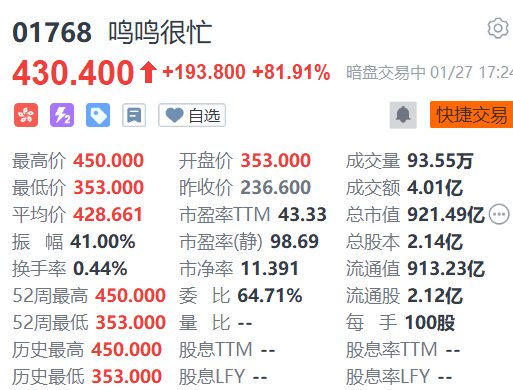
据悉,鸣鸣很忙此次IPO吸引了腾讯、淡马锡、贝莱德等8家顶级机构组成豪华基石阵容,累计认购1.95 亿美元,凸显资本市场对其赛道地位与增长潜力的认可。 中国零食商"零食很忙"和"赵一鸣零食"母企、被称为"量贩零食第一股"的鸣鸣很忙(1768.HK)即将于明 日在港挂牌上市,该股在目前的富途暗盘交易中暴涨,盘中一度涨超90%至450港元,一手100股,账面 赚21340港元。 | 01768 呜呜很忙 | | | | --- | --- | --- | | 430,400 ↑ +193.800 +81.91% 暗盘交易中 01/27 17:24 | | | | * % % (9 目 ♥ 白选 | | ● 快捷交易 | | 最高价 450.000 | 开盘价 353.000 | 成交量 93.55万 | | 最低价 353.000 | 昨收价 236.600 | 成交额 4.01亿 | | 平均价 428.661 | 市盈率TM 43.33 | 总市值 921.49亿 … | | 振 幅 41.00% | 市盈率(静) 98.69 | 总股本 2.14亿 | | 换手率 0.44% | 市净率 11.391 | ...
2026零食消费(有奖)大调研
Di Yi Cai Jing Zi Xun· 2026-01-27 07:17
一场关于"零食"的叙事正被重构 它已悄然从三餐的间隙出走 就有机会抱走惊喜好礼! (帆布袋、零食礼包、马克杯、新刊杂志、会员卡、日历……) 你的每一个选择 成为日常生活的"第四餐" 一个年规模突破万亿元的庞大市场 第一财经推出2026零食消费(有奖)大调研 戳海报,直达问卷通道 问卷通关不算完! 福利加"马"中 截图问卷完成页,在评论区打卡留言 ✅ 帮我们精准get零食消费的真实需求 ✅ 决定未来更多零食上新方向 ☆「马」上转发☆ 快喊上你的零食搭子一起参与~ 让未来的货架上 摆满我们爱吃的模样 愿大家零食常伴,快乐不打烊 ...
2026零食消费(有奖)大调研
第一财经· 2026-01-27 07:07
它已悄然从三餐的间隙出走 成为日常生活的"第四餐" 一个年规模 突破 万亿 元 的庞大市场 第一财经推出2026零食消费(有奖)大调研 戳海报,直达问卷通道 一场关于 " 零食 " 的叙事正被重构 福利加"马"中 截图问卷完成页,在评论区打卡留言 就有机会抱走惊喜好礼! ✅ 决定未来更多零食上新方向 (帆布袋、零食礼包、马克杯、新刊杂志、会员卡、日历……) 你的每一个选择 ✅ 帮我们精准get零食消费的真实需求 问卷通关不算完! ☆「马」上转发☆ 快喊上你的零食搭子一起参与~ 让未来的货架上 摆满我们爱吃的模样 愿大家零食常伴,快乐不打烊 点击阅读原文,一起参与~ ...