电子商务

Search documents
商务部:促进二手车出口由规模增长迈向价值增长
Xin Hua She· 2025-11-21 06:19
Group 1 - The Ministry of Commerce aims to shift the export of used cars from scale growth to value growth, providing a richer and more diverse product choice for global consumers [1][2] - A new notification has been issued to strengthen the management of used car exports, including measures to strictly control the export of new cars under the guise of used cars and establish a dynamic management and exit mechanism for enterprises [2] - The notification has received positive feedback from various sectors, reflecting a sustainable development concept focused on strong regulation, quality, and superior service in the used car export industry [2] Group 2 - E-commerce in China has shown significant growth, with online retail sales increasing by 9.6% year-on-year from January to October [3] - Smart products and online services have seen remarkable growth, with online retail sales of AI glasses and smartwatches increasing by 23.1%, and online service consumption rising by 21% [3] - The digital transformation of small and medium-sized enterprises is being supported through industrial e-commerce initiatives, with significant growth in transaction volumes in sectors like textiles and pharmaceuticals [3]
大行评级丨海通国际:首予阿里“优于大市”评级 憧憬公司进入AI引领的复苏阶段
Ge Long Hui· 2025-11-21 03:41
Core Viewpoint - Haitong International has initiated coverage on Alibaba's H-shares with an "Outperform" rating, setting a target price of HKD 200, which corresponds to a non-GAAP P/E ratio of approximately 28 times for the fiscal year 2026 and about 20 times for fiscal year 2027 [1] Group 1 - The report anticipates that Alibaba is entering a recovery phase driven by AI, with overall revenue growth expected to accelerate [1]
锐财经|消费潜力持续释放
Ren Min Ri Bao Hai Wai Ban· 2025-11-21 03:37
Core Insights - The overall retail sales of consumer goods in China increased by 4.3% from January to October, with online retail sales growing by 9.6% year-on-year, indicating a stable growth trend in the consumer market [1][2] - The National Bureau of Statistics reported that the retail sales in October reached 4.63 trillion yuan, a year-on-year increase of 2.9%, driven by the National Day and Mid-Autumn Festival holidays [2][3] Consumer Market Stability - From January to October, the total retail sales of consumer goods amounted to 41.2 trillion yuan, reflecting a growth rate of 4.3% [2] - In October, retail sales of goods grew by 2.8%, with significant increases in categories such as communication equipment (23.2%), cultural and office supplies (13.5%), and furniture (9.6%) [2] - Basic living goods saw rapid growth, with food and clothing retail sales increasing by 9.1% and 6.3%, respectively [2] - Upgraded consumer goods, including jewelry (37.6%), sports and entertainment products (10.1%), and cosmetics (9.6%), showed strong demand [2] - Service retail sales grew by 5.3% from January to October, outpacing goods retail sales by 0.9% [2] Impact of Holidays on Consumption - The overlapping National Day and Mid-Autumn Festival holidays led to increased spending on dining, accommodation, and entertainment, with restaurant income rising by 3.8% in October [3] - The number of inbound tourists during the holidays reached 751,000, marking a 19.8% increase [3] E-commerce Growth - E-commerce played a significant role in boosting consumption and modern industry development, with online retail sales increasing by 9.6% from January to October [4] - Notable growth was observed in smart products and online services, with sales of smart wearables increasing by 23.1% and online service consumption rising by 21% [4] - Agricultural products and rural online retail sales grew by 9.5% and 7.5%, respectively, indicating the positive impact of e-commerce on rural economies [4] New Consumption Trends - New consumption models are emerging, with sales of smart health devices and wearable technology increasing significantly [7] - Rural consumption is outpacing urban consumption, with rural retail sales growing by 4.1% in October, compared to urban areas [7] - The synergy between new urbanization and rural revitalization is enhancing county-level commercial facilities and market potential [7]
前10月,社会消费品零售总额增长4.3%,网上零售额增长9.6%——消费潜力持续释放
Ren Min Ri Bao Hai Wai Ban· 2025-11-21 01:05
Core Insights - The overall retail sales of consumer goods in China increased by 4.3% from January to October, with online retail sales growing by 9.6% year-on-year, indicating a stable growth trend in the consumer market [1][2][4] Group 1: Consumer Market Performance - From January to October, the total retail sales of consumer goods reached 41.2 trillion yuan, with October sales amounting to 4.63 trillion yuan, reflecting a year-on-year growth of 2.9% [2] - The consumption potential continues to be released, supported by the National Day and Mid-Autumn Festival holidays, which contributed to a stable growth in the consumer market [2][3] Group 2: Product Consumption Trends - In October, retail sales of goods grew by 2.8%, with significant increases in categories such as communication equipment (23.2%), cultural and office supplies (13.5%), and furniture (9.6%) [3] - Basic living goods saw rapid growth, with retail sales of grain and oil foods increasing by 9.1% and clothing by 6.3% [3] - Upgraded consumer goods showed strong demand, with jewelry sales rising by 37.6%, sports and entertainment products by 10.1%, and cosmetics by 9.6% [3] Group 3: Service Consumption Growth - From January to October, service retail sales increased by 5.3%, outpacing goods retail sales by 0.9 percentage points [3] - The holiday season boosted spending in dining, accommodation, and entertainment, with restaurant income growing by 3.8% in October [3] Group 4: E-commerce Development - E-commerce in China has played a significant role in boosting consumption and modern industry development, with online retail sales growing by 9.6% from January to October [4] - Notable growth was observed in smart products and online services, with sales of smart wearables increasing by 23.1% and online service consumption rising by 21% [4] Group 5: New Consumption Patterns - New consumption models are emerging, with sales of smart health devices growing over 20% and organic food sales increasing by over 8% in October [7] - Rural consumption is outpacing urban areas, with retail sales in rural regions growing by 4.1% in October, indicating a vibrant market in lower-tier cities [7]
沭阳县桑墟镇许明超电子商务中心(个体工商户)成立 注册资本5万人民币
Sou Hu Cai Jing· 2025-11-21 00:50
天眼查App显示,近日,沭阳县桑墟镇许明超电子商务中心(个体工商户)成立,法定代表人为许明 超,注册资本5万人民币,经营范围为许可项目:林木种子生产经营;草种生产经营(依法须经批准的 项目,经相关部门批准后方可开展经营活动,具体经营项目以审批结果为准) 一般项目:花卉种植; 礼品花卉销售;互联网销售(除销售需要许可的商品);肥料销售;农作物种子经营(仅限不再分装的 包装种子);园艺产品种植;园艺产品销售;日用陶瓷制品销售(除依法须经批准的项目外,凭营业执 照依法自主开展经营活动)。 ...
商务部表示促进二手车出口由规模增长迈向价值增长
Zhong Guo Zheng Quan Bao· 2025-11-21 00:10
Group 1 - The Ministry of Commerce aims to shift the focus of second-hand car exports from scale growth to value growth, providing a wider range of product choices for global consumers [1][2] - A new notification has been issued to strengthen the management of second-hand car exports, including measures to strictly control new cars being exported as second-hand vehicles and establish a dynamic management and exit mechanism for enterprises [2] - The notification has received positive feedback from various sectors, emphasizing the sustainable development concept of "strong regulation, quality emphasis, and service optimization" in the second-hand car export industry [2] Group 2 - E-commerce in China has played a significant role in boosting consumption, improving livelihoods, and promoting the construction of a modern industrial system, with online retail sales increasing by 9.6% year-on-year from January to October [3] - The growth of digital consumption and quality e-commerce has stimulated consumer potential, with notable increases in sales of smart products and online services, such as a 23.1% rise in retail sales of smart wearables and a 21% increase in online service consumption [3] - Initiatives like "Digital Commerce Promoting Agriculture" have been implemented to enhance the sales of specialty agricultural products through e-commerce, resulting in a 9.5% increase in agricultural product online retail sales [3]
10月我国消费市场保持平稳增长
Ren Min Ri Bao· 2025-11-20 21:49
Core Insights - The consumer market in China maintained a steady growth trend in October, with continuous release of consumption potential [1] Group 1: Goods Consumption - In October, retail sales of goods increased by 2.8%, with significant growth in sales of trade-in related products [1] - Retail sales of communication equipment, cultural and office supplies, and furniture for enterprises above designated size grew by 23.2%, 13.5%, and 9.6% respectively [1] - Demand for upgraded consumer goods remained strong, with retail sales of gold, silver, and jewelry, sports and entertainment products, and cosmetics increasing by 37.6%, 10.1%, and 9.6% respectively [1] Group 2: Service Consumption - From January to October, retail sales of services grew by 5.3%, driven by holiday travel demand [1] - Retail sales in tourism consulting and leasing services, transportation services, and cultural and recreational services all maintained a growth rate of over 10% [1] - In October, restaurant income increased by 3.8% [1] Group 3: New Consumption Trends - In October, sales of smart health devices increased by over 20%, while sales of smart wearable devices grew by approximately 4% [1] - Sales of certain first-level energy-efficient home appliances increased by over 10% [1] - E-commerce played a positive role in boosting consumption, with online service consumption growing by 21% [1]
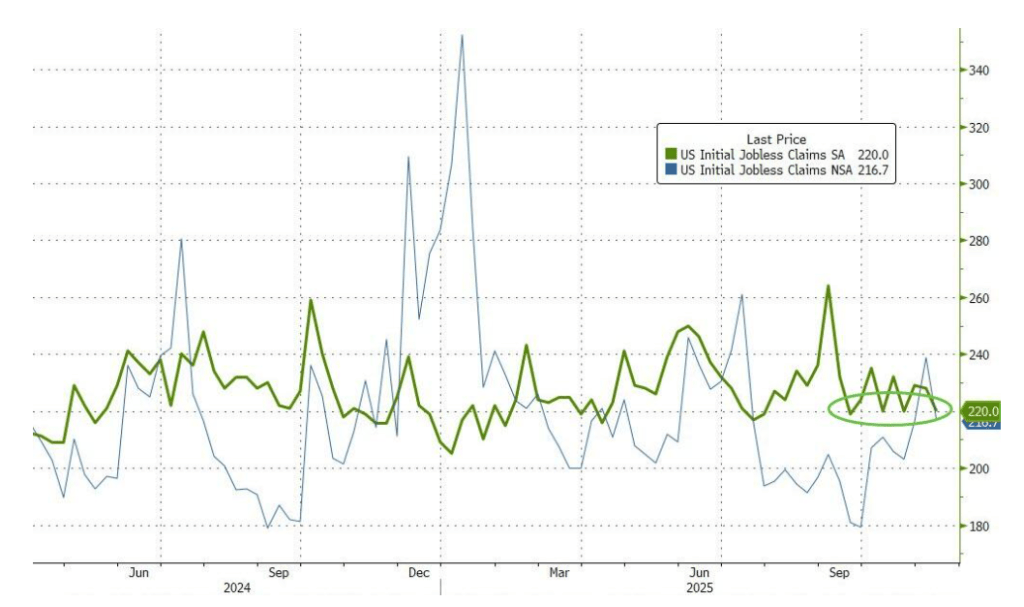
美国上周首申人数回落至22万人,续请失业金人数攀升至4年来最高水平
Sou Hu Cai Jing· 2025-11-20 16:52
Core Insights - The number of initial jobless claims in the U.S. has decreased to 220,000, indicating that employers are still trying to maintain their workforce despite economic uncertainties [1][3] - However, the number of continuing claims for unemployment benefits has risen to 1.974 million, the highest level since October 2021, suggesting a bleak outlook for the labor market [4] Group 1: Jobless Claims Data - Initial jobless claims fell by 8,000 to 220,000, below the expected 227,000 [1] - Continuing claims increased to 1.974 million, exceeding the expected 1.95 million [4] Group 2: Labor Market Context - Major companies like Amazon and Target have announced layoffs, yet the jobless claims remain relatively stable [3] - The Federal Reserve is facing challenges in decision-making due to a lack of key employment data, which complicates the assessment of the labor market [6][7]

假冒儿研所三件套背后:伪装资质与平台防线
Bei Jing Shang Bao· 2025-11-20 16:30
Core Viewpoint - The article highlights the ongoing issue of counterfeit products, specifically a fake eczema treatment sold on the Taobao platform, revealing systemic failures in the platform's regulatory mechanisms and the ease with which sellers can evade scrutiny [1][7]. Group 1: Personal Store Issues - Personal stores on Taobao can be easily registered using just an ID, allowing sellers to operate without proper business licenses, which complicates consumer protection efforts [3][4]. - Consumers, like Zhao Jing, face significant challenges in obtaining refunds and pursuing complaints against personal stores, as these stores often lack verifiable business credentials [3][4]. - The use of misleading store names, such as "国箹佳乐大箹房," which closely resemble legitimate pharmacy names, further confuses consumers and allows sellers to bypass platform scrutiny [4][5]. Group 2: Corporate Store Misuse - Some corporate stores exploit their legitimate status to sell counterfeit products, misleading consumers into believing they are purchasing from reputable sources [5][6]. - The "凌芳旗舰店," a corporate store on Tmall, showcases a complete business license but sells products outside its stated legal scope, including counterfeit medical items [5][6]. - The product descriptions and parameters listed in these stores often contain significant inaccuracies, misleading consumers about the nature and safety of the products [6][7]. Group 3: Regulatory Failures - The article points out a systemic failure in the platform's regulatory processes, where superficial checks on seller qualifications do not adequately assess the alignment between a seller's credentials and their actual product offerings [7][8]. - The platform's reactive approach to complaints, primarily focusing on refunds and removing individual listings, fails to address the underlying issues of counterfeit sales and allows sellers to quickly re-establish under new identities [7][8]. - Legal experts suggest that e-commerce platforms may bear joint liability for the sale of counterfeit goods if they fail to take necessary actions upon being aware of such activities [8].

最脏的一幕,出现了!
Xin Lang Cai Jing· 2025-11-20 16:15
Core Viewpoint - The rise of AI-generated fake images has led to a significant increase in fraudulent refund claims in the e-commerce sector, causing distress among merchants and undermining trust in the online shopping ecosystem [3][19][36]. Group 1: Impact on E-commerce - E-commerce platforms are facing a surge in fraudulent refund requests, where individuals use AI-generated images to falsely claim product defects [3][17]. - Merchants report that customers are submitting obviously fake images, sometimes with AI watermarks still visible, to justify their refund requests [5][8]. - The "only refund" policy, initially designed to streamline customer service, has become a burden for merchants as they now have to scrutinize refund requests more closely [17][22]. Group 2: Consequences for Merchants - Small businesses, particularly those in lower-tier cities, are severely affected by these fraudulent activities, with malicious refunds threatening their daily operations and livelihoods [23][24]. - The financial strain from these scams can wipe out the profits from multiple sales, pushing merchants into a precarious position where they must choose between accepting orders or risking losses [24][25]. - Merchants are increasingly raising prices to offset the risks associated with potential fraudulent refunds, which ultimately impacts consumers [22][36]. Group 3: Regulatory and Platform Responses - In response to the growing issue, regulatory bodies have begun implementing measures to combat AI misuse, including guidelines to prevent the malicious use of AI-generated content [29][30]. - E-commerce platforms are enhancing their verification systems to protect merchants' rights and prevent fraudulent activities [30][32]. - The establishment of an account integrity system aims to track and penalize users who engage in fraudulent refund practices [30][32]. Group 4: Trust and Ethical Considerations - The ongoing fraudulent activities are eroding the foundational trust that underpins the e-commerce ecosystem, leading to a situation where both consumers and merchants are increasingly suspicious of each other [19][36]. - The article emphasizes the importance of maintaining ethical standards in transactions, advocating for a return to simple, honest exchanges between buyers and sellers [38][39].