航空航天

Search documents
今日十大热股:金风科技、岩山科技领衔,雷科防务7天6板,神剑股份14天10板持续爆炒
Jin Rong Jie· 2026-01-09 01:28
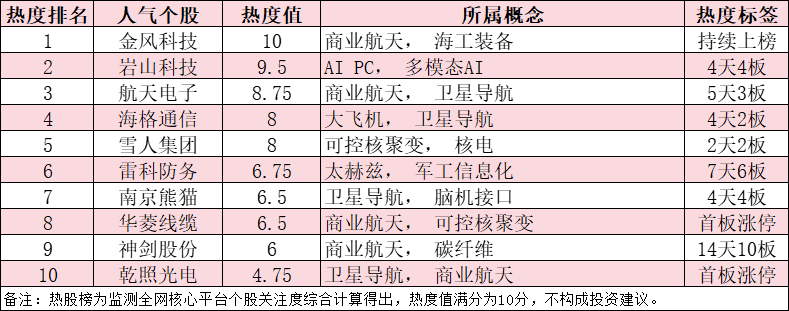
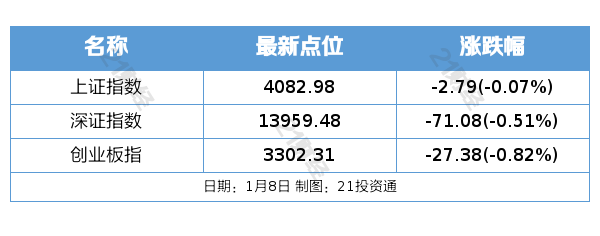
Market Overview - On January 8, A-shares saw most major indices decline, with the Shanghai Composite Index down 0.07%, Shenzhen Component down 0.51%, and ChiNext down 0.82%, while the Sci-Tech 50 index rose 0.82% [1] - The total trading volume in the Shanghai and Shenzhen markets was 2.80 trillion yuan, a decrease of approximately 53.8 billion yuan from the previous day [1] - There were 3,533 stocks that rose and 1,514 stocks that fell [1] Sector Performance - The aerospace and shipbuilding sectors saw the highest net inflows of funds, while sectors such as silver, energy metals, and brokerage firms experienced the largest declines [1] Popular Stocks - The top ten popular stocks included Jin Feng Technology, Yan Mountain Technology, Aerospace Electronics, Hai Ge Communication, Xue Ren Group, Lei Ke Defense, Nanjing Panda, Hualing Cable, Shen Jian Co., and Qian Zhao Optoelectronics [1][2] Key Factors Influencing Stock Prices - Jin Feng Technology's popularity is attributed to its leading position in the wind power industry and strong fundamentals, with significant growth in the sales capacity of wind turbines and an increased proportion of large-capacity units [3] - Yan Mountain Technology's rise is linked to its alignment with multiple hot technology sectors, including AI PC and multi-modal AI, and partnerships with AMD to expand terminal applications [3] - Aerospace Electronics benefits from the overall heat in the commercial aerospace sector, with policy support for projects like Qian Fan Constellation and China Star Network [3] - Hai Ge Communication's popularity stems from its technical capabilities in satellite navigation and communication, with applications in various scenarios [3] - Xue Ren Group's stock price increase is driven by the rising interest in controllable nuclear fusion, supported by significant capital inflow [4] - Lei Ke Defense is gaining attention due to its involvement in commercial aerospace and military information technology [4] - Nanjing Panda's stock is influenced by speculation around brain-computer interface technology, although the company has indicated that its related technology is still in the R&D phase [4] - Hualing Cable's growth is linked to its special cable business, which has seen significant revenue increases in high-end equipment sectors [4] - Shen Jian Co. benefits from both commercial aerospace and carbon fiber concepts, with strong fundamentals supporting its stock performance [4]




中国低空经济一飞冲天!航空航天ETF天弘(159241)跟踪指数昨日飙涨近5%,机构:产业正迎来政策与资源双轮驱动的加速发展期
2 1 Shi Ji Jing Ji Bao Dao· 2026-01-09 01:27
昨日(1月8日),商业航天概念集体爆发,二十余只成分股涨停。相关指数中,国证航天航空行业指数 大涨4.79%。 成分股中,海兰信"20CM"涨停,新劲刚、亚光科技涨超10%,海特高新、航天电子、中航机载、内蒙 一机纷纷涨停。 热门ETF中,航空航天ETF天弘(159241)昨日放量大涨,全天成交额达1.11亿元,换手率超18%,全 天交投活跃。 航空航天ETF天弘(159241)紧密跟踪国证航天航空行业指数,该指数覆盖航空装备、航天装备、军工 电子等细分领域,涉及卫星互联网、大飞机、低空经济等前沿科技方向。跟踪指数行业布局在申万一级 行业分类中,国防军工权重占比高达98.66%。 中信建投表示,随着制度与技术创新的进一步深化,基础设施的不断完善,应用场景的持续丰富拓展, 低空经济产业有望实现良好增长,为新质生产力发展注入新动能。 国元证券表示,从国家部委的产业定位到先行示范区的全面规划,低空经济正迎来政策与资源双轮驱动 的加速发展期。 (文章来源:21世纪经济报道) 消息面上,据央视新闻,中国低空经济一飞冲天。如今,国产飞行器越来越酷,也越来越强——截至 2025年12月30日,已有1081家企业完成登记注册 ...
中国石化与中国航油实施重组;广州规划攻关可重复使用火箭技术丨盘前情报
2 1 Shi Ji Jing Ji Bao Dao· 2026-01-09 01:03
Market Overview - On January 8, the Shanghai Composite Index fell by 0.07%, the Shenzhen Component Index decreased by 0.51%, and the ChiNext Index dropped by 0.82%. The total trading volume in the Shanghai and Shenzhen markets was 2.8 trillion yuan, a decrease of 53.8 billion yuan compared to the previous trading day, marking the fourth consecutive day of trading volume exceeding 2.5 trillion yuan. Over 3,700 stocks rose, with 111 stocks hitting the daily limit. Key sectors showing strength included commercial aerospace, brain-computer interface, controllable nuclear fusion, and AI applications, while large financials, rare earth permanent magnets, and non-ferrous metals saw significant declines [1][2]. International Market - In the U.S. stock market on January 8, the Dow Jones Industrial Average rose by 270.03 points to close at 49,266.11, a gain of 0.55%. The S&P 500 increased by 0.53 points to 6,921.46, a rise of 0.01%, while the Nasdaq Composite fell by 104.26 points to 23,480.02, a decline of 0.44%. In Europe, the FTSE 100 closed at 10,044.69, down 3.52 points (0.04%), while the CAC 40 rose by 9.55 points (0.12%) to 8,243.47, and the DAX increased by 5.20 points (0.02%) to 25,127.46 [2]. Oil Market - International oil prices rose on January 8, with light crude oil futures for February delivery increasing by $1.77 to $57.76 per barrel, a rise of 3.16%. Brent crude oil for March delivery rose by $2.03 to $61.99 per barrel, a gain of 3.39% [3]. Corporate Developments - The Ministry of Commerce of China responded to the review of Meta's acquisition of the AI platform Manus, stating that enterprises must comply with Chinese laws and regulations when engaging in foreign investment and technology cooperation [4]. - China Petroleum & Chemical Corporation (Sinopec) and China Aviation Oil Holding Company announced a restructuring, which is expected to enhance the competitiveness of China's aviation fuel industry and support the green transformation of the aviation sector [5]. - Guangzhou's new plan aims to accelerate the development of strategic industries, including low-altitude economy and aerospace, with a focus on reusable rocket technology [6]. - Zhiyuan Technology is set to launch a new generation of foundational model GLM-5, with expectations of significant growth in the large language model market in the coming years [7]. - OpenAI introduced ChatGPT Health, targeting the rapidly growing AI healthcare market, which is projected to reach approximately $505.59 billion by 2033 [8]. Regulatory Actions - The State Administration for Market Regulation of China has conducted talks with six leading photovoltaic companies regarding anti-monopoly risks, emphasizing the need for compliance with regulations on production capacity and pricing [9]. - The Ministry of Industry and Information Technology has warned against irrational competition in the lithium battery industry, gathering major players to discuss regulatory measures [10][11]. Investment Insights - Xiangcai Securities suggests that long-term industrial upgrades in China may create a favorable policy environment for market stability, particularly benefiting sectors like insurance, agriculture, aerospace, and technology [12]. - Galaxy Securities highlights the investment opportunities in the "AI + manufacturing" sector, focusing on the entire value chain from upstream to downstream applications [12].

广联航空:布局火箭贮箱核心环节,推动航天领域全品类覆盖
2 1 Shi Ji Jing Ji Bao Dao· 2026-01-09 00:56
Group 1 - The core viewpoint of the article is that Guanglian Aviation is strategically positioning itself in the rocket storage tank sector through the acquisition of Tianjin Yuefeng, addressing a critical bottleneck in the industry [1] - The company leverages its technological accumulation and customer qualifications, along with its leading position in the carbon fiber composite materials field, to enhance its capabilities in covering the full range of 'metal structural components + carbon fiber composites' [1] - The company advises investors to be aware of potential investment risks due to delays in equipment procurement or slower-than-expected capacity ramp-up [1]

新年后多地发布楼市新政,GPU厂商天数智芯上市 | 财经日日评
吴晓波频道· 2026-01-09 00:30
Group 1: Real Estate Market Policies - Multiple cities have introduced new real estate policies to stimulate housing demand, with Shenyang optimizing housing fund loan policies and Henan supporting housing consumption through subsidies and local government bonds [2] - The real estate market recovery shows significant divergence, with Shenyang's policies likely providing only temporary demand activation, while Henan's approach may effectively boost the market by reducing supply and easing financial burdens [2] Group 2: Banking Credit Policies - Several banks have launched credit policies with interest rates dropping to the "2s," particularly in first-tier cities, where competition is fierce and banks aim to attract quality clients [3][4] - The trend of lowering interest rates and simplifying loan approval processes is prevalent among banks, which may increase short-term loan volumes but could pose long-term risks [3] Group 3: Commercial Aerospace Developments - The first domestic offshore reusable rocket base has commenced construction, with a total investment of 5.2 billion yuan, aiming for an annual production capacity of 25 rockets [5] - The offshore recovery method is considered safer and more efficient, although significant technical challenges remain for achieving precise recovery [6] Group 4: E-commerce and Delivery Services - Alibaba's Taobao Flash Sale aims to become the market leader by increasing investment, achieving a peak daily order volume of 120 million and a monthly active user count exceeding 300 million [7] - The integration of delivery services into Taobao has led to increased user engagement, although the long-term impact on actual sales remains uncertain [8] Group 5: Airline Industry Trends - Following the New Year holiday, domestic flight ticket prices have dramatically decreased, with some routes offering tickets at 1-2% of their original prices, alongside a reduction in fuel surcharges [9] - The price drop is a typical seasonal adjustment as airlines prepare for upcoming travel peaks, although regulatory scrutiny on ultra-low fares may increase [10] Group 6: Technology and Semiconductor Sector - Domestic AI chip manufacturer Tensu Zhixin has successfully listed on the Hong Kong stock exchange, raising approximately 3.7 billion HKD, with plans for further development in GPU technology [13] - Despite revenue growth, Tensu Zhixin faces challenges with expanding losses and lower profit margins compared to peers, raising questions about its long-term sustainability [14] Group 7: Stock Market Performance - The stock market experienced narrow fluctuations, with significant trading volume and a diverse range of sector performances, particularly in commercial aerospace and AI applications [15] - Traditional sectors like real estate and beverage manufacturing showed signs of recovery after initial declines, indicating a potential shift in market sentiment [15]

上海累计培育42家“工赋链主”企业 加快推动“AI+制造”
Xin Hua She· 2026-01-08 22:50
Group 1 - The core viewpoint of the article highlights the success of Shanghai's "Industry Empowerment Chain Master" cultivation plan, which has fostered 42 key enterprises in sectors such as automotive, high-end equipment, and aerospace since its launch in 2022 [1] - The initiative has connected over 360,000 enterprises in the supply chain, empowered more than 7,000 core upstream and downstream companies, and linked over 2.3 million industrial equipment units [1] - The average operational maintenance costs of equipment have decreased by approximately 21%, while energy consumption has reduced by 10% [1] Group 2 - The "AI + Manufacturing" development white paper released at the conference indicates that Shanghai has formed a development pattern characterized by comprehensive initiation and multiple breakthroughs in AI-enabled manufacturing [1] - As of the first three quarters of 2025, there are 394 AI enterprises above a designated size in Shanghai, with an industry scale reaching 435.492 billion yuan, representing a year-on-year growth of 39.6% [1] - The total profit of these enterprises reached 40.781 billion yuan, showing an 11.4% year-on-year increase [1] - By December 24, 2025, Shanghai had 139 large models registered, and the number of AI professionals approached 300,000 [1]
520亿市值,“大模型第一股”来了
Sou Hu Cai Jing· 2026-01-08 20:04
Group 1 - The core viewpoint of the article highlights the successful IPOs of AI companies in Hong Kong, marking a strong start for VC/PE investments in the new year, with two "first stocks" emerging in the first week of January [2][3] - The market has shown significant enthusiasm for these IPOs, with Zhipu's market capitalization exceeding 52 billion HKD and an oversubscription rate of 1164 times during its public offering, indicating strong market recognition [3][5] - The article emphasizes the impressive investment history of Zhipu, which has raised over 8.3 billion RMB across 8 financing rounds, attracting major investors including Meituan, Ant Group, Alibaba, Tencent, and Xiaomi, as well as top-tier VC firms [5][6] Group 2 - The article discusses the broader implications of these IPOs, suggesting that they signal a resurgence in the hard technology sector and a collective acknowledgment of the long-term value of Chinese AI core assets by global capital [9][10] - It notes that early investors in Zhipu have seen substantial returns, with its market value increasing 17 times from a previous valuation of 2.8 billion RMB, and other companies like Biran Technology achieving returns exceeding 1150% [11] - The article identifies future investment opportunities in emerging industries supported by China's "14th Five-Year Plan," including new energy, aerospace, and quantum technology, indicating a growing interest from investors in these sectors [13][15]

全信股份拟发行可转债募资不超3.12亿元 加码商用航空传输等业务
Zheng Quan Shi Bao Wang· 2026-01-08 14:09
Core Viewpoint - The company plans to raise up to 312 million yuan through the issuance of convertible bonds to enhance its business structure and core competitiveness, focusing on the production of commercial aviation transmission and integrated communication products, as well as research and development of embedded heterogeneous computing platforms and supplementing working capital [1][2]. Group 1: Fundraising and Project Details - The company aims to invest 194 million yuan in the production of specialized civil aviation cables, harnesses, and rigid-flexible board components through its wholly-owned subsidiary, Xintuo Technology [1]. - The fundraising will also support the development of an embedded heterogeneous computing platform, which is expected to enhance the company's technological capabilities in aerospace communication integration and computing platforms [2]. Group 2: Market Context and Strategic Importance - The domestic market for civil aviation is experiencing steady growth, driven by the urgent demand for high-reliability, lightweight, and high-speed aviation data transmission systems, particularly with the C919 aircraft achieving regular commercial operations and accumulating over 1,000 domestic and international orders [2]. - The establishment of dedicated production lines for civil aviation cables and components will allow the company to achieve an independent and controllable production system, thereby enhancing production capacity and delivery efficiency, and securing a first-mover advantage in the civil aviation cable and component market [2]. Group 3: Company Background and Future Outlook - The company has extensive experience in the field of high-performance transmission cables for national defense and military applications, having established long-term stable partnerships with major military units and gained recognition from significant civil customers like COMAC [3]. - The issuance of convertible bonds is intended to meet business development needs and enhance capital strength and profitability, with the implementation of fundraising projects expected to significantly improve the company's competitiveness in the civil aviation sector and promote sustainable development [3].

商业航天涨停潮!New Space万亿市场蓄势待发,通用航空ETF(159231)暴力拉升4.46%连续刷新上市新高
Xin Lang Cai Jing· 2026-01-08 11:25
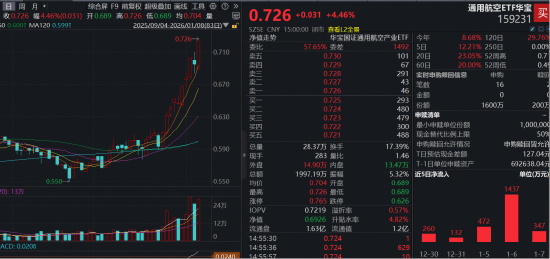
Core Viewpoint - The commercial aerospace and satellite sectors are experiencing significant growth, highlighted by the performance of the Universal Aviation ETF Huabao (159231), which saw a 4.46% increase, marking its largest single-day gain since its launch, with a net subscription of 14 million units on January 8 [1][7]. Group 1: Market Performance - The Universal Aviation ETF Huabao (159231) has shown strong market performance, with a 4.46% increase and a record high in trading volume [1][7]. - Among the 50 constituent stocks, 47 showed positive performance, with five stocks hitting the daily limit up, including Aerospace Nanhu and Aerospace Hongtu [4][10]. Group 2: Industry Developments - The construction of China's first offshore reusable rocket production base by Arrow Yuan Technology marks a significant milestone in the commercial aerospace sector, alongside the unveiling of the "Qiantang" rocket [2][8]. - A report by Guoxin Securities indicates that the commercial aerospace industry is transitioning from a state-led model to a private-led, cost-focused model, which is expected to drive innovation and reduce costs [3][9]. Group 3: Investment Opportunities - The report suggests that the commercial aerospace market is on the verge of a breakthrough, with a focus on high-barrier and high-elasticity sectors within the industry, particularly in rocket engines and satellite manufacturing [3][9]. - Key areas for investment include high-temperature alloys, special stainless steel, and metal 3D printing for rocket engines, as well as advanced satellite payloads and inter-satellite laser communication systems [5][11].


第十五根阳线 | 谈股论金
水皮More· 2026-01-08 10:46
Market Overview - A-shares showed mixed performance today, with the Shanghai Composite Index experiencing a slight decline of 0.07%, closing at 4082.98 points, while the Shenzhen Component and ChiNext Index fell by 0.51% and 0.82%, respectively [3][5] - The total trading volume in the Shanghai and Shenzhen markets reached 28,265 billion, a decrease of 552 billion compared to the previous day [5] Index Performance - The Shanghai Composite Index recorded a "15 consecutive days of gains" but did not turn positive today, closing slightly down [4][5] - Despite the decline in major indices, small-cap stocks showed resilience, with the small-cap index rising by 2% and the CSI 2000 Index closing up approximately 1.3% [5][6] Sector Analysis - The financial sector, particularly the securities and insurance segments, faced significant selling pressure, with notable declines in major stocks like CITIC Securities and China Ping An, which saw drops of over 3% and 5%, respectively [5][6] - The military industry sector outperformed, driven by speculation related to increased U.S. defense budgets, with aerospace stocks experiencing notable gains [6] - AI software and renewable energy sectors also showed strong performance, indicating ongoing investor interest in these areas [6] Investor Sentiment - The median stock gain today was 0.75%, reflecting stable market sentiment and continued interest in small and mid-cap stocks [6] - Despite the pressure on large-cap stocks, overall market enthusiasm remains, suggesting a potential for a mixed trading environment in the near term [6][7] Hong Kong Market Impact - The Hang Seng Index fell by 1.17%, and the Hang Seng Tech Index dropped by 1.07%, indicating a broader market correction [7] - While A-shares may not be immediately affected by Hong Kong's performance, long-term correlations between the two markets warrant ongoing observation [7]