石油

Search documents
国际油价突破100美元,物价会不会飞涨?
和讯· 2026-03-09 09:13
Market Overview - The Asia-Pacific markets experienced a "Black Monday," with over 4,500 stocks in the A-share market declining, the Shanghai Composite Index falling over 1%, and the Shenzhen Component Index dropping over 2% [1] - The commodity market saw a rare "limit-up" phenomenon, with international oil prices surging historically, WTI crude oil briefly exceeding $119 per barrel, marking an increase of over 31% [1] Japanese and Korean Markets - The Nikkei 225 index in Japan plummeted nearly 6%, recording the largest single-day drop since last year [2] - The KOSPI index in South Korea fell over 7%, triggering a market halt [2] Oil Price Impact - Analysts on Wall Street refer to the $100 oil price as the "Rubicon of the market," indicating a critical threshold that could lead to significant economic consequences [4] - Rising oil prices affect various sectors, including transportation, manufacturing, and logistics, leading to increased costs for consumers [4][5][6][7] Cost Calculations - A comparison of fuel prices shows that the cost of filling a 50-liter tank of gasoline increased from 354 RMB to 373.5 RMB due to a price hike of 0.39 RMB per liter, resulting in an additional cost of 19.5 RMB [8] - The logistics industry is highly sensitive to oil price changes, with estimates indicating that a 10% increase in oil prices raises delivery costs by 0.5% to 1% [9] Inflation Concerns - The IMF warns that a 10% rise in oil prices could lead to a 40 basis point increase in global inflation rates, suggesting that sustained high oil prices could gradually erode purchasing power [9][10] Historical Context of Geopolitical Events - Historical data shows that global stock markets tend to react negatively to conflicts in the Middle East, primarily due to fears of supply disruptions [12] - Three historical cases illustrate that while initial market reactions may be severe, the long-term impact depends on whether actual supply disruptions occur [13][16][17] - The Carson Group's analysis indicates a 65% probability of stock market gains 12 months after significant geopolitical crises, emphasizing that the market fears inflation and interest rate hikes more than the conflicts themselves [18]


美股三大股指盘前全线跳水,欧股集体大跌,黄金白银下挫,国际油价失守110美元
21世纪经济报道· 2026-03-09 09:02
Market Overview - Financial stocks in the US pre-market declined, with Goldman Sachs, American Express, and JPMorgan Chase all dropping over 2% [3] - Chip stocks also fell in pre-market trading, with AMD down nearly 2%, Intel down over 2%, Western Digital down over 2%, and ASML down nearly 3% [3] - Oil stocks in the US pre-market rose, with ConocoPhillips up nearly 3%, Occidental Petroleum and Marathon Oil up over 2%, and YPF, Chevron, ExxonMobil, and Equinor up over 1% [3] European Market Performance - European stocks opened collectively lower, with the Euro Stoxx 50 index down 2.58%, the UK FTSE 100 down 1.53%, the French CAC40 down 2.43%, the German DAX30 down 2.46%, and the Italian MIB index down 2.15% [4] - European chip stocks experienced significant declines, with ASML down over 5% and STMicroelectronics down over 4% [4] Oil Price Movements - International oil prices saw volatility, with both WTI and Brent crude oil prices falling below $110 per barrel, with WTI at $102.4 per barrel and Brent at $106.8 per barrel, erasing half of the intraday gains [4] - The panic index VIX rose by 5.53 points to 35.02, marking the highest level since April 2025 [4] Precious Metals - Spot gold and silver prices fluctuated downwards, with spot gold at $5092 per ounce, falling below $5100, and spot silver at $83 per ounce, down 1% for the day [6] G7 Meeting on Oil Reserves - The G7 is set to hold an emergency meeting to discuss the potential coordinated release of oil reserves in response to rising oil prices due to escalating tensions in the Middle East [8] - Reports suggest that US officials are proposing a joint release of 300 to 400 million barrels of oil, which would account for 25% to 30% of the total 1.2 billion barrels in reserves [8]

It is REALLY IMPORTANT for the taxpayer to understand this, GOP lawmaker says
Youtube· 2026-03-09 09:01
Core Viewpoint - The discussion highlights the urgent need for the U.S. military to modernize its weaponry and replenish stockpiles amid ongoing conflicts, particularly with Iran, while also addressing the economic implications of these military actions on global oil markets and geopolitical dynamics. Military Readiness and Funding - The U.S. military is facing challenges in stockpiling munitions, which has led to careful rationing of support for allies like Ukraine [2][3] - A potential request for a $50 billion supplemental funding package for military operations against Iran is anticipated, with bipartisan support likely [4][5] - The Pentagon's budget for defense is projected to be substantial, with discussions around how much will be supplemental versus part of the baseline budget [6][8] Modernization of Military Assets - The U.S. is in a critical phase of modernizing its military assets, including replacing aging systems like the B-52 bombers and intercontinental ballistic missiles, which are over 60 years old [10][12] - The modernization effort is essential to catch up with adversaries, particularly China, which has been heavily investing in new military technologies [11][12] Geopolitical and Economic Implications - Iran controls a significant portion of the world's oil reserves and its conflict with the U.S. has direct implications for global oil prices, particularly affecting China, which relies on Iranian oil [14][16] - The rise in oil prices, currently around $90 per barrel, poses economic challenges for China and has broader geopolitical ramifications [16][19] - The U.S. is becoming a more significant player in oil production, currently exceeding 13 million barrels per day, which could alter the dynamics of global oil supply and pricing [20]

Congressional Democrats demand reversal of Russian oil sales into India as energy prices soar
CNBC· 2026-03-09 09:00
Core Viewpoint - Congressional Democrats are urging the Trump administration to reverse a sanctions waiver that allows Indian refiners to purchase Russian oil, citing concerns over the impact of the Iran war on global energy markets [1][2]. Group 1: Sanctions Waiver and Its Implications - The Treasury Department issued a temporary 30-day sanctions waiver for India to buy Russian oil to mitigate rising oil prices due to the Iran war and disruptions at the Strait of Hormuz [2][4]. - Lawmakers argue that this waiver benefits Russia materially while it assists Iran in targeting U.S. military assets in the region [4][5]. - The waiver is seen as a failure of the administration to plan for alternative energy sources for allies, allowing adversaries to profit from previously sanctioned oil reserves [5]. Group 2: Impact on Oil Prices and Economic Concerns - Oil prices have surged since the onset of the war, with U.S. crude oil exceeding $108 per barrel and Brent nearing $110 per barrel, leading to a spike in U.S. gasoline prices to $3.44 per gallon [6]. - The rising oil prices are causing economic anxiety among voters ahead of the November midterm elections, with concerns about affordability impacting public perception of President Trump's economic management [3][7]. - The ongoing conflict is expected to exacerbate the energy cost crisis, further burdening American consumers [8].

午后,688316、301396等涨停!“龙虾”引爆算力概念
证券时报· 2026-03-09 08:37
Core Viewpoint - The article discusses the recent market trends in the A-share and Hong Kong stock markets, highlighting the surge in the computing power concept and the strong performance of the electric power sector, while also noting the volatility in the oil sector due to geopolitical tensions and market reactions. Group 1: A-share Market Trends - The A-share market opened lower and saw a decline, with the Shanghai Composite Index dropping over 1% at one point but later narrowing its losses to close down 0.67% at 4096.6 points [3] - Major sectors such as military, semiconductor, insurance, and brokerage saw declines, while the smart grid concept remained active, with stocks like Zeyu Intelligent hitting a 20% limit up [3] - The computing power concept experienced a significant surge, with multiple stocks including Yuke Technology and Hongjing Technology reaching their daily limit up of 20% [6][3] Group 2: Hong Kong Market Trends - In the Hong Kong market, stocks like Xun Ce surged over 50%, with a peak increase of over 70%, while MINIMAX-WP and Kingsoft Cloud also saw notable gains [4] Group 3: Computing Power Concept - The computing power concept saw a strong rally, with stocks like Yuke Technology and Hongjing Technology hitting their daily limit up of 20% [6] - The OpenClaw AI service has gained traction, with major cloud providers like Tencent Cloud and Alibaba Cloud announcing support, indicating a growing demand for AI-related computing power [9] Group 4: Electric Power Sector - The electric power sector showed strong performance, with stocks like Jinkai New Energy and Yinxing Energy hitting their daily limit up [11] - Recent approvals for $75 billion in transmission expansion projects in the U.S. are expected to significantly boost electric power demand, particularly driven by AI needs starting in 2026 [13] Group 5: Oil Sector Volatility - The oil sector initially saw strong gains, with companies like CNOOC and PetroChina approaching their daily limit up, but later experienced a pullback [15] - International oil prices have been highly volatile, with Brent and WTI crude oil prices experiencing significant fluctuations, influenced by geopolitical tensions in the Middle East [15][16]






中原期货晨会纪要-20260309
Zhong Yuan Qi Huo· 2026-03-09 08:18
Report Industry Investment Rating There is no information about the report industry investment rating in the provided content. Core Viewpoints of the Report - The market is affected by various factors such as geopolitical uncertainties, inflation, and energy price fluctuations. The A-share market's short - term adjustment is due to external geopolitical shocks and market structure differentiation. The mid - to long - term trend is mainly driven by domestic economic fundamentals and policy orientation, but the uncertainty of the Middle East situation cannot be ignored [19]. - Different commodity futures have different price trends and fundamentals. For example, sugar prices are expected to maintain a range - bound pattern, while energy - related commodities are affected by the Middle East situation and supply - demand relationships [11]. Summary by Relevant Catalogs 1. Chemical and Agricultural Product Price Changes - **Chemical Products**: On March 9, 2026, compared with March 8, most chemical products' prices showed an upward trend. For example, crude oil rose by 13.327% to 753.40, and fuel oil rose by 13.268% to 4,499.00. However, natural rubber decreased by 0.297% to 16,785.00 [4]. - **Agricultural Products**: Most agricultural products' prices also increased. For example, yellow soybean No.1 rose by 2.060% to 4,757.00, and palm oil rose by 2.560% to 9,454.00. But yellow corn decreased by 0.167% to 2,389.00 [4]. 2. Macroeconomic News - **Diplomatic and International Events**: At the press conference of the Fourth Session of the 14th National People's Congress on March 8, Foreign Minister Wang Yi made statements on Sino - US relations, the Taiwan issue, the Iranian situation, and Sino - Japanese relations. Globally, there are many important events this week, including the closing of domestic political meetings, the release of economic data, and corporate earnings announcements [7]. - **AI Security and Energy Market**: The open - source AI agent OpenClaw has security risks. On March 9, the US oil futures contract soared by 22%. The situation in the Middle East has led to a chain reaction of production cuts in oil - producing countries, and the global energy supply is under pressure [8]. 3. Morning Meeting Views on Main Varieties Agricultural Products - **Sugar**: The sugar price is expected to maintain a range - bound pattern, with short - term strength affected by energy prices. The supply side has both pressure and cost support, and the risk lies in the progress of the new Brazilian sugar - cane season and domestic policy changes [11]. - **Corn**: The corn price is in a high - level range - bound state. The supply in the Northeast production area is active, and the demand from deep - processing industries provides support. The upper space is limited, and caution is advised when trading [11]. - **Peanut**: The peanut price is in a narrow - range oscillation. The supply side has support from reduced imports, but the demand side has limited upward space. The price is close to the warehouse - receipt cost area [11]. - **Pig**: The national average pig price is weak. The supply is sufficient, and the futures market is in a state of seeking the bottom [11]. - **Egg**: The national egg spot price is stable and slightly strong. After the price drop, the inventory pressure has been released, and the spot price is rising. The futures market is recommended for short - term long - position trials [11][13]. - **Jujube**: The jujube price is stable in the short term, and the futures market is oscillating at the bottom. High - selling and low - buying strategies are recommended [13]. - **Cotton**: The cotton price is expected to be high - level range - bound. The supply side has support, but the demand side has uncertainties. Long positions can be considered at support levels [13]. Energy and Chemical Products - **Caustic Soda**: The domestic caustic soda market has high supply and inventory. Due to the tense situation in the Middle East, the export expectation has improved, and the price has rebounded. Short - term rebound thinking is recommended [12]. - **Coking Coal and Coke**: The supply of coking coal and coke is increasing, and the demand is expected to increase as steel mills resume production. The price is running strongly at a low level due to the coal substitution effect [12]. - **Double - offset Paper**: The supply of double - offset paper has increased, and the demand has limited improvement. The market is in a weak balance, and a range - bound trading strategy is recommended [12]. - **Urea**: The domestic urea supply is sufficient, and the demand has both support and suppression factors. Attention should be paid to the release of stored goods and demand follow - up [14]. Non - ferrous Metals - **Gold and Silver**: The prices of gold and silver are oscillating at a high level. The escalation of the Middle East conflict and weak US non - farm data have promoted price increases. Attention should be paid to risks [14]. - **Copper and Aluminum**: The prices of copper and aluminum are affected by the Middle East situation and inventory pressure. The impact on aluminum may be greater than that on copper [14]. - **Alumina**: The domestic alumina market has a supply - surplus situation, and the price is expected to remain low [14]. Steel and Iron Alloys - **Rebar and Hot - rolled Coil**: After the Lantern Festival, the inventory of steel products is accumulating. The terminal demand recovery is slow, but the steel price is expected to be slightly strong in the short term due to cost support [15]. - **Ferroalloys**: The supply of ferroalloys has decreased, and the demand has increased. The price has a low - level support, and a callback - buying strategy is recommended, but avoid chasing high prices [15]. Lithium Carbonate - The lithium carbonate price is oscillating. The supply pressure is continuous, but the demand provides support. Long positions can be considered at the lower edge of the oscillation range, but beware of supply increases [15]. Option Finance - **Stock Index Options**: On March 6, A - share indexes rose slightly, and most industry sectors closed up. The stock index futures and options markets showed different trends, and investors can pay attention to arbitrage opportunities and volatility trading [15][18]. - **Stock Index**: The A - share market adjustment is affected by external and internal factors. A volatile - market operation strategy is recommended, and attention can be paid to sectors with improved supply - demand patterns and low - valued assets [19].
中东油价突破百美元 中国对非零关税5月实施 OpenClaw掀起AI应用热潮
新财富· 2026-03-09 08:16
Group 1 - China will implement a 100% zero-tariff policy on products from Africa starting May 1, aiming to enhance trade cooperation and create opportunities for African products in the Chinese market [1] - International oil prices have reached a two-year high due to production cuts by Middle Eastern countries and the blockade of the Strait of Hormuz, with Brent crude oil closing at nearly $93 per barrel [2] - The U.S. has relaxed some sanctions on Russian oil, allowing India to purchase specific Russian crude, in response to supply shortages caused by conflicts in the Middle East [3] Group 2 - The ongoing conflict in the Middle East has led to a significant increase in international oil prices, with WTI crude futures rising by 18.67% to $107.87 per barrel, marking the first time prices have exceeded $100 since 2022 [4] - The Chinese Ministry of Commerce responded to ASML Netherlands' ban on Chinese employees using office software, emphasizing the need for responsible supply chain management and warning of potential crises [5] - President Xi Jinping outlined four new requirements for economic development during a meeting, focusing on technological breakthroughs, industry collaboration, and reform [6] Group 3 - The China Securities Regulatory Commission announced new regulations on short-term trading, effective April 7, 2026, aimed at facilitating long-term investments [7] - A report from Bank of America indicates that the storage industry is entering a super cycle, with minimal impact from Middle Eastern conflicts, and significant growth in semiconductor exports from South Korea and Taiwan [8] - China's special envoy for Middle East issues met with Saudi officials to promote peace and stability in the region amid escalating tensions [9] Group 4 - Shenzhen Longgang District introduced measures to support the development of OpenClaw, including financial incentives for skill development and project implementation [10] - Tencent's announcement to provide free installations of OpenClaw led to a surge in demand, with hundreds of installations occurring shortly after the announcement [12] - OpenAI's annual revenue has surpassed $25 billion, reflecting a 17% increase from the previous year, while competitor Anthropic has also seen significant growth [15] Group 5 - OpenAI and Oracle have abandoned plans to expand an AI data center in Texas due to financing issues, with Meta considering taking over the project [16] - The release of OpenAI's GPT-5.4 model has caused significant industry disruption, coinciding with a reduction in jobs in the U.S. tech sector [17] - Goldman Sachs reported that AI applications are entering a new phase, with tools like Anthropic's Claude Cowork and OpenClaw marking significant advancements [18] Group 6 - U.S. stock markets experienced collective declines, influenced by geopolitical tensions and rising oil prices, while Chinese concept stocks showed resilience [20] - A-shares also fell, with the Shanghai Composite Index down 0.67%, but energy sectors performed well amid market volatility [21]

日经股指大跌2892点,伊朗局势乐观预期消退
日经中文网· 2026-03-09 08:00
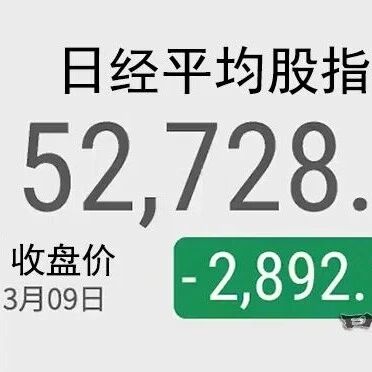
Core Viewpoint - The Japanese stock market experienced a significant decline, with the Nikkei average dropping by 5.20% to close at 52,728 points, reflecting a loss of 2,892 points from the previous week, as optimism regarding wartime stock price resilience faded [2][4]. Group 1: Market Reaction - The uncertainty surrounding the situation in Iran has heightened market volatility, leading to a cooling of investor sentiment [4]. - The rise in oil prices, with WTI crude oil futures reaching $111.24 per barrel, has raised concerns about stagflation risks, where high prices coexist with economic recession [4]. - Over 90% of stocks listed on the Tokyo Stock Exchange's Prime market experienced declines, indicating a broad market downturn [4]. Group 2: Oil Price Dynamics - Oil prices surged by 22% from the previous week, marking a significant increase from $90.90 to $111.24 per barrel, the highest level since July 2022 [4]. - Compared to the closing price of $67.02 on February 27, prior to military tensions with Iran, oil prices have risen by 66% [5].
原油价格加剧上涨的预期在走向现实
日经中文网· 2026-03-09 08:00
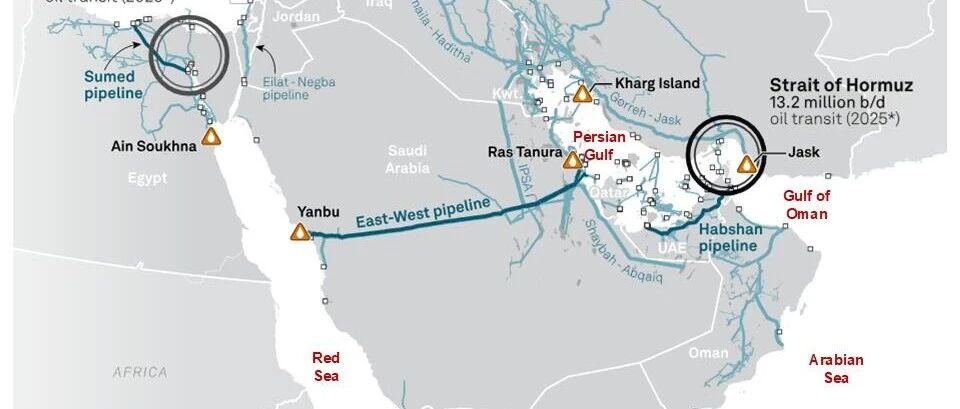
Core Viewpoint - The blockade of the Strait of Hormuz is threatening global oil supply, with predictions indicating that if the blockade continues for a month, oil prices could rise significantly due to reduced transportation capacity and potential production cuts [2][5][11]. Group 1: Oil Supply and Storage Capacity - Current oil storage capacity in key producing countries (Saudi Arabia, UAE, Iraq, Kuwait, Qatar, and Iran) will be fully utilized within 26 days if production continues without transportation [5][6]. - The International Energy Agency (IEA) has projected a surplus of 3.8 million barrels per day in global oil supply from January to March 2026, which could tighten if production cuts are implemented [6]. Group 2: Price Predictions - Goldman Sachs predicts that if pipeline transportation capacity is not utilized in the next month, oil prices could increase by $15 per barrel [4]. - If the blockade lasts for 4 to 5 weeks, Brent crude oil prices could reach between $100 and $120 per barrel [5]. Group 3: Alternative Transportation Routes - Saudi Arabia is increasing oil loading at the Yanbu port, with a loading rate of 2.5 million barrels per day, which could set a historical record if maintained [6]. - The east-west pipeline in Saudi Arabia has a capacity of 5 million barrels per day, but only 2 million barrels are currently in use, leaving limited capacity for additional transport [9]. Group 4: Global Demand and Strategic Reserves - Approximately 19 million barrels of oil and petroleum pass through the Strait of Hormuz daily, and alternative routes are insufficient to meet demand [10]. - OECD countries have an average of 87 days of land reserves, with significant disparities among countries, affecting their ability to respond to supply shortages [10].

沙特启用东西向石油管道
财联社· 2026-03-09 07:35
Core Viewpoint - The shipping disruption in the Strait of Hormuz is one of the most severe oil supply interruptions in modern history, with approximately 16 million barrels of oil products unable to be transported daily due to the blockade [1]. Group 1: Shipping Disruption - The Strait of Hormuz has been nearly stagnant for seven consecutive days, with only one Iran-associated bulk carrier passing through in the last day, and no oil or gas tankers have crossed [1]. - The current situation is causing significant challenges for oil supply, with daily shipments of around 16 million barrels of various oil products being affected [1]. Group 2: Alternative Shipping Routes - There are two alternative routes for Middle Eastern oil exports: the East-West Pipeline through Saudi Arabia and the Habshan Pipeline in the UAE, which can potentially transport 7 to 8 million barrels of oil daily, covering half of the supply disruption from the Strait of Hormuz [2][3]. - The East-West Pipeline has reached a historical high in crude oil transport, with a maximum capacity of 7 million barrels per day, and is currently operating at high load [3]. Group 3: Loading Capacity and Limitations - The East-West Pipeline can provide an additional 5 million barrels of crude oil to the international market, with loading facilities at Yanbu and Muajjiz capable of exceeding 20 million barrels per day if fully operational [4]. - However, the actual net diversion of oil through the pipeline has been significantly lower, with only 900,000 barrels per day being redirected, far below the theoretical capacity of 3.6 million barrels per day [5]. Group 4: Impact on Asian Markets - If the Strait of Hormuz remains blocked, countries like South Korea, Thailand, and India may face the most significant impacts, while Japan may stabilize in the short term due to its substantial oil reserves [6].