
科技

Search documents
跌破眼镜!沃尔玛迁至纳斯达克上市
Sou Hu Cai Jing· 2025-12-09 14:30
Core Viewpoint - Walmart's migration from the New York Stock Exchange to the Nasdaq marks the largest exchange migration in U.S. history, reflecting a strategic shift towards a technology-oriented narrative in the retail sector [3][4]. Group 1: Company Strategy - Walmart aims to position itself as a tech-driven retail company by integrating automation and artificial intelligence, enhancing customer experience and setting new standards for omnichannel retail [3][5]. - The migration to Nasdaq is seen as a move to align Walmart with high-growth tech companies, potentially increasing its valuation and attracting passive fund investments [3][6]. - Over 60% of Walmart's goods are transported through automated distribution centers, with more than half of online orders completed in automated facilities, showcasing its commitment to technological advancement [5][6]. Group 2: Market Positioning - By choosing to compete with Amazon rather than traditional retailers like Costco or Target, Walmart signals a paradigm shift in the retail industry, emphasizing technology over store count [5][6]. - The move to Nasdaq is expected to enhance Walmart's brand as a "tech retail" entity, allowing it to be compared directly with tech giants and potentially increasing investor interest [4][6]. - The lower costs associated with listing on Nasdaq, while minor for Walmart, align with the company's ethos of cost-saving, further supporting its strategic decision [6].



[12月9日]指数估值数据(螺丝钉定投实盘第393期发车;养老指数估值表更新)
银行螺丝钉· 2025-12-09 14:06
Market Overview - The overall market experienced a decline, closing at 4.2 stars [1] - Large, medium, and small-cap stocks all fell, with small-cap stocks declining slightly more [2] - The value style saw an overall decline, while the growth style, particularly the ChiNext index, saw a slight increase [3][5] - The market is characterized by style rotation [4] Performance Trends - From October to November, the growth style dropped over 15%, while the value style fell approximately 5% [5] - In December, the growth style has shown strength in recent days, contrasting with the weakness in the value style [6] - The market is experiencing cyclical shifts in performance [7] Hong Kong Market Insights - The Hong Kong stock market also faced declines today, with greater volatility compared to A-shares [8][9] - Following today's drop, technology stocks in Hong Kong, including the Hang Seng Tech index, have returned to undervaluation [10][11] Investment Strategies - The investment strategy includes a regular investment plan with a focus on various combinations, such as the index-enhanced advisory portfolio and actively selected advisory portfolio [12] - The index-enhanced portfolio has returned to normal valuation, prompting a pause in regular investments, while the actively selected portfolio continues normal investments [12] - The "Monthly Salary Treasure" investment strategy, which consists of 40% stocks and 60% bonds, is recommended for stable market participation [12] Pension Fund Investment - The pension fund investment strategy includes regular investments in specific funds, such as the CSI A50 and 300 Dividend Low Volatility [19] - The CSI A50 has recently returned to a low valuation, while the CSI 500 and CSI Dividend are at normal valuations, leading to a pause in regular investments [19] - The pension index fund is a new investment category, with a focus on classic combinations like CSI A500/A50 and CSI Dividend [21] Valuation Insights - A valuation table for various indices and funds is provided, indicating their price-to-earnings ratios, price-to-book ratios, and dividend yields [32] - The table highlights which indices are currently undervalued, normal, or overvalued, aiding in investment decision-making [36]
凯基:2026年中国资产重估仍有望延续 港股将继续受惠
Zhi Tong Cai Jing· 2025-12-09 12:14
该行续指,明年影响美股的重要变量包含关税演变、货币政策、劳动市场与期中选举。预期第一季受关 税不确定性、货币政策不如预期、景气下行及就业转弱的影响可能最明显,股市偏震荡下行;第二季开 始反映特朗普为选情考虑而减轻关税,以及经济逐渐走向见底、货币政策趋于明朗而股市回升;并在第 四季选举前后开始有望录得较可观的升幅。 对于亚洲市场,该行对日股明年展望正面,因日本终于摆脱通缩心态,进入通胀环境下的经济正常化, 企业敢加价、家庭愿意消费,有助企业收入和盈利改善,资本效率提升亦推动估值上调和外资进驻。企 业改革也确实见到成效,股本回报率(ROE)、资产回报率(ROA)、市帐率(PBR)、股息支付率皆上升,交 叉持股下降,以及企业持续增加股票回购等。 智通财经APP获悉,凯基发布12月最新市场走势分析,对于中国市场,2026年中国资产重估仍有望延 续,港股将继续受惠。凯基指,香港经济正摆脱困境,金融业率先回暖,出口展现韧性,房市逐步走出 阴霾,旅游业加速复苏;美联储减息趋势不改,利好港股表现;港股估值仍低,恒生指数当前动态PE只有 11.5倍,离历次上升趋势高点仍有较大差距,且随着中概股回归以及A股科技企业纷纷加速在港二 ...
亚太区亿万富豪增幅居全球之首
Zhong Guo Ji Jin Bao· 2025-12-09 11:57
Group 1 - The report indicates that the number of billionaires globally increased by 8.8% to 2,919, with total wealth reaching a record $15.8 trillion, marking a 13% increase [2] - The Asia-Pacific region saw a significant rebound, with the number of billionaires rising from 981 to 1,036, the highest growth rate globally [2] - In terms of wealth increment, billionaires in the Asia-Pacific region experienced an 11.1% growth, reaching $4.2 trillion, with mainland China leading at $1.8 trillion [2] Group 2 - Investment in the technology sector saw a wealth increase of 23.8% to $3 trillion, making it one of the top wealth-generating industries globally [2] - The report highlights a substantial increase in investment enthusiasm towards China and the Asia-Pacific region, with 34% of surveyed billionaires believing China offers the greatest investment opportunities, up from 11% in 2024 [3] - 61% of Asia-Pacific billionaires plan to increase investments in hedge funds, developed market equities (50%), and gold/precious metals (48%) [3]
亚太区亿万富豪增幅居全球之首
中国基金报· 2025-12-09 11:54
Group 1 - The core viewpoint of the report is that the wealth of global billionaires is expected to reach a historic high by 2025, with significant growth in the Asia-Pacific region, particularly in mainland China [2][4]. - By 2025, the number of billionaires globally is projected to increase by 8.8% to 2,919 individuals, with total wealth reaching a record $15.8 trillion, reflecting a 13% growth [4]. - The Asia-Pacific region will see a notable recovery, with the number of billionaires rising from 981 to 1,036, marking the highest growth rate globally [4]. Group 2 - In terms of wealth increase, billionaires in the Asia-Pacific region will experience an 11.1% growth, reaching $4.2 trillion, with mainland China leading at $1.8 trillion [4]. - The technology sector is highlighted as a significant driver of wealth, with billionaires in this industry seeing a 23.8% increase in wealth to $3 trillion, while the consumer and retail sector's growth has slowed to 5.3% [5]. - Investment enthusiasm in China and the Asia-Pacific region has surged, with 34% of surveyed billionaires believing China offers the greatest investment opportunities, a substantial increase from 11% in 2024 [7]. Group 3 - The report indicates that 61% of Asia-Pacific billionaires plan to increase investments in hedge funds, developed market stocks (50%), and gold/precious metals (48%) [8]. - There is a strong interest in emerging market stocks and private equity among billionaires, reflecting a shift in asset allocation preferences [8]. - The report anticipates a continued increase in the number of billionaires and millionaires globally, estimating that by 2040, approximately $6.9 trillion in wealth will be transferred, with at least $5.9 trillion going directly or indirectly to their children [8].


【环球财经】2026年美股展望:泡沫论或加剧波动 保持谨慎乐观
Xin Lang Cai Jing· 2025-12-09 10:37
Group 1 - The core viewpoint of the articles indicates that while the U.S. stock market has reached historical highs in 2025, its performance has lagged behind other major markets, suggesting a cautious optimism for 2026 driven by AI and loose monetary policies [1][2]. - The technology sector, particularly the "seven giants," has significantly influenced the S&P 500, accounting for over 30% of its total market capitalization and contributing nearly 50% to market expansion since 2023 [2][3]. - There is a growing debate regarding the potential "AI bubble," with concerns that if AI demand does not meet expectations, high valuations may not be sustainable, leading to a possible market correction [2][3]. Group 2 - Predictions indicate a substantial decline in capital expenditure growth for major tech companies, from 48.8% in 2025 to 18.8% in 2026, and further down to 6.0% in 2027, reflecting a weakening growth momentum [3]. - Major financial institutions like Bank of America and BlackRock are questioning the "AI bubble" narrative, suggesting that the current AI investment wave is driven by genuine corporate investments and productivity growth rather than speculative bubbles [4][5]. - Analysts suggest that the market may continue to experience upward momentum in the first half of 2026 due to ongoing fiscal and monetary easing, but may face more policy uncertainties in the latter half of the year [5][6]. Group 3 - Investment strategies are recommended to focus on the core segments of the AI value chain, including large-scale cloud service providers and chip manufacturers, while also identifying undervalued companies that could benefit from the AI trend [6][7]. - The discussion around the AI narrative emphasizes the importance of understanding the boundaries and duration of potential bubbles, with a focus on improving risk-reward ratios in high-valuation tech stocks [6][7]. - The overall market sentiment suggests that while the AI-driven tech rally may persist, volatility is expected to increase, making it crucial for investors to manage trading rhythms effectively [7].

封关在即,消费谋局!海南自贸港国际消费新机遇从这场盛会开启
Mei Ri Jing Ji Xin Wen· 2025-12-09 10:34
Group 1: Hainan Free Trade Port Development - Hainan is set to enter a new phase of open development with the full operation of the free trade port on December 18, marking a significant milestone for the island [1] - The "zero tariff" policy will be fully implemented post-closure, positioning consumption as the core engine for Hainan's high-quality development [1] - The "2025 14th Annual Conference on Listed Company Development" will be held in Haikou, focusing on new consumption opportunities in Hainan post-closure [1] Group 2: Cultural Empowerment in Consumption - The shift in consumer demand from "having" to "quality and preference" highlights the importance of "story value" in influencing purchasing decisions [2] - Ren Zhonglun, a prominent figure in the film industry, will share insights on how cultural empowerment can enhance consumer experiences at the upcoming forum [2] - IMAX CHINA's CEO will discuss the integration of technology and cultural content to create more engaging consumer experiences [2] Group 3: Youth Consumer Market - Engaging young consumers is a perpetual challenge for the industry, with companies focusing on understanding the unique characteristics of the post-95 and post-00 generations [4] - Subway's CEO highlighted the success of their university town locations, which cater to young consumers with a relaxed atmosphere and stylish design [4] - CFB Group's CEO emphasized the importance of understanding Gen Z's preferences to create a brand that resonates with their desire for enjoyable experiences [4] Group 4: Community Engagement and Cultural Narratives - Xiaohongshu's VP noted the platform's success in engaging Gen Z users, who excel in creating relatable cultural narratives [5] - The upcoming consumption trend report by Daily Economic News and QuestMobile aims to provide actionable insights for brands targeting the free trade port and young consumers [5] - The event serves as a platform for industry leaders to collectively strategize the future of the consumption landscape in Hainan [5]
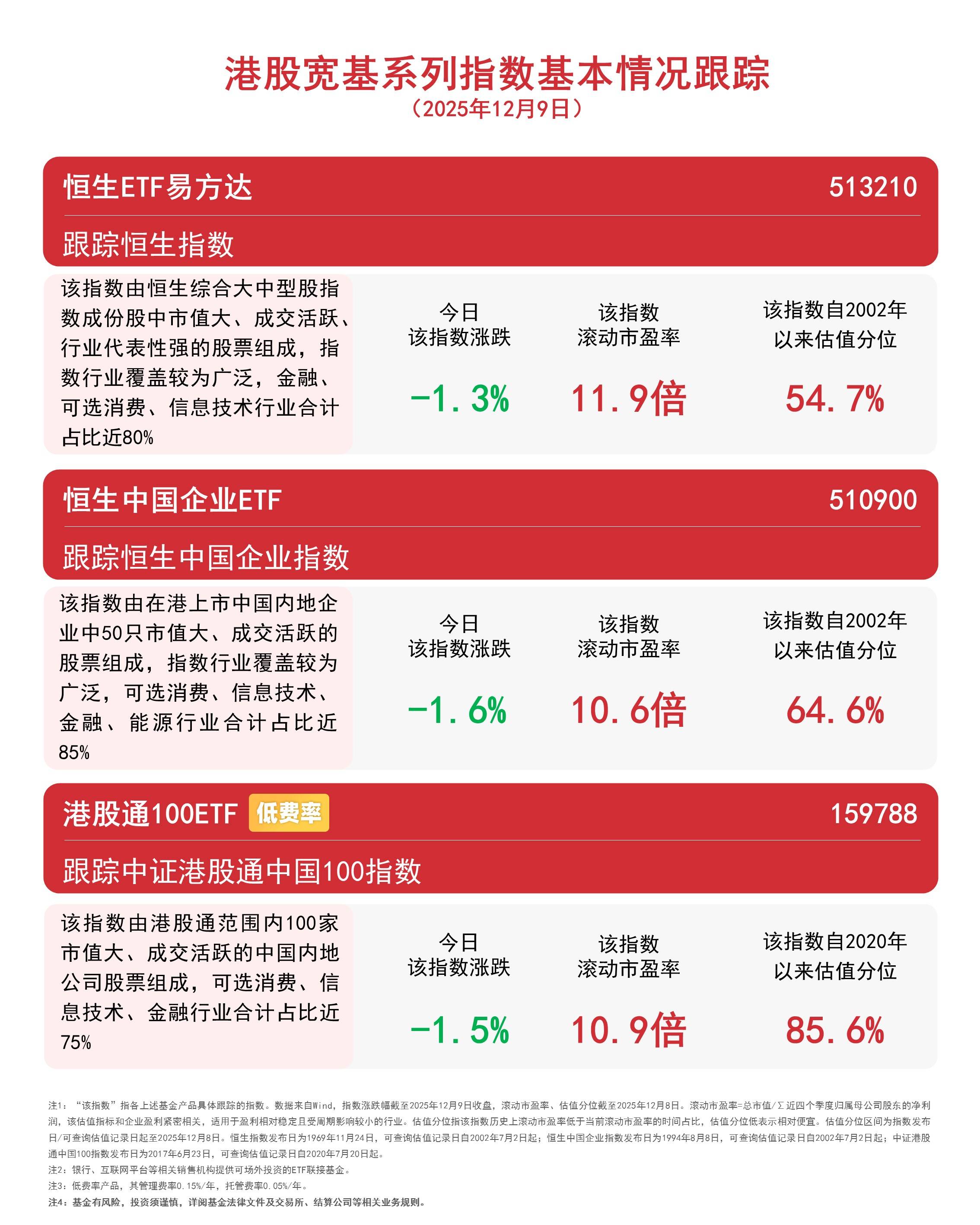
港股宽基指数延续调整,关注恒生中国企业ETF(510900)等产品投资价值
Sou Hu Cai Jing· 2025-12-09 10:12
Group 1 - The Hang Seng Index fell by 1.3%, the Hang Seng China Enterprises Index decreased by 1.6%, and the CSI Hong Kong Stock Connect China 100 Index dropped by 1.5% [1] - China Galaxy Securities' report suggests that the upcoming important domestic meetings in December and the Federal Reserve's interest rate meeting are expected to provide medium to long-term policy direction and short-term liquidity signals for the Hong Kong stock market [1] - The report recommends focusing on sectors such as precious metals, domestic consumption, and technology growth for investment opportunities [1]
跌破眼镜?沃尔玛今迁至纳斯达克上市,零售巨无霸转型科技企业
Feng Huang Wang· 2025-12-09 07:51
Core Insights - Walmart is migrating from the New York Stock Exchange to the Nasdaq, marking the largest exchange migration in U.S. history, which has garnered global attention [1] - The move reflects Walmart's strategy to align itself with high-tech narratives, as it aims to present itself as a company that integrates traditional retail with AI automation [1][3] - This transition is expected to enhance Walmart's valuation and attract passive investment funds by potentially including it in the Nasdaq-100 index [1][3] Company Strategy - Walmart has historically been viewed as a traditional retail giant, but it is now emphasizing its investments in automation and AI to reshape its image [3][5] - The company aims to position itself as a direct competitor to Amazon rather than other discount retailers like Costco or Target, indicating a shift in retail paradigms where technology is becoming more critical than store count [5][6] - In its third-quarter earnings call, Walmart reported that over 60% of its goods are transported through automated distribution centers, and more than 40% of new software code is generated or assisted by AI [5][6] Market Implications - The migration to Nasdaq is seen as a strategic move to signal to traders and investors that Walmart is a serious competitor in the tech-driven retail space [3][5] - By joining Nasdaq, Walmart is expected to attract more passive capital and enhance its brand as a "tech retail" entity, aligning itself with other tech giants [6] - The cost of listing on Nasdaq is generally lower than on the NYSE, which aligns with Walmart's cost-saving ethos, even if the financial impact is minimal for such a large company [6]
【环球财经】东京股市两大股指微幅上涨
Xin Hua Cai Jing· 2025-12-09 07:32
Core Points - The Tokyo stock market experienced slight gains on December 9, with the Nikkei 225 index rising by 0.14% and the Tokyo Stock Exchange index increasing by 0.02% [1][2] - The market opened higher but quickly turned to decline due to increased selling pressure from major tech stocks like Advantest and SoftBank Group, leading to fluctuations around the previous day's closing levels [1] - Investor sentiment is cautious as they await upcoming monetary policy announcements from major central banks, resulting in adjustments to their holdings in key stocks [1] Market Performance - The Nikkei index closed up by 73.16 points at 50655.10 points, while the Tokyo Stock Exchange index rose by 0.61 points to 3384.92 points [2] - Among the 33 industry sectors on the Tokyo Stock Exchange, most sectors saw declines, with notable losses in other products, real estate, and pulp and paper sectors [2] - Conversely, sectors such as rubber products, marine transportation, and pharmaceuticals experienced gains [2]