
商贸零售

Search documents
机构论后市丨预计指数整体维持震荡;关注银行等偏防守板块
Di Yi Cai Jing· 2025-06-08 09:58
Group 1 - The liquidity of the Hong Kong stock market continues to improve, presenting good opportunities for increasing positions during market fluctuations [1] - A-shares have shown strong performance, with the median increase in A-shares being the highest since 2022, particularly favoring smaller market capitalization stocks [2] - Consumer sectors are expected to remain a key driver of economic recovery, with domestic policies focusing on expanding domestic demand [3] Group 2 - Investment strategies should focus on traditional capacity reduction, the rise of new consumption, and sectors with high industry prosperity [2] - Defensive sectors such as banking are recommended for short-term stability, given the uncertain environment surrounding tariff negotiations [4] - The overall market index is expected to maintain a volatile trend, with external risks having potentially peaked [3]



本周超120只标的获券商推荐买入
Zhong Guo Zheng Quan Bao· 2025-06-06 21:00
Core Viewpoint - The A-share market showed a rebound in the first trading week of June, with over 125 stocks receiving "buy" ratings from brokerages, indicating a positive outlook for various sectors, particularly electronics, automotive, and power equipment [1][2]. Group 1: Market Performance - The A-share indices experienced a fluctuating upward trend from June 3 to June 6, with brokerages actively researching investment opportunities [1]. - By June 6, 125 stocks had received "buy" ratings, with notable interest in the electronics, automotive, and power equipment sectors [2]. Group 2: Sector Highlights - The electronics sector had the highest number of recommended stocks, totaling 23, including companies like Hengxuan Technology and BOE Technology Group [3]. - The automotive sector, particularly Great Wall Motors, received significant attention, with four brokerages issuing "buy" ratings due to a recovery in sales driven by new product launches [1][2]. - Power equipment companies are gaining traction as high temperatures increase market focus on electricity operators, with expectations of improved profitability [4]. Group 3: Investment Opportunities - The storage chip industry is viewed positively, with expectations of a recovery driven by rising demand for advanced computing chips and normalization of inventory levels [4]. - The automotive industry is expected to benefit from advancements in L4 autonomous driving technology, with recommendations to focus on fleet operators, leading component suppliers, and leading manufacturers in smart driving [5].

兴业期货日度策略-20250606
Xing Ye Qi Huo· 2025-06-06 11:45
Report Industry Investment Ratings No specific industry investment ratings are provided in the report. Core Viewpoints - The market risk preference may continue to rise after the positive signal from the Sino-US presidential call, and the stock index has a clear upward trend in shock, but short - term upward breakthrough needs further accumulation of capital and policy benefits [1]. - The central bank's intention to protect liquidity is clear, the short - end expectation of bonds has improved, but the long - end is weak, and the bond market is in an interval shock [1]. - Gold is affected by short - term risk aversion and long - term favorable factors yet to ferment, showing a shock - strong trend; silver is supported by the high gold - silver ratio [4]. - Copper price is affected by the macro - environment, with supply constraints and cautious demand expectations, and is in an interval shock [4]. - Alumina price is under pressure due to the resumption of production capacity and sufficient ore inventory [4]. - Nickel price is in an interval shock due to the balance between supply recovery and resource - country policy support [4]. - Lithium price is in a weak shock due to oversupply [6]. - Metal silicon industry is expected to accumulate inventory, and the short - term rebound height is limited [6]. - The black building materials sector is affected by macro - events and fundamentals, with prices in shock, and some varieties can hold corresponding option positions [6]. - Coal and coke prices are at the bottom and in shock due to oversupply and weak demand [9]. - Soda ash and float glass are in a shock - weak situation due to oversupply and lack of demand improvement [9]. - Oil price is in a weak shock with a downward center of gravity due to OPEC+ production increase and inventory changes [9]. - PTA supply increases and demand is weak, showing a weak shock trend [11]. - Methanol price may fall due to seasonal demand and import changes [11]. - Polyolefin price is in a downward trend due to supply increase and demand decline [11]. - Cotton price is in an interval shock due to good supply prospects and weak demand [11]. - Rubber price is in a weak shock due to weak demand and seasonal production increase [13]. Summary by Categories Stock Index - The A - share market has been strengthening this week, with trading volume increasing. The stock index is in a shock - upward trend, but short - term breakthrough needs more favorable factors [1]. Treasury Bond - The performance of treasury bonds was differentiated yesterday, with the long - end weak and the short - end strong. The central bank's operation affects market expectations, and the bond market is in an interval shock [1]. Precious Metals - Gold is affected by short - term risk aversion and long - term favorable factors yet to ferment, showing a shock - strong trend. Silver is supported by the high gold - silver ratio, and one can hold short - position out - of - the - money put options [4]. Non - ferrous Metals - **Copper**: Affected by the macro - environment, with supply constraints and cautious demand expectations, copper price is in an interval shock [4]. - **Aluminum and Alumina**: Alumina price is under pressure due to the resumption of production capacity and sufficient ore inventory. Aluminum has supply constraints but demand uncertainty [4]. - **Nickel**: Nickel price is in an interval shock due to the balance between supply recovery and resource - country policy support [4]. Energy and Chemicals - **Lithium**: Lithium price is in a weak shock due to oversupply [6]. - **Metal Silicon**: The metal silicon industry is expected to accumulate inventory, and the short - term rebound height is limited [6]. - **Crude Oil**: Oil price is in a weak shock with a downward center of gravity due to OPEC+ production increase and inventory changes [9]. - **PTA**: PTA supply increases and demand is weak, showing a weak shock trend [11]. - **Methanol**: Methanol price may fall due to seasonal demand and import changes [11]. - **Polyolefin**: Polyolefin price is in a downward trend due to supply increase and demand decline [11]. Black Building Materials - **Steel and Ore**: The black building materials sector is affected by macro - events and fundamentals, with prices in shock. Some varieties can hold corresponding option positions [6]. - **Coal and Coke**: Coal and coke prices are at the bottom and in shock due to oversupply and weak demand [9]. - **Soda Ash and Float Glass**: Soda ash and float glass are in a shock - weak situation due to oversupply and lack of demand improvement [9]. Agricultural Products - **Cotton**: Cotton price is in an interval shock due to good supply prospects and weak demand [11]. - **Rubber**: Rubber price is in a weak shock due to weak demand and seasonal production increase [13].
非金融企业类公募债发行人2024年流动性风险跟踪
Yuan Dong Zi Xin· 2025-06-06 11:26
1. Report Industry Investment Rating No relevant content provided. 2. Core Viewpoints of the Report - The report comprehensively assesses the liquidity risk of non - financial enterprises in 2024 from three dimensions: the profit basis of liquidity creation, financial flexibility, and short - term liquidity. Overall, the liquidity risk of non - financial enterprise - class public bond issuers has increased, with significant differences at the enterprise, industry, and regional levels [3][6][8]. - At the enterprise level, in 2024, although the financial flexibility of enterprises has marginally improved, overall profitability has continued to weaken, short - term liquidity is under pressure, and the liquidity risk has further increased, with intensified pressure on tail enterprises [6]. - At the industry level, in 2024, against the backdrop of shrinking terminal demand and continuous pressure on the entire real - estate chain, liquidity risks have significantly accumulated in industries related to the upstream and downstream of real estate and urban investment platforms deeply tied to land finance. Industries such as building decoration, urban investment, steel, commerce and retail, basic chemicals, and real estate have relatively high liquidity risks, and the risks in basic chemicals, steel, coal, and real estate have risen rapidly compared to 2023 [6]. - At the regional level, in 2024, Guangxi, Henan, Shaanxi, Fujian, Zhejiang, and Xinjiang have relatively high liquidity risks. Compared to 2023, the liquidity risks in Tianjin, Yunnan, Shandong, Hunan, Guangdong, Sichuan, Guangxi, and Shaanxi have improved, with Tianjin showing a significant improvement [6]. 3. Summary by Relevant Catalogs 3.1. Construction of the Liquidity Risk Measurement System from the Perspective of Debt Repayment Credit - The assessment of liquidity risk from the perspective of debt - repayment credit is mainly based on the analysis of liquidity sources and applications. Enterprises with good profitability, high financial flexibility, and strong short - term solvency generally face lower liquidity and default risks. The report selects several quantitative financial indicators from three dimensions (profit basis of liquidity creation, financial flexibility, and short - term liquidity) for basic evaluation and maps the scores to a five - level classification of liquidity risk evaluation results (L1 - L5) [4][9][12]. - The basic evaluation indicators include total asset return rate, asset - liability ratio, short - term debt ratio, EBIT/interest expense, (EBITDA - capital expenditure)/interest expense, operating cash flow net amount to current liability ratio, cash - to - short - term debt ratio, current ratio, and cash - to - current liability ratio [11]. 3.2. Sample Overview - Considering data availability, the report selects bond - issuing entities with outstanding public bonds (enterprise bonds, corporate bonds, medium - term notes, commercial paper, project revenue notes) as of May 26, 2025, excluding those that have experienced material defaults or have unavailable financial data. A total of 3,061 issuing entities are used as sample data, and their annual reports from 2021 - 2024 are used for analysis. Currently, the issuing entities of outstanding public bonds in China are mainly urban investment and state - owned enterprises [5][13]. 3.3. Analysis of the Liquidity Risk of Non - Financial Enterprise - Class Public Bond Issuers in 2024 3.3.1. Enterprise - Level Analysis - In 2024, the risk center of public bond - issuing entities has further deteriorated, and the proportion of tail enterprises has reached a new high. The overall profitability of enterprises has weakened, with the total profit of industrial enterprises above designated size decreasing by 3.3% compared to the previous year. The proportion of entities with liquidity risk evaluation results of L4 and L5 has increased from 49.0% and 5.4% in 2023 to 52.3% and 7.4% in 2024, respectively [14]. - From the perspective of each indicator dimension, in 2024, the profitability of public bond issuers in China has continued to decline, and the coverage ability of operating cash flow has weakened. Although the financial flexibility has marginally improved, the short - term debt pressure remains high, and the short - term liquidity has generally tightened [20][21]. 3.3.2. Industry - Level Analysis - In 2024, industries such as building decoration, urban investment, steel, commerce and retail, basic chemicals, and real estate have relatively high liquidity risks, with the proportion of L4 and L5 enterprises in each industry exceeding 60%. Compared to 2023, the liquidity risks in basic chemicals, steel, coal, and real estate have risen rapidly, with the proportion of L4 and L5 enterprises increasing by more than 10 percentage points [23][24]. - The real - estate industry continues to adjust, with real - estate enterprises facing significant cash - flow pressure due to factors such as weakening demand, cautious development strategies, and high inventory [25]. - The steel industry has seen a decline in production and demand, with prices falling and enterprises facing significant performance pressure and increased liquidity risks [26]. - The basic chemicals industry is in a low - prosperity stage, facing challenges such as over - capacity and weak domestic demand, with the overall profitability under pressure [27]. - The building decoration industry is affected by weak downstream demand, with a decline in new contracts and increased pressure on construction funds, especially for weak - quality tail enterprises [28]. - The commerce and retail industry has been affected by weakening consumer demand, with profit pressure on enterprises [29]. - Urban investment platforms face continued pressure on local finance due to the adjustment of the land market, and although the asset and debt structure has been optimized, the internal operating pressure remains, and the liquidity risk of some weak - quality entities has increased [29]. 3.3.3. Regional - Level Analysis - In 2024, regions such as Guangxi, Henan, Shaanxi, Fujian, Zhejiang, and Xinjiang have relatively high liquidity risks, with the proportion of L4 and L5 enterprises exceeding 70%. Compared to 2023, the liquidity risks in Tianjin, Yunnan, Shandong, Hunan, Guangdong, Sichuan, Guangxi, and Shaanxi have improved, with Tianjin showing a significant improvement [33][36].
资金情绪持续回暖 A股市场连日反弹
Zhong Guo Zheng Quan Bao· 2025-06-04 21:16
Market Overview - A-share market continued to rebound on June 4, with all three major indices opening higher and closing positively, particularly the ChiNext Index which rose over 1% [1][2] - The total trading volume reached 1.18 trillion yuan, with nearly 4,000 stocks rising and over 80 stocks hitting the daily limit [1][2] - The market is currently in a repair phase, supported by a series of domestic policies, limiting the adjustment space [1][5] Sector Performance - The consumer sector saw significant activity, with beauty care, textiles, and retail sectors leading the gains, with increases of 2.63%, 2.53%, and 2.41% respectively [2][3] - Solid-state battery and optical module sectors also performed well, contributing to the overall market rebound [1][2] - A total of 32 stocks reached historical highs, predominantly from the banking, pharmaceutical, and food and beverage sectors [3] Fund Flow - On June 4, the net inflow of main funds in the CSI 300 exceeded 3 billion yuan, indicating a recovery in market sentiment [3][4] - Among the 13 sectors with net inflows, electronics, communications, and power equipment led with inflows of 22.99 billion yuan, 13.48 billion yuan, and 11.00 billion yuan respectively [4] - Conversely, sectors such as defense, pharmaceuticals, and automotive experienced net outflows [4] Investment Strategy - Analysts suggest focusing on high-performance consumer leaders and traditional companies with new consumption thinking, as they may benefit from structural opportunities [3][5] - The current market environment is characterized by a focus on safety and stability, with recommendations to invest in dividend-paying stocks and technology sectors [5][6] - The upcoming Lujiazui Forum is expected to announce significant financial policies that could support market expectations [5]
A股震荡走强!科技与消费“双轮驱动”
Guo Ji Jin Rong Bao· 2025-06-04 15:36
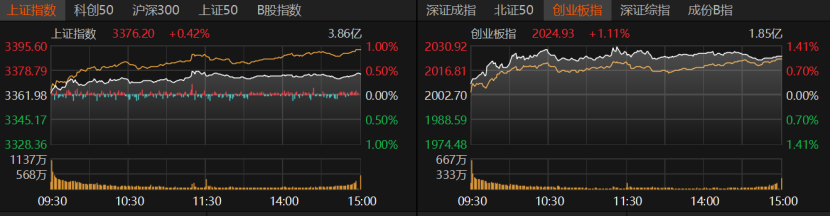
6月4日,A股市场整体表现积极,指数、板块及个股收涨居多。其中,消费和科技股表现亮眼,而通用航空和大飞机 板块则微跌。 今日震荡走强 A股继续震荡走高,沪指收涨0.42%报3376.2点,创业板指收涨1.11%报2024.93点。科创50、沪深300、上证50均微涨, 北证50涨逾1%。交易量微增,今日A股日成交额共计1.18万亿元。 A股共计3963只个股收涨,涨停股86只;1238只个股收跌,跌停股2只。 31个申万一级行业板块中,仅有交通运输、国防军工、公用事业板块微跌,其余飘红。消费、科技股表现亮眼,美容 护理、综合、纺织服饰板块涨幅均超过2%,通信、商贸零售、电子等板块涨幅超过1%。轻工制造板块掀起涨停潮, 嘉美包装(002969)等10只个股涨停,其中金陵体育(300651)20cm涨停。 | 名称 | ● | 涨幅% ↓ | 涨停家数 | 年初至今涨幅% | 5日涨幅% | 10日涨幅% | 下跌家数 | | --- | --- | --- | --- | --- | --- | --- | --- | | 昨日涨停 含- | 字 | 3.58 | 25 | 491.79 | 12.44 | 1 ...

关税担忧再起,内需韧性支撑 - “策略周中谈”
2025-06-04 15:25
Summary of Key Points from Conference Call Records Industry or Company Involved - The discussion primarily revolves around the Chinese market, U.S.-China trade relations, and various sectors including consumer goods, technology, and dividend stocks. Core Points and Arguments 1. **U.S.-China Tariff Concerns** The U.S. has increased tariff threats against China, particularly targeting AI and chip design software exports, which may disrupt trade negotiations and worsen U.S.-China relations [1][3][4] 2. **Short-term Tariff Impact** The likelihood of imposing new tariffs in the short term is low due to the U.S. retail sector's peak ordering season, with a 90-day grace period before any potential tariffs take effect. However, risks may rise post-grace period [5][6] 3. **Judicial Intervention in Trade** The U.S. judicial system's involvement in trade disputes may gradually reduce the extremity of tariff increases, indicating a potential shift in tariff authority back to Congress in the long term [6] 4. **Dividend Stocks in June** June typically sees seasonal pressure on dividend stocks due to profit-taking, leading to lower excess returns and win rates despite being a peak dividend distribution period [7][8] 5. **Long-term Outlook for Dividend Stocks** Despite short-term volatility, dividend stocks remain strategically significant in a low-interest-rate environment, with high dividend yields observed in indices [9] 6. **Focus on Emerging Consumption Sectors** The market is currently focused on service consumption, new consumption, and biomedicine, which are supported by policies and show strong performance. Notable companies in these sectors are less crowded, presenting investment opportunities [10][11] 7. **Weakness in Traditional Consumer Sectors** Traditional consumer sectors like home appliances and automobiles are underperforming due to declining consumer interest and the cessation of government subsidies, leading to concerns about their future growth [12][13] 8. **Technology Sector Trends** The technology sector is expected to rebound in the short term, with a long-term focus on significant capital expenditures and breakthroughs in areas like AI and robotics [14] 9. **Anti-Tariff Themes** The anti-tariff theme is performing steadily, with sectors like rare earths benefiting. The market is gradually desensitizing to tariff concerns, avoiding significant volatility [15] 10. **Recommended Industries** Key recommended industries include beauty care, biomedicine, computing, non-ferrous metals, social services, agriculture, defense, and retail, all of which are seen as having good growth potential [16][17] 11. **Market Outlook** The market is expected to remain in a narrow fluctuation pattern, supported by domestic demand resilience, with a focus on service consumption and emerging sectors as key growth drivers [18]
金融工程日报:A股延续上涨,黄金珠宝概念再度上行、算力产业链集体反弹-20250604
Guoxin Securities· 2025-06-04 15:03
The provided content does not contain any specific quantitative models or factors, nor does it include their construction processes, formulas, evaluations, or backtesting results. The documents primarily focus on market performance, sector analysis, ETF premiums/discounts, institutional activity, and other market-related data. There are no references to quantitative models or factors in the provided text.
【4日资金路线图】沪深300主力资金净流入超30亿元 电子等行业实现净流入
证券时报· 2025-06-04 10:52
6月4日,A股市场整体上涨。截至收盘,上证指数收报3376.2点,上涨0.42%;深证成指收报10144.58点,上涨 0.87%;创业板指收报2024.93点,上涨1.11%。两市合计成交11530.47亿元,较上一交易日增加116.38亿元。 1. 两市全天主力资金净流出近3亿元 | | | 沪深两市最近五个交易日主力资金流向情况(亿元) | | | | --- | --- | --- | --- | --- | | 日期 | | 净流入金额 开盘净流入 | 人得发起 | 超大单净买入 | | 2025-6-4 | -2. 61 | -33.75 | -0. 29 | 23. 41 | | 2025-6-3 | -91. 89 | -39. 38 | -8. 11 | -25. 46 | | 2025-5-30 | -352. 62 | -158. 05 | -37.83 | -193. 19 | | 2025-5-29 | 74. 33 | -19.58 | 23.89 | 121. 48 | | 2025-5-28 | -185. 39 | -73. 21 | -22. 45 | -57. 58 | ...

金融工程定期:港股量化:5月南下资金净流入有所放缓,6月增配价值
KAIYUAN SECURITIES· 2025-06-04 06:13
Quantitative Models and Construction Methods 1. Model Name: Hong Kong Stock Multi-Factor Model - **Model Construction Idea**: The model integrates four categories of factors: technical, capital flow, fundamental, and analyst expectations, to evaluate Hong Kong Stock Connect constituent stocks[38][39] - **Model Construction Process**: 1. Select Hong Kong Stock Connect constituent stocks as the sample universe 2. Construct four categories of factors: - **Technical factors**: Indicators derived from price and volume data - **Capital flow factors**: Metrics based on fund flow data, such as net inflow - **Fundamental factors**: Metrics like valuation ratios (e.g., PE, PB) and profitability indicators (e.g., ROE) - **Analyst expectation factors**: Metrics based on analyst ratings and earnings forecasts 3. Combine these factors into a composite score for each stock 4. Rank stocks based on their composite scores and select the top 20 stocks to form the portfolio[38][39][40] - **Model Evaluation**: The model demonstrates strong performance in historical backtesting, with significant excess returns over the benchmark[38][40] 2. Model Name: Hong Kong Stock Preferred 20 Portfolio - **Model Construction Idea**: This portfolio is constructed monthly by selecting the top 20 stocks with the highest composite scores from the multi-factor model, using equal weighting[40] - **Model Construction Process**: 1. At the end of each month, rank stocks based on their composite scores from the multi-factor model 2. Select the top 20 stocks 3. Allocate equal weights to each stock in the portfolio 4. Use the Hong Kong Composite Index (HKD, 930930.CSI) as the benchmark for performance comparison[40] - **Model Evaluation**: The portfolio has shown robust performance over the long term, with a high excess annualized return and a stable risk-return profile[40][44] --- Model Backtesting Results 1. Hong Kong Stock Multi-Factor Model - **Excess Annualized Return**: 13.3% (2015.1–2025.5)[40][44] - **Excess Annualized Volatility**: 13.4%[44] - **Excess Sharpe Ratio**: 1.0[44] - **Maximum Drawdown**: 18.2%[44] 2. Hong Kong Stock Preferred 20 Portfolio - **May 2025 Monthly Return**: 2.44%[40] - **May 2025 Excess Return**: -2.36% (Benchmark return: 4.80%)[40] - **Excess Annualized Return**: 13.3% (2015.1–2025.5)[40][44] - **Excess Annualized Volatility**: 13.4%[44] - **Excess Sharpe Ratio**: 1.0[44] - **Maximum Drawdown**: 18.2%[44] --- Quantitative Factors and Construction Methods 1. Factor Name: Technical Factors - **Factor Construction Idea**: Derived from price and volume data to capture market trends and momentum[38][39] - **Factor Construction Process**: 1. Calculate indicators such as moving averages, RSI, and MACD 2. Normalize and rank the indicators across the stock universe 3. Combine the normalized scores into a composite technical factor score[38][39] 2. Factor Name: Capital Flow Factors - **Factor Construction Idea**: Based on fund flow data to identify stocks with strong capital inflows[38][39] - **Factor Construction Process**: 1. Measure net fund inflows for each stock 2. Normalize and rank the net inflow data 3. Combine the normalized scores into a composite capital flow factor score[38][39] 3. Factor Name: Fundamental Factors - **Factor Construction Idea**: Focused on valuation and profitability metrics to identify undervalued stocks with strong fundamentals[38][39] - **Factor Construction Process**: 1. Calculate valuation ratios (e.g., PE, PB) and profitability indicators (e.g., ROE) 2. Normalize and rank these metrics across the stock universe 3. Combine the normalized scores into a composite fundamental factor score[38][39] 4. Factor Name: Analyst Expectation Factors - **Factor Construction Idea**: Based on analyst ratings and earnings forecasts to capture market sentiment and expectations[38][39] - **Factor Construction Process**: 1. Collect analyst ratings and earnings forecast data 2. Normalize and rank the data 3. Combine the normalized scores into a composite analyst expectation factor score[38][39] --- Factor Backtesting Results 1. Technical Factors - **Performance**: Demonstrated strong predictive power in identifying stocks with upward momentum[38][39] 2. Capital Flow Factors - **Performance**: Effective in capturing stocks with significant fund inflows, indicating strong market interest[38][39] 3. Fundamental Factors - **Performance**: Successfully identified undervalued stocks with robust financial performance[38][39] 4. Analyst Expectation Factors - **Performance**: Provided valuable insights into market sentiment and future earnings potential[38][39]