建筑

Search documents
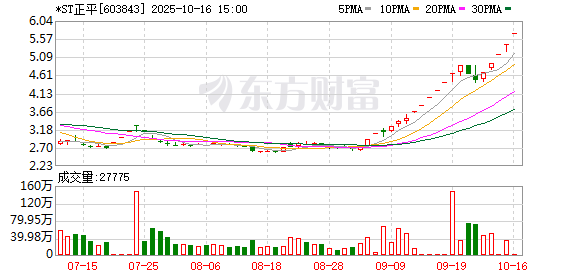
*ST正平:公司股价上涨过快,严重脱离基本面,积累了较高交易风险
Di Yi Cai Jing· 2025-10-16 10:55
Core Points - The company *ST Zhengping issued a stock trading risk warning, stating that its stock price increased by 101.86% from September 1 to September 30, 2025, with 15 days of trading limits and 4 instances of abnormal trading fluctuations [2] - The company conducted a suspension review of the abnormal trading fluctuations during this period and disclosed the results on October 16, 2025, after which the stock resumed trading and hit the trading limit again on the same day [2] - The short-term price increase of the company's stock shows a significant deviation from the Shanghai Composite Index and the construction industry, indicating that the stock price has risen too quickly and is severely detached from its fundamentals, accumulating high trading risks [2]


官方建立机制鼓励事故隐患内部报告 发放奖励金额近6亿元
Zhong Guo Xin Wen Wang· 2025-10-16 05:53
Core Insights - The establishment of an internal reporting reward mechanism for accident hazards has led to significant progress, with approximately 800 million hazards identified and rectified, and rewards totaling around 590 million yuan issued as of the end of Q3 this year [1][2] Group 1: Implementation and Progress - The mechanism has been actively promoted across various regions and departments, resulting in a comprehensive approach to safety management [1] - By the end of Q3, 99.5% of production units in 14 key industries had established the reporting mechanism, with all provinces achieving 100% compliance, except for a few inactive units [1][2] Group 2: Impact on Safety Culture - The reward system has effectively motivated employees, particularly in high-risk sectors such as chemicals, mining, construction, and transportation, where over two-thirds of the total rewards were distributed [2] - The initiative aims to encourage companies to take proactive measures in safety management, fostering a culture of shared responsibility among employees [2]
美联储最新调查:关税政策推动全美物价普涨
Sou Hu Cai Jing· 2025-10-16 05:44
Core Insights - The latest regional economic survey by the Federal Reserve indicates ongoing inflationary pressures across the U.S., primarily driven by import tariff policies [1][2] - The survey highlights a cautious outlook on economic prospects, with uncertainty factors potentially suppressing economic activity [1][2] Group 1: Inflation and Costs - Import costs and service fees, including technical services and health insurance, have risen across most regions, with some manufacturing and retail businesses passing these costs onto consumers [1] - The trade-weighted average tariff rate on U.S. products has increased significantly from 2.44% at the beginning of the year to 17.9% by mid-September [1] Group 2: Labor Market Dynamics - The labor market is experiencing a dual challenge: weak demand for labor across various sectors due to economic uncertainty and increased automation, alongside labor shortages in labor-intensive industries like hospitality, agriculture, and construction due to immigration policy changes [1][2] - Companies are resorting to layoffs and natural attrition to manage workforce sizes in response to the unclear economic outlook and the rise of artificial intelligence [1] Group 3: Policy Implications - The findings from this survey will inform the Federal Reserve's upcoming monetary policy decisions, emphasizing the need for a delicate balance between controlling inflation and sustaining economic growth amid protectionist policies and structural labor market challenges [2]
应急管理部:前三季度全国各类生产安全事故同比下降20.8%
Zhong Guo Xin Wen Wang· 2025-10-16 03:04
Group 1 - The core viewpoint is that the overall safety production situation in China has improved, with a significant decrease in various types of production safety accidents in the first three quarters of the year [1] - A total of 13,442 production safety accidents occurred, resulting in 12,804 deaths, representing a year-on-year decrease of 20.8% and 16.2% respectively [1] - Major accidents numbered 6 with 96 fatalities, showing a year-on-year decline of 14.3% in the number of major accidents and 20.7% in fatalities [1] Group 2 - The construction industry saw a decrease in total accidents, but significant accidents occurred in railway engineering, with frequent incidents of site collapses, falls from heights, and poisoning [2] - The transportation sector experienced a continuous decline in total accidents, although major accidents in water transport and several serious road incidents were reported [2] - The mining industry maintained a stable safety production situation, but illegal mining activities led to several significant accidents due to inadequate risk management [2] Group 3 - The chemical industry reported a decrease in both total accidents and major incidents, although violations during maintenance work and illegal production of hazardous chemicals posed significant safety risks [2] - Major fire accidents occurred in crowded places, particularly in restaurants and commercial venues, indicating a need for improved fire safety measures [2]
建筑企业购货不签订合同,用订货单的方式是否需要缴纳印花税?
蓝色柳林财税室· 2025-10-16 00:56
Group 1 - The article discusses the implementation of new tax reporting requirements for enterprises in Shanxi Province, effective from October 1, 2025, including changes to the corporate income tax prepayment declaration forms [8][11]. - Internet platform enterprises are required to report the identity and income information of operators and employees within their platforms between October 1 and October 31, 2025 [9][10]. - The corporate income tax prepayment declaration form will include new items such as "tax credit amount" and "income from sales of unfinished products," reflecting adjustments in tax calculation methods [8][11]. Group 2 - The article emphasizes the importance of electronic tax services, encouraging taxpayers to utilize the electronic tax bureau or app for tax payments and inquiries, with remote assistance available if needed [12][14]. - Taxpayers are reminded of various tax payment deadlines, including value-added tax, consumption tax, and individual income tax, with specific dates outlined for different types of taxes [7].

研究推进美丽北京建设持续深入打好污染防治攻坚战等事项
Bei Jing Ri Bao Ke Hu Duan· 2025-10-15 23:49
Group 1 - The meeting emphasized the importance of pollution prevention and control, aiming to achieve annual and "14th Five-Year Plan" goals, and to continuously improve the ecological environment quality in the capital [2][3] - Key tasks include winning the blue sky defense battle, enhancing air pollution control, and promoting the use of new energy vehicles, especially for old vehicles and non-road mobile machinery [2] - The meeting highlighted the need for strict supervision and enforcement in construction sites and road transport to prevent pollution, as well as the protection of water sources and soil environment [2] Group 2 - The fourth quarter is identified as a critical period for achieving annual goals and the "14th Five-Year Plan" completion, with a focus on economic stability and growth [3] - The meeting called for optimizing the business environment, enhancing talent services, and providing policy support to help enterprises overcome difficulties and improve competitiveness [3] - Emphasis was placed on expanding effective investment and planning major projects to play a key role in stabilizing growth [3]
国内高频 | 生产回落、出行走强 (申万宏观·赵伟团队)
赵伟宏观探索· 2025-10-15 16:03
Group 1: Industrial Production Trends - The industrial production has shown a slight decline, with high furnace operation rates remaining high but experiencing a week-on-week stability at 84.3%, and a year-on-year decrease of 1.2 percentage points to 83.4% [2] - The apparent consumption of steel has decreased significantly, with a week-on-week drop of 18.7% and a year-on-year decline of 29.8% to 17.6% [2] - The inventory of steel has increased by 6.5% week-on-week [2] Group 2: Midstream Production Insights - The operating rates in the petrochemical and automotive sectors have declined, with the soda ash operating rate decreasing by 0.8% week-on-week to 88.4%, and a year-on-year drop of 1.5 percentage points to 0.6% [7] - The textile industry has also seen a decrease, with PTA operating rates increasing by 1% to 77.5% week-on-week but down 2.9 percentage points year-on-year to 5.6% [7] - The operating rate for automotive semi-steel tires has dropped significantly, down 27.1% week-on-week to 46.5%, and down 22.9 percentage points year-on-year to 28.5% [7] Group 3: Construction Industry Performance - Cement demand has decreased, with the cement shipment rate falling by 3% week-on-week to 44.3%, and a year-on-year decline of 4.9 percentage points to 9.1% [14] - The cement inventory ratio has slightly increased, with a year-on-year rise of 1.4 percentage points to 1.4% [14] - The average price of cement has seen a slight increase during the week [14] Group 4: Demand Tracking - The transaction volume of commercial housing has improved, with the average daily transaction area in 30 major cities decreasing by 55.7% week-on-week but increasing by 21.3 percentage points year-on-year to 0.3% [30] - The freight volume related to domestic demand has shown weakness, with road freight volume down 25.6% year-on-year to 15.9% [37] - Passenger travel remains high, with the migration scale index at a high level, increasing by 37.2 percentage points year-on-year to 62.4% [46] Group 5: Price Trends - Agricultural product prices have generally declined, with prices for eggs, vegetables, and pork decreasing by 3.4%, 2.4%, and 0.3% respectively [65] - The industrial product price index has shown a mixed trend, with the Nanhua industrial product price index down 0.2% week-on-week, while the energy and chemical price index decreased by 2% [75]
北京市政府召开常务会议,研究推进美丽北京建设持续深入打好污染防治攻坚战等事项
Bei Jing Ri Bao Ke Hu Duan· 2025-10-15 14:29
Core Points - The Beijing municipal government held an executive meeting to discuss the progress of the "Beautiful Beijing" initiative and pollution prevention efforts, emphasizing the importance of achieving annual and "14th Five-Year Plan" goals [1][2] Group 1: Pollution Prevention and Environmental Protection - The meeting stressed the need to accelerate the implementation of key tasks to improve the ecological environment quality in the capital, with a focus on winning the "Blue Sky Defense War" and enhancing air pollution control [2] - Specific measures include deepening autumn and winter air pollution prevention, promoting the electrification of small vehicles, old trucks, and non-road mobile machinery, and advancing the creation of green enterprises [2] - The government will enhance supervision of construction sites and road transport, increase nighttime enforcement inspections, and strictly investigate road spillage [2] - Water pollution prevention will be prioritized, with measures to protect water sources and ensure safe drinking water for urban and rural areas [2] - The meeting highlighted the importance of managing soil environmental risks and preventing new pollution, while also promoting carbon peak and carbon neutrality initiatives [2] Group 2: Economic Growth and Business Environment - The fourth quarter is identified as a critical period for achieving annual goals and completing the "14th Five-Year Plan," with a focus on stabilizing economic growth [3] - The government aims to optimize the business environment by enhancing talent services, industrial support, and policy backing, while actively addressing enterprises' needs [3] - Specific sectors such as catering, accommodation, exhibitions, construction, and cultural entertainment will receive targeted measures to ensure stable growth [3] - The government plans to expand effective investment by implementing, reserving, and planning major projects to play a key role in stabilizing growth [3]
伊朗走投无路
Sou Hu Cai Jing· 2025-10-15 11:20
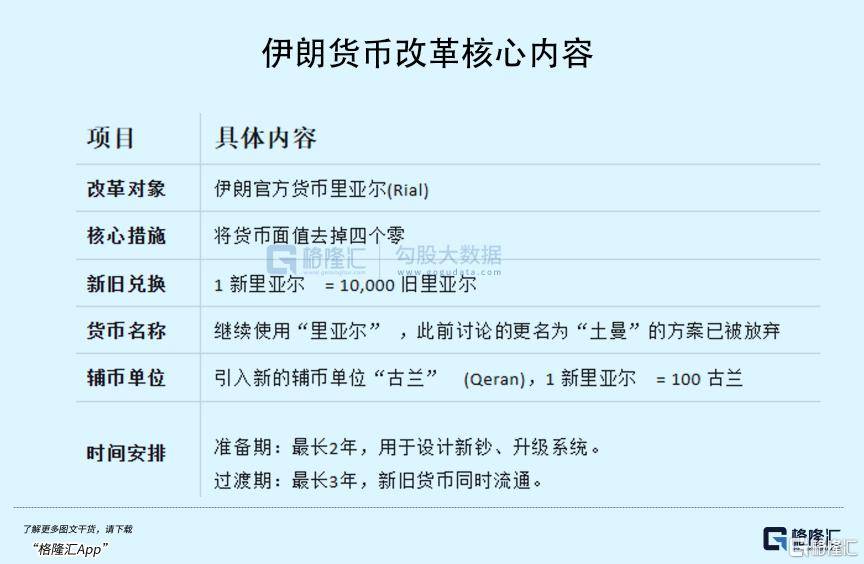
Core Viewpoint - Iran is undergoing a significant currency reform due to hyperinflation, which has led to the devaluation of its currency, the rial, necessitating the removal of four zeros from its face value to simplify transactions and restore some semblance of economic order [4][5][6][8]. Currency Reform - The Iranian parliament has approved a comprehensive reform of the currency system, which includes removing four zeros from the rial [4][5]. - The new exchange rate will be 1 new rial equal to 10,000 old rials, while the currency name will remain "rial" [11]. - A new subunit called "qeran" will be introduced, where 1 new rial equals 100 qeran [11]. - The reform will have a preparation period of up to two years and a transition period of up to three years during which both old and new currencies will circulate [11]. Economic Context - The Iranian economy is facing severe challenges, with a reported economic growth rate of -0.1% in the first quarter of 2025, and significant declines in industrial and agricultural sectors [17]. - Tax revenue for 2025 is projected to be around $12.8 billion, accounting for less than 2.5% of GDP, indicating a near collapse of the tax base [18][19]. - The government has been heavily reliant on borrowing from the central bank, leading to rampant money printing and further devaluation of the rial [52][54]. Structural Issues - The Iranian economy is characterized by a dual structure where religious foundations and the Islamic Revolutionary Guard Corps (IRGC) dominate economic activities, contributing over 50% of GDP but failing to benefit the general populace [48]. - The IRGC has expanded its influence into various sectors, including construction and energy, often without competition due to its privileged status [45][47]. - The economic model has led to a significant wealth gap, with a small elite controlling most resources while the general population suffers from declining purchasing power [40][61]. Historical Perspective - The current situation in Iran contrasts sharply with the historical "Golden Age" of Islam, where leaders were chosen based on merit rather than religious or military power [59]. - The present-day clerical leadership has shifted from moral exemplars to self-serving elites, exacerbating social inequalities and economic mismanagement [60][61].
中国建筑:本次增持计划已实施完毕
Ge Long Hui A P P· 2025-10-15 11:00
格隆汇10月15日|中国建筑:公司控股股东中国建筑集团有限公司拟自公告披露之日起12个月内通过上 海证券交易所交易系统以集中竞价交易方式增持公司A股股份,增持总金额不低于人民币6亿元,不超 过人民币12亿元。中建集团于2024年10月16日至2025年10月15日期间通过上海证券交易所交易系统以集 中竞价交易方式累计增持公司112,185,388股A股股份,占公司总股本比例约为0.27%,增持总金额约为 623,206,575.04元,本次增持计划已实施完毕。 ...