
非银金融

Search documents
市场风格切换了?要调仓吗?最新解读来了
天天基金网· 2025-11-05 05:20
Core Viewpoint - The article discusses the significant style switching in the A-share market observed in November, highlighting the shift from previously strong sectors like metals and new energy to more stable sectors such as banking and public utilities [3][4]. Group 1: Market Trends - In November, the banking sector rose by 2.03%, leading the market, while the previously strong metals sector fell by 3.04% [3]. - Historical data indicates that in bull markets, style switching often occurs at year-end, primarily driven by policy changes, industry trends, and fund rebalancing [4][6]. Group 2: Investment Strategies - Investors are advised to adopt a balanced allocation strategy to navigate the expected market volatility during the style switching period [7]. - Long-term growth in technology stocks remains promising, with macroeconomic factors expected to play a more significant role than valuation metrics [7][8]. Group 3: Sector Recommendations - Certain traditional industries, such as non-bank financials, steel, and basic chemicals, have shown improved capital returns but are currently underappreciated by investors [8]. - The article suggests focusing on sectors benefiting from global manufacturing recovery, including copper, aluminum, and lithium, as well as domestic sectors like coal and food and beverage [8].


市场风格切换了?要调仓吗?券商最新观点出炉
券商中国· 2025-11-05 04:12
Core Viewpoint - The A-share market is experiencing a significant style switch in November, with the banking sector leading the market gains while previously strong sectors like metals and new energy are declining [1][2]. Group 1: Market Trends - On November 4, the banking sector rose by 2.03%, leading the market, while the metals sector fell by 3.04% [1]. - Historical data shows that in bull markets, style switches are common at year-end, primarily driven by policy, industry trends, and fund reallocation [2][3]. Group 2: Institutional Behavior - In the fourth quarter, there is often pressure to realize gains in leading sectors, as these sectors have accumulated significant increases [4]. - As of Q3 2025, the electronic sector's holding ratio reached 25%, and TMT sector holdings exceeded 40%, both at historical highs [4]. Group 3: Investment Strategy - Investors are advised to adopt a balanced allocation strategy to navigate market volatility during the style switch period, while still recognizing the ongoing value in technology growth stocks [5]. - The macroeconomic environment is expected to favor growth stocks due to the anticipated easing of monetary policy in the U.S., which could enhance liquidity [5]. Group 4: Sector Recommendations - Current recommendations include focusing on traditional industries that show improved capital returns, such as non-bank financials, steel, basic chemicals, and machinery, despite their lack of investor interest [5][6]. - The recovery of global manufacturing is uneven but moving towards alignment, with the U.S. benefiting from AI spillover and emerging markets seeing a return of capital and capacity rebuilding [6].
上市公司扎堆派发“半年度红包”,深市超千亿中期分红在路上
Di Yi Cai Jing· 2025-11-05 02:35
Group 1: Overall Market Performance - Over 75% of companies in the Shenzhen market reported profits, with more than 53% showing year-on-year net profit growth [1] - Total operating revenue for Shenzhen companies reached 15.72 trillion yuan, a year-on-year increase of 4.31%, while net profit was 903.02 billion yuan, up 9.69% [1] - The main board companies demonstrated strong resilience, with operating revenue of 12.47 trillion yuan and net profit of 658.36 billion yuan, reflecting a year-on-year increase of 6.68% [1] Group 2: Electronic Industry Performance - The electronic industry in Shenzhen achieved operating revenue of 1.59 trillion yuan, a year-on-year growth of 15.03%, and net profit of 791.22 billion yuan, up 32.12% [2] - The leading companies in the electronic sector, such as Luxshare Precision, reported a net profit of 115.18 billion yuan, growing 27% year-on-year [2] - The semiconductor equipment leader, North Huachuang, saw a net profit of 51.3 billion yuan, reflecting a 15% year-on-year increase [2] Group 3: Power Equipment Industry - The power equipment industry recorded operating revenue of 1.32 trillion yuan, a year-on-year increase of 10%, and net profit of 946.09 billion yuan, up 29.53% [2] Group 4: Communication Industry - The communication sector reported operating revenue of 292.83 billion yuan, a year-on-year growth of 14.29%, and net profit of 30.79 billion yuan, increasing 36.71% [3] - The second and third quarters showed strong quarterly growth in net profit, with increases of 26.22% and 18.70% respectively [3] Group 5: Non-Banking Financial Sector - The non-banking financial sector achieved operating revenue of 213.58 billion yuan, a year-on-year increase of 10.67%, and net profit of 60.85 billion yuan, up 49.03% [3] Group 6: Brokerage Sector - The brokerage sector reported operating revenue of 117.48 billion yuan, a year-on-year increase of 30.05%, and net profit of 50.91 billion yuan, up 77.15% [4] - For example, Dongfang Fortune achieved operating revenue of 11.59 billion yuan, growing 58.67% year-on-year, with net profit increasing by 50.57% [4] Group 7: Shareholder Returns - A total of 507 Shenzhen-listed companies announced mid-term cash dividend plans amounting to 129.11 billion yuan, doubling from the previous year [4] - Companies also increased share buybacks and holdings, with 257 buyback plans totaling 74.57 billion yuan and 106 buyback plans amounting to 26.08 billion yuan [4]

慌,美国政府停摆要引发 “美元荒” ?
3 6 Ke· 2025-11-05 02:27
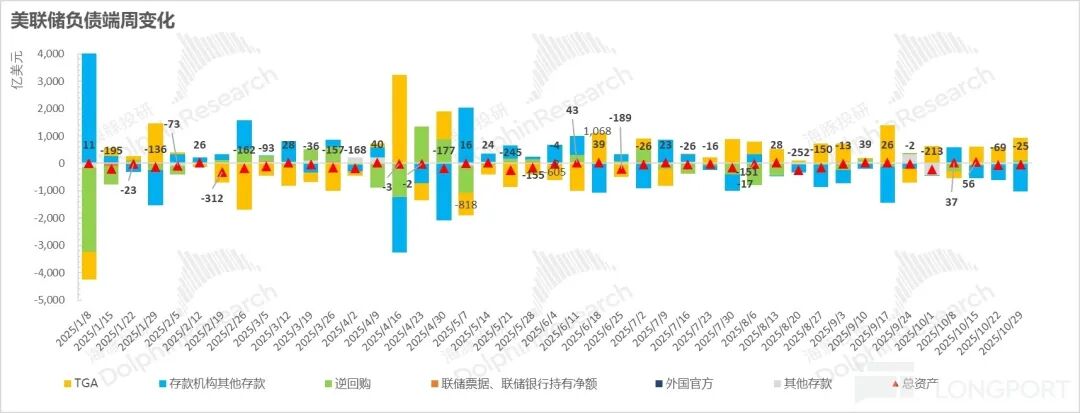
Core Viewpoint - The recent tightening of dollar liquidity is impacting various assets, including Bitcoin and overvalued tech stocks, as the market experiences a withdrawal of liquidity due to government shutdown and ongoing quantitative tightening by the Federal Reserve [1][5]. Group 1: Government Shutdown and TGA - The U.S. Treasury has been unable to distribute funds to the economy due to the government shutdown, leading to a situation where it is effectively "sucking" liquidity from the market [1]. - The Treasury General Account (TGA) has increased from under $300 billion to nearly $1 trillion, absorbing approximately $700 billion from the market, with $160 billion accumulated since November [2]. Group 2: Federal Reserve's Quantitative Tightening - The ongoing quantitative tightening by the Federal Reserve is exacerbating liquidity issues, despite indications that it may end on December 1 [5]. - The Federal Reserve's target federal funds rate is set at 3.75%-4%, but the effective federal funds rate (EFFR) is being influenced by the interest on reserve balances (IORB) and overnight reverse repurchase agreements (ON RRP) [7][8]. Group 3: Indicators of Liquidity Tightness - The widening spread between official rates and market rates indicates liquidity tightness, with the SOFR rate currently at 4.22%, exceeding the Federal Reserve's target range [8]. - The current conditions suggest that the Federal Reserve may not intervene unless the EFFR exceeds the target range significantly, which has not yet occurred [13]. Group 4: Future Outlook - The resolution of the liquidity crisis hinges on the timing of the government reopening and potential actions by the Federal Reserve to release liquidity [11]. - Market expectations suggest that a resolution may occur in mid-October, which could lead to a resurgence in liquidity-sensitive assets once the government reopens [12][14].
10月董监高增减持动态:减持总额环比下降超五成 海南华铁、隆基绿能增持金额居前
Xin Hua Cai Jing· 2025-11-04 23:21
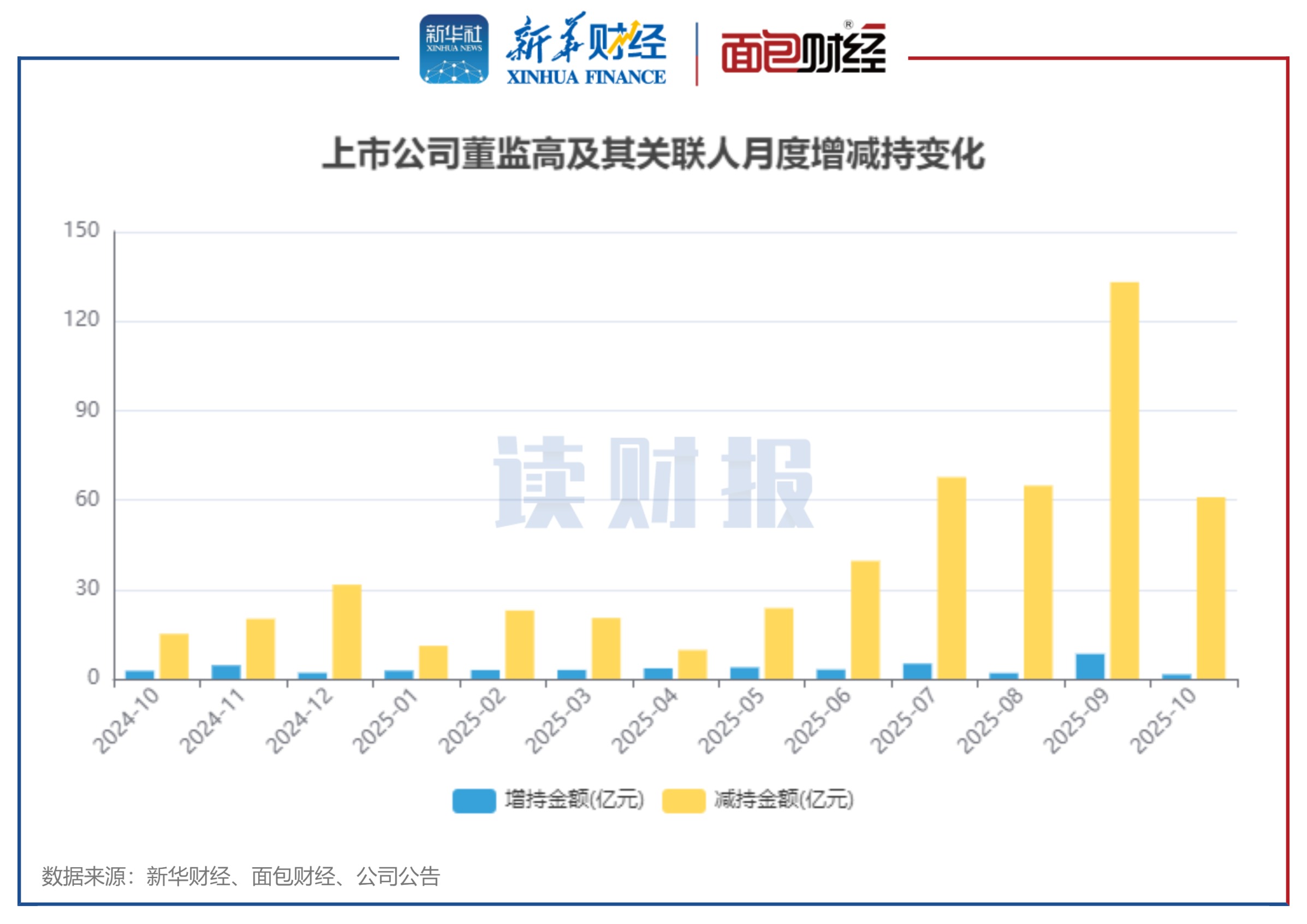
Core Insights - In October 2025, the total amount of shares sold by directors, supervisors, and senior executives of listed companies in the Shanghai and Shenzhen stock markets reached approximately 6.092 billion yuan, involving 266 companies, while the total amount of shares bought was about 148 million yuan, involving 48 companies, resulting in a net reduction of 5.944 billion yuan [1][4][12] Group 1: Share Reduction - The computer industry had the highest amount of share reductions in October 2025, totaling approximately 999 million yuan, while the non-bank financial sector saw the most significant share purchases [12][20] - The month-on-month reduction in share sales decreased by 54.23%, while year-on-year it increased by 303.98% [1] - The top three companies with the highest share reductions were Xinquan Co., Ltd. (7.09 billion yuan), Chunzong Technology (3.25 billion yuan), and Kesi Technology (2.26 billion yuan) [4][8] Group 2: Share Purchase - The total amount of shares purchased by directors, supervisors, and senior executives in October 2025 was approximately 148 million yuan, with the non-bank financial sector leading in share purchases [13][20] - The top three companies with the highest share purchases were Hainan Huatie (499.99 million yuan), Ziyuan Food (460.62 million yuan), and Longi Green Energy (137.54 million yuan) [14][17] - The non-bank financial industry had the highest share purchase amount, approximately 55 million yuan, followed by the food and beverage industry at about 47 million yuan [20]



兴业证券:A股什么情况下年末行情会“高切低”?
智通财经网· 2025-11-04 22:49
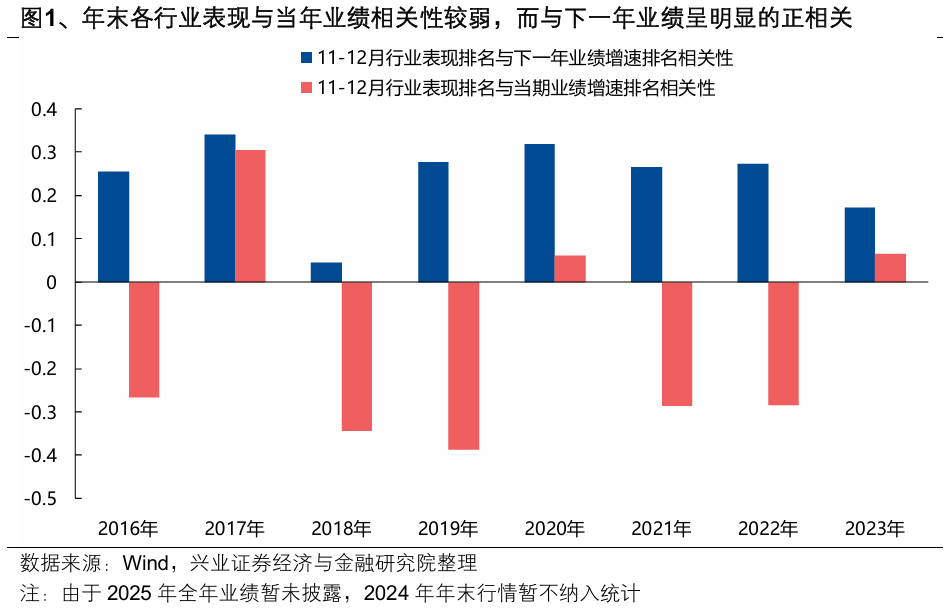
Core Viewpoint - The essence of the year-end market performance is the market's active search for future economic clues, leading to a revaluation of various industries based on next year's economic expectations [1][5]. Group 1: Year-End Market Dynamics - The year-end market's "high-low" nature is driven by investors' perspective shift towards economic conditions, resulting in a valuation reconstruction process [2][5]. - After the disclosure of Q3 reports in October, the market typically shifts focus to the next year, adjusting valuations based on economic expectations, which leads to year-end valuation reconstruction [2][5]. - Historical analysis since 2016 shows a strong positive correlation between industry performance rankings and next year's earnings growth, while the correlation with current earnings growth is weak or even negative [2]. Group 2: Historical Comparisons - If the market expects the main style's economic advantages to continue or accelerate next year, the main line will maintain stability and may deepen towards lower positions, as seen in 2006, 2014, 2016-2017, and 2019-2020 [6][5]. - In 2006, economic acceleration and a favorable real estate cycle led to a shift in market pricing from manufacturing to cyclical sectors [6]. - In 2016-2017, the recovery of listed companies' ROE and supply-side structural reforms maintained a focus on low-valuation value and blue-chip stocks throughout the year [6]. Group 3: Potential Market Reversals - If factors undermine the main line's economic expectations or improve lower economic expectations, the market may systematically shift towards lower positions, triggering a year-end "reversal" market [7][5]. - In Q4 2007, policy shifts to curb inflation and overheating led to a market structure change from "manufacturing + cyclical" to "TMT + consumption" [7]. - In November 2014, an unexpected interest rate cut by the central bank ignited bullish sentiment, causing a market structure shift from "manufacturing + TMT" to "financial real estate + cyclical" [7].

净利润超9000亿元,深市公司最新成绩单来了
Zhong Guo Ji Jin Bao· 2025-11-04 22:26
Core Insights - The overall performance of Shenzhen-listed companies shows steady growth in both revenue and net profit for the first three quarters of 2025, indicating a positive trend in the market [1][2] Revenue and Profit Growth - Shenzhen-listed companies achieved a total revenue of 15.72 trillion yuan, a year-on-year increase of 4.31%, and a net profit of 903.02 billion yuan, up 9.69% year-on-year [2] - 2,169 companies reported profits, accounting for 75.34% of the total, with 207 companies experiencing profit growth exceeding 100% [2] - The main board and the ChiNext board both showed strong performance, with the main board generating 12.47 trillion yuan in revenue and 658.36 billion yuan in net profit, while the ChiNext board achieved 3.2 trillion yuan in revenue and 244.66 billion yuan in net profit, both with double-digit growth rates [2] Leading Companies - There are 57 companies in Shenzhen with a market capitalization exceeding 100 billion yuan, collectively generating 4.38 trillion yuan in revenue and 461.37 billion yuan in net profit, with growth rates of 10.70% and 13.84% respectively [3] - Leading companies such as BYD, Midea Group, and CATL have significantly contributed to the overall performance, with revenues exceeding 100 billion yuan and net profits over 10 billion yuan [3] Sector Performance - The technology sector continues to thrive, with industries such as electronics, power equipment, and communications benefiting from policy support and demand, driving performance growth [4][5] - The electronics industry reported revenue of 1.59 trillion yuan, a year-on-year increase of 15.03%, and net profit of 791.22 billion yuan, up 32.12% [4] - The power equipment sector achieved revenue of 1.32 trillion yuan, a 10% increase, and net profit of 946.09 billion yuan, up 29.53% [5] - The communications sector saw revenue of 292.83 billion yuan, a 14.29% increase, and net profit of 307.94 billion yuan, up 36.71% [5] Non-Banking Financial Sector - The non-banking financial sector has shown a recovery, with total revenue of 213.58 billion yuan, a year-on-year increase of 10.67%, and net profit of 60.85 billion yuan, up 49.03% [6] - The brokerage sector performed particularly well, with revenue of 117.48 billion yuan, a 30.05% increase, and net profit of 50.91 billion yuan, up 77.15% [6] R&D and Investor Returns - Shenzhen-listed companies have increased R&D investment, with total R&D expenses reaching 518.01 billion yuan, a 6.20% increase, and an R&D intensity of 3.29% [7] - A total of 507 companies implemented or announced cash dividend plans, with a total dividend amount of 129.11 billion yuan, doubling from the previous year [7] - Companies also disclosed 257 share repurchase plans with a total upper limit of 74.57 billion yuan, and 106 shareholding increase plans with a total upper limit of 26.08 billion yuan [7]
深市公司三季报稳中向好 新质生产力相关企业表现亮眼
Shang Hai Zheng Quan Bao· 2025-11-04 19:09
Core Viewpoint - The performance of Shenzhen-listed companies in the first three quarters of 2025 shows steady growth in both revenue and net profit, driven by technological innovation and strong contributions from leading companies [1][2]. Group 1: Overall Performance - A total of 2879 Shenzhen-listed companies reported a combined revenue of 15.72 trillion yuan, a year-on-year increase of 4.31%, and a net profit of 903.02 billion yuan, up 9.69% [1]. - Among the reporting companies, 2169 achieved profitability, representing 75.34% of the total, with 207 companies experiencing growth rates exceeding 100% [2]. Group 2: Sector Performance - The main board and ChiNext board reported revenues of 12.47 trillion yuan and 3.25 trillion yuan, respectively, with net profits of 658.36 billion yuan and 244.66 billion yuan [2]. - The electronics sector saw a revenue of 1.59 trillion yuan, growing by 15.03%, and a net profit of 791.22 billion yuan, increasing by 32.12% [3]. - The power equipment sector achieved revenues of 1.32 trillion yuan, up 10%, and net profits of 946.09 billion yuan, a rise of 29.53% [4]. Group 3: Financial Sector Highlights - The non-bank financial sector reported revenues of 213.58 billion yuan, a year-on-year increase of 10.67%, and net profits of 608.54 billion yuan, up 49.03% [5]. - The brokerage sector performed particularly well, with revenues of 1174.83 billion yuan, a growth of 30.05%, and net profits of 509.14 billion yuan, increasing by 77.15% [6]. Group 4: Innovation and Shareholder Returns - Research and development expenses for Shenzhen-listed companies totaled 518.01 billion yuan, reflecting a year-on-year increase of 6.20%, with a research intensity of 3.29% [7]. - In the first ten months of the year, 507 companies announced cash dividend plans totaling 129.11 billion yuan, doubling from the previous year [7].





深市公司前三季营收净利双增 新质生产力成引擎
Zheng Quan Shi Bao· 2025-11-04 17:41
Core Insights - The overall performance of Shenzhen-listed companies shows both year-on-year and quarter-on-quarter growth in revenue and net profit, with over 70% of companies reporting profitability, highlighting the significant pull of leading enterprises and the evident characteristics of technology-driven innovation [1][2] Group 1: Financial Performance - Shenzhen-listed companies achieved a total revenue of 15.72 trillion yuan, a year-on-year increase of 4.31%, and a net profit attributable to shareholders of 903.02 billion yuan, up 9.69% year-on-year [1] - Among the companies, 2,169 reported profits, accounting for 75.34%, with 207 companies experiencing profit growth exceeding 100% [1] - The main board reported revenue of 12.47 trillion yuan and net profit of 658.36 billion yuan, with a net profit increase of 6.68% year-on-year, while the ChiNext board continued to show high growth with revenue of 3.25 trillion yuan and net profit of 244.66 billion yuan, both achieving double-digit growth [1] Group 2: Contribution of Leading Companies - The 57 Shenzhen-listed companies with a market capitalization exceeding 100 billion yuan contributed significantly, with a combined revenue of 4.38 trillion yuan, a year-on-year increase of 10.70%, and a net profit of 461.37 billion yuan, up 13.84% [2] - Major companies like BYD, Midea Group, and CATL reported revenues exceeding 100 billion yuan and net profits over 10 billion yuan, serving as core drivers of industry growth [2] Group 3: Sector Performance - The electronics sector benefited from the demand for AI computing power, domestic semiconductor testing, and a recovery in consumer electronics, achieving revenue of 1.59 trillion yuan, a year-on-year increase of 15.03%, and a net profit of 791.22 billion yuan, up 32.12% [2] - The power equipment industry, supported by the "dual carbon" policy, reported revenue of 1.32 trillion yuan, a 10% increase, and net profit of 946.09 billion yuan, up 29.53% [3] - The non-bank financial sector saw significant recovery, with total revenue of 213.58 billion yuan, a year-on-year increase of 10.67%, and net profit of 60.85 billion yuan, up 49.03% [3] Group 4: Innovation and R&D - Shenzhen-listed companies demonstrated a continuous enhancement of innovation capabilities, with total R&D expenses reaching 518.01 billion yuan, a year-on-year increase of 6.20%, and an R&D intensity of 3.29% [4] - A total of 507 companies implemented or announced mid-term cash dividends amounting to 129.11 billion yuan, doubling year-on-year, and 257 share repurchase plans with a maximum amount of 74.57 billion yuan were disclosed [4]
净利润超9000亿元!深市公司最新成绩单来了
Zhong Guo Ji Jin Bao· 2025-11-04 16:28
Core Viewpoint - The Shenzhen Stock Exchange companies reported double growth in revenue and net profit for Q3 2025, indicating a stable and improving performance across various sectors, driven by leading enterprises and technological innovation [1][2]. Revenue and Profit Growth - In the first three quarters of 2025, Shenzhen companies achieved a total revenue of 15.72 trillion yuan, a year-on-year increase of 4.31%, and a net profit of 903.02 billion yuan, up 9.69% year-on-year [2]. - A total of 2,169 companies reported profits, accounting for 75.34% of the total, with 207 companies experiencing profit growth exceeding 100% [2]. - The main board and the ChiNext board both showed strengths, with the main board generating 12.47 trillion yuan in revenue and 658.36 billion yuan in net profit, while the ChiNext board achieved 3.2 trillion yuan in revenue and 244.66 billion yuan in net profit, both with double-digit growth rates [2]. Leading Companies' Impact - There are 57 companies on the Shenzhen market with a market capitalization exceeding 100 billion yuan, collectively generating 4.38 trillion yuan in revenue and 461.37 billion yuan in net profit, with growth rates significantly surpassing the overall market [3]. High Growth in Technology Sector - The technology sector, particularly in electronics, power equipment, and communications, continued to thrive, driven by policy support and demand [4]. - The electronics industry reported revenue of 1.59 trillion yuan, a year-on-year increase of 15.03%, and net profit of 791.22 billion yuan, up 32.12% [4]. - The power equipment sector benefited from "dual carbon" policies, achieving revenue of 1.32 trillion yuan and net profit of 946.09 billion yuan, with growth rates of 10% and 29.53%, respectively [5]. Non-Banking Financial Sector Recovery - The non-banking financial sector showed a strong recovery, with total revenue of 213.58 billion yuan and net profit of 60.85 billion yuan, reflecting increases of 10.67% and 49.03% year-on-year [7]. - The brokerage sector performed particularly well, with revenue of 117.48 billion yuan and net profit of 50.91 billion yuan, marking growth rates of 30.05% and 77.15% [7]. R&D and Investor Returns - Shenzhen companies increased R&D spending to 518.01 billion yuan, a 6.20% year-on-year rise, with a research intensity of 3.29% [8]. - A total of 507 companies announced cash dividend plans amounting to 129.11 billion yuan, doubling from the previous year, and 257 companies disclosed share buyback plans totaling 74.57 billion yuan [8].