医药生物

Search documents
医药生物行业11月28日资金流向日报
Zheng Quan Shi Bao Wang· 2025-11-28 10:08
Market Overview - The Shanghai Composite Index rose by 0.34% on November 28, with 29 out of 31 sectors experiencing gains, led by the steel and agriculture sectors, both up by 1.59% [1] - The pharmaceutical and biological industry saw a modest increase of 0.14% [1] - The banking and coal sectors faced declines, down by 0.83% and 0.14% respectively [1] Capital Flow Analysis - The net inflow of capital in the two markets reached 10.84 billion yuan, with 19 sectors experiencing net inflows [1] - The electronics sector led the net inflow with 3.423 billion yuan and a daily increase of 1.30% [1] - The non-ferrous metals sector followed with a net inflow of 3.051 billion yuan and a daily increase of 1.44% [1] - Conversely, 12 sectors experienced net outflows, with the pharmaceutical and biological sector seeing the largest outflow of 2.334 billion yuan [1] Pharmaceutical and Biological Sector Performance - Within the pharmaceutical and biological sector, 477 stocks were tracked, with 260 stocks rising and 201 stocks falling [2] - The top three stocks with the highest net inflow were Haiwang Biological (1.45 billion yuan), Baihua Pharmaceutical (977.51 million yuan), and Tailong Pharmaceutical (801.56 million yuan) [2] - The sector's outflow was dominated by Zhongsheng Pharmaceutical (6.84 billion yuan), WuXi AppTec (1.65 billion yuan), and Te Yi Pharmaceutical (1.12 billion yuan) [2] Top Gainers in Pharmaceutical Sector - Haiwang Biological saw a significant increase of 10.03% with a turnover rate of 15.64% and a net inflow of 145.23 million yuan [4] - Baihua Pharmaceutical increased by 10.01% with a net inflow of 97.75 million yuan [4] - Tailong Pharmaceutical rose by 5.37% with a net inflow of 80.16 million yuan [4] Top Losers in Pharmaceutical Sector - Zhongsheng Pharmaceutical experienced a decline of 10.00% with a net outflow of 683.65 million yuan [4] - WuXi AppTec fell by 1.10% with a net outflow of 164.72 million yuan [4] - Te Yi Pharmaceutical decreased by 6.41% with a net outflow of 112.06 million yuan [4]


沪指11月收跌1.67%结束月线六连涨 国晟科技涨超155%成当月“股王”
Xin Hua Cai Jing· 2025-11-28 09:01
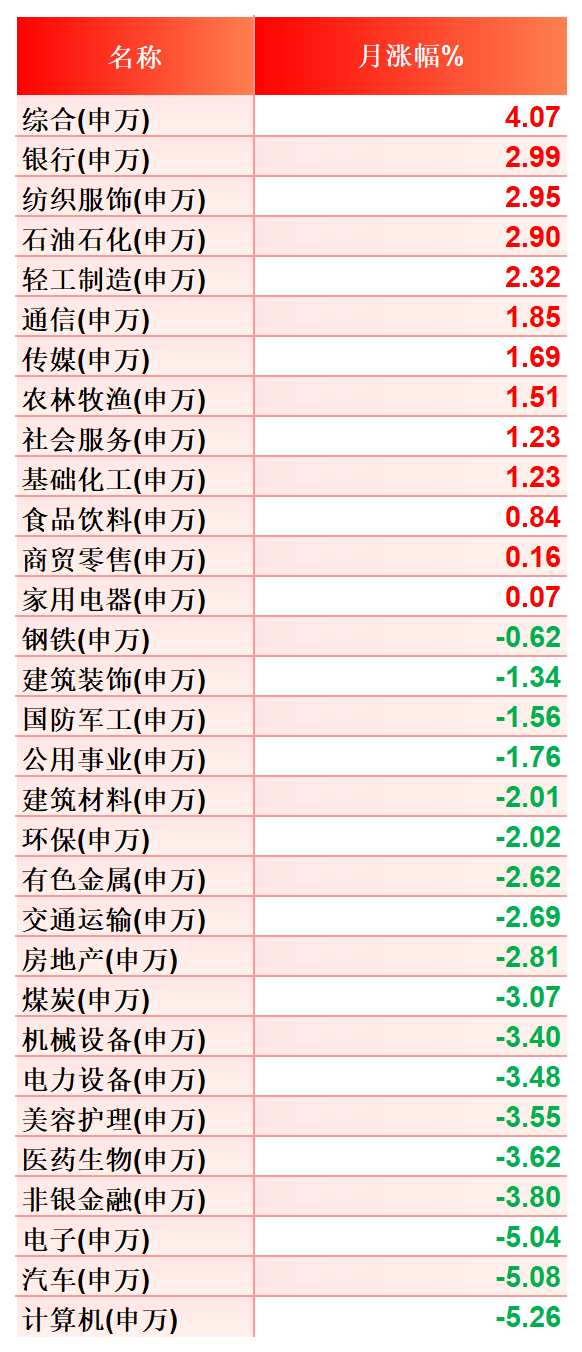
Market Overview - A-shares ended November with a slight increase, with the Shanghai Composite Index closing at 3888.6 points, up 0.34%, but down 1.67% for the month, ending a six-month consecutive rise [1] - The index experienced fluctuations, peaking at 4034.08 points early in the month and dropping to a low of 3856.25 points later, resulting in a monthly volatility of 5.5% [1] - Total trading volume for the month reached 16.1 trillion yuan, remaining stable compared to October, while the total trading volume for both Shanghai and Shenzhen markets was approximately 37.9 trillion yuan, an increase of 1.5 trillion yuan from October [1] Industry Performance - In November, the top-performing sectors included Comprehensive, Banking, Textile & Apparel, Oil & Petrochemicals, and Light Industry Manufacturing, with respective monthly gains of 4.07%, 2.99%, 2.95%, 2.90%, and 2.32% [2] - Conversely, sectors such as Computer, Automotive, Electronics, Non-bank Financials, and Pharmaceutical & Biological industries saw significant declines, with losses ranging from 3.62% to 5.26% [3] Individual Stock Performance - Guosheng Technology led individual stock gains in November, surging over 155%, primarily driven by a strategic acquisition of a lithium battery shell material producer [5] - Other notable gainers included Hefei China and Huasheng Lithium Battery, with increases of over 143% and 132%, respectively [6] Future Outlook - Analysts predict December will be a critical period for global financial markets, influenced by the Federal Reserve's final meeting of the year and key decisions from important domestic meetings [6] - The market is expected to experience a rhythm of "preliminary expectation game, mid-term policy implementation, and late-stage adjustment," providing a favorable environment for year-end positioning [6] - Key events in December include the Central Economic Work Conference and the clarification of the Federal Reserve's interest rate path, which are seen as pivotal for market direction [6]


真涨停了!“主力求您拉个涨停,孩子生病钱不够...”
Zhong Guo Ji Jin Bao· 2025-11-28 08:27
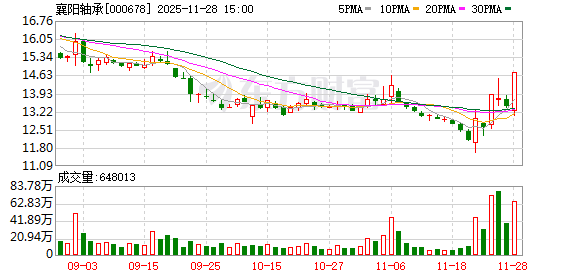
Group 1 - The stock of Xiangyang Bearing surged to its daily limit on November 28, following a plea from a retail investor on social media for support due to personal financial difficulties related to a child's illness [4] - The overall A-share market showed a recovery on the same day, with the Shanghai Composite Index rising by 0.34%, the Shenzhen Component Index increasing by 0.85%, and the ChiNext Index up by 0.7% [5] - A total of 4,122 stocks rose, with 81 stocks hitting the daily limit, while 1,193 stocks declined [6] Group 2 - The commercial aerospace sector saw a collective surge, with stocks like Aerospace Development hitting their daily limit, driven by news of a privately developed hypersonic missile in Sichuan [8] - The stock performance in the aerospace sector included significant gains, with companies like Qianzhao Optoelectronics rising by 20.01% and Aerospace Universe by 20.00% [9] - The Hainan Free Trade Zone concept stocks were also active, with Hainan Ruize reaching its daily limit [10] Group 3 - The consumer sector showed signs of recovery, with Hai Xin Food experiencing a dramatic price increase, referred to as a "limit-up" [11] - The titanium dioxide sector strengthened, with Jinpu Titanium Industry and others hitting their daily limit [11][12] - In contrast, the anti-influenza concept stocks faced declines, with companies like Zhongsheng Pharmaceutical and Guangji Pharmaceutical hitting their daily limit down [13]


机器学习因子选股月报(2025年12月)-20251128
Southwest Securities· 2025-11-28 07:02
Quantitative Models and Construction Methods - **Model Name**: GAN_GRU **Model Construction Idea**: The GAN_GRU model combines Generative Adversarial Networks (GAN) for processing volume-price sequential features and Gated Recurrent Unit (GRU) for encoding sequential features to construct a stock selection factor [4][13] **Model Construction Process**: 1. **GRU Model**: - The GRU model is based on 18 volume-price features, including closing price, opening price, trading volume, turnover rate, etc. [14][17][19] - Training data includes the past 400 days of volume-price features for all stocks, with feature sampling every 5 trading days. The feature sampling shape is 40x18, using the past 40 days' features to predict the cumulative return over the next 20 trading days [18] - Data processing includes outlier removal and standardization for each feature in the time series and cross-sectional standardization at the stock level [18] - The model structure includes two GRU layers (GRU(128, 128)) followed by an MLP (256, 64, 64). The final output, predicted return (pRet), is used as the stock selection factor [22] - Training is conducted semi-annually, with training points on June 30 and December 31 each year. The training set and validation set are split in an 80:20 ratio [18] - Hyperparameters: batch_size equals the number of cross-sectional stocks, optimizer is Adam, learning rate is 1e-4, loss function is IC, early stopping rounds are 10, and maximum training rounds are 50 [18] 2. **GAN Model**: - The GAN model consists of a generator (G) and a discriminator (D). The generator learns the real data distribution and generates realistic samples, while the discriminator distinguishes between real and generated data [23][24] - Generator loss function: $$L_{G} = -\mathbb{E}_{z\sim P_{z}(z)}[\log(D(G(z)))]$$ where \(z\) represents random noise, \(G(z)\) is the generated data, and \(D(G(z))\) is the discriminator's output probability for the generated data [24][25] - Discriminator loss function: $$L_{D} = -\mathbb{E}_{x\sim P_{data}(x)}[\log D(x)] - \mathbb{E}_{z\sim P_{z}(z)}[\log(1-D(G(z)))]$$ where \(x\) is real data, \(D(x)\) is the discriminator's output probability for real data, and \(D(G(z))\) is the discriminator's output probability for generated data [27][29] - The generator uses an LSTM model to retain the sequential nature of input features, while the discriminator employs a CNN model to process the two-dimensional volume-price sequential features [33][37] **Model Evaluation**: The GAN_GRU model effectively captures volume-price sequential features and demonstrates strong predictive power for stock selection [4][13][22] Model Backtesting Results - **GAN_GRU Model**: - IC Mean: 0.1131*** - ICIR (non-annualized): 0.90 - Turnover Rate: 0.83 - Recent IC: 0.1241*** - One-Year IC Mean: 0.0867*** - Annualized Return: 37.52% - Annualized Volatility: 23.52% - IR: 1.59 - Maximum Drawdown: 27.29% - Annualized Excess Return: 23.14% [4][41][42] Quantitative Factors and Construction Methods - **Factor Name**: GAN_GRU Factor **Factor Construction Idea**: The GAN_GRU factor is derived from the GAN_GRU model, leveraging GAN for volume-price sequential feature processing and GRU for sequential feature encoding [4][13] **Factor Construction Process**: - The factor is constructed using the predicted return (pRet) output from the GAN_GRU model. The factor undergoes industry and market capitalization neutralization, as well as standardization [22] **Factor Evaluation**: The GAN_GRU factor demonstrates robust performance across various industries and time periods, with significant IC values and excess returns [4][13][41] Factor Backtesting Results - **GAN_GRU Factor**: - IC Mean: 0.1131*** - ICIR (non-annualized): 0.90 - Turnover Rate: 0.83 - Recent IC: 0.1241*** - One-Year IC Mean: 0.0867*** - Annualized Return: 37.52% - Annualized Volatility: 23.52% - IR: 1.59 - Maximum Drawdown: 27.29% - Annualized Excess Return: 23.14% [4][41][42] Industry-Specific Performance - **Recent IC Rankings (Top 5 Industries)**: - Social Services: 0.2198*** - Real Estate: 0.2027*** - Steel: 0.1774*** - Non-Bank Financials: 0.1754*** - Coal: 0.1537*** [4][41][42] - **One-Year IC Mean Rankings (Top 5 Industries)**: - Non-Bank Financials: 0.1401*** - Steel: 0.1367*** - Retail: 0.1152*** - Textiles & Apparel: 0.1124*** - Utilities: 0.1092*** [4][41][42] - **Recent Excess Return Rankings (Top 5 Industries)**: - Environmental Protection: 7.24% - Machinery: 4.37% - Real Estate: 4.03% - Textiles & Apparel: 3.89% - Building Materials: 2.91% [4][45][46] - **One-Year Average Excess Return Rankings (Top 5 Industries)**: - Building Materials: 2.15% - Real Estate: 1.97% - Social Services: 1.77% - Textiles & Apparel: 1.71% - Retail: 1.62% [4][45][46]
恒瑞医药(600276):主业稳健,BD交易将增厚公司业绩
CSC SECURITIES (HK) LTD· 2025-11-28 05:20
Investment Rating - The report assigns a "Buy" rating for 恒瑞医药 (Hengrui Medicine) [3][6] Core Insights - The company's revenue for Q1-Q3 2025 reached RMB 23.19 billion, a year-over-year increase of 14.9%, with a net profit attributable to shareholders of RMB 5.75 billion, up 24.5% year-over-year [3] - The company has successfully completed five external licensing agreements since the beginning of 2025, with a total potential transaction value of approximately USD 16.7 billion, significantly contributing to its revenue and net profit [10] - The estimated net profits for 2025-2027 are RMB 10.1 billion, RMB 9.09 billion, and RMB 10.4 billion, reflecting year-over-year growth rates of 59.3%, -9.9%, and 14.5% respectively [10] Financial Performance Summary - For Q3 2025, the company reported a revenue of RMB 7.43 billion, a year-over-year increase of 12.7%, and a net profit of RMB 1.3 billion, up 9.5% year-over-year [3][10] - The gross margin for Q3 was stable at 85.5%, with a net profit margin increase of 0.5 percentage points to 17.5% [10] - The projected earnings per share (EPS) for 2025 is RMB 1.52, with a price-to-earnings (P/E) ratio of 41X [10] Market Position and Valuation - The current A-share price is RMB 62.09, with a target price set at RMB 83, indicating a potential upside [5][10] - The company has a market capitalization of approximately RMB 396.07 billion [5] - Institutional investors hold 9.1% of the circulating A-shares, indicating a moderate level of institutional interest [7]

两融余额三连升 杠杆资金大比例加仓67股
Zheng Quan Shi Bao Wang· 2025-11-28 02:01
Core Insights - The total margin balance in the market has reached 24,720.45 billion yuan, marking an increase for three consecutive trading days, with a total increase of 133.76 billion yuan during this period [1] Margin Balance by Market - The margin balance for the Shanghai Stock Exchange is 12,547.40 billion yuan, increasing by 4.89 billion yuan, while the Shenzhen Stock Exchange's margin balance is 12,098.16 billion yuan, increasing by 21.91 billion yuan [1] - The North Exchange's margin balance is 74.89 billion yuan, with a slight increase of 945.05 thousand yuan [1] Industry Margin Balance Changes - Among the 31 industries categorized by Shenwan, 21 industries saw an increase in margin balance, with the electronics industry leading with an increase of 66.25 billion yuan [1] - The communication industry had the highest percentage increase in margin balance at 5.10%, followed by electronics and real estate at 1.89% and 1.54%, respectively [1][2] Individual Stock Performance - During the period of increasing margin balance, 46.48% of the stocks saw growth in their margin balance, with 67 stocks experiencing an increase of over 20% [4] - The stock with the highest increase in margin balance is Dapeng Industrial, with a growth of 245.43%, followed by Haizike at 128.56% [4][5] - The computer industry had the most stocks with over 20% increase, totaling 10 stocks, while the electronics and biopharmaceutical industries had 8 and 6 stocks, respectively [4] Top Margin Increases by Individual Stocks - The stock with the highest absolute increase in margin balance is Xinyi Sheng, which increased by 1.593 billion yuan, with a growth rate of 10.73% [7] - Other notable increases include Zhongji Xuchuang and Hanwujing, with increases of 1.583 billion yuan and 1.076 billion yuan, respectively [7] Summary of Margin Balance by Industry - The electronics industry has a latest margin balance of 356.25 billion yuan, with an increase of 66.25 billion yuan, representing a growth of 1.89% [2] - The communication industry has a margin balance of 111.82 billion yuan, with an increase of 54.29 billion yuan, showing a growth of 5.10% [2] - The banking and non-bank financial sectors saw a decrease in margin balance, with declines of 3.94 billion yuan and 9.53 billion yuan, respectively [3]
361只个股流通市值不足20亿元
Zheng Quan Shi Bao Wang· 2025-11-28 01:49
Core Insights - Small-cap stocks exhibit higher volatility and activity compared to large-cap stocks, making them more likely to become market leaders [1] Market Overview - As of November 27, there are 947 stocks with a circulating market value below 3 billion yuan, and 361 stocks with a circulating market value below 2 billion yuan [1] - A total of 1,673 stocks have a total market value below 5 billion yuan, with 535 stocks having a total market value below 3 billion yuan [1] Smallest Stocks by Circulating Market Value - The three stocks with the smallest circulating market values are: - *ST元成: 189 million yuan - 坤泰股份: 635 million yuan - 康力源: 691 million yuan [1] Smallest Stocks by Total Market Value - The three stocks with the smallest total market values are: - *ST元成: 189 million yuan - *ST长药: 802 million yuan - *ST苏吴: 881 million yuan [1] Selected Stocks Overview - A table lists various stocks with their circulating market values, total market values, price-to-earnings ratios, and industry classifications, highlighting the diversity in sectors such as automotive, light manufacturing, and healthcare [1][2]




开源晨会-20251127
KAIYUAN SECURITIES· 2025-11-27 14:15
Group 1: Power Industry Insights - The power industry is expected to stabilize as electricity reform accelerates, with a focus on the profitability of thermal power, quality wind power, and opportunities for power equipment exports [6][12] - From January to November 2025, electricity demand in China maintained steady growth, with total electricity consumption reaching 8.62 trillion kWh, a year-on-year increase of 4.8% [6] - The price of thermal coal has rebounded since July 2025, which is anticipated to stabilize electricity prices, with the average monthly trading price in Jiangsu reaching 395.60 RMB/MWh, an increase of 82.80 RMB/MWh [7] Group 2: Hydropower and Nuclear Power - Hydropower companies have shown stable operations, with net interest margins widening in a low-interest-rate environment, making them attractive for long-term investment [8] - The marketization ratio of nuclear power is gradually increasing, with the marketable electricity volume for Lingao and Yangjiang nuclear power plants expected to rise by 14.3% in 2026 [9] Group 3: Green Energy and Equipment - The income policies for green energy have become clearer, with market reforms entering a deeper phase, and the wind power tax subsidy is expected to decline [10] - Investment in domestic power equipment has shown significant growth, with cumulative procurement for the State Grid's transmission and transformation equipment reaching 787.47 billion RMB, a year-on-year increase of 19.6% [11] Group 4: Pharmaceutical Sector - Iwubio - Iwubio is a leading company in the desensitization treatment field, with a strong market position in dust mite drops and a new growth point in the yellow flower pollen sublingual drops [14][15] - The company is expected to achieve net profits of 399 million RMB, 493 million RMB, and 600 million RMB for 2025-2027, with corresponding P/E ratios of 41.0, 33.3, and 27.3 times [14] Group 5: Pharmaceutical Sector - Aladdin - Aladdin has demonstrated significant synergy from external mergers and acquisitions, with revenue for the first three quarters of 2025 reaching 440 million RMB, a year-on-year increase of 17.59% [18] - The company has revised its profit forecasts upward for 2025-2027, expecting net profits of 110 million RMB, 160 million RMB, and 200 million RMB, with corresponding EPS of 0.33, 0.48, and 0.60 RMB [18]


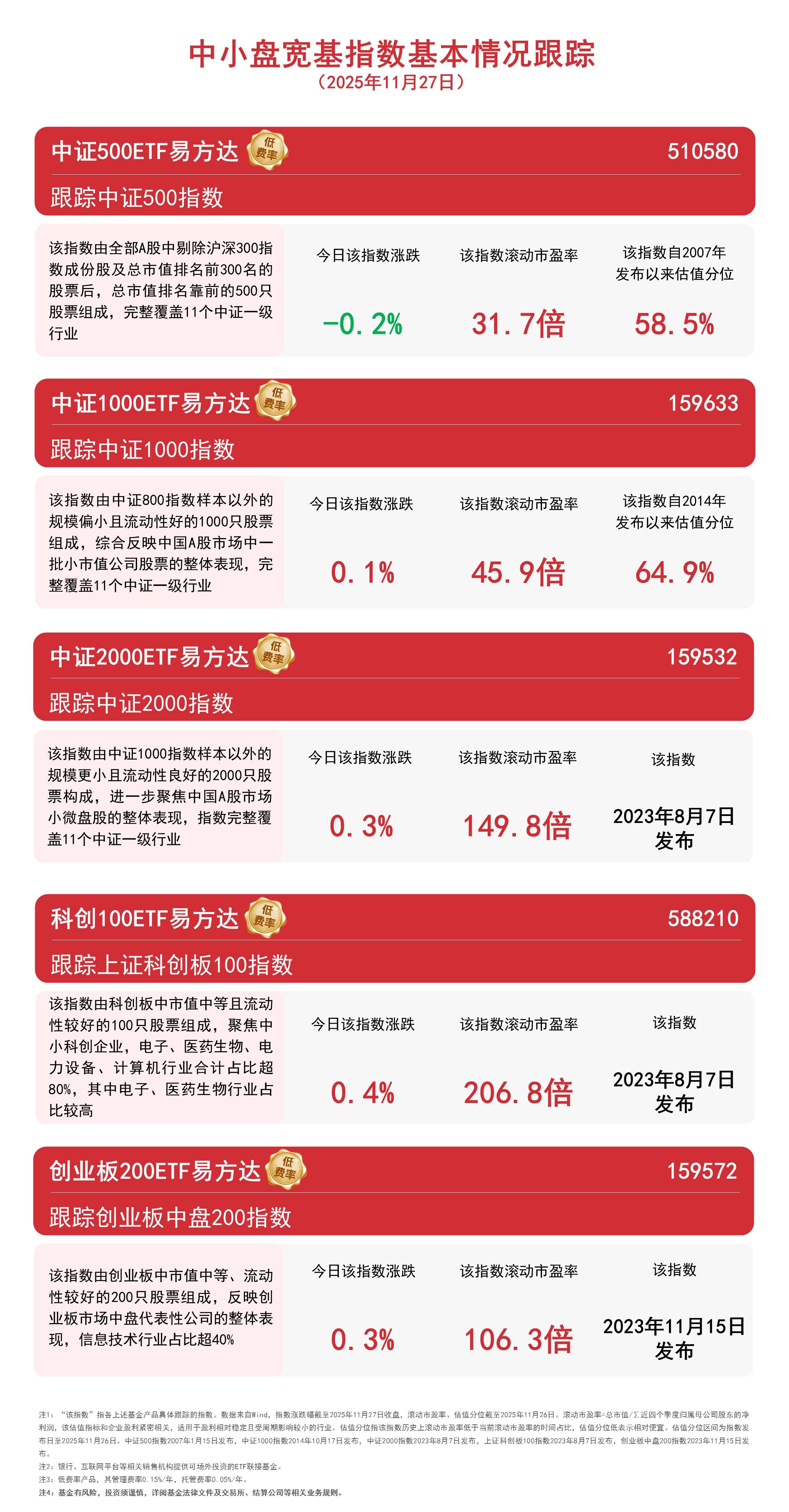
中证2000指数收涨0.3%,关注中证2000ETF易方达(159532)等投资价值
Sou Hu Cai Jing· 2025-11-27 11:54
Group 1 - The core viewpoint indicates that the current liquidity easing environment is beneficial for the performance of small and micro-cap stocks, with the CSI 2000 Index being a key target for capturing the benefits of technological transformation and industrial upgrades [1] - The CSI 2000 Index has shown good long-term annualized returns and Sharpe ratios, suggesting its growth potential may continue to be released under the backdrop of the explosion in AI, green energy sectors, and increased policy support [1] Group 2 - The CSI 2000 Index consists of 2000 stocks that are smaller in scale and have good liquidity, focusing on the overall performance of small and micro-cap stocks in the Chinese A-share market [6] - The index comprehensively covers 11 first-level industries in the CSI, reflecting the performance of a range of small-cap companies [4][6]
11月27日深港通医疗(983035)指数涨0.15%,成份股医脉通(02192)领涨
Sou Hu Cai Jing· 2025-11-27 11:10
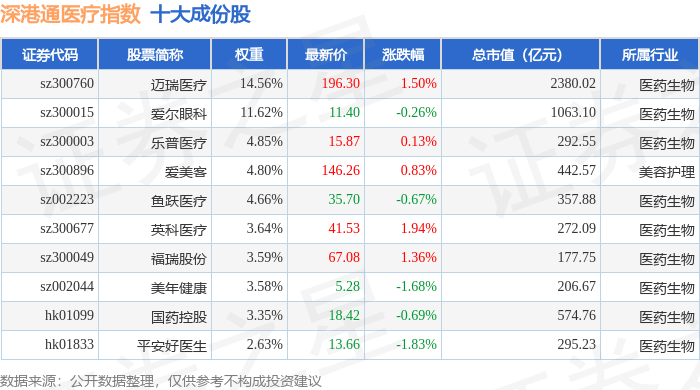
Core Points - The Shenzhen-Hong Kong Medical Index (983035) closed at 4494.42 points, up 0.15%, with a trading volume of 7.52 billion yuan and a turnover rate of 0.75% [1] - Among the index constituents, 32 stocks rose while 24 fell, with Medical Pulse leading the gainers at 3.65% and Health Road leading the decliners at 3.41% [1] Index Constituents Summary - The top ten constituents of the Shenzhen-Hong Kong Medical Index include: - Mindray Medical (14.56% weight, latest price 196.30 yuan, market cap 238 billion yuan, up 1.50%) [1] - Yier Eye Hospital (11.62% weight, latest price 11.40 yuan, market cap 106.31 billion yuan, down 0.26%) [1] - Lejin Medical (4.85% weight, latest price 15.87 yuan, market cap 29.26 billion yuan, up 0.13%) [1] - Aimeike (4.80% weight, latest price 146.26 yuan, market cap 44.26 billion yuan, up 0.83%) [1] - Yuyue Medical (4.66% weight, latest price 35.70 yuan, market cap 35.79 billion yuan, down 0.67%) [1] - Yingke Medical (3.64% weight, latest price 41.53 yuan, market cap 27.21 billion yuan, up 1.94%) [1] - Furuide (3.59% weight, latest price 67.08 yuan, market cap 17.78 billion yuan, up 1.36%) [1] - Meinian Health (3.58% weight, latest price 5.28 yuan, market cap 20.67 billion yuan, down 1.68%) [1] - Sinopharm (3.35% weight, latest price 18.42 yuan, market cap 57.48 billion yuan, down 0.69%) [1] - Ping An Good Doctor (2.63% weight, latest price 13.66 yuan, market cap 29.52 billion yuan, down 1.83%) [1] Capital Flow Analysis - The net outflow of main funds from the index constituents totaled 58.83 million yuan, while retail investors saw a net inflow of 78.07 million yuan [1] - Specific stock capital flows include: - Aimeike: Main fund net inflow of 46.99 million yuan, retail net outflow of 30.07 million yuan [2] - Mindray Medical: Main fund net inflow of 33.08 million yuan, retail net outflow of 17.11 million yuan [2] - Furuide: Main fund net inflow of 13.68 million yuan, retail net outflow of 19.08 million yuan [2] Recent Adjustments - The Shenzhen-Hong Kong Medical Index has undergone adjustments in the last 10 days, with one new stock added [2]