
石化

Search documents
事关韩国经济命脉,美国巨头突然高调宣布
Sou Hu Cai Jing· 2025-09-12 01:41
Core Viewpoint - The South Korean petrochemical industry, facing severe challenges, is experiencing significant losses among its major companies, prompting government intervention for structural reforms [1][2][3]. Industry Overview - The petrochemical sector is South Korea's fourth-largest export industry, but it is currently in a crisis, with major players like Lotte Chemical, LG Chem, Hanwha Solutions, and Kumho Petrochemical reporting substantial losses in the first half of 2025 [1][2][3]. - The Bank of Korea reported a 7.8% year-on-year decline in sales for the petrochemical industry, marking four consecutive quarters of negative growth since Q3 2024 [1][3]. Financial Performance - The "big four" petrochemical companies in South Korea are projected to incur a total loss of 878.4 billion KRW (approximately 5.1 million RMB) in 2024, with an additional loss of nearly 500 billion KRW in the first half of 2025 [1][3]. - The overall financial outlook for the industry suggests that losses may continue to expand throughout 2025 [1][3]. Structural Challenges - The industry's heavy reliance on imported raw materials has exacerbated cost pressures, with average sales costs rising to 98.6% in 2025, up from 87.6% in 2021 [4]. - The increase in electricity prices, which have risen by over 65% since 2022, has further strained production costs, contributing to the financial difficulties faced by major petrochemical companies [4]. Market Dynamics - Chevron's recent announcement to increase investments in South Korea has raised concerns about foreign control over the country's key industries during a downturn [1][8]. - The South Korean government has identified the petrochemical sector for restructuring, but industry responses have been slow, with many companies hesitant to implement necessary reforms [1][6][7]. Future Outlook - The ongoing crisis in the petrochemical industry is prompting discussions about potential mergers and acquisitions, as companies face existential challenges [6][7]. - There is a growing concern that increased foreign investment could lead to a loss of autonomy for South Korean firms, impacting the overall supply chain and profitability of the domestic manufacturing sector [11].


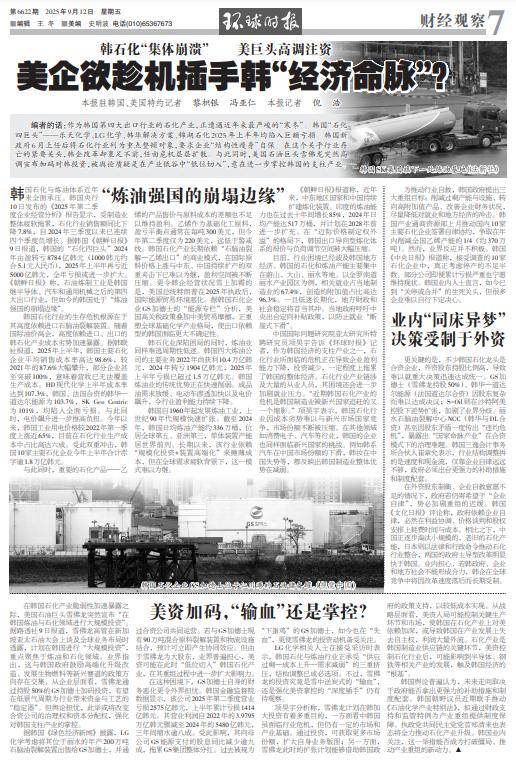
韩石化“集体崩溃”,美巨头高调注资,美企欲趁机插手韩“经济命脉”?
Huan Qiu Shi Bao· 2025-09-11 23:14
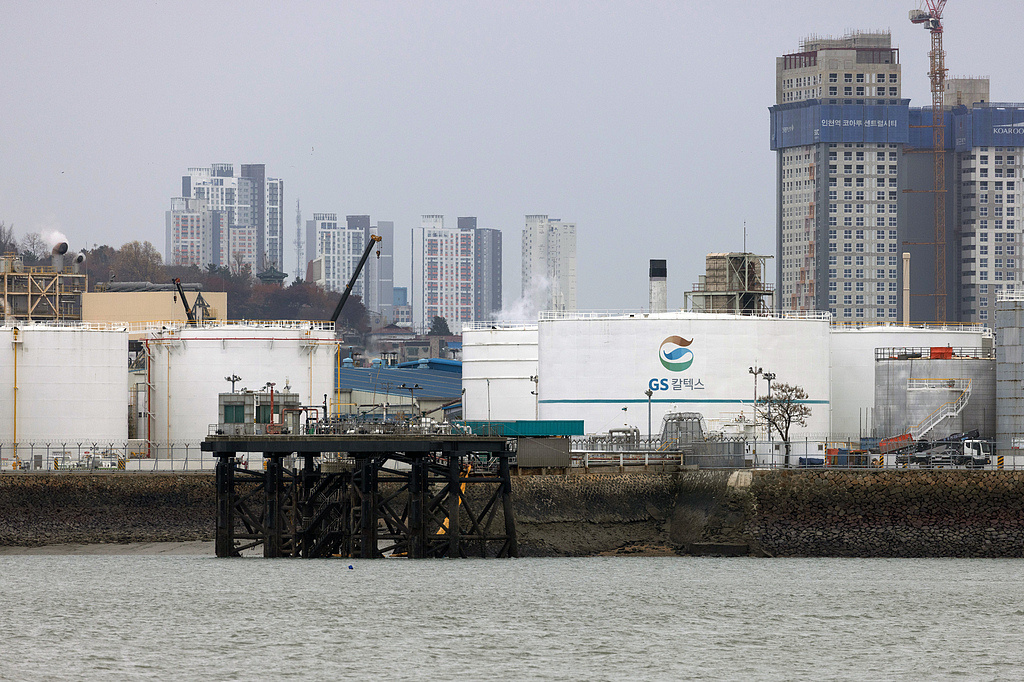
Core Viewpoint - The South Korean petrochemical industry is facing severe challenges, with major companies experiencing significant losses and the government pushing for structural reforms amid a crisis that threatens the industry's survival [1][2][3]. Industry Overview - The petrochemical sector, South Korea's fourth-largest export industry, has seen sales decline by 7.8% year-on-year, marking four consecutive quarters of negative growth since Q3 2024 [2]. - The "big four" petrochemical companies in South Korea reported a shift from profit to a loss of 878.4 billion KRW in 2024 and an additional loss of nearly 500 billion KRW in the first half of 2025 [2]. Financial Performance - Major petrochemical companies in South Korea reported an average sales cost rate of 98.6% in the first half of 2025, significantly up from 87.6% in 2021, with some companies exceeding 100% [3]. - The total deficit for ten major petrochemical companies in the first half of 2025 exceeded 18 trillion KRW [3]. Market Dynamics - The price difference between ethylene product sales and raw material costs is insufficient for profitability, with the breakeven point at 300 USD per ton, while the second-quarter price was only 220 USD [4]. - The South Korean refining industry, traditionally strong, is now facing a downturn, with major companies transitioning from a profit of 10.4 trillion KRW in 2022 to a loss of 1.9 trillion KRW in 2024 [4]. Structural Challenges - The industry is heavily reliant on imported naphtha cracking facilities, which has exposed cost disadvantages amid rising international oil prices [3]. - The traditional model of "scale investment and high-end facilities" is becoming unsustainable due to global demand weakness [6]. Employment and Economic Impact - The petrochemical and refining sectors are crucial for local economies, with significant employment and value creation in regions like Ulsan and Yeosu [6]. - The ongoing crisis is expected to increase employment pressure and could lead to severe local economic impacts if prolonged [7]. Government Response - The South Korean government has set three restructuring goals: reducing excess capacity, shifting to high-value products, and improving financial conditions [8]. - A self-regulatory agreement was signed by ten major petrochemical companies to cut national ethylene capacity by 25% (approximately 3.7 million tons) [8]. Foreign Investment Dynamics - Chevron's announcement of significant investment in South Korea's refining and petrochemical sectors has raised concerns about potential control over the industry [10][12]. - The financial deterioration of GS Caltex, a key player in the sector, has led to questions about the motivations behind foreign investments [11]. Future Outlook - The success of the restructuring efforts will depend on the government's ability to implement strong support measures and regulatory frameworks [12]. - The potential for increased foreign control over the petrochemical industry could impact South Korea's economic autonomy and the development of related sectors [12].
周大地:“十五五”新型电力系统重塑,新能源与储能迎新机遇
21世纪经济报道· 2025-09-11 10:52
Core Viewpoint - The article emphasizes the significant progress made in China's energy transition during the "14th Five-Year Plan" period, with a focus on achieving carbon peak targets in the upcoming "15th Five-Year Plan" through the development of renewable energy and strict limitations on coal consumption [1][4][5]. Group 1: Achievements in Energy Transition - During the "14th Five-Year Plan," China's non-fossil energy consumption target is expected to be exceeded, with the proportion of electricity in terminal energy consumption reaching around 30% [1]. - The installed capacity of renewable energy generation has increased from 40% to approximately 60% [5]. - By 2024, China's energy consumption increment has reached 1.5 times that of the previous five years, indicating robust energy supply capabilities [4]. Group 2: Future Directions for Energy Planning - The "15th Five-Year Plan" will continue to focus on the "dual carbon" goals, aiming for carbon emissions to peak before 2030 [6][7]. - The transition to a low-carbon energy structure will depend on the cost competitiveness of new clean energy sources [6]. - The article highlights the need for a systematic effort to accelerate the development of non-fossil energy and to strictly control coal consumption growth [7][9]. Group 3: Challenges in Energy System Transformation - The rapid growth of renewable energy generation presents challenges for grid stability and management, necessitating a shift towards a new power system that can accommodate high proportions of renewable energy [12][13]. - The current electricity market needs to balance the promotion of renewable energy consumption with the survival of traditional energy sources [14][15]. - The article discusses the importance of developing a multi-level energy storage system to enhance the stability and dispatchability of renewable energy [16][17]. Group 4: Technological and Structural Innovations - The article suggests that significant advancements in energy storage technology are essential for stabilizing renewable energy supply [16]. - It emphasizes the need for a collaborative approach among power generation, transmission, and consumption sectors to address the challenges posed by the integration of renewable energy [15]. - The future energy system should focus on decentralized energy solutions and the development of a competitive market for various energy sources [13][14].
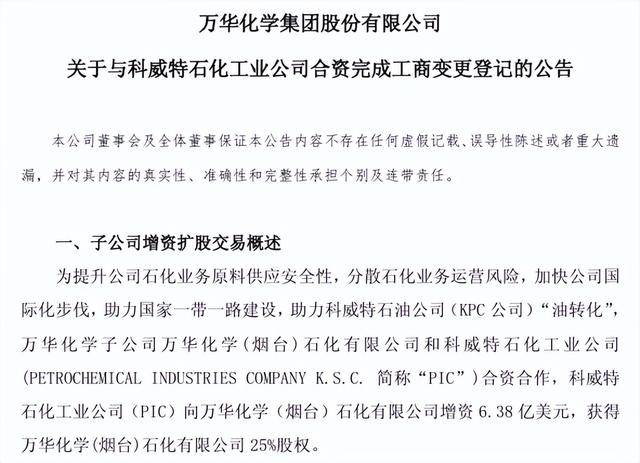
万华化学子公司获中东“巨头”科威特石化超6亿美元投资
Sou Hu Cai Jing· 2025-09-11 09:35
Core Viewpoint - Wanhua Chemical announced a joint venture with Kuwait Petrochemical Industries Company, with PIC investing $638 million for a 25% stake in Yantai Petrochemical [1][4] Group 1: Investment Details - PIC transferred $638 million to the Shandong Property Rights Trading Center on August 28, and Yantai Petrochemical completed the business registration on September 3 [4] - After the investment, Wanhua Petrochemical's registered capital increased from 2.979 billion yuan to 3.972 billion yuan [4] - Wanhua Chemical holds 75% of Yantai Petrochemical with a subscribed capital of 2.979 billion yuan, while Kuwait Petrochemical holds 25% with a subscribed capital of 993 million yuan [4] Group 2: Strategic Objectives - The collaboration aims to enhance the security of raw material supply for the company's petrochemical business, diversify operational risks, accelerate internationalization, and support the Belt and Road Initiative [4] - The partnership also aims to assist Kuwait Petroleum Company in its "oil conversion" strategy [4] Group 3: Financial Performance - In 2025, Wanhua Chemical reported total revenue of 90.901 billion yuan and a net profit attributable to shareholders of 6.123 billion yuan [4] - The polyurethane segment generated revenue of 36.888 billion yuan, a year-on-year increase of 4.04%, accounting for 40.58% of total revenue [4] - The petrochemical segment saw revenue of 34.934 billion yuan, a year-on-year decrease of 11.73%, while the fine chemicals and new materials segment achieved revenue of 15.628 billion yuan, a year-on-year increase of 20.41%, raising its share of total revenue to 17.19% [4]

武汉“十四五”规划收官:工业硬核突围 超百万民企筑牢半壁江山
2 1 Shi Ji Jing Ji Bao Dao· 2025-09-11 09:25
Group 1: Economic Performance - Wuhan's GDP is projected to grow by 5.5% in the first half of 2025, surpassing 1 trillion yuan for the first time, ranking 5th among 15 sub-provincial cities in terms of scale and growth rate [1] - The total industrial output value of Wuhan exceeded 1.67 trillion yuan during the first four years of the "14th Five-Year Plan," with an average annual growth rate of 7.1% [2] - The number of private enterprises in Wuhan has surpassed 1.17 million, doubling since the end of the "13th Five-Year Plan," contributing significantly to the local economy [1][8] Group 2: Industrial Development - Wuhan's industrial value added increased by 5.1% year-on-year in the first half of 2025, with industrial investment growth at 11.1%, maintaining double-digit growth for 19 consecutive months [1] - The proportion of high-tech industries in Wuhan's GDP is expected to reach 30.4% by 2024, exceeding the "14th Five-Year Plan" target of 28% [7] - The high-tech manufacturing value added grew by 15.7% in the first half of 2024, accounting for 24.6% of the total industrial value added [7] Group 3: Innovation and Technology - Wuhan has established 2 national and 7 provincial manufacturing innovation centers, focusing on high-end chips, industrial mother machines, humanoid robots, and new materials [5] - The optical fiber and cable industry in Wuhan has become a significant contributor, with an output value exceeding 756.6 billion yuan by 2024, holding over 50% of the national market share [5][6] - The city has built 5.65 million 5G base stations, a 4.5-fold increase since the end of the "13th Five-Year Plan," and has developed 300 digital production lines and 122 smart workshops [6] Group 4: Private Sector Growth - Private enterprises account for 79.3% of the 348 national-level specialized and innovative "little giant" companies in Wuhan, highlighting their role in driving innovation [8] - The contribution of the private economy to Wuhan's GDP has risen to 48.4%, with the number of large-scale industrial enterprises reaching 3,701 [8][9] - The city is implementing a tiered cultivation system for enterprises, focusing on technology-driven small and medium-sized enterprises to large leading companies [8]
桐昆股份(601233):2025Q2长丝开工较为饱和,行业供需格局持续优化
Huachuang Securities· 2025-09-11 09:13
Investment Rating - The report maintains a "Strong Buy" rating for Tongkun Co., Ltd. (601233) [1] Core Views - The company reported a revenue of 44.158 billion yuan for the first half of 2025, a year-on-year decrease of 8.41%, while the net profit attributable to shareholders was 1.097 billion yuan, an increase of 2.93% year-on-year [1] - In Q2 2025, the company achieved a revenue of 24.738 billion yuan, down 8.73% year-on-year but up 27.38% quarter-on-quarter, with a net profit of 486 million yuan, a slight increase of 0.04% year-on-year but a decrease of 20.54% quarter-on-quarter [1] - The long filament production capacity is fully utilized, with an operating rate of 96.3% in Q2 2025, and sales volume increased by 5% year-on-year and 38.2% quarter-on-quarter [7] - The report highlights that the supply-demand dynamics in the long filament industry are continuously improving, with expectations for profit margins to rise in the long term [7] Financial Summary - Total revenue for 2024 is projected at 101.307 billion yuan, with a year-on-year growth rate of 22.6%, while for 2025, it is expected to decrease to 97.086 billion yuan, reflecting a decline of 4.2% [3] - The net profit attributable to shareholders is forecasted to grow significantly from 1.202 billion yuan in 2024 to 2.167 billion yuan in 2025, representing a growth rate of 80.3% [3] - The earnings per share (EPS) is expected to increase from 0.50 yuan in 2024 to 0.90 yuan in 2025, with a corresponding price-to-earnings (P/E) ratio of 16 times [3] Market Position and Valuation - The company is positioned as a leader in the long filament industry, with a total production capacity of 13.5 million tons for polyester filament and 10.2 million tons for PTA [7] - The target price for the stock is set at 18.9 yuan, with the current price at 14.62 yuan, indicating a potential upside [3] - The report suggests that the stock price does not fully reflect the profitability potential of the petrochemical segment, which is significantly undervalued [7]

化工板块震荡分化,联泓新科涨停,磷肥领跌!政策预期升温,行业景气底部反转在即?
Xin Lang Ji Jin· 2025-09-11 03:11
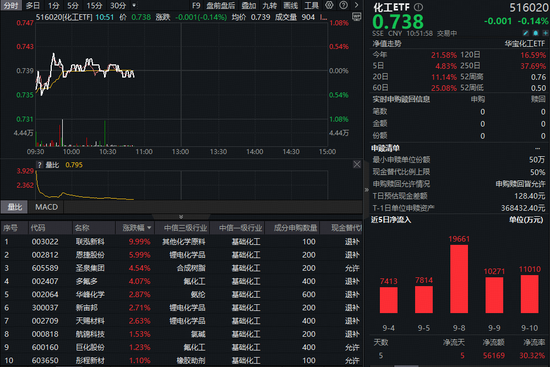
Group 1 - The chemical sector experienced fluctuations on September 11, with the chemical ETF (516020) showing a slight decline of 0.14% as of the report time [1] - Certain stocks within the chemical sector, such as lithium battery and synthetic resin companies, saw significant gains, with Lianhong Xinke hitting the daily limit and Enjie shares rising nearly 6% [1] - Conversely, stocks in the phosphate fertilizer, petrochemical, and nitrogen fertilizer sectors underperformed, with Hongda shares dropping over 2% [1] Group 2 - The chemical ETF (516020) has attracted substantial investment, with a total inflow of 560 million yuan over the past five trading days and over 1 billion yuan in the last ten trading days [1] - The pesticide industry is experiencing a reduction in inventory, with the total inventory-to-asset ratio for the pesticide sector at 13.94% as of June 30, 2025, down 0.12 percentage points from March 31 [3] - The chemical ETF's underlying index has a price-to-book ratio of 2.26, indicating a relatively low valuation compared to the past decade, suggesting a favorable long-term investment opportunity [3] Group 3 - Future policies are expected to address industry challenges, potentially leading to a recovery in the currently struggling chemical sector [4] - Domestic policies frequently mention supply-side requirements, while international factors such as rising raw material costs and capacity reductions in Europe and the U.S. add uncertainty to chemical supply [5] - The chemical ETF (516020) provides a diversified investment approach, covering various sub-sectors within the chemical industry, with nearly 50% of its holdings in large-cap stocks [5]



智能化改造增强企业韧性,石化ETF(159731)小幅上涨,联泓新科涨停
Mei Ri Jing Ji Xin Wen· 2025-09-11 02:42
Core Viewpoint - The A-share market showed a fluctuating upward trend on September 11, with the petrochemical industry benefiting from AI integration, which is expected to enhance cost efficiency and product quality for companies in the sector [1] Industry Summary - The petrochemical ETF (159731) experienced a slight increase of approximately 0.15% [1] - The top three sectors within the China Petrochemical Industry Index are refining and trading (27.12%), chemical products (23.87%), and agricultural chemical products (19.75%) [1] - The integration of AI in the chemical industry is anticipated to provide dual benefits of cost reduction and efficiency improvement, enhancing long-term cash flow and optimizing asset structures [1] Company Summary - Key stocks in the petrochemical sector, such as Lianhong Xinke, Shengquan Group, Huafeng Chemical, and Juhua Co., saw significant gains [1] - The intelligent transformation of research and production processes is expected to lower variable costs and reduce the occurrence of safety incidents, thereby strengthening risk resilience [1]
云南昆明加快推进工业领域绿色低碳转型
Ren Min Ri Bao· 2025-09-11 01:58
Group 1 - Kunming is accelerating the green and low-carbon transformation in the industrial sector, focusing on solid waste recycling and utilization [1][2] - The Anning base of Wugang Group Kunming Steel Co., Ltd. has achieved a significant transformation by turning industrial waste into valuable resources, with approximately 20% of solid waste being reused in production and nearly 80% converted into products [1] - The city aims to further reduce the intensity of general industrial solid waste generation by 2024 [1] Group 2 - In the field of energy and resource recycling, China National Petroleum Corporation (CNPC) Yunnan Petrochemical has developed a new process to convert high-viscosity filter residue into higher-value petroleum coke, addressing a common industry challenge [2] - The Anning Industrial Park is fostering a modern green circular economy, with companies developing comprehensive utilization technologies for by-products like coal slag and phosphogypsum, enhancing resource value [3] - The park is also focusing on the lithium battery supply chain, with the launch of a 300,000-ton integrated factory for lithium battery anode materials, promoting a full lifecycle approach to the industry [3]
各地新亮点丨海南儋州多产业体系加速形成
Jing Ji Ri Bao· 2025-09-11 01:51
Core Insights - Hainan Province's Danzhou City is leveraging the opportunities presented by the Hainan Free Trade Port, focusing on creating an international business environment to attract industries such as shipping and trade, thereby diversifying its industrial chain [1][2] Policy Benefits - The processing and value-added domestic sales tax exemption policy is a key tax incentive of the Hainan Free Trade Port, with Danzhou's Yangpu implementing mechanisms to encourage enterprises to benefit from this policy [2] - Hainan Auscar International Grain and Oil Co., as a pilot enterprise, has saved nearly 300 million yuan in tariffs since 2021, with its annual output value increasing from 1 billion yuan to nearly 6 billion yuan by 2024 [2] - The cumulative domestic sales of goods in Danzhou reached 8.494 billion yuan, with a total tariff exemption of 655 million yuan by mid-2025 [4] Transportation and Logistics - Yangpu International Container Port has opened 56 container shipping routes, including 30 foreign trade routes, enhancing its connectivity with ASEAN and South Asia [5][6] - The establishment of the Hainan International Ship Registration Administration has streamlined the registration and management of international vessels, contributing to a total tax refund of 400 million yuan for newly built vessels and over 1.1 billion yuan in tax exemptions for foreign vessels [5][6] Industrial Cluster Development - The Hainan Free Trade Port policies have attracted numerous enterprises to Danzhou, leading to the formation of multi-industry clusters [7] - The first phase of the 1.2 million kW offshore wind power project in Danzhou, with a total investment of approximately 12 billion yuan, is expected to generate an average annual power output of 3.54 billion kWh [7] - Various food processing projects and the first digital processing trade zone in the country have been established in Yangpu, contributing to the rapid formation of a health food industry cluster [8]