AI

Search documents
2025胡润百富榜揭晓 农夫山泉钟睒睒第四次登顶“首富”
Sou Hu Cai Jing· 2025-10-28 10:31
Core Insights - The 2025 Hurun Rich List reveals that Zhong Shanshan, founder of Nongfu Spring, has seen his wealth increase by 190 billion RMB, making him the richest person in China for the fourth time with a net worth of 530 billion RMB [2][3] - A total of 1,434 individuals with wealth exceeding 5 billion RMB are listed this year, an increase of 340 from last year, with total wealth approaching 30 trillion RMB, reflecting a 42% growth [2][4] Group 1: Wealth Distribution - The number of billionaires has increased by 15 this year, totaling 41, which constitutes 3% of the total list [4] - The second tier includes 72 individuals with wealth between 50 billion and 500 billion RMB, making up 5% of the total [4] - 92% of the entrepreneurs fall within the wealth range of 5 billion to 50 billion RMB, with 1,321 individuals, indicating a balanced distribution between those with 5-10 billion and 10-50 billion RMB [4] Group 2: Notable Individuals - Zhong Shanshan leads the list, followed by Zhang Yiming of ByteDance with 470 billion RMB, and Ma Huateng of Tencent with a wealth of 450 billion RMB [3] - Lei Jun of Xiaomi ranks fifth with 326 billion RMB, marking his return to the top five after ten years [3] - The wealth of Zhong Shanshan is double that of the ninth-ranked Li Ka-shing family at 235 billion RMB and the eleventh-ranked Jack Ma family at 210 billion RMB [3] Group 3: New Entrants and Growth - The 2025 list features 376 newcomers, a sevenfold increase from last year, with notable entries including Xu Gaoming and Xu Dongbo of Laopu Gold with 69.5 billion RMB [6] - Xiaomi's Lei Jun is highlighted as the "growth king," with a wealth increase of 196 billion RMB, attributed to the explosive growth of Xiaomi's automotive business and high-end smartphone sales [6] - Other significant growth figures include Wang Ning of Pop Mart, whose wealth increased by 154.5 billion RMB, and Chen Tianshi of Cambrian, with a wealth increase of 148 billion RMB [6] Group 4: Geographic Distribution - The geographical distribution of listed entrepreneurs shows a "3+2+3" pattern, with Shanghai, Shenzhen, and Beijing leading in density [7] - Shanghai tops the list with 152 individuals, an increase of 40 from last year, followed closely by Shenzhen with 147 and Beijing with 146 [7] - The growth in these regions is primarily driven by a recovery in the A-share market and their status as hubs for industries like semiconductors, biomedicine, gaming, and AI [7] Group 5: Female Entrepreneurs - Zhong Huijuan of Hansoh Pharmaceutical has become the richest woman in China with a wealth of 141 billion RMB, surpassing Zong Fuli of Wahaha at 87.5 billion RMB [8] - The analysis indicates that despite a generally cool economic sentiment, the wealth of entrepreneurs has significantly increased due to the market recognizing the undervaluation of many companies [8]






互联网又要“死”了?
腾讯研究院· 2025-10-28 08:46
Core Viewpoint - The article discusses the notion that the internet is "dead," primarily due to the overwhelming presence of AI-generated content (AIGC) and its impact on user-generated content (UGC) [3][7][30]. Group 1: The State of the Internet - Alexis Ohanian, co-founder of Reddit, claims that much of the internet's content is "dead," highlighting the value of genuine human activity in the current attention economy [3][6]. - Sam Altman, a prominent figure in the AI industry, acknowledges the proliferation of AI-driven accounts on platforms like Twitter, suggesting a shift in content creation dynamics [5][6]. - The article raises the question of whether the internet is truly "dead" or if it is undergoing a transformation due to AIGC [7][8]. Group 2: The Impact of AIGC - AIGC content has become pervasive, with examples of AI-generated videos achieving millions of views, indicating a significant shift in content consumption [8][12]. - The distinction between UGC and AIGC is becoming increasingly blurred, challenging traditional measures of the internet's vitality [12][16]. - AIGC tools are seen as beneficial for creators, allowing them to realize their creative visions more easily, akin to how tube paints revolutionized painting in the 19th century [14][15]. Group 3: Concerns and Future Implications - There are concerns about the sustainability of AI models trained on synthetic data, which may lead to a decline in content quality and relevance [18][20]. - Research indicates that using synthetic data can degrade AI model performance, raising alarms about the future of AI-generated content [21][22]. - The article suggests that if AIGC continues to dominate, it could lead to a scenario where traditional UGC is entirely replaced, potentially validating the "internet is dead" theory [23][28]. Group 4: Historical Context and Evolution - The article draws parallels between the current state of the internet and historical shifts in entertainment, such as the decline of stereoscopic view cards in favor of motion pictures [24][27]. - It posits that technological evolution will always create new opportunities, even if it disrupts existing content creation paradigms [28][30]. - The narrative concludes that while the traditional internet may be changing, a new form of internet, co-created by AI and humans, is emerging [30].

股市“高切低” 的缪惑
雪球· 2025-10-28 08:38
Core Viewpoint - The article discusses the concept of "high cut low," which refers to the investment strategy of selling high-performing stocks (often in technology) and buying undervalued stocks that have potential for recovery, particularly in sectors like dividends, consumption, and parts of AI [3][4]. Group 1: Market Dynamics - The phenomenon of "high cut low" is likened to a fire waiting to happen in a dry environment, suggesting that while it seems inevitable, the timing of such market movements is unpredictable [4]. - The article emphasizes that the perception of being able to predict market movements can lead to significant losses, as investors may overestimate their ability to time the market [5]. Group 2: Investment Performance - In the U.S. market, while the S&P 500 has risen approximately 15% since early 2025, AI stocks have surged by 30%, indicating a narrow market rally primarily driven by AI, with traditional sectors lagging behind [5][7]. - The article notes that if global markets are focused on AI and technology, other markets, including A-shares, are likely to follow suit rather than remain isolated [7]. Group 3: Investment Strategy - The author suggests that maintaining a safety margin is crucial, advocating for a balanced investment approach that does not overly rely on high valuations [7]. - A diversified investment strategy is recommended, where both high and low-performing stocks are included in the portfolio to mitigate risks associated with market fluctuations [8][9]. - Key performance indicators (KPIs) such as market share, growth curves, and profitability metrics should be prioritized over mere valuation to assess the underlying business quality [9]. Group 4: Behavioral Insights - The article stresses the importance of patience in investment, warning against the pitfalls of chasing trends and the emotional turmoil that can arise from missing out on high-performing stocks [10][11]. - It concludes with a reflection on the cyclical nature of the market, highlighting the ongoing struggle of investors between high and low valuations [11].

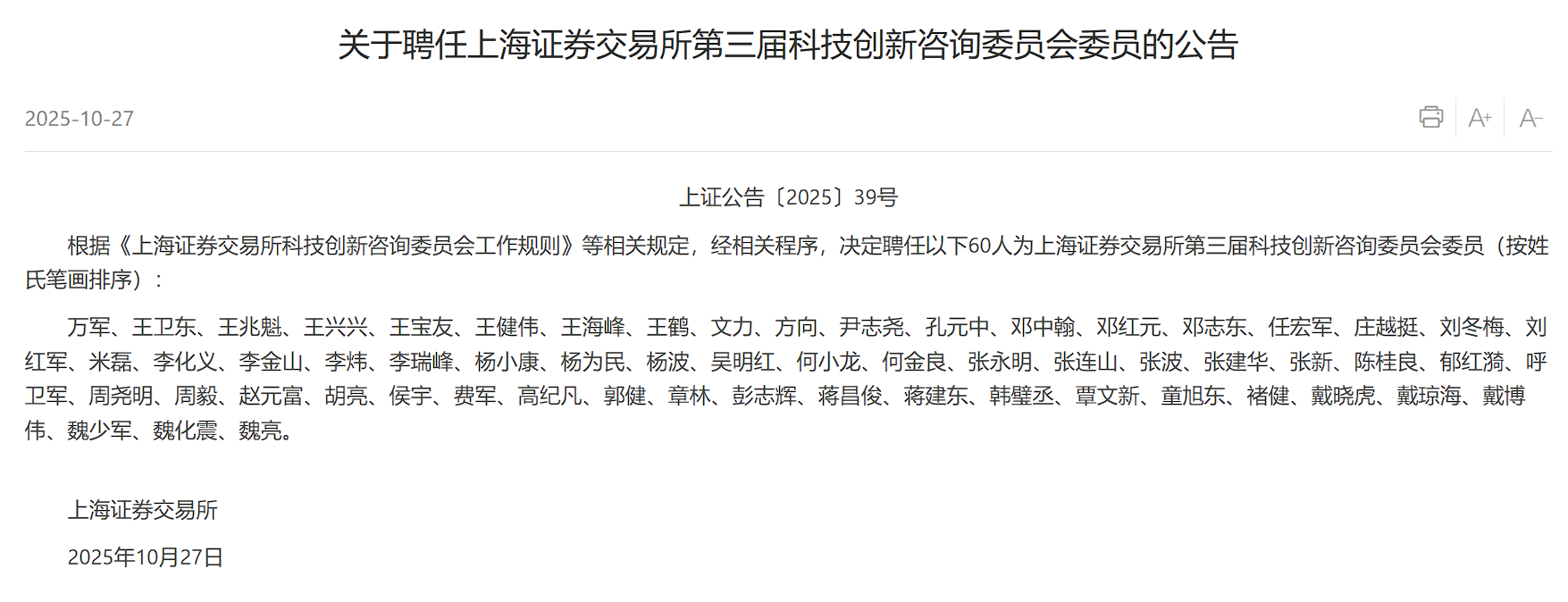
上交所聘任,宇树王兴兴等有新职
21世纪经济报道· 2025-10-28 06:19
Group 1 - The Shanghai Stock Exchange (SSE) announced the appointment of the third Technology Innovation Advisory Committee, consisting of 60 members primarily from research institutions, leading enterprises, and government agencies, with a focus on continuity and expertise in future industries such as artificial intelligence, robotics, commercial aerospace, and low-altitude economy [2][3] - Notable new members include Wang Xingxing, CEO of Yushu Technology, and Peng Zhihui, co-founder and CTO of Zhiyuan Robotics, indicating a strong representation from the AI and robotics sectors [2] - The proportion of experts from the integrated circuit and chip industries has significantly increased, with new members including Zhang Xin, Chairman and President of the National Integrated Circuit Industry Investment Fund, and Yin Zhiyao, Chairman and General Manager of Zhongwei Company [2] Group 2 - The SSE Technology Innovation Advisory Committee serves as an expert body to provide professional opinions for the construction and development of the Sci-Tech Innovation Board, focusing on the technological innovation attributes of issuers and the dynamics of domestic and international technological innovation and industrial application [3]

Valaris Limited (VAL) Gained Over 17% This Week. Here is Why.
Insider Monkey· 2025-10-28 05:46
Core Insights - Artificial intelligence (AI) is identified as the greatest investment opportunity of the current era, with a strong emphasis on the urgency to invest in AI technologies now [1][13] - The energy demands of AI technologies are highlighted as a critical concern, with data centers consuming as much energy as small cities, leading to potential crises in power supply [2][3] Investment Opportunity - A specific company is presented as a unique investment opportunity, positioned to benefit from the increasing energy demands of AI, owning critical energy infrastructure assets [3][6] - This company is not a chipmaker or cloud platform but is described as the "Toll Booth" operator of the AI energy boom, collecting fees from energy exports [4][5] Market Position - The company is noted for its ownership of nuclear energy infrastructure, making it integral to America's future power strategy and capable of executing large-scale energy projects [7][8] - It is characterized as debt-free, with a significant cash reserve amounting to nearly one-third of its market capitalization, which positions it favorably compared to other energy firms burdened with debt [8][10] Growth Potential - The company holds a substantial equity stake in another AI-related venture, providing investors with indirect exposure to multiple growth engines in the AI sector [9][10] - The stock is described as undervalued, trading at less than seven times earnings, which presents a compelling investment case given its ties to the booming AI and energy sectors [10][11] Industry Trends - The article discusses the broader trends of AI disruption across traditional industries, emphasizing the importance of investing in companies that are adapting to these changes [11][12] - The influx of talent into the AI field is noted as a driving force for innovation and advancements, reinforcing the potential for growth in AI investments [12][14]


宇树王兴兴、智元彭志辉 担任上交所科技创新咨询委员会委员
2 1 Shi Ji Jing Ji Bao Dao· 2025-10-28 04:49
Core Viewpoint - The Shanghai Stock Exchange (SSE) has announced the appointment of the third session of its Technology Innovation Advisory Committee, consisting of 60 members from various sectors, including research institutions and leading enterprises, with a focus on future industries such as artificial intelligence and robotics [4]. Group 1: Committee Composition - The third advisory committee includes 60 members, primarily consisting of reappointed members from previous sessions [4]. - New members include experts from future industries such as artificial intelligence, robotics, commercial aerospace, and low-altitude economy [4][5]. - Notable new members include Wang Xingxing, CEO of Yushu Technology, and Peng Zhihui, co-founder and CTO of Zhiyuan Robotics [4]. Group 2: Industry Representation - There is a significant increase in the representation of experts from the integrated circuit and chip industries within the committee [6]. - New members from the integrated circuit sector include He Xiaolong, chairman of China Resources Microelectronics, and Zhang Xin, chairman and president of the National Integrated Circuit Industry Investment Fund [6]. Group 3: Committee Responsibilities - The SSE Technology Innovation Advisory Committee serves as an expert body to provide professional opinions for the construction and development of the Sci-Tech Innovation Board [6]. - The committee will advise on the positioning of the Sci-Tech Innovation Board and assess whether issuers possess technological innovation attributes [6].
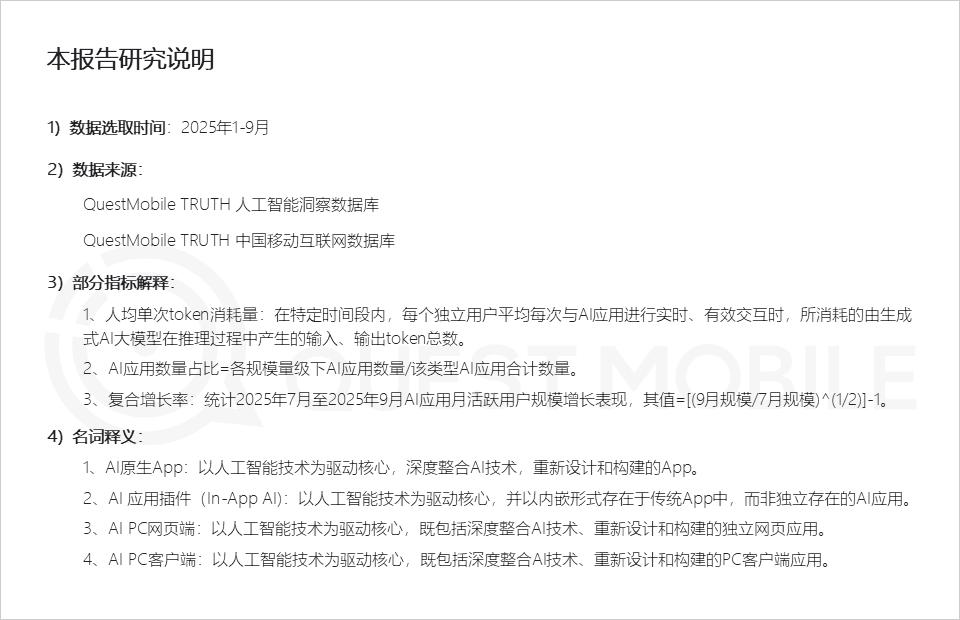
QuestMobile2025年三季度AI应用行业报告:移动端AI应用规模突破7亿大关,模型升级加速,MCP助推产业开放
3 6 Ke· 2025-10-28 03:26
Core Insights - The AI application market is experiencing significant growth, with mobile and PC active user counts reaching 729 million and 200 million respectively by September 2025, driven by a shift towards ecosystem collaboration and model optimization [1][6][14]. Market Overview - As of September 2025, the mobile AI application market includes 287 million users for native apps, 706 million for In-App AI, and 535 million for smartphone manufacturer AI assistants, with respective growth rates of 3.4%, 9.3%, and 1.2% [1][14]. - The overall scale of mobile AI applications has surpassed 700 million, indicating a maturation and commercialization of the industry [6][14]. User Engagement - In-App AI applications dominate the user engagement landscape, with 31 out of the top 50 AI applications being plugins, led by Baidu AI Search, Douyin AI Search, and WeChat AI Search [2][31]. - The average number of In-App AI applications per app in the top 20 has increased to 2.5, while PC web applications and smartphone AI assistants lag behind [2][31]. Competitive Landscape - The competition has shifted from a focus on parameter comparisons to ecosystem collaboration, with major players like Baidu, Alibaba, Tencent, and Douyin updating their models frequently [1][6][14]. - The user engagement time for native AI applications remains the highest at 117.7 minutes, compared to 31 minutes for AI plugins and 5.3 minutes for smartphone AI assistants [2][16]. Trends in AI Applications - The industry is moving towards a "value-driven" model, with pricing strategies becoming more refined and user stickiness increasing, particularly for In-App AI plugins [2][12][18]. - The average single-use token consumption has decreased, indicating improved efficiency and cost control in AI applications [18][20]. Ecosystem Development - The MCP (Model Cloud Platform) services have reached 9,384 by October 20, 2025, facilitating a shift from model development to a service-oriented ecosystem [1][20]. - The integration of AI assistants into smartphones has become standard, with a collective growth of 65 million users across six major manufacturers, reflecting a 13.9% year-on-year increase [40][61]. PC Application Dynamics - The PC application market is undergoing contraction, with over 75% of web applications facing growth challenges, while the client applications are also struggling with 75% showing negative growth [50][57]. - Successful PC applications are primarily in productivity sectors, with notable growth in applications like Xiaoyi and WPS Lingxi, indicating a need for professional value to sustain growth [54][57]. Strategic Focus - Internet companies are focusing on integrating AI with business scenarios to enhance their core offerings, while smartphone manufacturers are building open ecosystems around AI assistants [61][70]. - The evolution of AI applications is characterized by a shift from single-point technology competition to an ecosystem-based collaboration model, with payment capabilities marking a significant milestone in commercialization [74][78].
APEC峰会本周在韩国举行,港股通科技ETF(513860)连续12日“吸金”,机构:科技板块仍将是贯穿中长期的投资主线
2 1 Shi Ji Jing Ji Bao Dao· 2025-10-28 02:07
Group 1 - The Hong Kong Hang Seng Index opened up by 0.28%, while the Hang Seng Tech Index rose by 0.45%, indicating a positive trend in the Hong Kong stock market, particularly in tech stocks [1] - The Hong Kong Stock Connect Technology ETF (513860) has seen a continuous net inflow of funds over the past 12 trading days, accumulating over 56 million yuan, reflecting strong investor interest [1] - The ETF closely tracks the CSI Hong Kong Stock Connect Technology Index, which selects 50 large-cap, high R&D investment, and fast-growing revenue tech companies to represent the overall performance of tech leaders in the Hong Kong Stock Connect [1] Group 2 - The AI industry maintains a high level of prosperity, with rapid advancements in application areas such as multimodal animation, browser entry, and programming, indicating a robust growth trajectory [2] - The technology sector, represented by artificial intelligence, is expected to be a long-term investment theme, further integrating with China's advantageous industries, including leading internet platforms and high-end equipment manufacturing [2] - The year is anticipated to be pivotal for the explosion of open-source large models in China and the reshaping of application patterns within the AI sector [2]

A股开盘速递 | A股集体低开 沪指跌0.25% 存储芯片等板块领跌
智通财经网· 2025-10-28 01:40
Group 1 - A-shares opened lower with the Shanghai Composite Index down 0.25% and the ChiNext Index down 0.9%, with storage chips, combustible ice, cultivated diamonds, and CPO sectors leading the declines [1] Group 2 - Guotai Junan indicates that a new round of financial policies and capital market reforms is imminent, which is expected to further promote economic transformation and enhance the perception of the value of Chinese assets, suggesting that the "transformation bull" in the Chinese stock market still has room for new highs [2] Group 3 - Everbright Securities suggests that multiple favorable factors are likely to support a strong market performance in the short term, with attention on TMT and advanced manufacturing sectors in the medium term, as company earnings are expected to improve, contributing new momentum to the market [3] - The report highlights that while the recovery process remains relatively slow, some areas show improvement, and domestic exports are expected to remain resilient, with the potential for sustained improvement in domestic demand [3] Group 4 - Dongfang Securities notes that the battle for the 4000-point mark is entering a critical phase, with short-term upward movement not expected to be smooth, emphasizing the importance of tracking technology themes [4] - The report indicates that the stocks contributing most to the gains in the Shanghai Composite Index are primarily bank stocks and "state-owned enterprises," along with leading AI stocks like Industrial Fulian, showcasing recent market characteristics [4]



“超级央行周”来了!外资:看好新兴市场投资机会,聚焦科技、资源品
券商中国· 2025-10-27 12:30
Core Viewpoint - The article discusses the upcoming "Super Central Bank Week," highlighting the anticipated interest rate decisions from multiple central banks, particularly the Federal Reserve, which is expected to lower rates by 25 basis points to a range of 3.75% to 4% [1][2]. Group 1: Emerging Market Investment Opportunities - Following the Federal Reserve's initiation of a rate-cutting cycle, Fidelity International has shifted its tactical asset allocation to a more positive stance on risk assets, particularly favoring emerging market equities and bonds [3]. - Fidelity International maintains a bullish outlook on emerging market stocks, especially in China, anticipating more consumer stimulus measures and improvements in industrial profit margins due to "anti-involution" policies [3]. - The firm also sees emerging market bonds as attractive due to their solid fundamentals and better valuations compared to developed market investment-grade bonds, with a weaker dollar further enhancing their appeal [3]. Group 2: Focus on Technology and Resource Sectors - The A-share market is viewed as being in a critical window, with foreign asset management institutions optimistic about structural opportunities in the fourth quarter due to improved liquidity and risk appetite [4]. - The technology growth sector is particularly favored, with an emphasis on AI applications, semiconductor manufacturing, and storage, despite potential short-term price pressures [4]. - The resource sector is gaining attention, with rising prices in precious metals, base metals, and energy metals, as the investment focus shifts towards cyclical commodities like copper and other non-ferrous metals [4]. Group 3: Gold as a Strategic Asset - Fidelity International holds a bullish view on gold, suggesting that as investors reduce exposure to U.S. assets and diversify, gold may attract structural inflows due to factors like Fed rate cuts and geopolitical risks [5].