
油脂加工

Search documents
高库存压制 油脂震荡格局难打破
Qi Huo Ri Bao· 2025-12-18 00:39
Group 1: Oilseed Market Overview - The oilseed sector remains in a volatile pattern, with differentiated performance among various oil types. Since late November, canola oil prices have been on a downward trend, while soybean and palm oil prices have shown some resilience [1] - The U.S. Department of Agriculture (USDA) reported a significant increase in U.S. soybean oil exports, indicating a structural shift in the global vegetable oil market driven by policy and trade [2] Group 2: U.S. Soybean Oil Supply and Demand - The USDA maintained the U.S. soybean oil ending stocks forecast for the 2025/2026 season at 1.726 billion pounds, with a stocks-to-use ratio of 5.65%. This stability is supported by strong crushing demand and robust export sales [3] - U.S. soybean crushing reached a record high in October, with a volume of 237 million bushels, reflecting a month-on-month increase of 15.6% and a year-on-year increase of 9.9% [3] - U.S. soybean oil inventories rose to 1.781 billion pounds by the end of October, up 1.95% month-on-month and 11.87% year-on-year, indicating that strong crushing capacity is outpacing consumption and export [3] Group 3: Global Soybean Oil Market Dynamics - The USDA raised the global soybean oil ending stocks forecast for 2025/2026 to 5.891 million tons, an increase of 198,000 tons from the previous report. Despite a relaxed global soybean supply, soybean oil's unique industrial properties and policy drivers are expected to create a relatively independent market trend [4] Group 4: Palm Oil Supply Issues - Malaysia's palm oil inventory surged by 13% to 2.84 million tons by the end of November, exceeding market expectations and reaching the highest level since April 2019. This increase is attributed to high production levels and a sharp decline in exports [5] - November palm oil exports fell by 28.1% month-on-month to 1.21 million tons, marking a new low for the year, primarily due to weak demand from China and India [5] Group 5: Indonesian Palm Oil Production Challenges - Indonesia's palm oil production may face contraction due to severe flooding impacting infrastructure, although the Indonesian Palm Oil Association claims no significant production losses. However, logistical issues are expected to delay at least 40% of December's export volume [6] - The Indonesian government's crackdown on illegal land use is affecting palm oil plantations, with significant penalties imposed on companies, potentially leading to operational disruptions for 3-6 months [6] Group 6: Domestic Oilseed Market Conditions - As of December 12, domestic commercial inventories of soybean, palm, and canola oils totaled 2.1186 million tons, a decrease of 3.42% week-on-week, but still 9.83% higher year-on-year, indicating high supply levels that continue to pressure oil prices [7] - The price gap between soybean and palm oil has narrowed to 500 yuan per ton, with palm oil blending demand being suppressed due to high inventory levels [8]
油脂日报:棕榈油库存压制,价格承压震荡-20251217
Hua Tai Qi Huo· 2025-12-17 02:44
Report Industry Investment Rating - The investment strategy is neutral [4] Core View of the Report - The prices of the three major oils oscillated and declined yesterday. High - frequency shipping data showed that the export data in early December was also poor, possibly related to India's reduced palm oil purchases. In December, the destocking cycle is not expected to start yet. The high inventory in the producing areas continues to suppress prices. Currently, it is still in the stage of negative realization, and there is no substantial positive news yet. Future attention should be paid to the production and export situations in the producing areas [3] Summary According to Related Catalogs Futures Prices - The closing price of the palm oil 2605 contract yesterday was 8,410 yuan/ton, a decrease of 82 yuan or 0.97% compared to the previous day. The closing price of the soybean oil 2605 contract was 7,872 yuan/ton, a decrease of 68 yuan or 0.86%. The closing price of the rapeseed oil 2605 contract was 9,063 yuan/ton, a decrease of 133 yuan or 1.45% [1] Spot Prices - The spot price of palm oil in Guangdong was 8,430 yuan/ton, a decrease of 100 yuan or 1.17%, with a spot basis of P05 + 20 yuan, a decrease of 18 yuan. The spot price of first - grade soybean oil in Tianjin was 8,280 yuan/ton, a decrease of 70 yuan or 0.84%, with a spot basis of Y05 + 408 yuan, a decrease of 2 yuan. The spot price of fourth - grade rapeseed oil in Jiangsu was 9,560 yuan/ton, a decrease of 120 yuan or 1.24%, with a spot basis of OI05 + 497 yuan, an increase of 13 yuan [1] Market Information - Affected by the shutdown of coastal oil mills, the output of imported and pressed rapeseed oil continued to stagnate last week. Against the background of overall sluggish spot trading, the inventory of imported and pressed rapeseed oil maintained a passive downward trend and has dropped to a relatively low level in the same period in recent years. As of the end of the 50th week of 2025, the inventory of imported and pressed rapeseed oil in China was 384,000 tons, a decrease of 22,000 tons or 5.34% from the previous week. The contract volume was 54,000 tons, an increase of 4,000 tons or 9.98% from the previous week [2] - The C&F price of Argentine soybean oil (January shipment) was 1,159 US dollars/ton, a decrease of 12 US dollars/ton compared to the previous trading day; the C&F price of Argentine soybean oil (March shipment) was 1,120 US dollars/ton, a decrease of 5 US dollars/ton. The C&F quotation of imported rapeseed oil: Canadian rapeseed oil (January shipment) was 1,090 US dollars/ton, unchanged from the previous trading day; Canadian rapeseed oil (March shipment) was 1,070 US dollars/ton, unchanged [2] - The C&F price of US Gulf soybeans (January shipment) was 484 US dollars/ton, a decrease of 1 US dollar/ton compared to the previous trading day; the C&F price of US West soybeans (January shipment) was 480 US dollars/ton, a decrease of 1 US dollar/ton; the C&F price of Brazilian soybeans (January shipment) was 480 US dollars/ton, a decrease of 1 US dollar/ton. The import soybean premium quotes: Mexico Gulf (January shipment) was 245 cents/bushel, unchanged; US West Coast (January shipment) was 235 cents/bushel, unchanged; Brazilian ports (January shipment) was 235 cents/bushel, unchanged [2] - According to data from the Southern Peninsula Palm Oil Millers' Association (SPPOMA), from December 1 - 15, 2025, the yield per unit area of Malaysian palm oil decreased by 2.55% compared to the same period last month, the oil extraction rate decreased by 0.08%, and the output decreased by 2.97% [2]
油脂数据日报-20251216
Guo Mao Qi Huo· 2025-12-16 02:59
来阳 60 40 根据中国粮油商务网监测数据,截至2025年第48周末,国内进口压榨菜 油库存量为42.5万吨,较上周的43.9万吨减少1.4万吨,环比下降 3.35%。与此同时,合同量为4.9万吨,较上周的3.8万吨增加1.1万吨, 17 20 23 26 29 32 35 38 42 45 48 51 环比增加27. 70%。这表明尽管进口菜籽到港量有限,但市场对后续供应 仍保持一定预期。 - 2020 - 2021 - 2022 - 2023 - 2024 - 2025 棕榈油(华南)进口盘面利润 马来西亚棕榈油月度港口库存(万吨) 500 120 - 100 80 据冬衣 -2000 -2500 20 -3000 -3500 02 10 11 01 03 04 05 06 07 08 09 02 03 06 07 08 09 10 12 01 04 05 - 2022 = 2023 = 2024 - 2025 =2022 = 2023 = 2024 - 2025 马来高频数据仍然利空、库存压力大、建议做空棕榈油;全球菜籽新作丰产,近端原料端短缺题材利多出尽,建议做空菜油。 本报告中的信息均源于公开可获 ...
油脂有“料”: 棕榈油及大豆供应宽松抑制豆油涨幅
Xin Lang Cai Jing· 2025-12-15 13:33
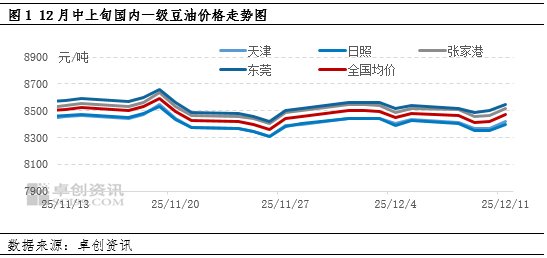
【导语】 12月国际油脂市场两大供需报告数据偏空,且国内在12月中旬拍储进口大豆缓解了原料供应 压力,整体给豆油施加回落压力,但近期内因菜籽油偏强整理带来底部支撑,预计春节前国内豆油价格 或窄幅向好整理。 12月中上旬国内豆油窄幅弱势整理 12月中上旬国内豆油市场先跌后涨,整体震荡回落,截至12月11日,国内豆油价格在8470元/吨,较月 初回落30元/吨,幅度0.35%。本阶段主要受到马来西亚棕榈油供需数据不佳、美农供需报告中性偏空、 阿根廷下调大豆及副产品出口税及国内进口大豆拍储缓解原料供应担忧的影响,给予豆油施加下滑压 力;周内菜籽油一度明显走高带动豆油反弹,但因油脂市场本阶段偏空气氛略浓,豆油整体呈现窄幅弱 势下滑。 国内豆油库存维持高位限制豆油涨幅 国内大豆进口量维持高位,压榨企业原料供应充足,整体维持高开工负荷,豆油产出宽松。虽然华南因 豆粕出库有压力,被迫出现个别企业压榨及精炼产线全部或分批停机,但豆油供应量整体依然较大。据 卓创资讯数据显示,上周(12月1日-12月7日)为57.28%,本周(12月8日-12月14日)预计为64.50%, 环比上升7.22个百分点,豆油产量增加4.39万吨。 ...

产地棕榈油减产周期即将到来,国内油脂一季度或震荡偏强
Hua Lian Qi Huo· 2025-12-15 10:13
期货交易咨询业务资格:证监许可【2011】1285号 华联期货油脂年报 产地棕榈油减产周期即将到来 国内油脂一季度或震荡偏强 20251215 邓丹 从业资格号:F0300922 0769-22111252 交易咨询号:Z0011401 审核:姜世东 从业资格号:F03126164 交易咨询号:Z0020059 请务必阅读正文后的免责声明。本报告的信息均来自已公开信息,关于信息的准确性与完整性,建议投资者谨慎判断,据此入市,风险自担。 请务必阅读正文后的免责声明。本报告的信息均来自已公开信息,关于信息的准确性与完整性,建议投资者谨慎判断,据此入市,风险自担。 年度观点及策略 请务必阅读正文后的免责声明。本报告的信息均来自已公开信息,关于信息的准确性与完整性,建议投资者谨慎判断,据此入市,风险自担。 基本面观点 请务必阅读正文后的免责声明。本报告的信息均来自已公开信息,关于信息的准确性与完整性,建议投资者谨慎判断,据此入市,风险自担。 ◆ 棕榈油方面,马棕9-11月超预期累库打压棕榈油价格大幅下跌,但库存大增的利空在盘面已基本反应。而东 南亚近期迎来洪涝灾害,这表明雨季的到来,加之拉尼娜的影响,同时今年5-8月 ...
2026年油脂年度行情展望:模糊的需求驱动与供应的蜂拥三年
Guo Tai Jun An Qi Huo· 2025-12-15 10:00
Report Title - Fuzzy Demand Drivers and Flocking Supply - Outlook for the Annual Vegetable Oil Market in 2026 [1] Report Date - December 15, 2025 [1] Report Author - Li Junyu, Investment Consulting Practitioner Qualification Number: Z0021380, lijunyu@gtht.com [2] Report Investment Rating No investment rating was provided in the report. Core Viewpoints - Vegetable oils are in a situation of weak current reality with improving expectations. In the 25/26 season, the inventory-to-sales ratio of the four major vegetable oils increased slightly. The year 2026 is a period of hibernation and preparation for a breakthrough. The inventory increase of only 1 million tons is easily affected by the US biodiesel policy for soybean oil and unexpected palm oil production. Starting from the first quarter of next year, there is room for palm oil, domestic soybean oil, and US soybean oil to reverse the weak reality. However, the uncertainty of whether palm oil production can increase regularly makes the supply trading full of variables and unsmooth. It is necessary to observe the performance during the low-production period. After the high-production trading is fully priced in, it is advisable to build long positions in palm oil 09 contracts on dips. Soybean oil can also be lightly allocated long in the first quarter. Rapeseed oil prices face the risk of being relatively weak among varieties, and it is mainly recommended to build short positions in rapeseed oil 05 contracts driven by events [2]. Summary by Directory 1. Review of the Vegetable Oil Market in 2025 - **First Stage (December 2024 - Mid-to-Late January 2025)**: The supply pressure of new Brazilian crops and the depreciation of the real led to a continuous decline in Brazilian soybean premiums since December. The US soybean oil market was affected by pessimistic expectations of the biodiesel policy and declined continuously. Palm oil lacked marginal positive factors. As a result, the entire vegetable oil and oilseed sector was under pressure. Palm oil started a continuous decline after reaching a previous high due to the lack of marginal positive factors. During this period, US soybean oil and crude oil also adjusted significantly. Concerns about the decline in export demand from Malaysia and Indonesia, doubts about whether B40 could be fully implemented, and the possibility that the tax increase associated with B40 might fall short of expectations led investors to view the subsequent driving forces of palm oil with caution [7]. - **Second Stage (Early February - End of March 2025)**: The USDA report at the beginning of the year was unexpectedly positive, leading to a continuous rise in US soybeans. The pessimistic expectations of the US soybean oil biodiesel policy were fully priced in. The cold wave problem in US fuel made US soybean oil temporarily strong. Additionally, the short - term import restrictions on raw materials only provided emotional support to US soybean oil, laying the foundation for the rise in February. After the Spring Festival, soybean oil showed strong momentum, supported by import costs due to slow harvesting in Brazil, unfavorable weather in Argentina, low soybean arrivals in China in the first quarter, and tight near - term supply. The MPOB supply - demand data showed that Malaysia's palm oil production in January was significantly lower than expected, and production in February was also expected to remain low, with inventory difficult to improve. Combined with the upcoming Ramadan, palm oil had strong fundamental support among vegetable oil varieties. At the same time, rumors of an export ban in the producing areas stimulated palm oil to move strongly due to supply concerns. In March, China's 10% tariff increase on US soybeans stirred market sentiment. The potential for the US - Europe tariff tension to prompt Europe to shift its procurement of soybean - related products to South America might lead to an increase in the potential import cost of soybean oil, causing vegetable oils to maintain a relatively strong pattern in a volatile market [8]. - **Third Stage (April - Mid - June 2025)**: Palm oil fluctuated between strong current reality and weak expectations, and the market had significant differences on when the inflection point would arrive, leading to intense long - short battles. During the Tomb - Sweeping Festival, the US reciprocal tariff policy had a systematic impact on the global financial market, causing international oil prices to decline sharply, and the three major vegetable oils followed suit. After the market sentiment stabilized, palm oil traded the recovery of supply and export pressure, and the vegetable oil market entered a bottom - building phase, waiting for new contradictions in the third quarter [9]. - **Fourth Stage (Late June - Early October 2025)**: Driven by both domestic and international factors, vegetable oil varieties started the first smooth upward trend this year, with palm oil rising by 2,000 points. On the demand side, the negative factors such as the cumulative year - on - year decline in apparent demand in China and India, negative growth in European diesel consumption, and cumulative year - on - year decline in US biodiesel production did not support short - selling vegetable oils in the second half of the year. On the supply side, since the second quarter, the market's pessimistic sentiment about Malaysia's palm oil inventory reaching a high of over 2.3 million tons this year has gradually subsided. The high production from April to May released the negative factors in advance. Coupled with the potential production risks during the high - production period from July to August, the price of palm oil reached its low point earlier. Internationally, the positive news of the US RVO policy in mid - June injected upward momentum into the vegetable oil sector. The increase in European carbon targets and changes in the double - carbon ticket rules led to an upward trend in HVO prices since the end of June. Meanwhile, geopolitical risks in the Middle East boosted oil prices, and the European diesel crack spread reached a historical high. Driven by both domestic and international factors, palm oil started a two - month upward trend, rising by 2,000 points. Subsequently, from September to mid - October, palm oil oscillated in a very narrow range between 9,200 and 9,600, waiting for further guidance during the low - production season [10]. - **Fifth Stage (Mid - October 2025 - Present)**: The US biodiesel policy has been delayed, and palm oil maintained high - yield power in the fourth quarter. The trading momentum of the strong expectations under the weak reality was difficult to sustain. US soybean oil gradually fell back to the platform on June 13, and the de - stocking time of Malaysian palm oil was repeatedly postponed. Palm oil prices completely gave back the gains since June, falling back to the price platform in June, creating the second smooth downward trend this year. However, this round of decline was entirely caused by the unexpected over - production of palm oil itself. Soybean oil prices were still supported by the slow ship - buying under the China - US economic and trade relations and the logic of crushing profit repair. Therefore, the soybean - palm oil price spread rebounded significantly during this period, rising by nearly 1,000 points; rapeseed oil gradually gave back the premium caused by the China - Canada policy disturbance, and the rapeseed - soybean oil price spread also declined by about 500 points [11]. 2. Outlook for the Supply Side of Vegetable Oils in 2026 - **Overall Supply and Demand**: In the 25/26 season, the global production of the four major vegetable oils is expected to increase by about 4 million tons to 210 million tons, with the growth rate slowing down compared to the previous two seasons. The global production of soybean oil is expected to increase by 1.5 million tons, palm oil by 1.8 million tons, rapeseed oil by 0.4 million tons, and sunflower oil to remain flat year - on - year. The global consumption of the four major vegetable oils is expected to increase by about 5.5 million tons to 209 million tons, recovering from the negative growth in the 24/25 season. This is mainly due to the recovery of India's vegetable oil consumption, the implementation of PSO - B50 in Indonesia in the second half of the year, the full - year plan of B15 in Brazil, and the rebound of the US biodiesel policy. As a result, the global industrial demand is expected to increase by 4.4 million tons year - on - year, including a 1.2 - million - ton increase in palm oil, a 2 - million - ton increase in soybean oil, and an 0.8 - million - ton increase in rapeseed oil. The global ending inventory of the four major vegetable oils is expected to increase by 1 million tons to 25.65 million tons, and the inventory - to - sales ratio is expected to rise from 12.22% in the previous season to 12.25%. However, the main inventory increase is contributed by palm oil, while soybean, rapeseed, and sunflower oils remain in tight balance. The rapid inventory accumulation period of palm oil has been fully priced in the fourth quarter of 2025, and the pressure of vegetable oil inventory reconstruction has been released in advance [19][20]. - **Palm Oil** - **Malaysia**: From January to November 2025, Malaysia's cumulative palm oil production increased by 3.37% year - on - year, and the full - year production is expected to approach 20.2 million tons, an increase of about 0.85 million tons compared to 2024. The continuous high production in the past two years has not only led to a decline in palm oil prices in the fourth quarter but also raised concerns about the supply inflection point. The high production in October and November may be due to less rainfall, the development of mechanized operations, and the increase in foreign labor. Based on the current tree - age structure and historical rainfall conditions, the production potential in 2026 is expected to decline slightly compared to 2025, but considering the positive impact of labor on production, the production in 2026 is estimated to be in the range of 19.6 - 19.8 million tons. Attention should be paid to the possible low - production situation from March to May next year [27][28][30]. - **Indonesia**: From January to September 2025, Indonesia's cumulative palm oil production was 43.33 million tons, an increase of 11% year - on - year, with an increase of 4.55 million tons in the first three quarters. The full - year production is estimated to be about 57.5 million tons, an increase of 4.8 million tons year - on - year. For the production in 2026, two main factors need to be considered: the improvement of the tree - age structure and the production capacity release cycle due to the increase in the planted area in the early stage, and the impact of the transfer of 3 million hectares of illegal plantations to state - owned companies on the unit yield. Overall, the production in 2026 is expected to increase to 58.68 million tons in the GAPKI statistics. However, the relatively dry weather in July this year may lead to lower - than - expected production from April to May next year [39][40][43]. - **Soybean Oil**: In the 25/26 season, the global soybean oil production is expected to increase to 71.27 million tons, an increase of 1.46 million tons compared to the previous season, with a significantly slowed growth rate. The global soybean production in the 25/26 season has a small increase compared to the previous year. Except for the United States, the increase in soybean crushing volume in other countries is not significant. The United States' soybean crushing capacity has an average annual growth rate of about 3 - 5% in recent years. Under the background of high crushing profits and high operating rates, the crushing volume in the 25/26 season is expected to increase by 3 - 4 million tons, and the production of soybean oil is expected to increase by about 0.65 million tons. In Brazil, with the significantly higher old - crop soybean inventory compared to the same period last year, the crushing volume is expected to increase by more than 1 million tons, corresponding to an increase of 0.2 million tons in soybean oil production. Argentina's production is slightly reduced, and China's soybean oil production is expected to increase by 0.6 million tons in the 25/26 season due to the high supply of raw materials and the high cost - effectiveness of soybean oil. The global demand for soybean oil in the 25/26 season is expected to increase to 70.99 million tons, an increase of 2.29 million tons compared to the previous season, higher than the production increase. The change in the US biofuel policy has a great impact on the industrial demand for US soybean oil next year. The difference between the most pessimistic and the most optimistic scenarios is as high as 2 million tons. Even in the most pessimistic scenario, the US demand for soybean oil in the 25/26 season will increase by at least 1.4 million tons to 13.6 million tons, including 7.1 million tons of industrial consumption. The final global ending inventory of soybean oil is expected to increase by 0.28 million tons, and the inventory - to - sales ratio will only slightly increase from 10.34% in the previous season to 10.40%. In the continuation of the soybean bear market, soybean oil first regains demand through price adjustment, greatly weakening the contradiction of inventory accumulation at the margin [55][56]. - **Rapeseed and Sunflower Oil** - **Rapeseed**: In the 2025/26 season, the global rapeseed production is expected to increase significantly year - on - year, and the global rapeseed supply is expected to become looser. According to the USDA's November forecast, the global rapeseed production in the 2025/26 season will increase by 6.27 million tons compared to the 2024/25 season. The rapeseed production in the EU, the main consumer region, is expected to increase by more than 3 million tons year - on - year. Among the main exporting countries, except for Ukraine, the production of other major exporting countries will increase. However, the beginning inventory of rapeseed in the main exporting countries has decreased significantly year - on - year, and the supply pressure of global rapeseed is expected to be postponed. The effective supply (beginning inventory + production) of global rapeseed in the 2025/26 season will increase by 4.15 million tons year - on - year, with an increase rate of 4.2% [65][66]. - **Sunflower Oil**: The production and crushing estimates of sunflower seeds in the EU, Russia, and Ukraine have been revised down again, suppressing the growth of global sunflower oil production this season. The current forecast for global sunflower oil production in the 25/26 season is about 21 million tons, and the year - on - year production increase has shrunk from the initial 2 million tons to almost zero. The sunflower oil supply in Europe, Russia, and Ukraine is much lower than expected, in contrast to the increasing production in Argentina. From January to October 2025, Argentina's sunflower oil exports increased by 30% year - on - year to a multi - year high of 1.36 million tons, and its market share in multiple importing countries has continued to expand. Argentina's sunflower oil exports are expected to further increase in 2026, although recent rainfall has hindered local production by about 0.4 million tons. Affected by this, the price of sunflower oil for near - month delivery remains strong and maintains a premium over other major vegetable oils in the European market [67][68]. 3. Outlook for the Demand Side of Vegetable Oils in 2026 - **China**: In terms of total demand, the domestic consumption of vegetable oils has not shown a counter - trend increase. From January to October 2025, the cumulative apparent consumption of the four major vegetable oils in China was 22.755 million tons, a decrease of 1.38 million tons compared to the same period last year, with an average monthly decrease of 0.14 million tons. In terms of variety structure, soybean oil's demand share has further increased due to its cost - effectiveness. From January to October 2025, the cumulative apparent consumption of domestic soybean oil was 16.94 million tons, an increase of 0.61 million tons compared to the same period last year, and the monthly average share rose to over 70%. The cumulative apparent consumption of palm oil was 2.42 million tons, a decrease of 1 million tons compared to the same period last year, and the monthly average share fell to below 15%. The cumulative apparent consumption of rapeseed oil was 2.9 million tons, a decrease of 0.42 million tons compared to the same period last year, and the monthly average share fell to below 15%. The cumulative apparent consumption of sunflower oil was 0.47 million tons, a decrease of 0.06 million tons compared to the same period last year, and the monthly average share remained at 2 - 3%. The annual apparent demand for soybean oil exceeded 20 million tons (20.4 million tons in the 24/25 season) and is expected to further increase to 20.7 million tons in the 25/26 season. The palm oil consumption in China is expected to remain flat year - on - year, with an estimated annual demand of about 3.15 million tons. The demand for rapeseed oil in China is expected to continue to decline to about 3.4 million tons in the 25/26 season. Overall, the demand for the four major vegetable oils in China decreased by 1.3 million tons to 28.1 million tons in the 24/25 season and is expected to further decline to 27.8 million tons in the 25/26 season [72][73][75]. - **India**: From January to October 2025, India's cumulative imports of edible vegetable oils were 13.07 million tons, a decrease of 0.35 million tons compared to the same period last year. Among them, palm oil imports were 6
金融服务“沉下去”县域经济“活起来”——邮储银行江西省分行:探索金融助力县域经济高质量发展新路径
Zheng Quan Ri Bao Zhi Sheng· 2025-12-15 02:20
Group 1: Financial Support and Impact - Postal Savings Bank of China Jiangxi Branch has focused on serving the real economy by providing targeted financial resources to key areas of county economic development, resulting in an agricultural loan balance of nearly 106.5 billion yuan and inclusive small and micro enterprise loans exceeding 78.5 billion yuan by the end of November 2025 [1] - The bank has implemented a customized financial service model, creating exclusive financial product solutions tailored to the unique agricultural industry layout in Jiangxi Province, particularly focusing on five major industrial chains and two characteristic industrial chains [1] - The bank's support has enabled companies like Guodu Traditional Chinese Medicine to secure timely funding, which has been crucial for their growth and operational needs, demonstrating the bank's role in facilitating business development during critical periods [2][3] Group 2: Industry Development and Innovation - Guodu Traditional Chinese Medicine has invested over 100 million yuan in modernizing its pharmaceutical workshop and research center, showcasing the integration of traditional practices with modern technology, supported by Postal Savings Bank [3] - Tianyu Oil Co., Ltd. has expanded its product range and enhanced its production capabilities through financial backing from the bank, which has allowed for increased research and development and digital transformation [4][5] - Jiangxi Hongcheng Aluminum Co., Ltd. has benefited from a tailored financial service plan that addresses its specific needs for high-end technology and equipment, enabling it to pursue a green development strategy [6] Group 3: Support for Green and Sustainable Development - Postal Savings Bank Jiangxi Branch has established a comprehensive financial service system to support traditional industry upgrades and technological innovation, focusing on green and low-carbon economic initiatives [7] - The bank has actively engaged with local governments and businesses to provide diversified financing solutions, thereby promoting the development of the circular economy and supporting green industries [6][7] - Jiangxi Dertai Technology Co., Ltd. has received significant financial support for its expansion projects, reflecting the bank's commitment to fostering innovation in the medical equipment sector [8] Group 4: Tailored Financial Products for Specific Industries - The bank has developed specialized loan products, such as the "Metal Furniture Industry Loan," to better match the financial needs of small and micro enterprises in the metal furniture sector, addressing challenges like insufficient collateral [9][10] - Through initiatives like "Hundred Banks Enter Ten Thousand Enterprises," the bank has conducted in-depth visits to understand the operational status and funding needs of private enterprises, allowing for customized financing solutions [10]

市场利空,油脂震荡回落
Hua Long Qi Huo· 2025-12-15 02:06
研究报告 油脂周报 市场利空,油脂震荡回落 华龙期货投资咨询部 投资咨询业务资格: 证监许可【2012】1087 号 农产品板块研究员:姚战旗 期货从业资格证号:F0205601 投资咨询资格证号:Z0000286 电话:13609351809 邮箱:445012260@qq.com 本报告中所有观点仅供参 考,请投资者务必阅读正文之后 的免责声明。 摘要: 【行情复盘】: 本周油脂期价震荡回落,全周豆油 Y2605 合约下跌 1.06%, 以 7994 元/吨报收,棕榈油 P2605 合约下跌 2.40%以 8552 元/吨 报收,菜油 OI2605 合约下跌 0.64%,以 9347 元/吨报收。 【重要资讯】: 一、现货分析: 截止至 2025 年 12 月 11 日,张家港地区四级豆油现货价格 8,570 元/吨,较上一交易 日上涨 50 元/吨。从季节性角度来分析,当前张家港地区四级豆油现货价格较近 5 年相比 维持在较低水平。 截止至 2025 年 12 月 12 日,广东地区 24 度棕榈油现货价格 8,580 元/吨,较上一交易 日下跌 100 元/吨。从季节性角度来分析,当前广东地区 24 ...
【建投油脂年报】拨云见日终有时,守得云开见月明
Xin Lang Cai Jing· 2025-12-14 23:21
热点栏目 自选股 数据中心 行情中心 资金流向 模拟交易 客户端 来源:CFC商品策略研究 作者 | 中信建投期货 研究发展部 石丽红 本报告完成时间 | 2025年12月14日 重要提示:本报告观点和信息仅供符合证监会适当性管理规定的期货交易者参考。因本平台暂时无法设 置访问限制,若您并非符合规定的交易者,为控制交易风险,请勿点击查看或使用本报告任何信息。对 由此给您造成的不便表示诚挚歉意,感谢您的理解与配合! 2025年国内油脂走势一波三折,品种间走势分化明显。在产量及生柴题材驱动下,棕榈油引领了多数时 间的油脂涨跌;豆油以稳为主,涨跌均不显眼;菜油则在进口大幅收紧的背景下走势偏强势且独立。 尽管当前油脂整体表现不佳,我们仍对其2026年走势持乐观态度。结合当前时点及潜在交易题材,油脂 市场或正临近转折点,市场分歧最大的棕榈油预计仍是关键所在。近期市场对马棕大幅增产的恐慌打压 棕榈油连破支撑,但可能将面临市场预期的再度反转。2025年东南亚棕榈油超预期的增产面临天时地利 人和,在前期降雨不佳、树龄趋于老化、印尼大量罚没种植园的背景下,恐难在2026年复刻。 生物柴油需求增长则是另一潜在驱动。美国生物柴油政 ...

油脂周度行情观察-20251210
Hong Ye Qi Huo· 2025-12-10 14:05
Report Industry Investment Rating - Not provided in the content Core Viewpoints - This week (December 1st - 5th), the oil and fat sector showed a divergent trend. Palm oil and soybean oil rebounded in a volatile manner, while rapeseed oil trended weakly in a volatile way. Palm oil is expected to fluctuate in the short - term due to supply - demand pressure; soybean oil will also fluctuate in the short - term with uncertainties; rapeseed oil will trend weakly in the short - term, and the arrival of Australian rapeseed may relieve the supply shortage [12] Summary by Directory 1. Market Review Palm Oil - Malaysian palm oil production decreased, with MPOA showing a 4.38% month - on - month decrease in production from November 1st - 30th. Export was weak, with ITS data showing a 19.7% month - on - month decline in November exports, AmSpec showing a 15.89% decrease, and SGS showing a 39.21% decrease. November inventory may rise to a six - and - a - half - year high. Indian refiners cancelled about 70,000 tons of soybean oil orders, and there is an expectation of resuming palm oil procurement, causing palm oil to rise in a volatile manner [4] Soybean Oil - China's import of US soybeans slowed down as US soybean prices are higher than Brazilian soybeans. As of Friday, 462,000 tons of soybeans were sold to China, and the confirmed sales since the end of October reached 2.7 million tons, accounting for 22.5% of the 12 million - ton procurement target. The US EIA indicated that the use of soybean oil for biofuel production in September 2025 was 1.053 billion pounds, higher than that in August, strengthening the market's expectation of continuous increase in future soybean oil use [4] 2. Fundamental Observation Supply - Palm oil: This week, 4 new palm oil purchase vessels were added in China, with all ship dates spanning from December to January, and no new cancellations. Due to mainly rigid domestic demand, the palm oil purchase volume is low. - Soybean oil: As of December 5th, the actual soybean crushing volume in oil mills was 205.58 tons, with an operating rate of 56.55%, a 6.59% month - on - month decrease but still at a high level. The soybean oil production was 390,000 tons, a 27,500 - ton month - on - month decrease. The domestic soybean port inventory is at a high level, and the supply is loose. - Rapeseed oil: As of December 5th, the rapeseed oil production in coastal oil mills was 0 tons. Pay attention to the crushing situation in December after the arrival of Australian rapeseeds [10] Demand - Palm oil: As of December 5th, the total trading volume of 24 - degree palm oil in key domestic oil mills was 700 tons, a 7,900 - ton month - on - month decrease, with mainly rigid domestic demand. - Soybean oil: As of December 5th, the weekly trading volume of domestic soybean oil was 136,900 tons, a 61,500 - ton month - on - month increase, but the demand is still weak. - Rapeseed oil: As of December 5th, the pick - up volume of rapeseed oil in coastal oil mills was 220 tons, a 10 - ton month - on - month decrease, and it is at a low level compared to the same period [7] Inventory - Palm oil: As of December 5th, the commercial inventory of palm oil in key domestic regions was 683,700 tons, a 30,200 - ton month - on - month increase, a 4.62% increase. - Soybean oil: As of December 5th, the commercial inventory of soybean oil in key domestic regions was 1.163 million tons, a 15,800 - ton month - on - month decrease, a 1.34% decrease, but the inventory still has pressure. - Rapeseed oil: The rapeseed oil inventory was 347,000 tons, a 18,200 - ton month - on - month decrease, a 4.98% decrease. The rapeseed oil inventory continues to decline, and the supply is tight [8] Cost and Profit - As of December 5th, the CIF price of Malaysian palm oil was $1,049/ton; the import cost price was 8,864 yuan/ton, a 20 - yuan/ton month - on - month decrease [9] 3. Conclusion Palm Oil - Recently, the precipitation in Southeast Asia has increased, and Malaysia and Indonesia have experienced floods. Malaysian palm oil production has decreased, but Indonesia said the floods have not had a significant impact on production. Exports are weak, and there is pressure on inventory accumulation. Indonesia has lowered the export tariff in December to increase competitiveness. Pay attention to the MPOB report. It will fluctuate in the short - term [12] Soybean Oil - China's procurement of US soybeans has slowed down. Domestically, the soybean arrival volume has increased significantly, the soybean supply is loose, the oil mill operating rate has decreased but is still at a high level, the soybean crushing volume is still high, the soybean oil production has decreased month - on - month, the soybean oil inventory has decreased but still has pressure, and the demand is weak. Pay attention to the domestic inventory reduction rhythm, and the US biodiesel policy is still uncertain. It will fluctuate in the short - term [12] Rapeseed Oil - China still maintains the anti - dumping policy against Canada, and the China - Canada relationship has not progressed. The domestic rapeseed inventory is at a low level, the oil mills are shut down, the rapeseed oil production is 0, and the inventory continues to decline. The fundamentals of rapeseed oil have changed little. The arrival of Australian rapeseeds may relieve the tight supply of rapeseed oil. Pay attention to the crushing of Australian rapeseeds. It will trend weakly in a volatile way in the short - term [12] 4. Spot Prices - As of December 5th, the spot price of Zhangjiagang Grade 4 soybean oil was 8,570 yuan/ton, a 40 - yuan/ton month - on - month increase. - The spot price of 24 - degree palm oil in Guangdong was 8,740 yuan/ton, a 170 - yuan/ton month - on - month increase. - The spot price of Nantong Grade 4 rapeseed oil was 9,870 yuan/ton, a 200 - yuan/ton month - on - month decrease [14] 5. Malaysian Palm Oil Data Production - In October 2025, affected by the increase in working days and favorable weather, the Malaysian palm oil production was 2.044 million tons, a 11.02% month - on - month increase. The production in the Malay Peninsula was 1.1171 million tons, a 6.56% month - on - month increase; the production in Sarawak was 481,200 tons, a 14.65% month - on - month increase; the production in Sabah was 445,600 tons, a 19.50% month - on - month increase [16] Inventory - In October, the inventory was 2.46 million tons, a 4.44% month - on - month increase, and it is at a high level compared to the same period [17] Export - In October, the Malaysian palm oil export volume was 1.6929 million tons, an 18.58% month - on - month increase [20] Consumption - The domestic consumption in Malaysia was 282,400 tons, a 15.58% month - on - month decrease, falling back to the normal range [21] 6. Indian Palm Oil Import - In October, India imported 602,300 tons of palm oil, a 226,600 - ton month - on - month decrease, a 27% decrease, and it is at a low level compared to the same period [24] 7. Domestic Palm Oil Data Import and Inventory - As of December 5th, the commercial inventory of palm oil in key domestic regions was 683,700 tons, a 30,200 - ton month - on - month increase, a 4.62% increase. In October, the domestic palm oil import volume was 220,000 tons, a 70,000 - ton month - on - month increase, and the import volume rebounded [27] Consumption - In October, the palm oil consumption was 228,300 tons, a 23,200 - ton month - on - month decrease, and it is at a low level compared to the same period [30] Import Profit - As of December 5th, the import profit of 24 - degree palm oil was - 66 yuan/ton, a 143 - yuan/ton month - on - month increase [33] 8. Domestic Soybean Oil Data - As of December 5th, the oil mill operating rate dropped to 56.55%, the soybean oil production was 390,000 tons, a 27,500 - ton month - on - month decrease, and it is still at a high level compared to the same period. The commercial inventory of soybean oil in key domestic regions was 1.163 million tons, a 15,800 - ton month - on - month decrease, but the inventory still has pressure [35][36] 9. Domestic Rapeseed Oil Data - As of December 5th, the rapeseed inventory dropped to 0 tons, the crushing plant operating rate was 0%, the rapeseed crushing volume was 0 tons, and the rapeseed oil production in coastal oil mills was 0 tons. The rapeseed oil inventory was 347,000 tons, a 18,200 - ton month - on - month decrease, the inventory continued to decline, and it is at a low level compared to the same period. The first shipment of Australian rapeseeds has arrived. Pay attention to the customs clearance and subsequent crushing of Australian rapeseeds [38]