零售业

Search documents
【抗战胜利80周年】洞见山城
Zhong Guo Xin Wen Wang· 2025-08-20 02:14
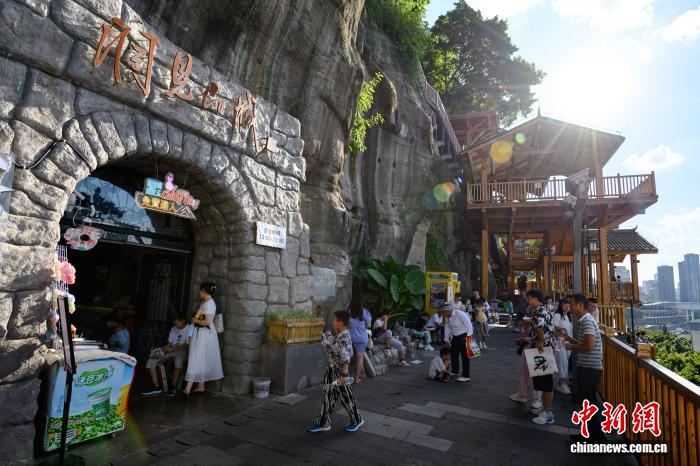
在山城重庆,防空洞是一种极为特殊的存在。抗日战争时期,侵华日军对重庆及其周边实施了长达6年 零10个月的无差别轰炸,史称"重庆大轰炸"。修筑防空洞,成为当时最直接、最有效的避难方式。据史 料记载,1937年至1942年间,重庆的防空洞数量从54个激增至1603个。八十余年过去,这些大大小小的 防空洞挺过了战火硝烟,涅槃重生,与城市融为一体。它们或成为菜市场、纳凉点,或变身博物馆、火 锅店、书店……从战争庇护所到城市生活的一部分,防空洞见证了重庆从苦难到繁盛的漫长蜕变,成为 今日山城独具魅力的风景线。图为8月17日,游客来到重庆渝中区戴家巷崖壁公园的"洞见山城"防空洞 参观。中新社记者何蓬磊 摄 图为8月16日,市民在重庆渝北区的防空洞背篓菜市场选购蔬菜。中新社记者 何蓬磊 摄 图为8月16日,市民在重庆渝北区的防空洞背篓菜市场选购蔬菜,该防空洞菜市场主要用来接驳重庆"背 篓专线",为菜农提供一个免费卖菜场地。中新社记者 何蓬磊 摄 图为8月19日,市民在重庆渝北区一防空洞火锅店就餐。该防空洞火锅店设有两百多张桌位,可同时容 纳上千人烫火锅。中新社记者何蓬磊 摄 图为7月3日,市民来到重庆南岸区重柴厂人防工程纳 ...

东方甄选报警◆胖东来董事长:胖东来的经营模式要完全复制不容易,也没必要◆一地将全面暂停网约车“一口价”“特惠单”?官方回应:属实
Jin Rong Shi Bao· 2025-08-19 23:00
2025年8月20日 ■ 8月19日,外交部发言人毛宁主持例行记者会。有记者提问,特朗普与泽连斯基以及与欧洲多国领导 人在白宫举行了会晤,外交部对此有何评论?毛宁表示,中方始终认为对话谈判是解决乌克兰危机的唯 一可行出路,我们支持一切有利于和平的努力。 ■ 工业和信息化部、中央社会工作部、国家发展改革委、国务院国资委、市场监管总局、国家能源局8 月19日联合召开光伏产业座谈会,深入学习贯彻习近平总书记重要指示批示精神,贯彻落实党中央、国 务院决策部署,进一步规范光伏产业竞争秩序。 ■ 财政部19日发布数据显示,今年前7个月,全国一般公共预算收入135839亿元,同比增长0.1%。 ■ 人力资源社会保障部等5部门8月19日对外发布《关于领取个人养老金有关问题的通知》,进一步丰富 个人养老金领取情形,明确具体操作办法,自9月1日起开始实施。(详情) ■ 水利部于19日对天津、河北、辽宁、云南4省份启动洪水防御Ⅳ级应急响应,并维持对北京市的洪水 防御Ⅳ级应急响应。 ■ 据国家档案局19日消息,《抗日战争档案汇编》新书发布会19日在北京举行,其中多数档案属首次公 布。 ■ 据西藏自治区财政厅19日消息,在西藏自治区成 ...

合肥百货大楼集团股份有限公司2025年半年度报告摘要
Shang Hai Zheng Quan Bao· 2025-08-19 18:53
Core Viewpoint - The company, Hefei Department Store Group Co., Ltd., has announced its 2025 semi-annual report, indicating no significant changes in its operational status during the reporting period [1][6][9]. Group 1: Company Overview - The company has confirmed that all directors attended the board meeting to review the semi-annual report [1]. - There has been no change in the controlling shareholder or actual controller during the reporting period [4][5]. Group 2: Financial Decisions - The company plans to use up to 500 million yuan of its idle funds for entrusted wealth management, which is approximately 10.64% of its audited net assets for 2024 [11][22]. - The investment will focus on low-risk financial products, including short-term bank wealth management products and structured deposits [20][22]. Group 3: Board and Supervisory Committee Actions - The board of directors and the supervisory committee both approved the semi-annual report with unanimous votes [8][15]. - The decision to use idle funds for wealth management was also unanimously approved by both the board and the supervisory committee [11][16].

王府井(600859)8月19日主力资金净流出1464.12万元
Sou Hu Cai Jing· 2025-08-19 13:35
金融界消息 截至2025年8月19日收盘,王府井(600859)报收于14.16元,上涨0.21%,换手率2.21%, 成交量24.86万手,成交金额3.52亿元。 资金流向方面,今日主力资金净流出1464.12万元,占比成交额4.16%。其中,超大单净流入785.91万 元、占成交额2.23%,大单净流出2250.03万元、占成交额6.39%,中单净流出流入628.69万元、占成交 额1.79%,小单净流入835.42万元、占成交额2.37%。 王府井最新一期业绩显示,截至2025一季报,公司营业总收入29.85亿元、同比减少9.76%,归属净利润 5564.12万元,同比减少72.43%,扣非净利润2701.08万元,同比减少86.02%,流动比率1.619、速动比率 1.385、资产负债率50.17%。 天眼查商业履历信息显示,王府井集团股份有限公司,成立于1993年,位于北京市,是一家以从事零售 业为主的企业。企业注册资本113504.9451万人民币,实缴资本37277.6396万人民币。公司法定代表人为 白凡。 通过天眼查大数据分析,王府井集团股份有限公司共对外投资了109家企业,参与招投标项目6 ...

合百集团: 2025年半年度报告摘要
Zheng Quan Zhi Xing· 2025-08-19 11:12
| | | | 摘要 | | | | | | --- | --- | --- | --- | --- | | 证券代码:000417 | | 证券简称:合百集团 | | 公告编号: | | 2025-26 | | | | | | 合肥百货大楼集团股份有限公司 年半年度报告摘要 | | 2025 | | | | 一、重要提示 | | | | | | 本半年度报告摘要来自半年度报告全文,为全面了解本公司的经营成果、财务状况及未来发展规划,投 | | | | | | 资者应当到证监 | | | | | | 会指定媒体仔细阅读半年度报告全文。 | | | | | | 所有董事均已出席了审议本报告的董事会会议。 | | | | | | 非标准审计意见提示 | | | | | | □适用 | ?不适用 | | | | | 董事会审议的报告期利润分配预案或公积金转增股本预案 | | | | | | □适用 | ?不适用 | | | | | 公司计划不派发现金红利,不送红股,不以公积金转增股本。 | | | | | | 董事会决议通过的本报告期优先股利润分配预案 | | | | | | □适用 | ?不适用 | | | | ...
【宏观经济】一周要闻回顾(2025年8月13日-8月19日)
乘联分会· 2025-08-19 08:40
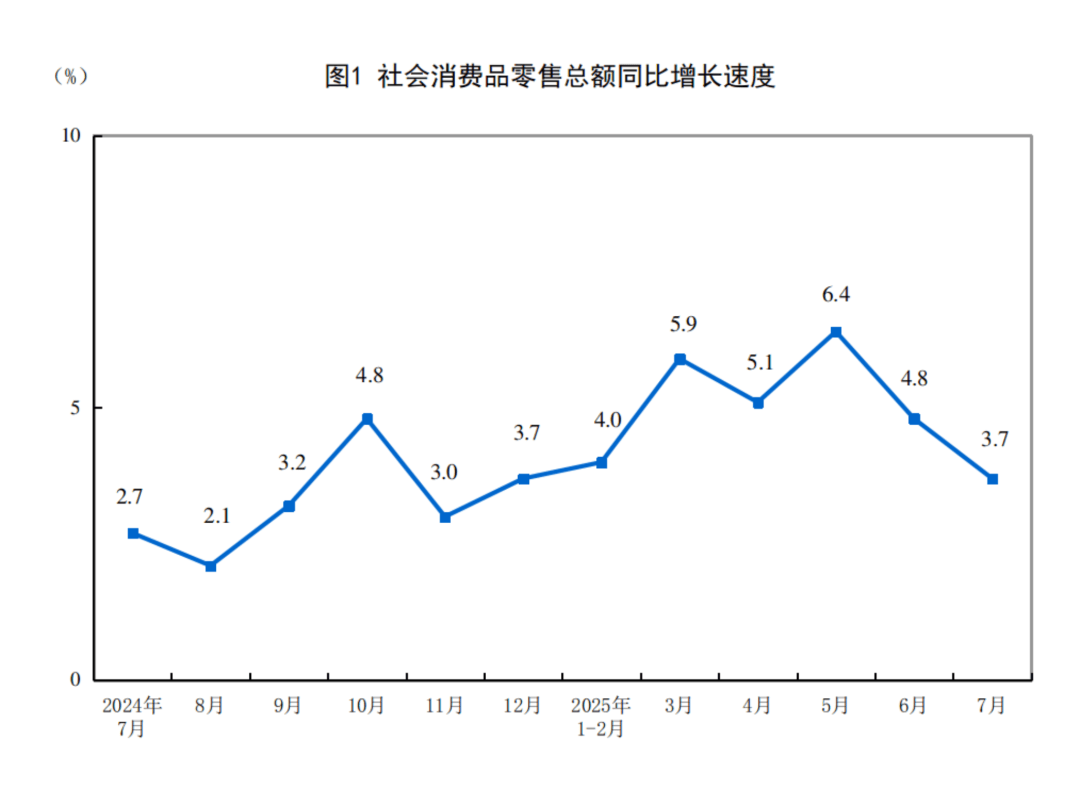
Group 1: Retail Sales - In July 2025, the total retail sales of consumer goods reached 38,780 billion yuan, with a year-on-year growth of 3.7%. Excluding automobiles, retail sales amounted to 34,931 billion yuan, growing by 4.3% [2][4] - From January to July 2025, the total retail sales of consumer goods reached 284,238 billion yuan, with a growth rate of 4.8%. Excluding automobiles, retail sales were 257,014 billion yuan, growing by 5.3% [2][4] Group 2: Fixed Asset Investment - From January to July 2025, national fixed asset investment (excluding rural households) totaled 288,229 billion yuan, with a year-on-year growth of 1.6%. Private fixed asset investment decreased by 1.5% [5][6] - In July 2025, fixed asset investment (excluding rural households) decreased by 0.63% month-on-month [6] - By industry, the first industry saw an investment of 5,646 billion yuan (growth of 5.6%), the second industry 104,455 billion yuan (growth of 8.9%), and the third industry 178,128 billion yuan (decline of 2.3%) [6] Group 3: Industrial Production - In July 2025, the industrial added value of enterprises above designated size grew by 5.7% year-on-year, with a month-on-month increase of 0.38% [7][8] - From January to July 2025, the industrial added value increased by 6.3% year-on-year [8] - By sector, mining industry added value grew by 5.0%, manufacturing by 6.2%, and electricity, heat, gas, and water production and supply by 3.3% [8] Group 4: Energy Production - In July 2025, the production of crude oil was stable, with an output of 1,812 million tons, a year-on-year increase of 1.2% [17] - Natural gas production accelerated, reaching 216 billion cubic meters in July, with a year-on-year growth of 7.4% [19] - Electricity production increased by 3.1% year-on-year in July, totaling 9,267 billion kilowatt-hours [21]

7月经济数据点评:扩大内需从多方面入手
Bank of China Securities· 2025-08-19 05:36
Economic Performance - July industrial added value grew by 5.7% year-on-year, down 1.1 percentage points from June and slightly below the consensus expectation of 5.8%[4] - Retail sales in July increased by 3.7% year-on-year, a decline of 1.1 percentage points from June, with non-automotive retail sales growing by 4.3%[12] - Fixed asset investment from January to July showed a cumulative year-on-year growth of 1.6%, with private investment declining by 1.5%[23] Sector Analysis - From January to July, manufacturing investment rose by 6.2%, while real estate investment fell by 12.0%[25] - High-tech industries saw a cumulative year-on-year growth of 9.5% in industrial added value, indicating resilience in this sector[7] - Service consumption in July grew by 5.2% year-on-year, supported by strong demand during the summer travel season[15] Challenges and Risks - Economic data for July reflects significant downward pressure on growth, influenced by complex external conditions and adverse domestic weather factors[34] - Price factors continue to drag down nominal growth rates in retail sales and fixed asset investment[34] - Risks include potential global inflation resurgence and rapid economic downturns in Europe and the U.S.[36] Policy Recommendations - The report suggests that proactive macroeconomic policies are essential to stimulate domestic demand and support growth[35] - Attention should be given to the implementation of consumption loan interest subsidies and the impact of U.S.-China trade negotiations on foreign trade dynamics[35]
零售周报|Apple深圳第三家直营店开业;蓝瓶咖啡即将在北京开店
Sou Hu Cai Jing· 2025-08-19 04:05
Group 1 - In July, the total retail sales of consumer goods reached 38,780 billion yuan, with a year-on-year growth of 3.7% [1][6] - Excluding automobiles, the retail sales of consumer goods amounted to 34,931 billion yuan, growing by 4.3% [1][6] - From January to July, the total retail sales of consumer goods were 284,238 billion yuan, with a growth rate of 4.8% [1][6] Group 2 - Urban retail sales in July were 33,620 billion yuan, reflecting a year-on-year increase of 3.6%, while rural retail sales reached 5,160 billion yuan, growing by 3.9% [3] - For the first seven months, urban retail sales totaled 246,669 billion yuan, with a growth of 4.8%, and rural retail sales were 37,569 billion yuan, increasing by 4.7% [3] Group 3 - In July, the retail sales of goods were 34,276 billion yuan, with a year-on-year growth of 4.0%, while catering revenue was 4,504 billion yuan, growing by 1.1% [3][6] - From January to July, the retail sales of goods reached 252,254 billion yuan, with a growth of 4.9%, and catering revenue was 31,984 billion yuan, increasing by 3.8% [3] Group 4 - For the first seven months, retail sales in convenience stores, supermarkets, department stores, specialty stores, and brand exclusive stores grew by 7.0%, 5.2%, 1.1%, 5.8%, and 1.9% respectively [4] - The national online retail sales reached 86,835 billion yuan, with a year-on-year growth of 9.2%, and the physical goods online retail sales were 70,790 billion yuan, growing by 6.3% [4] Group 5 - The newly opened Apple Store in Shenzhen is the third in the city and the 58th in Greater China, completing the layout along the east-west axis of Shenzhen [11] - The first city duty-free store in Shenzhen is set to open on August 26, featuring a diverse range of products including beauty, watches, and high-end liquor [13] Group 6 - The local fashion brand Lemanism is opening its first store in Nanchang, focusing on a comfortable and sunny shopping experience for the youth [25] - The brand BornTooth is expanding with its fourth store in Shanghai, emphasizing natural pet care products [27] Group 7 - The high-end dining brand PIZZERIA from Pizza Hut has opened its first store in South China, targeting young consumers with a focus on aesthetic dining experiences [30] - JD's first outlet in Nanjing has opened, featuring over 70 brands and a unique shopping experience [31] Group 8 - The sports brand 361 Degrees reported a revenue of 5.705 billion yuan for the first half of 2025, with a year-on-year growth of 11% [38] - Lilang Group's revenue for the first half of the year was 1.727 billion yuan, reflecting a growth of 7.9% [41] Group 9 - The company Bubu Gao reported a net profit of 201 million yuan for the first half of 2025, marking a significant turnaround [42] - The company has improved its operational quality by closing underperforming stores and focusing on high-potential locations [43]




【环球财经】市场缺少刺激因素 纽约股市三大股指18日涨跌不一
Xin Hua Cai Jing· 2025-08-18 22:43
Market Overview - The New York stock market showed mixed performance on August 18, with the Dow Jones Industrial Average down by 34.30 points to close at 44,911.82, a decrease of 0.08%. The S&P 500 index fell by 0.65 points to 6,449.15, a decline of 0.01%, while the Nasdaq Composite Index rose by 6.797 points to 21,629.774, an increase of 0.03% [1]. Sector Performance - In the S&P 500, six out of eleven sectors declined, with the Real Estate and Communication Services sectors leading the losses at 0.95% and 0.70%, respectively. Conversely, the Industrial and Consumer Discretionary sectors led the gains, increasing by 0.40% and 0.38% [1]. Upcoming Earnings Reports - Major retail companies such as Walmart, Target, and Home Depot are set to release their earnings reports this week. Analysts expect these reports to reflect concerns over tariffs, rising inflation, and economic slowdown [1]. Federal Reserve Insights - Federal Reserve Chairman Jerome Powell is anticipated to provide insights on monetary policy during the Jackson Hole annual central bank officials meeting. Market participants are particularly focused on whether he will signal a rate cut in September, although the likelihood of this is considered low [2]. Housing Market Data - The National Association of Home Builders and Wells Fargo reported that the Housing Market Index for August stands at 32, which is below the market expectation and the previous month's value of 33 [2].
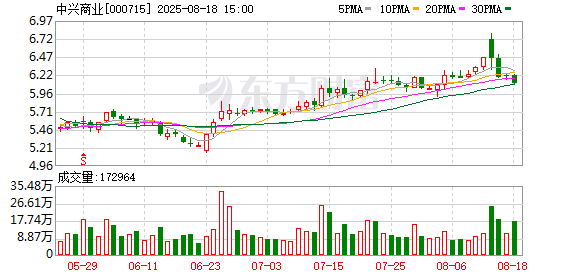
中兴商业:关于完成注册资本工商变更登记的公告
Zheng Quan Ri Bao· 2025-08-18 13:35
证券日报网讯 8月18日晚间,中兴商业发布公告称,公司于2025年7月8日召开2025年第二次临时股东 会,审议通过了《关于修订〈公司章程〉的议案》,因公司实施了2024年度利润分配及资本公积金转增 股本方案,公司注册资本相应由415,718,940元增加至540,434,622元。2025年8月15日,公司完成 了本次注册资本工商变更登记及《公司章程》备案手续,并取得沈阳市市场监督管理局换发的《营业执 照》。 (文章来源:证券日报) ...