水泥

Search documents
气候相关风险和机遇及财务影响
Shanghai Securities· 2025-11-05 05:15
Group 1: Climate Risks - Climate-related risks are categorized into transition risks and physical risks, impacting financial, compliance, and reputational aspects for companies[3] - Transition risks arise from changes in policies, laws, technologies, and consumer preferences aimed at addressing climate change[3] - Physical risks include acute events like extreme weather and long-term changes in climate patterns, affecting operational stability[3] Group 2: Climate Opportunities - Efforts to mitigate and adapt to climate change can create opportunities for businesses, including resource efficiency and market resilience[3] - Enhanced disclosure of climate-related risks and opportunities will provide necessary metrics for investors and stakeholders to analyze potential financial impacts[3] Group 3: Regulatory Framework - The Ministry of Finance and the Ministry of Ecology and Environment released a draft for the "Corporate Sustainable Disclosure Standards No. 1 - Climate" on April 30, 2025, establishing systematic disclosure requirements[3] - The TCFD framework emphasizes the financial impacts of climate-related issues through revenue, expenditure, assets, liabilities, and capital[3] Group 4: Global Emission Trends - From 1850 to 2019, the cumulative CO2 emissions reached approximately 2400±240 GtCO2, with over 58% occurring before 1990[12] - The remaining carbon budget to limit global warming to 1.5°C is estimated at 500 GtCO2, with a 50% probability of success[23] Group 5: International Agreements - The Paris Agreement aims to limit global temperature rise to well below 2°C, with 194 parties committed to its goals[28] - The TCFD was established by the Financial Stability Board in 2015 to provide guidance on climate-related financial disclosures, enhancing market stability[33]
西部证券晨会纪要-20251105
Western Securities· 2025-11-05 02:18
Group 1: China Jushi (600176.SH) - The company achieved a revenue of 139.04 billion yuan in the first three quarters of 2025, representing a year-on-year increase of 19.53% [6] - The net profit attributable to shareholders reached 25.68 billion yuan, up 67.51% year-on-year, with a non-recurring net profit of 26.12 billion yuan, increasing by 125.91% [6][9] - The company is expected to achieve net profits of 34.91 billion, 41.07 billion, and 46.48 billion yuan from 2025 to 2027, driven by the recovery of fiberglass prices and demand from various downstream sectors [9] Group 2: Transsion Holdings (688036.SH) - The company reported a revenue of 204.66 billion yuan in Q3 2025, a year-on-year increase of 22.60%, while the net profit attributable to shareholders was 9.35 billion yuan, down 11.06% year-on-year [11] - The company is expected to achieve revenues of 694.0 billion, 751.7 billion, and 871.6 billion yuan from 2025 to 2027, with net profits of 38.2 billion, 56.7 billion, and 70.8 billion yuan respectively [13] Group 3: Tonglian Precision (688210.SH) - The company reported a revenue of 2.4 billion yuan in Q3 2025, a year-on-year increase of 5.75%, while the net profit attributable to shareholders was 884,000 yuan, down 91.67% year-on-year [15] - The company is expected to achieve revenues of 11.4 billion, 15.5 billion, and 21.1 billion yuan from 2025 to 2027, with net profits of 1.0 billion, 1.9 billion, and 2.9 billion yuan respectively [17] Group 4: Topband Co., Ltd. (002139.SZ) - The company achieved a revenue of 26.9 billion yuan in Q3 2025, a slight increase of 0.1% year-on-year, while the net profit attributable to shareholders was 900 million yuan, down 44.7% year-on-year [18] - The company is expected to achieve net profits of 6.2 billion, 8.5 billion, and 10.8 billion yuan from 2025 to 2027 [19] Group 5: Inspur Information (000977.SZ) - The company reported a revenue of 1206.69 billion yuan in the first three quarters of 2025, a year-on-year increase of 45%, with a net profit of 14.82 billion yuan, up 15% year-on-year [25] - The company is expected to achieve net profits of 26.38 billion, 37.31 billion, and 47.77 billion yuan from 2025 to 2027 [26] Group 6: Benda Pharmaceutical (300558.SZ) - The company achieved a revenue of 27.17 billion yuan in the first three quarters of 2025, a year-on-year increase of 15.90%, while the net profit attributable to shareholders was 3.17 billion yuan, down 23.86% year-on-year [28] - The company is expected to achieve revenues of 35.50 billion, 43.71 billion, and 53.09 billion yuan from 2025 to 2027, with net profits of 5.73 billion, 7.21 billion, and 8.56 billion yuan respectively [29] Group 7: XWANDA (300207.SZ) - The company reported a revenue of 435.34 billion yuan in the first three quarters of 2025, a year-on-year increase of 13.73%, with a net profit of 14.05 billion yuan, up 15.94% year-on-year [35] - The company is expected to achieve net profits of 21.83 billion, 30.29 billion, and 40.31 billion yuan from 2025 to 2027 [37] Group 8: YH Technology (688080.SH) - The company achieved a revenue of 2 billion yuan in Q3 2025, a year-on-year increase of 34.5%, with a net profit of 400 million yuan, up 17.5% year-on-year [39] - The company is expected to achieve net profits of 1.5 billion, 2 billion, and 2.6 billion yuan from 2025 to 2027 [40] Group 9: Zhongji Xuchuang (300308.SZ) - The company reported a revenue of 102.2 billion yuan in Q3 2025, a year-on-year increase of 56.8%, with a net profit of 31.4 billion yuan, up 125% year-on-year [42] - The company is expected to achieve net profits of 107 billion, 205 billion, and 268 billion yuan from 2025 to 2027 [43] Group 10: Dongfang Tower (002545.SZ) - The company achieved a revenue of 33.92 billion yuan in the first three quarters of 2025, a year-on-year increase of 9.05%, with a net profit of 8.28 billion yuan, up 77.57% year-on-year [44] - The company is expected to achieve net profits of 12.68 billion, 14.46 billion, and 17.19 billion yuan from 2025 to 2027 [46]



海螺水泥(600585):Q3盈利小幅改善 期待反内卷释放盈利弹性
Ge Long Hui· 2025-11-04 19:53
Core Viewpoint - The company reported a decline in revenue for the first three quarters of 2025, but an increase in net profit, indicating improved profitability despite challenging market conditions [1]. Financial Performance - For the first three quarters of 2025, the company achieved revenue of 61.3 billion yuan, a year-on-year decrease of 10.1%, while net profit attributable to shareholders was 6.31 billion yuan, reflecting a year-on-year increase of 21.3% [1]. - In Q3 alone, the company recorded revenue of 20.01 billion yuan, down 11.4% year-on-year, but net profit increased by 3.4% to 1.94 billion yuan [1]. - The company's gross margin in Q3 was 22.44%, up 1.66 percentage points year-on-year, attributed to a larger decline in coal and raw material prices compared to cement prices, as well as the release of high-margin overseas capacity [1]. Cost and Cash Flow - The overall expense ratio for the first three quarters was 10.66%, an increase of 0.74 percentage points year-on-year, with specific changes in expense categories: sales (+0.64), management (+0.89), R&D (-0.49), and financial expenses (-0.29) [1]. - Operating cash flow for Q3 was 2.81 billion yuan, a decrease of 666 million yuan year-on-year [1]. Industry Outlook - The cement industry is currently at a cyclical low in profitability, with demand expected to remain stable but slightly declining due to weak infrastructure and housing demand [1]. - The industry is strengthening measures against overproduction, with a policy document released in July 2025 aimed at enhancing supply coordination, which may lead to a gradual recovery in profitability [1]. - As an industry leader, the company is expected to benefit from cost advantages that provide profit elasticity [1]. Profit Forecast - Revenue projections for 2025 and 2026 are 90.8 billion yuan and 92.5 billion yuan, respectively, with year-on-year changes of -0.3% and +1.9% [2]. - Expected net profits for 2025 and 2026 are 8.81 billion yuan and 9.92 billion yuan, reflecting year-on-year increases of 14.5% and 12.6% [2]. - Corresponding price-to-earnings ratios for 2025 and 2026 are projected at 14.0X and 12.4X [2].
宁夏68家企业纳入全国碳市场 为绿色转型注入强劲动力
Zhong Guo Xin Wen Wang· 2025-11-04 17:24
Core Insights - Ningxia has released a list of 68 key emission units in the power generation, steel, cement, and aluminum smelting industries for the year 2026, aiming to enhance the role of market mechanisms in controlling greenhouse gas emissions and promoting green low-carbon transformation [1] Group 1: National Carbon Market Overview - The national carbon market has been expanding since its launch in July 2021, with increasing policy incentives and constraints [1] - The newly added 21 key emission units in Ningxia are expected to increase carbon dioxide emissions coverage by approximately 31 million tons, enhancing the market's breadth and depth in the region [1] Group 2: Performance of Ningxia Enterprises - In the first compliance period, 35 key enterprises in Ningxia were included in quota management, with a total carbon dioxide emission of about 294 million tons and a quota compliance rate of 98.12% [2] - The number of enterprises under management increased to 39 in the second compliance period, with total emissions of approximately 327 million tons and 29 enterprises participating in trading, resulting in a significant increase in transaction volume and value [2] - In 2023, 37 key enterprises were managed, with emissions around 169 million tons and a compliance rate of 99.43%, indicating a sustained increase in market activity and enterprise participation [2] Group 3: Data Management and Future Goals - Reliable carbon emission data is essential for the stable operation of the national carbon market, emphasizing the importance of daily management of data quality [3] - The Ningxia Ecological Environment Department plans to enhance policy promotion and guidance to improve enterprises' carbon trading capabilities and management levels, aiming for a new stage in green low-carbon development [3]
国内高频 | 港口货运量大幅上行(申万宏观·赵伟团队)
申万宏源宏观· 2025-11-04 15:23
Core Viewpoint - The article discusses the current state of industrial production, construction, and demand trends in China, highlighting a mixed performance across various sectors, with some showing signs of recovery while others remain weak. Industrial Production Tracking - The operating rate of blast furnaces has significantly declined, with a week-on-week decrease of 3% to 81.7%, and a year-on-year drop of 3.3 percentage points [2][6] - Steel apparent consumption has increased by 2.7% week-on-week and returned to positive territory year-on-year, up 2.9 percentage points to 2.8% [2][8] - Social inventory continues to decline, down 2.1% week-on-week [2] Construction Industry Insights - Cement production and demand have shown slight improvement but remain weaker than the same period last year, with a grinding operating rate up 1% to 46.3% week-on-week and a year-on-year increase of 2.8 percentage points [24][25] - Cement shipment rates increased by 0.8% week-on-week but are down 8.8% year-on-year [24][28] - The cement inventory ratio continues to rise, up 2.3% week-on-week [24][31] Demand Tracking - The transaction volume of commercial housing continues to decline, with a week-on-week drop of 11.3% and a year-on-year decrease of 4.3 percentage points to -25% [47][48] - The average daily transaction area in 30 major cities has seen significant declines, particularly in first-tier cities, which experienced a year-on-year drop of 20.1 percentage points [47][51] - Port cargo throughput has rebounded significantly, with a year-on-year increase of 16.5% [57][64] Price Trends - Agricultural product prices are showing mixed performance, with vegetable prices rising by 8.1% week-on-week, while pork and egg prices have decreased by 0.8% and 0.5%, respectively [99][100] - The overall industrial product prices are on the rise, with the South China Industrial Product Price Index increasing by 1.8% week-on-week [111][112]

塔牌集团:公司在福建龙岩武平生产基地建有2条日产4500吨的新型干法旋窑水泥熟料生产线
Zheng Quan Ri Bao· 2025-11-04 13:39
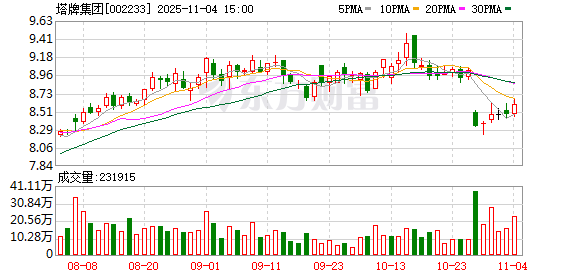
Core Viewpoint - The company has established two new dry-process rotary kiln clinker production lines with a daily capacity of 4,500 tons at its production base in Wuping, Longyan, Fujian, primarily serving the eastern Guangdong market with limited sales in the western Fujian region [2] Company Summary - The production base in Wuping, Longyan, is equipped with two production lines, each capable of producing 4,500 tons of clinker daily [2] - The cement produced at this facility is mainly sold in the eastern Guangdong region, with a small portion transported by road to the western Fujian area [2] - The company's market share in the western Fujian region is relatively limited [2]

塔牌集团:福建龙岩武平生产基地生产的水泥主要销往粤东,少量通过公路运输方式销售到闽西地区
Mei Ri Jing Ji Xin Wen· 2025-11-04 11:50
Core Viewpoint - The company, Taipai Group, has limited market share in Fujian for its cement products, primarily selling to the eastern Guangdong region and a small portion to the western Fujian area [2] Group 1 - Taipai Group operates a production base in Longyan, Wuping, Fujian, with two new dry-process rotary kiln clinker production lines, each with a daily capacity of 4,500 tons [2] - The cement produced at this base is mainly sold to the eastern Guangdong market, with limited sales to the western Fujian region via road transportation [2] - The company acknowledges the question regarding its market presence in Fujian and compares its production capacity with local competitors [2]
中金:建材行业盈利分化明显 关注供给优化
Zhi Tong Cai Jing· 2025-11-04 09:09
Group 1: Cement Industry - The cement industry experienced a year-on-year production decline of 7% in Q3 2025, with average prices also decreasing. However, the drop in raw material prices supported the gross profit per ton to remain stable year-on-year [1] - In Q4, coal prices rebounded, increasing by 8% in October compared to September, which may lead to marginal cost increases for cement [1] - If the industry strictly limits overproduction in 2026, capacity utilization rates could recover to over 60%, which, along with staggered production execution, may support industry profitability recovery [1] Group 2: Consumer Building Materials - Key consumer building materials companies reported a combined revenue decline of 3% year-on-year in Q3 2025, with a gross margin decrease of 1.2 percentage points, although the decline rate has narrowed [2] - The sector has implemented strict cost control measures, leading to a slight improvement in cash flow [2] - It is recommended to consider undervalued stocks in segments where supply and price competition are easing, such as home decoration coatings and waterproof materials, as well as in stable demand sectors like coatings and gypsum boards [2] Group 3: Glass Fiber - The glass fiber sector saw improvements in both revenue and gross margin year-on-year in Q3 2025, with stable prices for wind power yarn and thermoplastic short-cut products [3] - There is potential for price increases in both roving and electronic fabrics, indicating a balanced industry outlook for 2026 [3] - Special glass fiber fabrics are expected to maintain rapid growth driven by AI advancements [3] Group 4: Glass Industry - The glass industry continues to face pressure from construction, with float glass profitability at a low point [4] - Looking ahead to 2026, after price declines in the off-season, some cash flow-negative capacities may undergo cold repairs, which could gradually improve supply-demand relationships [4]
水泥板块11月4日跌0.2%,上峰水泥领跌,主力资金净流入6857.27万元
Zheng Xing Xing Ye Ri Bao· 2025-11-04 08:48
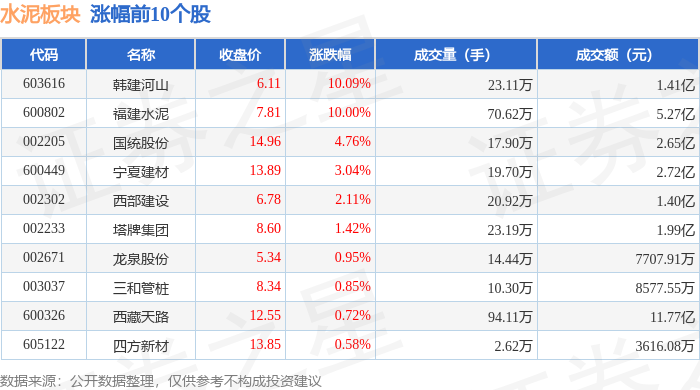
Market Overview - The cement sector experienced a decline of 0.2% on November 4, with Shangfeng Cement leading the drop [1] - The Shanghai Composite Index closed at 3960.19, down 0.41%, while the Shenzhen Component Index closed at 13175.22, down 1.71% [1] Individual Stock Performance - Hanjian Heshan saw a significant increase of 10.09%, closing at 6.11, with a trading volume of 231,100 shares and a turnover of 141 million yuan [1] - Fujian Cement also rose by 10.00%, closing at 7.81, with a trading volume of 706,200 shares and a turnover of 527 million yuan [1] - Conversely, Shangfeng Cement fell by 1.83%, closing at 10.74, with a trading volume of 152,300 shares and a turnover of 164 million yuan [2] Capital Flow Analysis - The cement sector had a net inflow of 68.57 million yuan from institutional investors, while retail investors saw a net outflow of 93.65 million yuan [2][3] - Notably, Fujian Cement experienced a net inflow of 102 million yuan from institutional investors, but a net outflow of 68.33 million yuan from retail investors [3] - Hanjian Heshan had a substantial net inflow of 77.89 million yuan from institutional investors, with a significant net outflow of 39.61 million yuan from retail investors [3]


AI“盆景”已成“风景”?大模型的规模复制让工业长出数智生产力!
Sou Hu Cai Jing· 2025-11-04 08:23
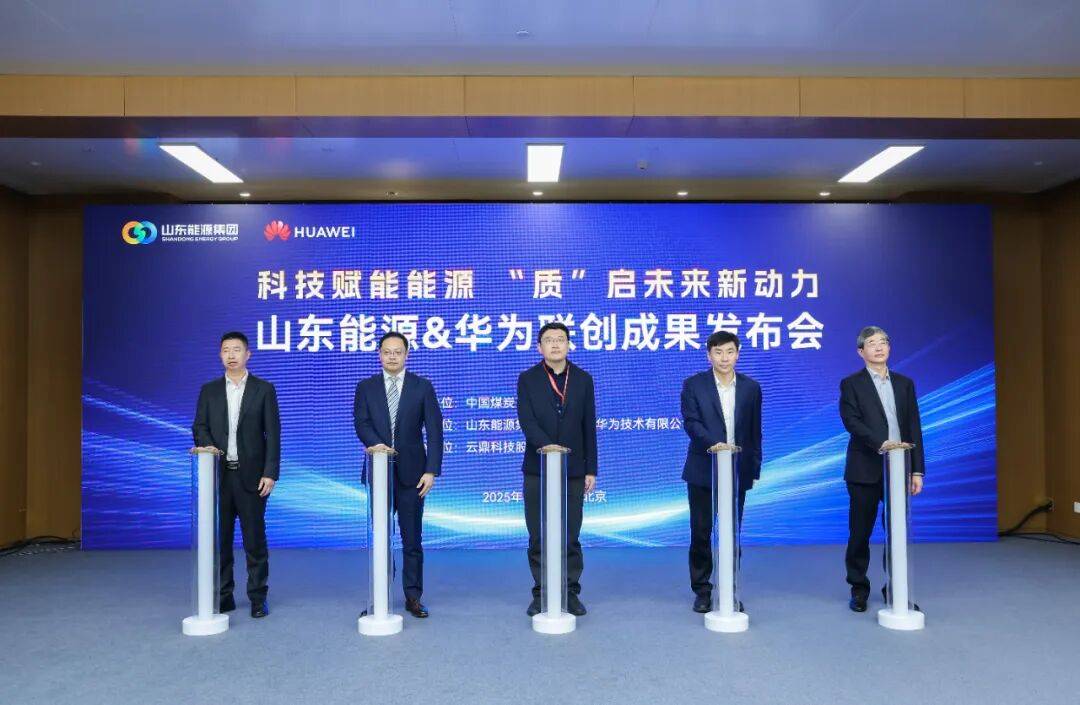
Core Insights - The AI revolution is transitioning from a "workshop" model to a "factory" model, enabling the replication of industrial wisdom from deep mines to broader industrial applications [1][3] - A joint release of six innovative results by Shandong Energy Group, Yunding Technology, and Huawei marks a pivotal moment in the intelligent transformation of traditional industries [1][3] Group 1: AI Development Model - The "Pangu Model" aims to overcome the fragmented and high-cost nature of AI applications in mining, moving towards a standardized "factory-style" AI development pipeline [3][4] - The new AI production line consists of "1 AI development platform + 4 core capabilities (vision, prediction, natural language processing, multi-modal) + N high-value scenarios," enhancing scalability and efficiency [3][4] - The implementation of the Pangu model has already been successful in over 100 scenarios across various coal mines, demonstrating significant improvements in operational efficiency and cost reduction [3][4] Group 2: Standardization and Modularization - Standardization of architecture addresses the challenges of implementing AI across different industrial sectors, allowing for a unified approach to data collection and application [4][5] - Modular capabilities provided by the Pangu model, such as visual and predictive functions, can be reused across different industries, significantly lowering the barriers to new scenario development [5][7] - The collaborative ecosystem between Huawei and industry leaders ensures that AI solutions are both technologically advanced and closely aligned with industry needs [7] Group 3: Cross-Industry Applications - The AI model is being applied to optimize critical processes in steel and chemical industries, transforming traditional practices into precise, replicable data models [8][9] - Predictive maintenance models are enhancing operational efficiency in heavy asset industries, with significant improvements in equipment reliability and reduced downtime [10][12] - Cost control through global optimization algorithms is being implemented in raw material management, leading to substantial cost savings across various sectors [14][16] Group 4: Future Implications - The shift from isolated AI applications to a comprehensive, interconnected approach signifies a major turning point in industrial intelligence, with the potential for widespread economic benefits [17] - The anticipated growth in the deployment of autonomous mining vehicles and AI models across the entire production process indicates a significant move towards large-scale intelligent operations [17]