建筑业

Search documents
什么是关税不确定性下的最佳决策?
2025-06-04 01:50
Summary of Conference Call Records Industry Overview - The records primarily discuss the tire industry and its relation to the automotive supply chain, particularly focusing on the impact of recent tariff policies in the United States and their effects on both domestic and international markets [1][2][10]. Key Points and Arguments 1. **Tariff Impact on Tire Industry**: - The operating rate of semi-steel tires was initially high in Q1 2025 but dropped to last year's levels after the implementation of equal tariffs in April and further declined with the introduction of tariffs on auto parts in May [1][2]. - This indicates a sustained negative impact from tariffs on the tire industry [2]. 2. **Consumer Behavior and Inventory Management**: - U.S. consumers showed a cautious approach to spending, with durable goods orders spiking in March but declining to the lowest growth rate of the year by April, reflecting increased uncertainty [1][3][4]. - Companies are advised to focus on inventory management and adjust production and sales strategies in response to changing demand [1]. 3. **U.S. Import Trends**: - In Q1 2025, U.S. imports accounted for nearly 13% of consumer spending, with industrial goods imports increasing by 53% year-over-year, while energy imports remained stable [5][6]. - There was a notable decline in imports of automobiles and parts, attributed to domestic price wars in the automotive sector [6]. 4. **Domestic Economic Conditions**: - The domestic economy entered a low season in May, with declines in asphalt and cement mill operating rates, and a drop in rebar demand [8]. - However, the issuance of government bonds and special bonds may support infrastructure development [8]. 5. **Economic Performance in Q2 2025**: - The overall economic performance has shown seasonal weakness, with a decline in operating rates and low PTA prices [9]. - New home sales have rebounded to last year's levels, but the second-hand housing market remains weak [9]. 6. **Manufacturing PMI Data**: - May's manufacturing PMI was reported at 49.5, indicating a slight increase but still below the growth threshold, reflecting the impact of tariffs and other uncertainties [12][18]. - The service sector showed resilience, with a business activity expectation index reaching 56.5, indicating strong performance in productive services [19]. 7. **Future Economic Predictions**: - The upcoming months are expected to be challenging due to seasonal factors and the uncertainty surrounding U.S. tariff policies, which may continue to impact manufacturing negatively [20]. - There is a need for potential policy measures to support domestic demand and stabilize production growth [20]. Other Important Insights - The records highlight the complex interplay between tariff policies, consumer behavior, and inventory management, emphasizing the need for companies to remain agile in their strategies [2][4][10]. - The discussion also touches on the broader economic cycles, indicating that the current tariff uncertainties are beginning to yield to cyclical economic pressures [10][21].
中国银河证券:基建投资增速维持高位 持续关注稳增长
智通财经网· 2025-06-04 01:29
智通财经APP获悉,中国银河证券发布研报称,4月建筑业景气度受季节性需求影响有所回落,但基建 投资增速维持高位,专项债靠前发力支撑资金来源。房地产投资承压但销售降幅收窄,政策组合拳有望 提振市场信心。推荐稳增长、出海、低空经济等主线。看好三大方向:1)低估值高分红、业绩稳健、处 于基建房建产业链的央国企;2)业绩高增长的出海国际工程企业;3)低空经济主力军设计企业。 中国银河证券主要观点如下: 建筑业景气度有所回落,固定资产投资增速放缓 房地产投资、竣工承压,销售、新开工降幅继续收窄 1-4月,全国房地产开发投资27730亿元,同比下降10.3%,降幅较1-3月扩大0.4pct;商品房销售面积28262 万平方米,同比下降2.8%,降幅较1-3月收窄0.2pct;房屋新开工面积17836万平方米,同比下降23.8%, 降幅较1-3月收窄0.6pct;竣工面积15648万平方米,同比下降16.9%,降幅较1-3月扩大2.6pct。房地产政策 组合拳发布后,奠定了房地产行业去库存的大方向,一线城市快速响应,放开限购、下调首付比例和房 贷利率,稳地产节奏加快,有望促进供需结构改善、房企融资提速,提振房地产市场信心, ...

韩经济疲软促央行再次降息
Jing Ji Ri Bao· 2025-06-03 22:15
Core Viewpoint - The Bank of Korea has lowered the benchmark interest rate by 25 basis points to 2.5% and significantly revised down its GDP growth forecast for 2023 from 1.5% to 0.8%, reflecting a pessimistic assessment of the current economic situation [1][2][3] Economic Growth Factors - The construction sector's collapse is a major contributor to the GDP downgrade, accounting for 0.4 percentage points of the total 0.7 percentage point reduction [1] - Weak exports, particularly in key industries like semiconductors and automobiles, are also negatively impacting economic growth, with a potential drag of 0.2 percentage points on GDP [2] - Private consumption has not been able to compensate for the declines in construction investment and exports, with limited recovery expected despite interest rate cuts and fiscal spending [2][3] Monetary Policy Implications - The recent interest rate cut signals the possibility of further reductions if economic conditions do not improve, with the central bank emphasizing the need for careful control of policy measures to avoid past issues of irrational real estate price increases and high household debt [3] - The effectiveness of monetary easing is diminished due to structural constraints, with the focus shifting from merely stimulating growth to preventing further economic decline and financial market volatility [3][4] Long-term Economic Challenges - Structural issues in the economy are becoming more pronounced, with a reliance on construction investment and exports proving unsustainable, while domestic consumption is hindered by high housing prices and aging labor demographics [4] - The export sector faces challenges not only from reduced demand but also from global supply chain restructuring, with potential negative impacts on employment and consumer confidence [4][5] Key Variables for Future Outlook - The coordination of fiscal and monetary policies, the adjustment of the real estate market, and changes in global trade policies will be critical in determining the future of the South Korean economy [5][6]
5月PMI数据点评:供需修复,经济回稳
Tai Ping Yang Zheng Quan· 2025-06-03 15:17
宏观 证券研究报告 |点评报告 2025/6/3 5月PMI数据点评—— 供需修复,经济回稳 徐超 S1190521050001 证券分析师: 分析师登记编号: 万琦 S1190524070001 证券分析师: 分析师登记编号: 目录 请务必阅读正文之后的免责条款部分 守正 出奇 宁静 致远 1、制造业PMI温和改善 2、非制造业延续平稳扩张态势 ➢ 中国5月官方制造业PMI49.5,预期49.5,前值49.0。 1、制造业PMI温和改善 ➢制造业PMI边际小幅修复。5月制造业采购经理指数为49.5%,比上月上升0.5个百分点,符合市场预 期,表现好于季节性。经济有所回稳,如期实现温和修复,这一方面得益于国内积极政策的加紧实 施,另一方面也与5月中美日内瓦经贸会谈达成协议、关税冲击有所缓和有关。 ➢多数分项较前值有所反弹。从主要分项指数的边际变化来看,本月除产成品库存指数、购进价格指 数、出厂价格指数和供应商配送时间指数较前值下降外,其余分项(生产指数、新订单指数、新出 口订单指数、积压订单指数、采购量指数、进口指数、原材料库存指数、从业人员指数和生产经营 活动预期指数)均出现不同程度的上行,上升幅度在0.2 ...
海外避险情绪升温,国内弱复苏延续
Tong Guan Jin Yuan Qi Huo· 2025-06-03 12:12
Report Title - Macro Weekly Report: Overseas Risk-Aversion Sentiment Intensifies, Domestic Weak Recovery Continues [1] Core Views - Overseas, there are signs of partial recovery in the US "soft data", with the Michigan Consumer Sentiment Index rising in May and inflation expectations falling from their highs. However, the manufacturing sector remains sluggish due to tariff disruptions, with the May ISM Manufacturing PMI contracting for three consecutive months, weaker than expected, and the import sub-index hitting a 16-year low, while the price sub-index remains high. Overall, the US economic fundamentals remain resilient, and the GDPNow model has revised up its Q2 economic growth forecast to 4.6%. This week, attention is focused on the May non-farm payroll report and the services PMI. Last week, the US dollar index maintained a weak oscillation, and the gold price returned to a high level, reflecting three risks: internal conflicts in the US weakening its sovereign credit, setbacks in the US tariff negotiations with other countries, and renewed conflicts in war-torn countries. In June, attention is on the progress of Trump's tax cut bill in the Senate and the trade court's ruling on tariffs [2]. - Domestically, the manufacturing sector's sentiment improved slightly in May, with both supply and demand improving. The reduction in Sino-US tariffs has led to a marginal recovery in production driven by pre-export activities, and new orders have significantly improved due to external demand. However, price pressures remain, and the signs of companies "trading price for volume" and actively reducing inventory continue. In addition, the sentiment in the service and construction sectors remains lower than in previous years, indicating that domestic demand is still the main drag in the second quarter, and more policy support is urgently needed in the context of weak inflation. In June, attention is on the possibility of a meeting between the Chinese and US presidents [3] Section Summaries Overseas Macro - US May Manufacturing PMI Weakens: The May ISM Manufacturing PMI was weak, indicating that the "rush to import" may have ended. The May ISM Manufacturing PMI was 48.5, lower than the expected 49.5 and the previous value of 48.7, remaining in the contraction range for three consecutive months. New orders continued to shrink, external demand was under pressure, costs were high, and employment was weak. The import sub-index hit a 16-year low, suggesting that the peak of "rush to import" may have passed under tariff disruptions. The trade surplus has led the GDPNow to revise up the Q2 economic growth rate to 4.6%. Meanwhile, the final value of the US May Markit Manufacturing PMI was 52.0, slightly lower than the expected 52.3 and the initial value of 52.3, still in the expansion range. The difference between the two may be due to the ISM PMI's high dependence on external demand, supply chains, and large manufacturers, making it more sensitive to policy shocks and external uncertainties [5]. - Consumer Confidence Recovers, Inflation Expectations Fall from Highs: After the easing of tariff negotiations, the US "soft data" has improved. The final value of the US May Michigan Consumer Sentiment Index was 52.2, higher than the expected 51.0 and the initial value of 50.8. With the significant reduction in Sino-US tariffs, consumer confidence has recovered, but the absolute level remains at a historical low, indicating that consumers are still highly concerned about the future economy. The final value of the one-year inflation expectation in May was 6.6%, lower than the expected 7.1% and the initial value of 7.3%; the final value of the 5 - 10-year inflation expectation was 4.2%, lower than the expected 4.5% and the initial value of 4.6%, ending four months of sharp increases [7]. Domestic Macro - China's May Manufacturing Sentiment Improves as Expected: The May Manufacturing PMI rose slightly to 49.5, in line with expectations and up from the previous value of 49.0. There were differences among enterprises of different sizes, with large enterprises rising 1.5 to 50.7, entering the expansion range, while medium and small enterprises remained in the contraction range. Both supply and demand improved, with external demand making a prominent contribution. Production rose 0.9 to 50.7, returning to the expansion range; new orders rose 0.6 to 49.8, approaching the boom-bust line; new export orders rose significantly by 2.8 to 47.5, showing obvious marginal improvement. Overall, with the phased easing of Sino-US tariff frictions, enterprises have seized the window period to accelerate production, and the release of export orders has driven the recovery of the production side. Prices were weak, and enterprises actively reduced inventory. The raw material inventory rose to 47.4, and the finished product inventory fell 0.8 to 46.5. In terms of prices, the purchase price of raw materials in April fell 0.1 to 46.9, and the ex-factory price fell 0.1 to 44.7, indicating that the signs of companies "trading price for volume" and actively reducing inventory continue [10]. - Construction and Service Sectors Remain Sluggish, Domestic Demand Recovery is Weak: In the non-manufacturing sector, the May Service PMI was 50.2, slightly higher than the previous value of 50.1 but lower than the level of previous years. Driven by the May Day holiday, tourism, travel, and catering consumption were active, and the sentiment in the transportation and accommodation industries rose to the expansion range; high - growth industries such as postal, communication, and the Internet continued to grow steadily. The Construction PMI was 51.0, lower than the previous value of 51.9 and at the lowest level in the same period over the years, with real estate construction remaining sluggish [11]. Performance of Major Asset Classes - Equity: The performance of equity markets varied. In the A-share market, the Wind All - A Index was at 5074.29, with a weekly decline of -0.02%, a monthly increase of 2.39%, and a year - to - date increase of 1.04%. The Shanghai Composite Index was at 3347.49, with a weekly decline of -0.03%, a monthly increase of 2.09%, and a year - to - date decline of -0.13%. In the Hong Kong stock market, the Hang Seng Index was at 23289.77, with a weekly decline of -1.32%, a monthly increase of 5.29%, and a year - to - date increase of 15.44%. Overseas, the Dow Jones Industrial Average was at 42270.07, with a weekly increase of 1.60%, a monthly increase of 3.94%, and a year - to - date decline of -0.64% [19]. - Bonds: In the domestic bond market, the 1 - year Treasury yield was 1.46%, with a weekly increase of 1.51 basis points, a monthly increase of 0.08 basis points, and a year - to - date increase of 35.30 basis points. In the overseas bond market, the 2 - year US Treasury yield was 3.89%, with a weekly decline of 11.00 basis points, a monthly increase of 29.00 basis points, and a year - to - date decline of 36.00 basis points [22]. - Commodities: The Nanhua Commodity Index was at 2349.69, with a weekly decline of -1.62%, a monthly decline of -2.40%, and a year - to - date decline of -5.88%. The CRB Commodity Index was at 290.43, with a weekly decline of -2.10%, a monthly increase of 0.57%, and a year - to - date decline of -2.12%. COMEX Gold was at 3313.10, with a weekly decline of -1.57%, a monthly decline of -0.18%, and a year - to - date increase of 25.45% [23]. - Foreign Exchange: The US dollar to RMB exchange rate was 7.1953, with a weekly increase of 0.08%, a monthly decline of -0.93%, and a year - to - date decline of -1.42%. The US dollar index was at 99.4393, with a weekly increase of 0.32%, a monthly decline of -0.20%, and a year - to - date decline of -8.34% [26]. High - Frequency Data Tracking - Domestic: The report includes data on the congestion index of 100 cities, the subway passenger volume of 23 cities, the commercial housing transaction area of 30 cities, the second - hand housing transaction area of 12 cities, passenger car sales, and the apparent consumption of rebar [28]. - Overseas: The report includes data on the Redbook commercial retail sales and the number of unemployment benefit claims in the US [32]. This Week's Important Economic Data and Events - The report lists important economic data and events for this week, including China's May Caixin Manufacturing PMI, the eurozone's May CPI annual and monthly rates, the US's May ADP employment data, and the US's May ISM Non - Manufacturing PMI [39].
5月PMI数据点评:制造业PMI边际改善,但仍偏弱
LIANCHU SECURITIES· 2025-06-03 11:31
Group 1: Manufacturing Sector - The manufacturing PMI for May is 49.5%, an increase of 0.5 percentage points from the previous month, but still below the critical line, indicating weak manufacturing sentiment[7] - The new orders index for manufacturing is at 49.8%, up 0.6 percentage points, but remains below the critical line, suggesting insufficient demand[11] - The inventory indices for raw materials and finished products are both below the critical point, indicating inadequate replenishment sentiment in manufacturing[16] Group 2: Service Sector - The service sector PMI increased to 50.2%, a rise of 0.1 percentage points, indicating continued expansion in business activities[21] - The new orders index for services is at 46.6%, below the critical line, pointing to weak demand conditions[21] - The business activity expectations index is at 56.5%, indicating a positive outlook for future service sector activities[21] Group 3: Construction Sector - The construction PMI is recorded at 51%, a decrease of 0.9 percentage points, but still above the critical line, indicating ongoing expansion albeit at a slower pace[27] - The new orders index for construction is at 43.3%, suggesting pressure on demand[27] - The employment index in construction is at 39.5%, indicating insufficient hiring sentiment in the sector[27] Group 4: Economic Outlook - The overall economic sentiment is supported by recent monetary policy measures, including interest rate cuts and structural adjustments aimed at economic recovery[30] - Risks include deviations from expected fundamental recovery, unexpected macroeconomic policies, and geopolitical uncertainties[31]
5月PMI与4月工业企业绩效分析:6月18日是重要观察点
Yong Xing Zheng Quan· 2025-06-03 09:14
Industrial Performance - In the first four months, industrial enterprises' cumulative revenue increased by 3.2% year-on-year, down from 3.4% in the previous period[2] - Cumulative profit for industrial enterprises rose by 1.4% year-on-year, up from 0.8% previously, with April's profit showing a 3.0% increase year-on-year[2] - Private industrial enterprises achieved a cumulative profit growth of 4.3%, recovering from a decline of 0.3% in the previous period[2] Price and Inventory Trends - The Producer Price Index (PPI) for April showed a year-on-year decline of 2.7%, continuing a downward trend for two consecutive months[3] - Cumulative inventory of finished products in industrial enterprises increased by 3.9% year-on-year, down from 4.2% previously, marking the first decline since November 2024[3] PMI Insights - The manufacturing PMI for May was reported at 49.5%, slightly up from 49.0% in April, with the production index exceeding the critical threshold[3] - The new orders index for manufacturing PMI in May was 49.8%, an increase from 49.2% in April, while the export orders index rose to 47.5% from 44.7%[3] Employment and Sector Performance - The employment index for manufacturing in May was 48.1%, up from 47.9% in April, indicating a slight improvement in employment conditions[4] - The construction PMI for May was 51.0%, down from 51.9% in April, while the services PMI remained stable at 50.2%[4] Economic Outlook - June 18 is identified as a critical observation point for economic and policy developments, following the release of key economic data and the Federal Reserve's meeting[5] - The report highlights risks including external uncertainties and potential delays in counter-cyclical policies[6]
2025年5月PMI数据点评:PMI环比回升,生产回到扩张区间
Tebon Securities· 2025-06-03 07:35
Group 1: PMI Overview - The manufacturing PMI for May is at 49.5%, a month-on-month increase of 0.5 percentage points, still in the contraction zone[4] - The production index rose to 50.7%, up 0.9 percentage points, indicating a return to the expansion zone[4] - The new orders index increased to 49.8%, up 0.6 percentage points, reflecting improved demand[4] Group 2: Sector Performance - The new export orders index rose to 47.5%, up 2.8 percentage points, but remains below the levels seen in March (49.0%) and April[4] - High-tech manufacturing PMI decreased by 0.6 percentage points to 50.9%, remaining in the expansion zone for four consecutive months[4] - Large enterprises' PMI increased to 50.7%, up 1.5 percentage points, while medium enterprises' PMI fell to 47.5%, down 1.3 percentage points[5] Group 3: Price and Inventory Trends - The raw materials price index is at 46.9%, down 0.1 percentage points, indicating ongoing price pressure[4] - The finished goods price index is at 44.7%, also down 0.1 percentage points, suggesting weak downstream demand[4] - The raw materials inventory index is at 47.4%, up 0.4 percentage points, while the finished goods inventory index is at 46.5%, down 0.8 percentage points[5] Group 4: Economic Outlook - The production activity expectation index for manufacturing is at 52.5%, up 0.4 percentage points, indicating improved business sentiment[6] - The overall economic environment shows a structural characteristic where supply exceeds demand, necessitating policy support to alleviate price pressures[4]
【数据发布】2025年5月中国采购经理指数运行情况
中汽协会数据· 2025-06-03 07:04
Group 1: Manufacturing PMI Overview - In May, the Manufacturing Purchasing Managers' Index (PMI) was 49.5%, an increase of 0.5 percentage points from the previous month, indicating an improvement in manufacturing activity [1] - Large enterprises had a PMI of 50.7%, up 1.5 percentage points, while medium-sized enterprises saw a PMI of 47.5%, down 1.3 percentage points, and small enterprises had a PMI of 49.3%, up 0.6 percentage points [1] - The production index was at 50.7%, rising 0.9 percentage points, indicating an acceleration in production activities [1] Group 2: Manufacturing Sub-Indices - The new orders index was 49.8%, up 0.6 percentage points, suggesting a recovery in market demand [2] - The raw materials inventory index was 47.4%, up 0.4 percentage points, indicating a narrowing decline in inventory levels [2] - The employment index was 48.1%, up 0.2 percentage points, reflecting an improvement in employment conditions within the manufacturing sector [2] - The supplier delivery time index was at 50.0%, down 0.2 percentage points, indicating stable delivery times compared to the previous month [2] Group 3: Non-Manufacturing PMI Overview - In May, the Non-Manufacturing Business Activity Index was 50.3%, a decrease of 0.1 percentage points, but still above the critical point, indicating continued expansion in the non-manufacturing sector [5] - The construction industry business activity index was 51.0%, down 0.9 percentage points, while the service industry index was 50.2%, up 0.1 percentage points [8] Group 4: Non-Manufacturing Sub-Indices - The new orders index for non-manufacturing was 46.1%, up 1.2 percentage points, indicating a rebound in market demand [10] - The input prices index was 48.2%, up 0.4 percentage points, suggesting that input prices remained below the previous month's level [10] - The sales prices index was 47.3%, up 0.7 percentage points, indicating a narrowing decline in sales prices [10] - The employment index for non-manufacturing was 45.5%, stable compared to the previous month, indicating stable employment conditions [10] Group 5: Composite PMI Overview - The Composite PMI Output Index was 50.4% in May, an increase of 0.2 percentage points, indicating that production and business activities continued to expand overall [15]

5月PMI:内外分化加深——中采PMI点评(25.05)(申万宏观·赵伟团队)
赵伟宏观探索· 2025-06-03 01:06
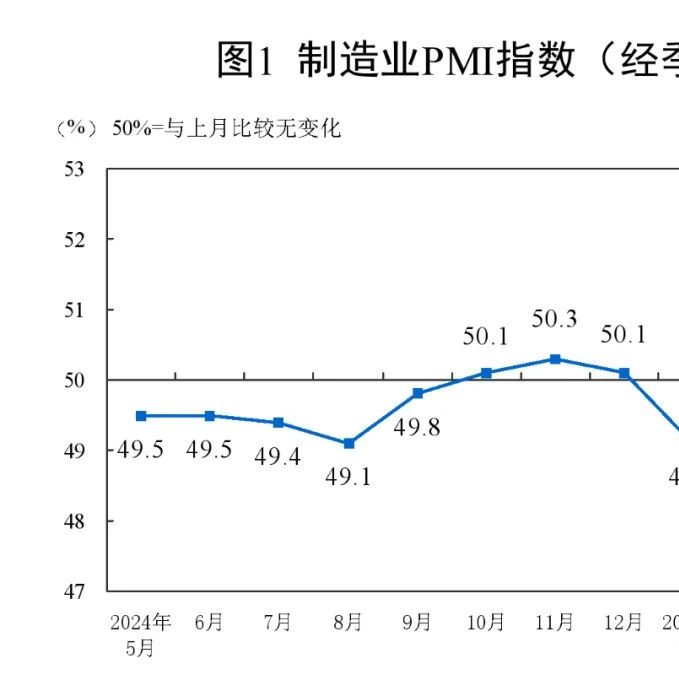
Core Viewpoints - The manufacturing PMI for May increased marginally to 49.5%, up 0.5 percentage points from the previous month, indicating a slight recovery in manufacturing activity [2][10][52] - The new export index remains low, while domestic demand, particularly in consumer goods and equipment manufacturing, shows significant improvement [2][21] Manufacturing Sector - The manufacturing PMI shows overall improvement, with production and new order indices rising by 0.9 and 0.6 percentage points to 50.7% and 49.8%, respectively [2][52] - The production index has recovered above the expansion threshold, while the new order index remains in contraction territory, indicating faster production but weaker demand [2][10] - Industries with high domestic demand, such as equipment manufacturing and consumer goods, have seen PMIs rise by 1.6 and 0.8 percentage points to 51.2% and 50.2% [2][21] - Conversely, export-dependent sectors like textiles and chemicals have underperformed, with production and new order indices below the critical point [2][21] Non-Manufacturing Sector - The non-manufacturing PMI decreased slightly to 50.3%, with the construction sector experiencing a notable decline due to weak real estate performance [2][67] - The construction PMI fell by 0.9 percentage points to 51%, while civil engineering activities are accelerating, as indicated by a PMI of 62.3% [29][67] - Service sector PMI saw a marginal increase to 50.2%, driven by improved activity in tourism and dining during the holiday period [40][67] Future Outlook - Uncertainties surrounding U.S. tariff policies remain significant, necessitating close monitoring of fiscal policies' impact on domestic demand [45] - The recent court ruling against Trump's tariffs has created a temporary freeze on tariff enforcement, adding to the external uncertainties [45] - Service consumption and infrastructure investment are expected to be key areas for fiscal support, potentially enhancing domestic demand [45]