航天

Search documents
A股2025年收官:沪指全年上涨18.41%,创指暴涨49.57%
YOUNG财经 漾财经· 2025-12-31 10:36
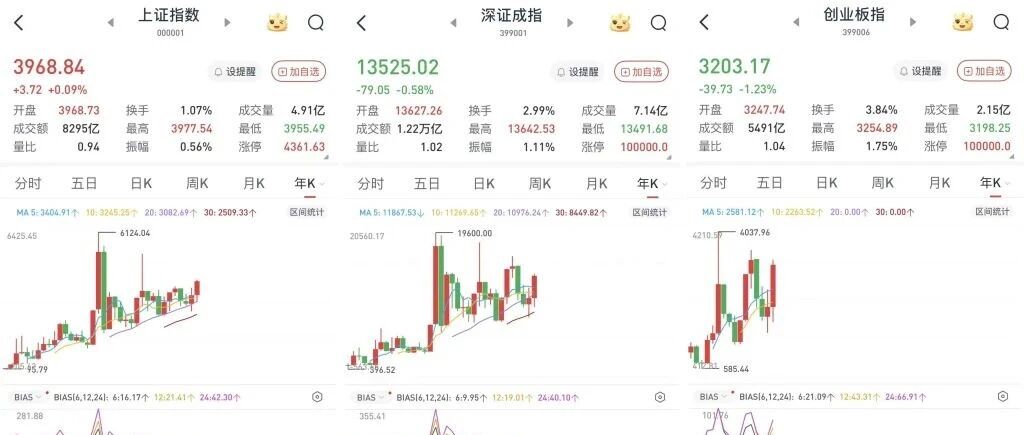
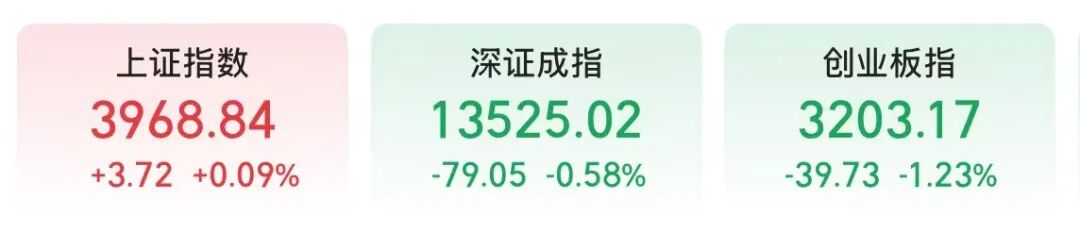
Market Performance - The A-share market saw the Shanghai Composite Index rise by 18.41% in 2025, while the ChiNext Index surged by 49.57% [2] - On the last trading day of the year, the Shanghai Composite Index closed at 3968.84 points, with the ChiNext Index and Shenzhen Component Index declining by 1.23% and 0.58% respectively [2] Trading Volume and Stock Movement - A total of 2470 stocks rose while 2768 stocks fell, with a total trading volume of 20,451 billion yuan, a decrease from the previous day's 21,423 billion yuan [3] - 86 stocks experienced gains of over 9%, while 16 stocks saw declines of over 9% [4] Sector Performance - The defense and military sector continued to rise significantly, with multiple stocks hitting the daily limit or increasing by over 10% [6] - The real estate sector also performed well, with several stocks reaching their daily limit and others increasing by over 5% [6] - AI application concept stocks saw a broad surge, with many stocks rising by over 10% [6] Market Outlook - Dongguan Securities noted that the recent upward trend in the A-share market indicates the beginning of a long-awaited year-end rally, driven by easing liquidity concerns [8] - Debon Securities maintained a bullish outlook, suggesting that the market will continue to experience a slow bull trend, supported by strong liquidity and foreign capital inflows [9] - Pacific Securities predicted a broad market rally, with technology stocks expected to yield excess returns [9] Investment Strategy - Zheshang Securities recommended focusing on mid-cap growth stocks and sectors such as non-bank financials, machinery, and electronic components for potential investment opportunities [10] - The emphasis on technology and cyclical sectors is expected to remain strong, with a particular focus on robotics and commercial aerospace as key investment themes [10]

A股2025年收官:上证指数11连阳
Jin Rong Shi Bao· 2025-12-31 09:17
Market Performance - The Shanghai Composite Index closed at 3968.84 points on the last trading day of 2025, marking an 11-day consecutive rise with a slight increase of 0.09% [1] - For the entire year, the Shanghai Composite Index rose by 18.41%, the Shenzhen Component Index increased by 29.87%, and the ChiNext Index surged by 49.57% [1] Sector Performance - The cultural media and commercial aerospace sectors led the gains on the last trading day, with the cultural media sector rising by 3.11% and a net capital inflow of 95.93 billion yuan, while the commercial aerospace sector increased by 2.77% with a net inflow of 122.35 billion yuan [2] - The cultural media sector is expected to benefit from the upcoming three-day New Year holiday in 2026, which is anticipated to significantly boost consumption in the cultural and tourism sectors [2] - The film industry in China achieved a total box office of over 50 billion yuan in 2025, driven by popular films, and is expected to maintain high audience enthusiasm as the Spring Festival approaches [2] Aerospace Industry Insights - The successful launch of the Practice-29 satellite by the Long March 7 rocket at the Wenchang Space Launch Site has reignited market enthusiasm for the commercial aerospace sector [3] - The commercial aerospace sector has expanded into various primary industries, including machinery, automotive, and battery sectors, and is integrating new technologies such as photovoltaics [3] - Market attention towards the commercial aerospace sector is driven by policy support and developments in the industry chain, particularly in low-orbit satellite launches [3]

12月31日连板股分析:连板股晋级率近四成 商业航天概念重拾升势
Xin Lang Cai Jing· 2025-12-31 08:53
转自:智通财经 【12月31日连板股分析:连板股晋级率近四成 商业航天概念重拾升势】今日共57股涨停,连板股总数 13只,其中三连板及以上个股7只,上一交易日共18只连板股,连板股晋级率38.89%(不含ST股、退市 股)。个股方面,算力硬件权重股全线走弱拖累指数,"易中天"、工业富联、胜宏科技等均跌超3%。 此外,福建本地股继续回调,鹭燕医药跌停,平潭发展、海峡创新跌超8%。板块方面,商业航天概念 经过昨日下午短暂分歧后,今天重拾升势,大业股份上演"准天地天"行情走出6连板,神剑股份、中国 卫星、鲁信创投均走出反包涨停,中国卫通走出4天2板,续创历史新高,总市值突破1500亿;AI应用 概念全天领涨,南兴股份2连板,万事利、蓝色光标、挖金客20CM涨停,北交所立方控股一度30CM涨 停,消息面上,Meta以数十亿美元收购开发AI应用Manus的母公司蝴蝶效应。 ...
2025年要结束了,马斯克吹过的牛,没有一个兑现
Hua Er Jie Jian Wen· 2025-12-31 07:29
Group 1: Core Insights - Elon Musk's ambitious commitments for 2025, including advancements in autonomous driving and artificial intelligence, have largely failed to materialize, leading to a significant credibility crisis in the market regarding his future projections [1][2]. - Tesla's Robotaxi service, which was promised to cover half of the U.S. population by the end of 2025, is currently limited to a small area in Austin, Texas, and still requires human safety monitors, contrary to Musk's claims of achieving full autonomy [1][3]. Group 2: Financial Commitments and Government Spending - Musk's leadership of the government efficiency department (DOGE) has not resulted in the promised $2 trillion reduction in federal spending; instead, spending increased by approximately $248 billion in the first 11 months of 2025 compared to the previous year [1][4]. - The initial goal of reducing federal spending was revised down from $2 trillion to $1 trillion, and then to several hundred billion, indicating a significant failure to achieve the intended fiscal savings [4]. Group 3: Delays in Technological Advancements - The timeline for achieving artificial general intelligence (AGI) through Musk's company xAI has been postponed, with no significant milestones reached in 2025 as initially promised [2][5]. - The highly anticipated Tesla Roadster prototype, which was expected to be showcased by the end of 2025, has not been released, and the promised flying car demonstration has not occurred [5][6]. Group 4: Space Exploration Setbacks - Musk's long-term vision for SpaceX to send humans to Mars by 2025 has not been realized, with the goal remaining unachieved as of the end of 2025, echoing previous unfulfilled timelines [2][7].
2026年1月财经日历请查收!
第一财经· 2025-12-31 05:41
Group 1 - The article discusses significant events and important data scheduled for January 2026, including the Boao Global Digital Consumption Conference and the International Consumer Electronics Show (CES 2026) [2][4] - It highlights the implementation of the new Value-Added Tax Law in China and the exemption of purchase tax for new energy vehicles [2][4] - The article notes that major futures exchanges will reduce transaction fees, which may impact trading volumes and market dynamics [2][4] Group 2 - The article mentions the upcoming release of key economic indicators such as the Consumer Price Index (CPI) and Producer Price Index (PPI) for December 2025 in the United States [4][5] - It outlines various conferences and forums taking place in January 2026, including the 19th Asian Financial Forum and the Beijing International Commercial Space Exhibition [5][6] - The article indicates that the U.S. Federal Reserve will announce its interest rate decision in January 2026, which could influence market sentiment [5]

一则大消息 “一字”涨停!
Zhong Guo Zheng Quan Bao· 2025-12-31 04:43
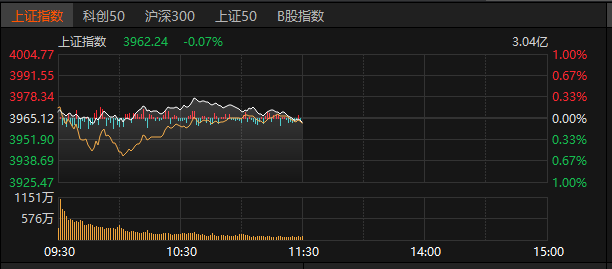
A股迎来2025年最后一个交易日。今天上午,A股三大指数震荡走低,但个股表现活跃。 有色金属两大龙头股紫金矿业、洛阳钼业上涨,盘中股价双双创历史新高。N蘅东光上午大涨919.31%,盘中一度涨超1000%。人形机器人龙头股三花智 控上涨3.75%,盘中股价创历史新高。长鑫科技概念股合肥城建"一字"涨停。中国卫星、航天晨光等商业航天概念股继续上涨。AI应用主线走强,蓝色光 标"20CM"涨停。 截至上午收盘,上证指数下跌0.07%,深证成指下跌0.67%,创业板指下跌1.1%。 长鑫科技概念股走强 12月25日,TrendForce集邦咨询最新发布的存储现货价格趋势报告显示,DDR4、DDR5与模组价格仍连日上扬,虽然价格涨幅较先前略有收敛,但观察后 研判并非缺货现象舒缓,比较倾向为部分中间交易商为了年底结账而释出较多库存的短期现象。与此同时,NAND Flash现货市场在合约价格上涨的预期 下呈现看涨情绪。 诚通证券分析称,需求端,云端、终端对高带宽内存(HBM)及大容量存储的需求高增;供给端,原厂产能结构性转向高端产品,导致传统存储供给长 期紧张。需求增长与供给约束形成共振,推动存储市场进入价格上行周期。 ...
2025绘梦天工开物——大国工程,见证中国重塑山河
Huan Qiu Wang Zi Xun· 2025-12-31 04:12
Group 1: Renewable Energy - In the first three quarters of 2025, China's renewable energy generation reached 2.89 trillion kilowatt-hours, a year-on-year increase of 15.5% [2] - Wind and solar power generation totaled 1.73 trillion kilowatt-hours, growing by 28.3% year-on-year, accounting for 22% of total electricity consumption [2] - The combined generation from wind and solar exceeded the total increase in national electricity consumption by 241 billion kilowatt-hours [2] Group 2: Aerospace Industry - By December 24, 2025, China completed 87 space launches, with 23 conducted by private commercial rocket companies [3] - China has conducted over 10 vertical landing recovery tests and 2 sea splash recovery tests, making it the country with the most rocket recovery solutions globally [3] Group 3: Infrastructure Development - The national comprehensive three-dimensional transportation network's main framework has been completed by over 90% [4] - It is projected that by 2025, transportation fixed asset investment will exceed 3.6 trillion yuan, with over 2,000 kilometers of new high-speed railways and approximately 8,000 kilometers of new highways [4] - The construction of the Tian Mountain Victory Tunnel has been completed, enhancing transportation infrastructure [4] Group 4: Bridge Construction - The completion of the Li River Grand Bridge has established a monitoring network for large bridges, incorporating 696 bridges, making China the country with the most bridges [5] Group 5: Island Construction - The "island-building fleet" has created over 1,000 square kilometers of new land, with operations in various locations including Shanghai and overseas in over 15 countries [6] Group 6: Robotics Industry - In the first eight months of 2025, the financing amount in China's robotics sector reached 38.624 billion yuan, 1.8 times that of the entire year of 2024, with over 150 humanoid robot companies existing [7] - The robotics industry is growing at an annual rate exceeding 50%, with the market expected to reach 100 billion yuan by 2030 [7] Group 7: Nuclear Fusion Research - The "International Scientific Program on Burning Plasma" was officially launched in Hefei, with the BEST research plan for compact fusion energy devices also announced globally [8] - The EAST superconducting tokamak device has become an important platform for international fusion research, collaborating with over 120 research institutions from more than 50 countries [8] Group 8: Transportation Infrastructure - The completion of the Xiamen-Jinmen Bridge will create a new integrated transportation network connecting Xiamen International Airport and the Xiamen-Jinmen shipping route, significantly contributing to cross-strait development [9]
沪指半日收跌0.07% AI应用端集体走强
Sou Hu Cai Jing· 2025-12-31 03:48
Market Overview - The Shanghai Composite Index fell by 0.07%, the Shenzhen Component Index decreased by 0.67%, and the ChiNext Index dropped by 1.1% on December 31 [1][1][1] - The total trading volume in the Shanghai and Shenzhen markets reached 1.31 trillion yuan [1][1][1] Sector Performance - The AI application sector showed strong performance, with stocks such as Wanshili, Desheng Technology, and BlueFocus hitting the daily limit [1][1][1] - The commercial aerospace concept remained active, with stocks like Reco Defense achieving three consecutive limit-ups, and Shunhao Co., Beidouxingtong, and Changjiang Communication also hitting the daily limit [1][1][1] - The robotics sector saw localized activity, with Fenglong Co. achieving five consecutive limit-ups and Wuzhou New Spring reaching a historical high with three consecutive limit-ups [1][1][1] Declining Sectors - The Fujian sector experienced a downturn, with Luyan Pharmaceutical hitting the daily limit down, and Pingtan Development, Hexing Packaging, and Haixia Innovation experiencing significant declines [1][1][1]
创新中国 攀高向新——二〇二五年我国重大科技成果盘点
Ren Min Ri Bao· 2025-12-31 03:14
Core Insights - In 2025, China made significant technological breakthroughs across various fields, contributing to high-quality development and global progress [1][3][4] Group 1: Technological Innovations - The "artificial sun" achieved a world record of 1 million degrees Celsius for 1066 seconds, marking a major step in nuclear fusion research [10] - The first large-area two-dimensional metal material was successfully produced, opening new avenues in material science [4] - The DeepSeek AI model broke traditional paths by optimizing algorithms, allowing for high performance with limited computational resources [8] Group 2: Space Exploration - The Tianwen-2 probe was launched for China's first asteroid exploration mission, enhancing capabilities in deep space exploration [11] - The Chang'e 6 mission returned samples from the moon's far side, providing groundbreaking insights into lunar geology [5] Group 3: Healthcare and AI - The first invasive brain-computer interface clinical trial in China demonstrated the ability to control devices through thought, showcasing advancements in neurotechnology [9] - AI applications in healthcare, such as the "Xiao Yi" system, improved diagnostic capabilities in community health services [13] Group 4: Economic Impact - The integration of AI and other innovations is driving high-quality development across various sectors, including transportation and healthcare [15] - The approval of 69 innovative drugs in 2025 surpassed the previous year's total, indicating a robust growth in the pharmaceutical sector [14] Group 5: Strategic Developments - China's R&D investment intensity is nearing the OECD average, with a leading position in high-level international publications and patents [16] - The establishment of a comprehensive innovation ecosystem is fostering new industries and economic models, positioning China as a leader in technological advancement [12][16]
【人民日报】创新中国 攀高向新——二〇二五年我国重大科技成果盘点
Ren Min Ri Bao· 2025-12-31 02:47
Group 1: Technological Breakthroughs - The year 2025 witnessed significant breakthroughs in various fields, including the successful operation of the "artificial sun" EAST, achieving a world record of 1 million degrees Celsius for 1066 seconds, marking a step towards practical fusion energy [15] - The development of the DeepSeek AI model, which became the first major model to pass peer review, showcases China's innovative capabilities in AI, breaking traditional paths by optimizing algorithms and engineering [12] - The successful construction of the 105-bit superconducting quantum computing prototype "Zuchongzhi No. 3" demonstrates a processing speed that is a trillion times faster than the fastest supercomputers [14] Group 2: Space Exploration - The Tianwen-2 probe was successfully launched, marking China's first asteroid exploration and sample return mission, which will enhance understanding of small celestial bodies [16] - The Chang'e 6 mission returned significant lunar samples, revealing new insights into the moon's evolution and geological history [10][11] - The Shenzhou-22 manned spacecraft successfully completed an emergency launch, highlighting advancements in China's manned space program [16] Group 3: AI and Robotics - The year 2025 is noted as a breakthrough year for humanoid robots, with significant participation in international competitions and real-world performance validations [19] - AI innovations are being integrated across various sectors, enhancing efficiency in research and healthcare, exemplified by the deployment of AI solutions in community health services [18] - The successful clinical trials of invasive brain-computer interface technology position China as the second country globally to enter this phase, showcasing advancements in human-machine interaction [13] Group 4: Energy and Environmental Technologies - The global largest "Hualong One" nuclear power base successfully connected its second unit to the grid, contributing to energy supply [17] - The promotion of carbon capture technology in the cement industry and the digital transformation in the steel sector reflect ongoing efforts towards sustainable practices [20] - The continuous breakthroughs in high-temperature superconductivity materials provide new avenues for energy efficiency and technological advancements [14] Group 5: Economic Impact and Innovation - The approval of 69 innovative drugs in 2025 marks a historical high, indicating a robust growth in China's pharmaceutical innovation [20] - The integration of technology and industry is accelerating, with significant advancements in new energy vehicles and high-speed rail technology, reinforcing China's competitive edge [20][21] - The emphasis on high-level technological self-reliance and innovation is driving the development of new productive forces, contributing to high-quality economic growth [21]