《PUBG Mobile》

Search documents
腾讯控股:2025Q4 业绩点评:游戏稳健增长,AI 商业化落地加速-20260325
Soochow Securities· 2026-03-25 00:25
Investment Rating - The investment rating for Tencent Holdings is "Buy" (maintained) [1] Core Insights - The company's performance in Q4 2025 showed steady growth, with total revenue reaching 194.4 billion yuan, a year-on-year increase of 13%, slightly above Bloomberg consensus expectations of 194.1 billion yuan. Non-IFRS net profit was 64.7 billion yuan, up 17% year-on-year, although slightly below the expected 64.9 billion yuan [8][13] - The gaming sector performed well, with domestic game revenue of 38.2 billion yuan, up 15% year-on-year, and international game revenue of 21.1 billion yuan, up 32% year-on-year, driven by new contributions from titles like "Delta Force" and "PUBG Mobile" [18] - AI continues to empower advertising business, with ad revenue reaching 41.1 billion yuan, a 17% increase year-on-year, although slightly below the expected 41.6 billion yuan [22] - Financial technology and enterprise services showed steady growth, with revenue of 60.8 billion yuan, up 8% year-on-year, driven by improvements in wealth management and commercial payment services [23] Summary by Sections 1. Performance Overview - Q4 2025 total revenue was 194.4 billion yuan, a 13% increase year-on-year, and Non-IFRS net profit was 64.7 billion yuan, a 17% increase year-on-year [13] - Gross margin improved by 3 percentage points to 56%, driven by a higher proportion of high-margin businesses and improved cost efficiency in fintech and cloud services [13] 2. Gaming Performance - Domestic game revenue reached 38.2 billion yuan, up 15% year-on-year, while international game revenue was 21.1 billion yuan, up 32% year-on-year [18] 3. Social Network Revenue - Social network revenue was 30.6 billion yuan, a 3% increase year-on-year, supported by growth in video account live streaming and music subscription services [19] 4. AI Empowerment - AI continues to enhance advertising capabilities, contributing to a 17% year-on-year growth in ad revenue [22] 5. Financial Technology and Enterprise Services - Revenue from financial technology and enterprise services was 60.8 billion yuan, an 8% increase year-on-year, driven by growth in wealth management and cloud services [23] 6. User Engagement - WeChat's monthly active users reached 1.418 billion, a 2% year-on-year increase, while QQ's mobile MAU slightly declined to 508 million [26] 7. Profitability Metrics - Overall gross margin was 56%, with specific margins for value-added services at 60%, advertising at 60%, and fintech and enterprise services at 51% [31] 8. Investment Forecast - The forecast for Non-IFRS net profit for 2026-2027 has been adjusted to 291.8 billion yuan and 339.2 billion yuan, respectively, with an expected net profit of 371.2 billion yuan for 2028 [34]

腾讯控股:2025Q4业绩点评:游戏稳健增长,AI商业化落地加速-20260325
Soochow Securities· 2026-03-25 00:24
Investment Rating - The report maintains a "Buy" rating for Tencent Holdings [1] Core Insights - The company achieved a total revenue of 194.4 billion yuan in Q4 2025, representing a year-on-year increase of 13%, slightly above Bloomberg's consensus estimate of 194.1 billion yuan [8][13] - Non-IFRS net profit for the same quarter was 64.7 billion yuan, up 17% year-on-year, though slightly below the expected 64.9 billion yuan [8][13] - The overall gross margin improved by 3 percentage points to 56%, driven by a higher proportion of high-margin businesses and improved cost efficiency in fintech and cloud services [8][13] Revenue and Profit Performance - Q4 2025 domestic game revenue reached 38.2 billion yuan, a 15% increase year-on-year, exceeding the expected 37.5 billion yuan [18] - International game revenue was 21.1 billion yuan, up 32% year-on-year, surpassing the expected 20 billion yuan, primarily driven by games from Supercell and PUBG Mobile [18] - Social network revenue for Q4 2025 was 30.6 billion yuan, a 3% increase year-on-year, supported by growth in video account live streaming and music subscription services [19] - Advertising revenue was 41.1 billion yuan, a 17% increase year-on-year, although slightly below the expected 41.6 billion yuan [22] - Financial technology and enterprise services revenue reached 60.8 billion yuan, an 8% increase year-on-year, slightly below the expected 61.2 billion yuan [23] User Engagement Metrics - WeChat's monthly active users (MAU) grew to 1.418 billion, a 2% year-on-year increase, while QQ's MAU slightly declined to 508 million, down 3% year-on-year [26] Margin and Cost Analysis - The overall gross margin for Q4 2025 was 56%, with the gross margin for value-added services at 60%, benefiting from growth in both domestic and international games [31] - Sales expenses for Q4 2025 were 13 billion yuan, a 7% increase year-on-year, primarily due to seasonal marketing expenditures related to gaming and esports [32] Earnings Forecast and Valuation - The report adjusts the forecast for Non-IFRS net profit for 2026 and 2027 to 291.8 billion yuan and 339.2 billion yuan, respectively, with an expected Non-IFRS net profit of 371.2 billion yuan for 2028 [34] - The corresponding price-to-earnings (P/E) ratios for 2026-2028 are projected to be 14, 12, and 11 times [34]
传媒行业跟踪报告:腾讯2025年财报发布,游戏业务表现突出,强调AI赋能
Wanlian Securities· 2026-03-23 08:18
Investment Rating - The industry investment rating is "Outperform the Market" with an expectation of a relative increase of over 10% in the industry index compared to the broader market within the next six months [22]. Core Insights - The report highlights that Tencent's 2025 financial results show significant growth, with total revenue reaching 751.766 billion yuan and net profit at 224.842 billion yuan, both reflecting double-digit growth. The gaming business has seen substantial revenue increases both domestically and internationally, with AI deployment enhancing content production and marketing effectiveness [1][10]. - The gaming industry is expected to maintain growth and profitability resilience through 2026, supported by a solid product pipeline and deepening globalization. The integration of AI is anticipated to accelerate content iteration and operational efficiency, further enhancing revenue potential [1][10]. - The long-term growth potential of the gaming industry remains strong, driven by a steady release of new products and normalization of licensing processes. The report suggests focusing on leading companies with robust product reserves, R&D capabilities, and mature global operations, particularly in AI-enhanced applications [2][10]. Summary by Sections Industry Performance - Last week, the media industry (Shenwan) declined by 3.78%, ranking 13th in the market and underperforming the CSI 300 index by 1.59 percentage points and the ChiNext index by 5.04 percentage points. Year-to-date, the media industry has seen a cumulative decline of 2.91% [11][13]. Industry Dynamics - In February, the domestic gaming market generated 33.231 billion yuan, marking an 18.96% year-on-year growth, the highest in nearly 10 months. The client game market revenue was 8.87 billion yuan, up 56.75% year-on-year, while mobile game revenue reached 22.729 billion yuan, growing 9.05% year-on-year. Additionally, domestic games generated 2.114 billion USD in overseas sales, reflecting a 40.46% year-on-year increase [3][19][20]. - Tencent's gaming revenue for the year was 241.6 billion yuan, with domestic revenue at 164.2 billion yuan (up 18%) and international revenue at 77.4 billion yuan (up 33%). Several major games are set to launch soon, including "Honor of Kings World" and "Rock Kingdom: World" [3][20]. Industry Valuation - The SW media industry PE (TTM) valuation decreased from 27.10X to 26.07X, slightly below the average level from 2018 to 2025, which is 26.24X, indicating a decline of 0.64% [4][17].
腾讯控股(00700):主业强韧支撑AI投入,为社交注入智能体
GF SECURITIES· 2026-03-19 01:35
Investment Rating - The investment rating for the company is "Buy" with a current price of HKD 550.50 and a fair value of HKD 731.64 [5]. Core Insights - The company's core business remains resilient, supported by strong cash flow, allowing for increased investment in AI infrastructure and talent. The integration of AI into social applications is expected to enhance user engagement and operational efficiency [11][19]. - The company is projected to achieve revenues of RMB 8,287 billion in 2026 and RMB 9,082 billion in 2027, with year-on-year growth rates of 10.2% and 9.6% respectively. Adjusted net profit is expected to reach RMB 2,872 billion and RMB 3,263 billion for the same years, reflecting growth rates of 10.6% and 13.6% [4][11]. Financial Performance Overview - In Q4 2025, the company reported revenue of RMB 1,944 billion, a year-on-year increase of 13% and a quarter-on-quarter increase of 1%, slightly above Bloomberg consensus estimates [11]. - The adjusted net profit for Q4 2025 was RMB 647 billion, representing a year-on-year increase of 17% but a quarter-on-quarter decrease of 8% [11]. - The full-year revenue for 2025 was RMB 7,518 billion, with a year-on-year growth of 14%, and the adjusted net profit was RMB 2,596 billion, up 17% from the previous year [11]. Revenue Breakdown - The gaming business generated RMB 593 billion in Q4 2025, with a year-on-year increase of 21%. Domestic game revenue was RMB 382 billion, up 15%, while overseas game revenue reached RMB 211 billion, up 32% [12][19]. - Social network revenue for Q4 2025 was RMB 306 billion, reflecting a year-on-year increase of 3% [17]. - Marketing services revenue was RMB 411 billion, with a year-on-year increase of 17%, driven by AI-enhanced advertising capabilities [19]. Profitability Metrics - The gross profit for Q4 2025 was RMB 1,083 billion, with a gross margin of 56%, up 3 percentage points year-on-year [20]. - Operating profit for Q4 2025 was RMB 603 billion, reflecting a year-on-year increase of 17% [20]. - The adjusted EPS for Q4 2025 was RMB 6.97, representing an 18% year-on-year increase [11]. Future Projections - The company is expected to solidify its mixed-reality model capabilities, leveraging cross-platform social scenarios to enhance AI product integration and application ecosystems [11]. - The estimated fair value of the company, based on a sum-of-the-parts (SOTP) valuation, is HKD 731.64 per share, maintaining the "Buy" rating [36][37].
数娱工场 | 2025年中国电竞产业报告解读:高基数增长的“喜”与结构不均衡的“忧”
Xin Hua Cai Jing· 2025-12-05 05:45
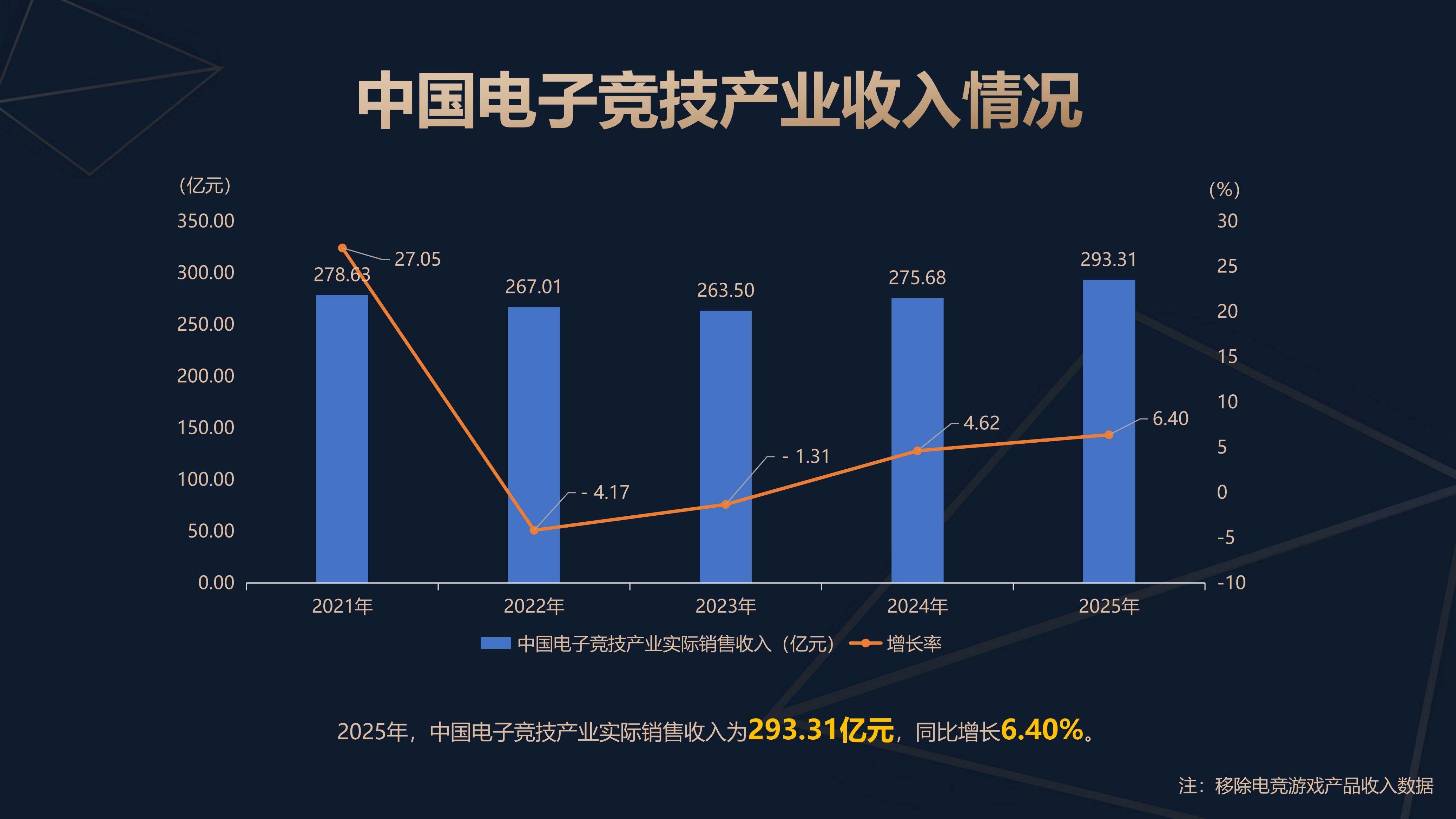
Core Insights - The Chinese esports industry is experiencing a recovery and adjustment phase, with a projected revenue of 293.31 billion yuan in 2025, marking a 6.40% year-on-year increase, the highest growth rate in three years [2][33] - The industry faces structural issues, particularly a heavy reliance on live streaming for revenue, which constitutes 80.81% of total income, while direct revenue from events and clubs only accounts for 15.03% [5][33] - User growth is plateauing, with a projected user base of 495 million in 2025, reflecting a 1.06% increase, indicating future growth will depend more on enhancing existing user engagement rather than acquiring new users [8][33] Industry Overview - The esports industry in China is recovering from a decline in sales revenue experienced in the previous two years, indicating improved monetization capabilities [2] - The dominance of shooting games is evident, comprising 28.3% of esports gameplay types, with mobile platforms leading at 58.6% [9][33] - The number of professional esports events is increasing, with 142 events planned for 2025, a rise of 18 from the previous year, and over half of these events being held offline [14][33] Regional Dynamics - Shanghai maintains its status as the "global esports capital," hosting 19.2% of offline events and having 38 esports clubs, both leading figures nationally [17][33] - Other major cities like Chengdu, Chongqing, Hangzhou, and Beijing form a strong second tier for event hosting, contributing to a significant concentration of esports clubs [22][33] International Expansion and Challenges - The international presence of Chinese esports is growing, with successful events held globally, showcasing the competitive edge of Chinese esports in terms of business models and content operation [25][33] - However, the club ecosystem shows signs of vulnerability, with 54.3% of clubs participating in only one type of event, which raises concerns about their resilience to market changes [29][33] Conclusion - The Chinese esports industry is characterized by stable revenue growth, increased offline events, and significant regional clustering, alongside challenges such as revenue dependency on live streaming and a need for diversified club participation [33]

腾讯的AI征程:构筑游戏新纪元,登顶全球霸主
阿尔法工场研究院· 2025-10-30 00:07
Core Viewpoint - Tencent is leveraging AI tools like Hunyuan and VISVISE to revolutionize game development, significantly reducing production time and driving strong revenue growth, positioning itself as a leader in the smart entertainment era [3][4][10]. AI Leadership: Rapid Innovation in Development and Distribution - Tencent's AI capabilities are not theoretical but are reshaping game development on an industrial scale, with tools like VISVISE automating the generation of textures and animations, compressing development time to minutes [6][7]. - The Hunyuan Game AI can generate hyper-realistic characters in seconds, democratizing AAA game development for independent developers and Tencent's studios [6][8]. Global Expansion: From Shenzhen to the World - Tencent is expanding its global footprint as the second-largest game publisher, with international game revenue growing by 35% in Q2 2025, driven by AI innovations [8][9]. - Strategic investments, such as in Antix, are enhancing AI digital human technology, significantly reducing production costs in film and supporting Tencent's metaverse strategy [9]. Long-term Value: Core Asset in the AI-Game Era - Tencent is projected to achieve a revenue of approximately 755 billion RMB by 2025, with a compound annual growth rate (CAGR) of 13%, driven by AI and global expansion [12]. - The company is expected to maintain a robust return on equity (ROE) of 15%+, potentially increasing to 20%-30%+ by 2030, supported by its data-driven business model [12]. Conclusion - Tencent is not just adapting to the AI revolution; it is a key architect of this transformation in the gaming industry, providing developers with liberation, players with immersion, and investors with a solid investment opportunity [13].

数娱工场 | 手游收益榜前十过半来自中国!透视俄罗斯游戏市场淘金热
Xin Hua Cai Jing· 2025-10-24 03:42
Core Insights - Yandex Ads has launched its growth platform Yandex Ads Boost in China, aimed at supporting mobile app and game developers in monetization and data analysis, particularly in the Russian and emerging global markets [1][5] - The Russian gaming market is experiencing significant growth, with the market size expected to reach $2.4 billion in 2024, a 6% year-on-year increase, and mobile game downloads ranking fifth globally [2][3] - Chinese game exports to Russia have surpassed $1 billion in 2024, reflecting a 20% year-on-year growth, indicating a favorable window for Chinese developers to enter the Russian market [1][2] Market Dynamics - The Russian gaming market is characterized by a strong growth trajectory, with mobile game revenue reaching $898 million and a 53% increase in the online advertising market, totaling $13.4 billion [2] - The increasing acceptance of Asian culture among Russian consumers is a positive sign for Chinese game developers, as evidenced by the rising sales of Chinese products in Russia [6][7] - The demographic shift towards younger and higher-spending gamers in Russia, with 60% of core users aged 18 to 44, presents a lucrative opportunity for game developers [7] Challenges and Solutions - Chinese developers face challenges such as language and cultural barriers, difficulties in monetizing user engagement, and complex compliance requirements in the Russian market [3][4] - Yandex Ads Boost aims to address these challenges by simplifying technical integration and compliance processes, allowing developers to focus on business growth [5] - The platform's design caters specifically to the needs of small and medium-sized developers, helping them save resources and streamline operations [5] Future Outlook - The future of Chinese games in Russia looks promising, with a strong cultural fit and a growing user base that is increasingly willing to pay for high-quality games [6][7] - The ability to navigate localization, payment, and operational challenges will be crucial for developers looking to capitalize on the current market opportunities [7]
+30%收入,切支付,大厂们都是怎么做的?
3 6 Ke· 2025-09-15 00:23
Core Insights - The article discusses how mobile game developers are increasingly directing players to external payment options to avoid Apple's 30% commission, referred to as the "Apple tax" [1][3][12] - A study by Liquid & Grit analyzed over 30 cases of leading mobile game companies like Supercell and Niantic, focusing on their strategies to sell in-app purchases (IAP) directly to players outside of the App Store [1][3] Group 1: Strategies for Redirecting Players - Liquid & Grit categorized the new store designs into four main types: offering web store discounts in the native IAP store, pop-ups, buttons on the main game interface, and using in-game news and email systems for guidance [1][3] - "Social Casino" games are the most proactive in redirecting players to web stores, utilizing all four methods, while other game categories show varied adoption [3][5] - Specific games like "Dragon City" and "PUBG Mobile" employ different strategies, such as banners and pop-ups, to encourage players to use web stores for purchases [5][7] Group 2: Incentives and Challenges - To enhance conversion rates, developers must reduce payment friction and increase player motivation to choose external payment options over Apple’s [11][12] - Companies like Epic Games offer incentives, such as a 20% cash back, to encourage players to opt for web payments [11] - The report suggests that the most effective design so far is the "purchase pop-up," which allows players to complete transactions without leaving the game, thus maintaining a seamless experience [11][12] Group 3: Alternative Payment Solutions - Companies with in-house resources are encouraged to build their own web stores and utilize payment processors like Stripe or Adyen to handle transactions [12] - For developers who prefer not to create their own stores, managed web store service providers like Xsolla and Stash are available, offering a quicker setup at a cost lower than Apple's commission [12]


最高提效8倍,腾讯游戏发布专业游戏AI大模型,美术师做动画不用辣么“肝”了
3 6 Ke· 2025-08-26 01:52
Core Insights - The article highlights the significant advancements in AI technology within the gaming industry, particularly showcased at the recent Devcom developer conference alongside the Cologne International Game Show. Major companies like Microsoft, Tencent, Google, and Meta presented over 20 discussions focused on how AI can enhance game art production efficiency and integrate seamlessly with traditional workflows [1][3]. Group 1: AI Tools and Solutions - Tencent Games launched its AI-driven comprehensive game creation solution, VISVISE, which includes tools for animation production, model creation, digital asset management, and intelligent NPCs, aimed at alleviating the repetitive and labor-intensive tasks in game art development [3][8]. - The MotionBlink tool within VISVISE can automatically complete animation sequences based on minimal user input, significantly reducing the time required for animation production from several days to just seconds [3][15]. - The GoSkinning tool, part of VISVISE, automates the skinning process for 3D models, improving efficiency by up to 60% in animation skinning tasks, and has been successfully implemented in popular games like "PUBG Mobile" and "Peacekeeper Elite" [8][24]. Group 2: Challenges in Game Art Production - Traditional game art production consumes 50%-60% of time on asset creation, with 3D modeling and animation being the most labor-intensive processes. The complexity of these tasks often leads to inefficiencies, particularly in skinning and animation adjustments [9][10]. - The article discusses the limitations of traditional methods such as manual keyframing and motion capture, which can be time-consuming and require extensive corrections, highlighting the need for AI solutions to streamline these processes [10][11]. Group 3: Development and Future of AI in Gaming - Tencent's approach to developing VISVISE was driven by actual development needs, beginning its exploration of AI in gaming as early as 2016. The system was officially launched in 2024, integrating various AI tools tailored to different aspects of game creation [24][26]. - The future of AI in gaming is seen as a critical area for development, with the potential for AI to enhance NPC interactions and create more immersive gaming experiences. The relationship between gaming and AI is described as symbiotic, with games serving as both a testing ground and a catalyst for AI advancements [29][30][32].
马化腾最新表态:Q2净赚630亿,但最赚钱的不是游戏……
Wind万得· 2025-08-14 03:32
Core Viewpoint - Tencent's Q2 2025 financial performance shows strong growth across multiple business segments, driven by gaming, advertising, and AI strategies, leading to a significant increase in revenue and profit margins [4][6]. Financial Performance - Q2 revenue reached 184.5 billion yuan, a year-on-year increase of 15% and a quarter-on-quarter increase of 2% [6]. - Non-IFRS operating profit was 69.25 billion yuan, up 18% year-on-year [6]. - Non-IFRS net profit stood at 63 billion yuan, reflecting a 10% year-on-year growth [6]. - Gross margin improved to 57%, an increase of 4 percentage points, benefiting from high-margin business optimization [6]. - Free cash flow amounted to 43 billion yuan, with capital expenditures of 19.1 billion yuan [6]. Business Highlights and Strategic Directions 1. **Gaming Business Recovery** - Domestic market: "Delta Action" achieved over 20 million daily active users, contributing to top revenue [7]. - International market: "PUBG Mobile" reached a record high monthly revenue, while "Clash Royale" saw a seven-year revenue peak with a fixed exchange rate growth of 33% [7]. 2. **Advertising Business Driven by AI** - Video account advertising surged by 50%, with AI optimization increasing click-through rates (CTR) to 3% [8]. - WeChat search revenue grew by 60%, aided by large model optimization for product intent understanding [8]. 3. **Steady Growth in Financial Technology and Enterprise Services** - Growth in enterprise services accelerated due to GPU leasing and API calls, with Tencent Cloud being recognized as a global leader in CPaaS for three consecutive years by Gartner [9]. 4. **Accelerated Investment in AI Strategy** - R&D expenses reached 20.25 billion yuan, a year-on-year increase of 17%, with the "Hunyuan" large model ranking first in 3D generation capabilities on HuggingFace [10]. - Capital expenditures are projected to be between 80 to 100 billion yuan in 2025, accounting for 10% to 15% of revenue [10]. 5. **WeChat Ecosystem AI Upgrade** - Monthly active users reached 1.411 billion, a year-on-year increase of 3%, with new AI customer service and video account interpretation features [11]. Management Key Statements - CEO Ma Huateng emphasized the core focus on the "Hunyuan" large model and AI applications, with ongoing investments planned [12]. - President Liu Chiping highlighted prioritizing high-return areas for AI investments, noting that some GPU leasing has already contributed to revenue [12]. - CFO Luo Shuhan discussed cost control measures, stating that free cash flow covers capital expenditures [12].