军工

Search documents
“长跑型”基金经理调仓揭秘:逆势减仓热门股, 持股集中度下降
Zhong Guo Zheng Quan Bao· 2026-01-25 14:31
Core Viewpoint - The report highlights the contrasting strategies of long-term fund managers in the fourth quarter of 2025, showcasing their unique approaches to portfolio adjustments amidst market trends, particularly in the context of popular stocks like Zhongji Xuchuang and Xinyi Sheng. Group 1: Fund Manager Strategies - Long-term fund managers are reducing their positions in popular stocks like Zhongji Xuchuang, despite it being the top holding for public funds, with some managers cutting their stakes by over 40% [2][3] - There is a notable divergence among fund managers regarding their positions in stocks like Xinyi Sheng, with some increasing their holdings while others significantly reduce them [2][3] - Fund managers are also moving away from high concentration holdings, opting for a more diversified portfolio approach, as seen in the significant reductions in the concentration of top holdings [4] Group 2: Sector Focus and Investment Trends - The AI industry remains a focal point for investment, but fund managers are diversifying their portfolios to include sectors such as commercial aerospace, robotics, and military [4] - There is a growing interest in cyclical sectors, with managers increasing their positions in aluminum, copper, and chemicals, indicating a shift in investment strategy [5] - The consumer and social services sectors are also seeing increased investment, with managers adding new positions in companies related to tourism and luxury goods [6] Group 3: Market Outlook for 2026 - Fund managers express optimism for the market in 2026, anticipating a potential upward trend driven by profit recovery and liquidity [7] - The focus on AI applications is expected to shift from foundational infrastructure to practical applications, with specific attention on AI-driven technologies [7] - Investment in cyclical sectors is expected to remain valuable, with managers highlighting the potential for recovery in aluminum and copper prices [7]
申万宏源展望2026:春季前科技成长还有机会,下半年A股有望迎普涨行情
Di Yi Cai Jing Zi Xun· 2025-11-19 02:49
Core Viewpoint - The upcoming year 2026 is anticipated to be a year of comprehensive reform and development, with new driving forces for economic growth emerging, particularly in technology and innovation [1][2][3]. Economic Outlook - The "14th Five-Year Plan" emphasizes accelerating high-level technological self-reliance and innovation, which is expected to drive new productivity in the economy [2]. - The accumulation of technological factors is projected to lead to breakthroughs in future industries such as AI, biomedicine, hydrogen energy, and sixth-generation mobile communications [2]. - The focus on expanding domestic demand is expected to strengthen under the reform framework, with a notable emphasis on structural economic recovery in 2026 [3]. A-Share Market Strategy - A-share market is currently experiencing a phase of high valuation and potential adjustment, particularly in the AI sector, but a significant upward trend is not yet concluded [6][7]. - A small rebound in technology growth is expected before the spring of 2026, with a potential comprehensive market rally in the second half of the year [7]. - Key investment themes for 2026 include recovery trades in basic chemicals and industrial metals, technology industry trends in humanoid robots and energy storage, and enhanced manufacturing influence [7]. Consumer and Investment Trends - The nominal GDP is expected to improve, leading to better profitability and a recovery in investment growth, with fixed asset investment projected to return to around 3% [4]. - Consumer retail growth is anticipated to be 4.5% in 2026, with service sector retail expected to perform better at 5.5% [3]. External Demand - Export resilience is expected to remain strong, with a narrowing decline in exports to the U.S. and an increase in trade with non-U.S. regions [5].

杨德龙:十月份行情收官 多重因素驱动大盘突破4000点
Xin Lang Ji Jin· 2025-11-01 04:21
Group 1 - A-shares have strongly broken through the 4000-point mark for the first time since 2014, confirming a new bull market trend [1] - There is an increase in divergence between bulls and bears around the 4000-point level, with a technical pullback observed, but the upward channel remains intact [1] - Substantial progress has been made in China-US economic and trade consultations, leading to a phase of easing bilateral relations and a rapid recovery in global risk appetite [1] Group 2 - The market structure is transitioning from a "one-star" performance to a "multi-flower" growth, with technology leaders leading the rally, followed by new energy sectors such as energy storage, lithium batteries, and photovoltaics [2] - There is an expectation of continued monetary easing, with potential reserve requirement ratio cuts of 25-50 basis points and policy interest rate reductions of 10-20 basis points [2] - The fiscal policy is set to expand categories and scales for "old-for-new" replacements, along with subsidies for green, smart, and service consumption [2] Group 3 - The overall judgment for the fourth quarter indicates that the index will continue to operate within an upward channel, with a bull market expected to last 2-3 years [3] - Investment recommendations include focusing on technology sectors such as humanoid robots, computing chips, semiconductor equipment, and industrial software during pullbacks [3] - The A-share market is currently in a phase of rising profits and valuations, suggesting a strategy of maintaining composure and making low-cost investments to achieve steady wealth growth [3]
量化择时周报:牛市思维,下周关注哪些行业?-20250817
Tianfeng Securities· 2025-08-17 09:14
Quantitative Models and Construction Methods 1. Model Name: Timing System Signal (Wind All A Moving Average Distance Model) - **Model Construction Idea**: This model uses the distance between the short-term moving average (20-day) and the long-term moving average (120-day) of the Wind All A Index to determine the market's overall trend. A positive and expanding distance indicates an upward trend[2][9]. - **Model Construction Process**: 1. Calculate the 20-day moving average (short-term) and the 120-day moving average (long-term) of the Wind All A Index. - Latest values: 20-day MA = 5658, 120-day MA = 5241[2][9]. 2. Compute the percentage difference between the two moving averages: $ \text{Distance} = \frac{\text{20-day MA} - \text{120-day MA}}{\text{120-day MA}} \times 100\% $ - Current distance = 7.96%[2][9]. 3. Interpret the signal: If the distance is greater than 3% and positive, the market is in an upward trend[2][9]. - **Model Evaluation**: The model effectively captures the market's upward momentum and provides a clear signal for maintaining high equity positions during positive trends[2][9]. 2. Model Name: Industry Allocation Model - **Model Construction Idea**: This model identifies industries with potential for medium-term outperformance based on factors such as policy support, valuation, and growth trends[2][10]. - **Model Construction Process**: 1. Analyze industry-specific drivers, including policy incentives and growth catalysts. 2. Identify sectors with "distressed reversal" characteristics or benefiting from policy-driven growth. 3. Recommend sectors such as innovative pharmaceuticals, securities insurance, photovoltaics, coal, and non-ferrous metals. 4. Use the TWO BETA model to emphasize technology-related sectors, including military, computing power, and batteries[2][10]. - **Model Evaluation**: The model provides actionable insights for sector rotation, aligning with macroeconomic and policy trends[2][10]. 3. Model Name: Position Management Model - **Model Construction Idea**: This model determines optimal equity allocation levels based on valuation metrics and market trends[3][10]. - **Model Construction Process**: 1. Assess valuation levels of the Wind All A Index using PE and PB ratios. - Current PE: 70th percentile (moderate level). - Current PB: 30th percentile (low level)[3][10]. 2. Combine valuation analysis with timing signals (e.g., moving average distance and profit-making effect). 3. Recommend equity allocation levels based on the above factors. - Current recommendation: 80% equity allocation[3][10]. - **Model Evaluation**: The model balances valuation and trend analysis, providing a systematic approach to equity allocation[3][10]. --- Model Backtesting Results 1. Timing System Signal - Moving average distance: 7.96% (greater than the 3% threshold, indicating an upward trend)[2][9]. 2. Industry Allocation Model - Recommended sectors: Innovative pharmaceuticals, securities insurance, photovoltaics, coal, non-ferrous metals, military, computing power, and batteries[2][10]. 3. Position Management Model - PE: 70th percentile (moderate level)[3][10]. - PB: 30th percentile (low level)[3][10]. - Recommended equity allocation: 80%[3][10]. --- Quantitative Factors and Construction Methods 1. Factor Name: Profit-Making Effect - **Factor Construction Idea**: This factor measures the market's ability to generate profits for investors, serving as a key indicator of market sentiment and potential capital inflows[2][10]. - **Factor Construction Process**: 1. Calculate the profit-making effect value based on market performance. - Current value: 3.73% (positive)[2][10]. 2. Interpret the signal: A positive value indicates sustained investor confidence and potential for further capital inflows[2][10]. - **Factor Evaluation**: The factor is a reliable indicator of market sentiment, supporting timing and allocation decisions[2][10]. --- Factor Backtesting Results 1. Profit-Making Effect - Current value: 3.73% (positive, indicating sustained market confidence)[2][10].

《关于金融支持新型工业化的指导意见》解读 创金合信基金罗水星:加速制造业产业升级
Xin Lang Ji Jin· 2025-08-11 07:28
Group 1 - The "Guiding Opinions" issued by seven departments, including the central bank, focus on 18 targeted support measures for the new industrialization strategy, emphasizing the high-end, intelligent, and green development of manufacturing [1][2] - The capital market plays a crucial role in financing and optimizing financial resource allocation, which is essential to prevent "involution" competition by making financial resources appropriately scarce [1][3] - The financial system is expected to mature by 2027, enhancing service adaptability and addressing financing pain points in the industrial and manufacturing sectors through various financial instruments [2][3] Group 2 - The future industrialization will be characterized by high-end manufacturing and intelligent transformation, with traditional industries transitioning to smart factories and digital production lines through AI integration [3][4] - The capital market is expected to provide multi-level financing channels for emerging industries, support mergers and acquisitions, and innovate bond varieties to broaden financing sources [3][4] - The emphasis on long-term financing for key technology breakthroughs in manufacturing indicates a shift towards sustainable financial support for emerging industries [3][5] Group 3 - The investment and financing functions must be balanced, ensuring that promising companies receive support while reinforcing regulatory measures to prevent misuse of funds [4][5] - The pain points in emerging industry development include the scarcity of new technologies and the need for specialized talent to identify potential opportunities [5][6] - The focus on preventing "involution" competition involves making financial resources scarce and ensuring that investments yield returns, thereby constraining disorderly capacity expansion [5][6] Group 4 - Key investment opportunities in the new industrialization process include innovative pharmaceuticals, computing power, photolithography machines, high-end CNC machine tools, nuclear fusion, AI applications, IoT, military industry, and robotics [6][7]
A股重磅信号!错过了创新药和新消费,还能买什么?
天天基金网· 2025-06-16 11:06
Core Viewpoint - The recent economic data in China exceeded expectations, leading to a collective rebound in A-shares despite external conflicts, with over 3,400 stocks rising [1][5]. Economic Data - China's industrial added value in May increased by 5.8% year-on-year, surpassing the expected 5.7% and the previous value of 6.1% [6]. - The retail sales of consumer goods in May reached 41,326 billion yuan, growing by 6.4% year-on-year, exceeding the expected 4.9% and the previous 5.1% [6]. Impact of External Conflicts - The geopolitical tensions in the Middle East have significant implications, but their actual impact on Chinese assets is limited. Short-term market fluctuations may provide investment opportunities [4][8]. - Analysts suggest that while external conflicts may trigger risk-averse sentiments globally, the fundamental factors within China will primarily dictate market trends [9]. Investment Opportunities - Goldman Sachs remains optimistic about A-shares, indicating a return of global capital to China, which could disproportionately benefit major index-weighted stocks like Tencent, Alibaba, Xiaomi, BYD, Meituan, NetEase, Midea, Heng Rui Pharmaceutical, Ctrip, and Anta [9]. - The upcoming Lujiazui Forum on June 18-19 is expected to announce significant financial policies, which could enhance domestic economic resilience [9]. Sector Performance - Recent trends show that sectors such as wind power, gaming, media, and computing have performed well, while pharmaceuticals and precious metals have seen corrections [3]. - The period from June 15 to July 15 has historically shown a high performance rate for industries with positive earnings forecasts, indicating potential investment opportunities in these sectors [10]. Market Rotation - Following the recent surge in innovative drugs and new consumption sectors, there is speculation that these themes may have reached a temporary peak. Funds are beginning to rotate towards technology sectors, including AI, media, and military technology [15][24]. - The technology sector has shown resilience during past geopolitical conflicts, suggesting it may continue to perform well despite external pressures [26].


AI算力股爆发,通信、5G相关ETF大涨
Guo Ji Jin Rong Bao· 2025-05-08 23:50
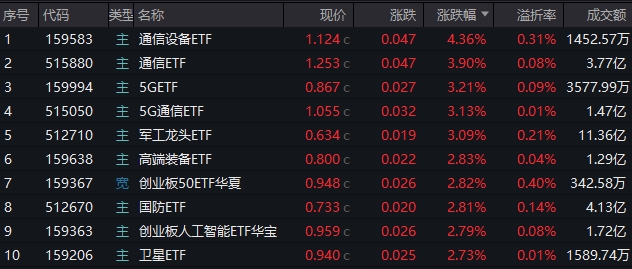
Group 1 - The AI industry chain continues to attract investment, with a focus on computing power [1][6] - The communication and military industry ETFs have seen significant gains, driven by geopolitical tensions and AI-related stocks [2][3] - The CPO concept index has led the market with a 4.91% increase, while several communication and 5G-related ETFs have also surged [3][4] Group 2 - The military sector's rise is linked to heightened geopolitical tensions, while the drop in gold prices is attributed to market corrections [2][5] - The domestic demand for computing power is expected to increase due to geopolitical conflicts and trade tariffs, benefiting the local market [6][9] - The semiconductor sector, particularly in light modules, is gaining attention as the market remains focused on AI developments [7][8]