
冷轧

Search documents
深跌之后,钢铁板块怎么看?
Changjiang Securities· 2026-03-30 11:16
Investment Rating - The investment rating for the steel industry is Neutral, maintained as of March 30, 2026 [9]. Core Insights - Since early March, the steel index has dropped by 14.9%, while rebar prices have increased by 30 CNY/ton. The profitability of sample steel companies has risen from 38.10% to 43.29%, an increase of 5.19 percentage points. This indicates that the recent decline in the steel sector is primarily due to valuation drops rather than significant changes in fundamentals, which have slightly improved [2][7]. - The market's valuation drop for the steel sector is attributed to the "US-Iran conflict" that began in early March, which has limited oil supply from the Middle East, potentially leading to price increases and inflation expectations that suppress global commodity demand. However, the impact on the steel sector is considered limited due to its domestic demand orientation and the sector being at a low valuation level [7]. Summary by Sections Demand and Supply - The demand for steel continues to recover, with the apparent consumption of steel products showing a slight increase compared to last year. The recovery is attributed to the later timing of the Spring Festival this year, affecting the availability of funds and labor for construction sites. The apparent consumption of steel products has been slightly lower than last year in the Gregorian calendar but higher in the lunar calendar [5]. - The production of steel has slightly decreased, with a daily average iron output rising to 2.31 million tons, reflecting a 2.94 thousand tons/day increase. The profitability of sample steel mills remains stable at 43.29%, with a slight increase of 0.87% [6]. Inventory and Pricing - Steel inventories have continued to decrease, with total inventory down by 2.61% compared to the previous period. The price of Shanghai rebar has fallen to 3,200 CNY/ton, while hot-rolled steel has risen to 3,280 CNY/ton [6]. - The recent geopolitical events, including airstrikes on Iranian steel plants, may lead to a tightening of steel supply in the Middle East, potentially increasing import demand [5]. Market Positioning - The steel sector is characterized as a low-position sector compared to other cyclical commodities, with prices, profitability, and equity positions at long-term lows. The report suggests that the recent panic-driven sell-off may lead to a rebound, as lower valuations imply better cost-effectiveness for the sector [7]. - The report emphasizes the importance of monitoring the recovery progress in demand, supply, and cost factors within the steel industry [7].
钢材铁矿周度报告-20260320
Zhong Hang Qi Huo· 2026-03-20 10:23
1. Report Industry Investment Rating - No information provided 2. Core Views of the Report - Steel prices are expected to fluctuate within a range. The firm cost support from raw materials and the inventory reduction during the traditional peak season are positive factors, while limited demand growth, high energy prices, and reduced overseas interest - rate cut expectations are negative factors [9][39] - Iron ore prices are expected to be strong in the short - term. The improvement in fundamentals, including increased global shipments, inventory replenishment by steel mills, and rising iron - water production, boosts the price. However, high port inventories are a potential negative factor [10][42] 3. Summary by Directory 3.1 Report Summary - **Market Focus**: Multiple events influence the market, such as steel price increases in Hubei, changes in steel billet and iron ore inventories, national policies on industry development, and international trade policies [6] - **Fundamental Overview**: Steel production capacity utilization is recovering, with increased output of rebar and hot - rolled coils. Blast - furnace profits for finished products have slightly declined. After the Spring Festival, steel mill demand has gradually recovered [8] - **Main Views**: Rebar demand related to real estate is under pressure. The inflection point of steel inventory reduction has emerged. Global iron ore shipments have slightly increased, and freight rates have slightly decreased. Steel mills have replenished iron ore, and port inventories have slightly decreased. Iron - water production and the daily consumption of iron ore by steel mills have increased [11] 3.2 Multi - and Short - Focus - **Finished Products**: Positive factors include strong raw material prices and the arrival of the traditional peak season with an inventory inflection point. Negative factors are limited demand growth, high energy prices, and reduced overseas interest - rate cut expectations [14] - **Iron Ore**: Positive factors are rising energy prices increasing transportation costs, rising iron - water production and consumption, and steel mills' inventory replenishment. The negative factor is high port inventories [16] 3.3 Data Analysis - **Production and Capacity Utilization**: As of March 20, rebar output was 203.33 million tons (up 8.03 million tons week - on - week), hot - rolled coil output was 300.21 million tons (up 4.95 million tons week - on - week). The blast - furnace capacity utilization rate of 247 steel enterprises was 85.53% (up 2.61% week - on - week), and the independent electric - arc furnace capacity utilization rate was 56.57% (up 6.13% week - on - week) [18] - **Profit**: As of March 19, the blast - furnace production profit of rebar was 63 yuan/ton, and that of hot - rolled coils was - 1 yuan/ton. The electric - arc furnace production cost of rebar was 3422 yuan/ton [20] - **Demand**: As of March 20, rebar consumption was 208.09 million tons (up 78.58 million tons week - on - week), hot - rolled coil consumption was 310.51 million tons (up 15.15 million tons week - on - week), and cold - rolled consumption was 94.61 million tons (up 3.41 million tons week - on - week) [21] - **Real Estate Impact**: From January to February 2026, national real - estate development investment decreased by 11.1% year - on - year, construction area decreased by 11.7% year - on - year, and new commercial housing sales area decreased by 13.5% year - on - year [24] - **Inventory**: As of March 20, rebar inventory in steel mills decreased by 3.42 million tons, and social inventory decreased by 1.34 million tons. Hot - rolled coil inventory in steel mills decreased by 4.32 million tons, and social inventory decreased by 5.98 million tons [26] - **Iron Ore Shipment and Freight**: As of March 13, global iron ore shipments were 3048.8 million tons (up 151 million tons week - on - week). The freight rate from Port Hedland to Qingdao decreased slightly but was still higher than at the beginning of the year [30] - **Iron Ore Inventory and Consumption**: As of March 20, 45 - port iron ore inventory decreased by 89.12 million tons, and the daily consumption of imported iron ore by 247 steel enterprises increased by 9.2 million tons [32][34] - **Rebar - Hot - Rolled Coil Spread**: As of March 20, the spread between rebar and hot - rolled coil futures contracts was 167 yuan/ton, up from the previous week [36] 3.4 Market Outlook - **Steel**: The market is expected to fluctuate within a range. Attention should be paid to inventory reduction during the peak season and the impact of the Middle - East situation on overseas export demand [39] - **Iron Ore**: The short - term fundamentals have improved, boosting the price. Attention should be paid to the restocking momentum from demand recovery and the impact of fuel costs on transportation costs [42]
钢铁周报:预期先行,钢铁继续-20260301
ZHESHANG SECURITIES· 2026-03-01 10:54
Investment Rating - The industry investment rating is optimistic [1] Core Viewpoints - The report indicates that the steel industry is expected to continue its positive trend, with a focus on price performance and inventory levels [1][4][6] Price Performance - The SW Steel Index has shown a year-to-date increase of 17.8%, while the SW General Steel Index and SW Special Steel Index have increased by 15.9% and 17.2% respectively [4] - The price of rebar (HRB400 20mm) is at 3,200 CNY/ton, reflecting a 3% increase week-on-week and a 3.6% increase year-to-date [4] - Hot-rolled coil prices are at 3,260 CNY/ton, with a 0% change week-on-week and a 0% change year-to-date [4] Inventory Levels - The total social inventory of the five major steel products is 1,294 million tons, with a week-on-week increase of 9.6% and a year-to-date increase of 48.4% [6] - The total inventory at steel mills is 550 million tons, showing a week-on-week increase of 3% and a year-to-date increase of 42.8% [6] - Port inventory of iron ore stands at 17,096 million tons, with a week-on-week increase of 0.9% and a year-to-date increase of 7.8% [6] Supply and Demand - The weekly output of the five major steel products is projected to continue increasing, with daily molten iron production expected to rise as well [10] - The report highlights the importance of monitoring the operating rates of blast furnaces and electric furnaces across the country to gauge supply dynamics [12][15]
首钢股份涨2.18%,成交额3609.05万元,主力资金净流出129.58万元
Xin Lang Cai Jing· 2026-02-25 02:06
Core Viewpoint - Shougang Co., Ltd. has shown a significant increase in stock price and profitability, despite a slight decline in revenue, indicating potential investment opportunities in the steel industry [1][2]. Group 1: Stock Performance - As of February 25, Shougang's stock price increased by 2.18% to 5.62 CNY per share, with a total market capitalization of 43.583 billion CNY [1]. - Year-to-date, the stock price has risen by 14.69%, with a 32.86% increase over the past 60 days [1]. - The trading volume on February 25 was 36.09 million CNY, with a turnover rate of 0.09% [1]. Group 2: Financial Performance - For the period from January to September 2025, Shougang reported operating revenue of 77.234 billion CNY, a year-on-year decrease of 5.78% [2]. - The net profit attributable to shareholders reached 0.953 billion CNY, reflecting a substantial year-on-year increase of 368.13% [2]. Group 3: Shareholder Information - As of September 30, 2025, the number of shareholders increased to 91,800, up by 9.59% from the previous period [2]. - The average number of circulating shares per shareholder decreased by 8.75% to 70,890 shares [2]. - The top ten circulating shareholders include significant entities such as Hong Kong Central Clearing Limited and Southern CSI 500 ETF, with notable changes in their holdings [3].

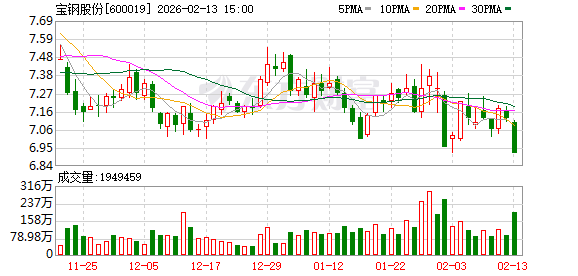
宝钢股份:公司每年出口到欧盟的产品约50万吨
Zheng Quan Ri Bao· 2026-02-13 09:40
Group 1 - The company exports approximately 500,000 tons of products to the European Union each year, including hot-rolled, cold-rolled, automotive sheets, tinplate, and silicon steel among various types [2]


【钢铁】有色金属价格普跌,但金、钨、钼、钒价格环比上涨——金属周期品高频数据周报(2026.2.2-2026.2.8)(王招华/戴默)
光大证券研究· 2026-02-09 23:06
Liquidity - The BCI small and medium enterprise financing environment index increased by 6.62% month-on-month to 50.27 in January 2026 [4] - The M1 and M2 growth rate difference was -4.7 percentage points in December 2025, a month-on-month decrease of 1.6 percentage points [4] - The current price of London gold is $4,967 per ounce [4] Infrastructure and Real Estate Chain - Weekly inventory of hot-rolled steel is at a low level compared to the same period over the past five years [5] - Price changes this week include rebar at -0.93%, cement price index at -0.28%, rubber at -2.45%, coke at 0.00%, coking coal at -1.28%, and iron ore at -3.99% [5] - National blast furnace capacity utilization rate, cement, and asphalt operating rates changed by +0.00 percentage points, -3.40 percentage points, and -1.3 percentage points respectively [5] Real Estate Completion Chain - Prices of titanium dioxide and glass are at low levels, with titanium dioxide price unchanged and glass price up by 0.28% [6] - The gross profit for titanium dioxide is -1,880 yuan per ton, while the flat glass operating rate is 73.89% this week [6] Industrial Products Chain - The operating rate of semi-steel tires is at a five-year high [7] - Major commodity price changes this week include cold-rolled steel at -0.53%, copper at -4.34%, and aluminum at -6.21%, with corresponding gross profit changes of turning losses into profits and a loss increase of 10.37% and 17.83% respectively [7] - The national semi-steel tire operating rate is 72.76%, a decrease of 2.08 percentage points [7] Subcategories - The price of oriented silicon steel has reached a new low since 2018 [8] - The price of graphite electrodes is 19,000 yuan per ton, unchanged, with a gross profit of 1,944.04 yuan per ton, up by 1.17% [8] - The price of electrolytic aluminum is 23,110 yuan per ton, down by 6.21%, with a calculated profit of 6,072 yuan per ton (excluding tax), down by 17.83% [8] - The price of electrolytic copper is 100,100 yuan per ton, down by 4.34% [8] - The price of tungsten concentrate is 674,500 yuan per ton, up by 11.49% from last week [8] Price Comparison Relationships - The price ratio of rebar to iron ore is 4.09 this week [10] - The price difference between hot-rolled and rebar steel is 60 yuan per ton this week [10] - The price difference between Shanghai cold-rolled steel and hot-rolled steel reached 370 yuan per ton, an increase of 10 yuan per ton [10] - The price ratio of stainless steel hot-rolled to electrolytic nickel is 0.10 [10] - The price difference between small rebar (mainly used in real estate) and large rebar (mainly used in infrastructure) is 180 yuan per ton this week, a decrease of 10.00% from last week [10] - The price difference between medium-thick plates and rebar steel is 110 yuan per ton this week [10] Export Chain - The new export orders PMI for China in January is 47.80%, a decrease of 1.2 percentage points month-on-month [11] - The China Containerized Freight Index (CCFI) composite index is 1,122.15 points this week, down by 4.55% [11] - The capacity utilization rate for crude steel in the U.S. is 76.00%, a decrease of 0.90 percentage points [11] - Starting January 1, 2026, the Ministry of Commerce and the General Administration of Customs will implement export licensing management for certain steel products, which is expected to further regulate China's steel product exports [11] Valuation Percentiles - The CSI 300 index decreased by 1.33% this week, with the best-performing cyclical sector being engineering machinery at +4.35% [12] - The PB ratio of ordinary steel and industrial metals relative to the PB ratio of the Shanghai and Shenzhen markets is currently 60.06% and 84.30% respectively [12] - The PB ratio of the ordinary steel sector relative to the Shanghai and Shenzhen markets is currently 0.50, with the highest value since 2013 being 0.82, reached in August 2017 [12]

【钢铁】热轧与螺纹价差处于5年同期低位水平——金属周期品高频数据周报(2026.1.26-2026.2.1)(王招华/戴默)
光大证券研究· 2026-02-04 23:06
Summary of Key Points Core Viewpoint - The report highlights the current trends in various sectors, including liquidity, infrastructure, real estate, industrial products, and export chains, indicating potential investment opportunities and market dynamics. Group 1: Liquidity and Financing Environment - SPDR Gold ETF holdings are at their highest level since June 2022 [4] - The BCI small and medium enterprise financing environment index for January 2026 is 50.27, up 6.62% month-on-month [4] - The M1 and M2 growth rate difference was -4.7 percentage points in December 2025, down 1.60 percentage points month-on-month [4] - Current London gold spot price is $4,880 per ounce [4] Group 2: Infrastructure and Real Estate Chain - January high furnace capacity utilization is expected to be at the highest level for the same period in five years [5] - Weekly price changes include rebar down 0.61%, cement price index down 1.10%, rubber up 4.49%, coke up 3.65%, coking coal down 0.64%, and iron ore up 0.50% [5] - National high furnace capacity utilization, cement, and asphalt operating rates decreased by 0.04 percentage points, 0.02 percentage points, and 0.7 percentage points respectively [5] Group 3: Real Estate Completion Chain - Titanium dioxide and glass prices are at low levels, with titanium dioxide price unchanged and glass price up 1.38% [6] - Titanium dioxide gross profit is -1,834 yuan per ton, while flat glass operating rate is 73.89% [6] Group 4: Industrial Products Chain - January national PMI new orders index is at 49.20% [7] - Major commodity price changes include cold-rolled steel unchanged, copper up 3.50%, and aluminum up 2.11%, with corresponding gross profit changes showing improvements [7] - National semi-steel tire operating rate is 74.84%, up 0.28 percentage points [7] Group 5: Subcategories - Orientation silicon steel prices have reached the lowest level since 2018 [8] - Graphite electrode price is 19,000 yuan per ton, unchanged, with a gross profit of 1,921.48 yuan per ton, down 4.00% [8] - Electrolytic aluminum price is 24,640 yuan per ton, up 2.11%, with estimated profit of 7,389 yuan per ton (excluding tax), up 6.91% [8] - Electrolytic copper price is 104,640 yuan per ton, up 3.50% [8] - Tungsten concentrate price is 605,000 yuan per ton, up 11.42% from last week [8] Group 6: Price Comparison Relationships - The price ratio of hot-rolled to rebar is at the lowest level for the same period in five years [9] - The price ratio of rebar to iron ore is 3.96 this week [10] - The price difference between hot-rolled and rebar steel is 50 yuan per ton [10] - The price difference between Shanghai cold-rolled and hot-rolled steel is 360 yuan per ton, up 30 yuan per ton [10] - The price difference between small rebar (mainly used in real estate) and large rebar (mainly used in infrastructure) is 200 yuan per ton, up 33.33% from last week [10] - The price difference between medium-thick plates and rebar is 50 yuan per ton [10] Group 7: Export Chain - January China PMI new export orders are at 47.80%, down 1.2 percentage points [11] - The China Containerized Freight Index (CCFI) composite index is 1,175.59 points this week, down 2.74% [11] - The U.S. crude steel capacity utilization rate is 76.90%, up 1.00 percentage points [11] - Starting January 1, 2026, China will implement export licensing management for certain steel products, which is expected to further regulate steel exports [11] Group 8: Valuation Percentiles - This week, the CSI 300 index increased by 0.08%, with the best-performing cyclical sector being oil and petrochemicals, up 7.95% [12] - The PB ratio of ordinary steel and industrial metals relative to the PB of the two markets is 32.46% and 100.00% respectively [12] - The PB ratio of the ordinary steel sector relative to the two markets is currently 0.52, with the highest value since 2013 being 0.82, reached in August 2017 [12]
【钢铁】M1 M2 增速差已连续三个月回落 ——金属周期品高频数据周报(2026.1.12-2026.1.18)(王招华/戴默)
光大证券研究· 2026-01-20 23:06
Liquidity - The negative difference in the growth rates of M1 and M2 has expanded for three consecutive months, reaching -4.7 percentage points in December 2025 [3] - The BCI small and medium enterprise financing environment index for December 2025 is 47.15, a month-on-month decrease of 10.19% [3] - The correlation between the M1 and M2 growth rate difference and the Shanghai Composite Index is strong, with the difference in December 2025 being -4.7 percentage points, a month-on-month decrease of 1.60% [3] Infrastructure and Real Estate Chain - In early January, the average daily crude steel output of key steel enterprises rebounded to levels seen in mid-October 2025 [3] - Price changes this week include rebar up by 1.22%, cement price index down by 0.94%, rubber down by 1.26%, coke unchanged, coking coal up by 1.23%, and iron ore down by 0.12% [3] - National blast furnace capacity utilization rate, cement, and asphalt operating rates changed by +0.04 percentage points, -1.92 percentage points, and +3.7 percentage points respectively [3] Real Estate Completion Chain - Prices of titanium dioxide and glass are at low levels, with titanium dioxide price unchanged and glass price down by 0.73% [4] - The gross profit for titanium dioxide is -1707 yuan/ton, while the flat glass operating rate is 73.89% this week [4] Industrial Products Chain - The operating rate of semi-steel tires is at the median level for the past five years, with a current rate of 73.44%, an increase of 7.55 percentage points [5] - Major commodity price changes this week include cold-rolled steel unchanged, copper up by 1.19%, and aluminum down by 0.25% [5] - Copper spot prices have reached a historical high, while tungsten concentrate prices have continued to reach new highs since 2012 [5] Price Comparison Relationships - The gold-silver price ratio in London has reached its lowest level since 2013 [6] - The price ratio of rebar to iron ore is 3.99 this week, with the price difference between hot-rolled and rebar steel at 30 yuan/ton [6] - The price difference between small rebar (mainly used in real estate) and large rebar (mainly used in infrastructure) reached 200 yuan/ton, an increase of 31.03% from last week [6] Export Chain - In December, China's PMI new export orders stood at 49.00%, an increase of 1.4 percentage points month-on-month [7] - The China Containerized Freight Index (CCFI) composite index this week is 1209.85 points, up by 1.25% [7] - The Ministry of Commerce and the General Administration of Customs announced that starting January 1, 2026, export licensing management will be implemented for certain steel products, which is expected to further regulate China's steel product exports [7] Valuation Percentiles - The CSI 300 Index decreased by 0.57% this week, with the best-performing cyclical sector being industrial metals, which increased by 2.81% [8] - The PB ratio of ordinary steel and industrial metals relative to the PB ratio of the Shanghai and Shenzhen markets is 28.96% and 100.00% respectively [8] - The current PB ratio of the ordinary steel sector relative to the Shanghai and Shenzhen markets is 0.50, with the highest value since 2013 being 0.82, reached in August 2017 [8]

钢矿周报:市场情绪反复,盘面延续震荡走势-20260118
Hua Lian Qi Huo· 2026-01-18 14:29
1. Report Industry Investment Rating - No relevant information provided. 2. Core Viewpoints of the Report 2.1. Steel (Rebar) - Inventory: The latest inventory of the five major steel products decreased slightly week - on - week. Rebar inventory decreased slightly, while wire rod inventory increased slightly. Under the influence of the off - season, the pressure of inventory accumulation increased [7]. - Supply: Affected by environmental protection in the north, the hot metal output of blast furnace steel mills decreased slightly. However, with the recovery of steel profits, steel mills are willing to resume production, and there is room for an increase in steel supply [7]. - Demand: The total apparent demand of the five major steel products rebounded week - on - week. Although the expectation of a decline in steel demand remains unchanged, the weakening pace is slow, and demand has a certain degree of resilience [7]. - View: Recently, the pace of steel mill resumption has been erratic, and rebar production has been relatively stable. However, with acceptable profitability of steel mills and low inventory levels, there is room for a marginal increase in supply. As the off - season deepens, demand gradually weakens, and the pressure of inventory accumulation increases. The industrial supply - demand contradiction will gradually accumulate. Currently, the expectation of increasing supply and weakening demand in the steel market exerts pressure, but in the short term, steel prices show a range - bound trend due to macro expectations and cost support [7]. - Strategy: The 2605 contract is expected to fluctuate in the range of 3100 - 3200 [7]. 2.2. Iron Ore - Supply: In the latest period (January 5 - January 11, 2026), the global iron ore shipment volume decreased, while the arrival volume in China increased. The total global iron ore shipment volume was 31.809 million tons, a week - on - week decrease of 32,800 tons. The total shipment volume from 19 ports in Australia and Brazil was 25.332 million tons, a week - on - week decrease of 1.333 million tons. Australia's shipment volume was 18.689 million tons, a week - on - week decrease of 5100 tons, and Brazil's shipment volume was 6.643 million tons, a week - on - week decrease of 1.282 million tons. The arrival volume at 47 ports in China was 30.15 million tons, a week - on - week increase of 1.903 million tons; the arrival volume at 45 ports was 29.204 million tons, a week - on - week increase of 1.64 million tons; the arrival volume at six northern ports was 14.692 million tons, a week - on - week decrease of 437,000 tons [9]. - Demand: As of January 16, 2026, the blast furnace operating rate of 247 steel mills was 78.84%, a week - on - week decrease of 0.47 percentage points; the blast furnace iron - making capacity utilization rate was 85.48%, a week - on - week decrease of 0.56 percentage points; the steel mill profitability rate was 39.83%, a week - on - week increase of 2.17 percentage points; the daily average hot metal output was 2.2801 million tons, a week - on - week decrease of 14,900 tons. Affected by environmental protection, the blast furnace operating rate of steel mills decreased slightly, and the hot metal output decreased slightly week - on - week [9]. - Inventory: As of January 16, 2026, the total inventory of imported iron ore at 47 ports in China was 172.887 million tons, a week - on - week increase of 2.4426 million tons; the daily average port clearance volume was 3.3502 million tons, a decrease of 19,400 tons. The total inventory of imported iron ore in national steel mills was 92.6222 million tons, a week - on - week increase of 2.7263 million tons; the daily consumption of imported ore by the current sample steel mills was 2.8184 million tons, a week - on - week decrease of 14,300 tons; the inventory - to - consumption ratio was 32.86 days, a week - on - week increase of 1.13 days. The iron ore port inventory continued to reach a new high, and the steel mill inventory increased week - on - week [9]. - View: In terms of the industry, overseas iron ore shipments continued to decline, and the expectation of tightened overseas shipments under the influence of seasonal factors was strong. The arrival volume in China remained at a high level, and the port inventory continued to reach a new high. On the demand side, in the short term, affected by environmental protection, the steel mill hot metal output decreased slightly again, but the steel mill profitability was acceptable, and the hot metal output still increased year - on - year. Overall, the supply - demand pattern of iron ore is relatively loose, but the expectation of supply - demand improvement provides certain support for ore prices [9]. - Strategy: The iron ore 2605 contract is expected to operate in the range of 800 - 850 [9]. 3. Summary by Relevant Catalogs 3.1. Weekly Supply and Demand Data of Steel - Supply: The blast furnace operating rate of 247 steel mills was 78.84%, a week - on - week decrease of 0.47 percentage points; the capacity utilization rate was 85.48%, a week - on - week decrease of 0.56 percentage points; the profitability rate was 39.83%, a week - on - week increase of 2.17 percentage points; the daily average hot metal output was 228.01 tons, a week - on - week decrease of 1.49 tons. The operating rate of 94 independent electric furnaces was 72.97%, with no week - on - week change; the capacity utilization rate was 57.99%, a week - on - week increase of 1.09 percentage points; the scrap consumption was 244.24 tons, a week - on - week decrease of 3.06 tons. The total output of the five major steel products was 819.21 tons, a week - on - week increase of 0.62 tons [10]. - Demand: The average daily trading volume of traders (MA5) was 8.84 tons, a week - on - week decrease of 1.04 tons; the procurement volume of wire rods and rebars in Shanghai was 17,850 tons, a week - on - week decrease of 4650 tons; the apparent demand for rebar was 190.34 tons, a week - on - week increase of 14.44 tons; the apparent demand for hot - rolled coils was 314.16 tons, a week - on - week increase of 5.55 tons; the apparent demand for wire rods was 71.54 tons, a week - on - week increase of 4.90 tons; the apparent demand for cold - rolled coils was 91.93 tons, a week - on - week increase of 3.09 tons; the apparent demand for medium - thick plates was 158.15 tons, a week - on - week decrease of 0.47 tons [10]. - Inventory: The total inventory of the five major steel products was 1247.01 tons, a week - on - week decrease of 6.91 tons; the rebar inventory was 438.07 tons, a week - on - week decrease of 0.04 tons; the hot - rolled coil inventory was 362.33 tons, a week - on - week decrease of 5.80 tons; the wire rod inventory was 91.76 tons, a week - on - week increase of 1.95 tons; the cold - rolled coil inventory was 158.49 tons, a week - on - week decrease of 3.26 tons; the medium - thick plate inventory was 196.36 tons, a week - on - week increase of 0.24 tons [10]. 3.2. Weekly Supply and Demand Data of Iron Ore - Shipment Volume: The global iron ore shipment volume was 31.809 million tons, a week - on - week decrease of 32,800 tons; the shipment volume from 19 ports in Australia was 18.689 million tons, a week - on - week decrease of 5100 tons; the shipment volume from 19 ports in Brazil was 6.643 million tons, a week - on - week decrease of 1.282 million tons [11]. - Arrival Volume: The arrival volume at 45 ports in China was 29.204 million tons, a week - on - week increase of 1.64 million tons; the arrival volume at six northern ports was 14.692 million tons, a week - on - week decrease of 437,000 tons [11]. - Inventory: The inventory at 47 ports was 172.887 million tons, a week - on - week increase of 2.4426 million tons; the inventory of 247 steel mills was 92.6222 million tons, a week - on - week increase of 2.7263 million tons [11]. - Demand: The port clearance volume at 47 ports was 3.3502 million tons, a week - on - week decrease of 19,400 tons; the daily consumption of steel mills was 2.8184 million tons, a week - on - week decrease of 14,300 tons [11]. 3.3. Futures - Spot Market - As of January 16, 2026, the closing price of the RB2605 contract was 3163 yuan/ton; the closing price of the HC2605 contract was 3315 yuan/ton; the closing price of the I2605 contract was 812 yuan/ton. The basis of Shanghai rebar's main contract was 137 yuan/ton; the basis of Shanghai hot - rolled coil's main contract was - 15 yuan/ton. The spot screw - coil spread in Shanghai was 0 yuan/ton, and the screw - coil spread of the main contract was - 152 yuan/ton [21]. 3.4. Demand Side - The report mainly presents the apparent consumption volume of various types of steel products (such as rebar, hot - rolled coils, wire rods, cold - rolled coils, medium - thick plates), trading volume, procurement volume, cement outbound volume, and concrete production capacity utilization rate through charts, but no specific numerical analysis is provided in the text [57][63][65]. 3.5. Inventory Side - The report mainly shows the inventory of various types of steel products (such as rebar, hot - rolled coils, wire rods, cold - rolled coils, medium - thick plates) and the inventory - to - sales ratio through charts, but no specific numerical analysis is provided in the text [78][89][98]. 3.6. Supply Side - Steel Production: The report shows the production volume of various types of steel products (such as rebar, hot - rolled coils, medium - thick plates, wire rods, cold - rolled coils) and the total production volume of the five major steel products through charts, but no specific numerical analysis is provided in the text [109][114][116]. - Steel Mill Operation: The report shows the operating rate and capacity utilization rate of 247 blast furnace steel mills and independent electric furnace steel mills through charts, but no specific numerical analysis is provided in the text [123]. - Hot Metal and Scrap: The report shows the hot metal production volume and scrap consumption through charts, but no specific numerical analysis is provided in the text [125]. - Steel Mill Profit: The report shows the steel mill profitability rate and steel profit through charts, but no specific numerical analysis is provided in the text [130]. 3.7. Raw Material - Iron Ore - Global Shipment: From January 5 - January 11, 2026, the total global iron ore shipment volume was 31.809 million tons, a week - on - week decrease of 32,800 tons [136]. - Australia - Brazil Shipment: The total iron ore shipment volume from 19 ports in Australia and Brazil was 25.332 million tons, a week - on - week decrease of 1.333 million tons. Australia's shipment volume was 18.689 million tons, a week - on - week decrease of 5100 tons, and the volume shipped from Australia to China was 15.933 million tons, a week - on - week increase of 395,000 tons. Brazil's shipment volume was 6.643 million tons, a week - on - week decrease of 1.282 million tons [140]. - Arrival Volume: From January 5 - January 11, 2026, the arrival volume at 47 ports in China was 30.15 million tons, a week - on - week increase of 1.903 million tons; the arrival volume at 45 ports was 29.204 million tons, a week - on - week increase of 1.64 million tons; the arrival volume at six northern ports was 14.692 million tons, a week - on - week decrease of 437,000 tons [153]. - Port Inventory: As of January 16, 2026, the total inventory of imported iron ore at 47 ports in China was 172.887 million tons, a week - on - week increase of 2.4426 million tons; the daily average port clearance volume was 3.3502 million tons, a decrease of 19,400 tons. In terms of components, the Australian ore inventory was 75.8221 million tons, an increase of 1.5887 million tons; the Brazilian ore inventory was 61.6914 million tons, an increase of 612,400 tons; the trading ore inventory was 113.5285 million tons, an increase of 1.8404 million tons; the coarse powder inventory was 131.6586 million tons, an increase of 923,600 tons; the lump ore inventory was 21.6713 million tons, an increase of 387,500 tons; the iron concentrate powder inventory was 15.5271 million tons, an increase of 699,400 tons; the pellet inventory was 4.03 million tons, an increase of 432,100 tons [157][161]. - Steel Mill Inventory: The total inventory of imported iron ore in national steel mills was 92.6222 million tons, a week - on - week increase of 2.7263 million tons; the daily consumption of imported ore by the current sample steel mills was 2.8184 million tons, a week - on - week decrease of 14,300 tons; the inventory - to - consumption ratio was 32.86 days, a week - on - week increase of 1.13 days [173].
债市基本面高频数据跟踪:2026年1月第2周:水泥价格再创新低
SINOLINK SECURITIES· 2026-01-14 15:18
Group 1: Economic Growth Production - Power plant daily consumption is higher than the same period last year. On January 13, the average daily consumption of 6 major power generation groups was 826,000 tons, a 2.7% decrease from January 6. On January 6, the daily consumption of power plants in eight southern provinces was 2.278 million tons, a 9.6% increase from December 30 [5][12]. - The blast furnace operating rate has generally recovered moderately. On January 9, the national blast furnace operating rate was 79.3%, a 0.4 - percentage - point increase from January 2; the capacity utilization rate was 86.1%, a 0.8 - percentage - point increase from January 2. However, the blast furnace operating rate of Tangshan steel mills decreased by 3.7 percentage points [5][16]. - The tire operating rate has declined for two consecutive weeks. On January 8, the operating rate of all - steel truck tires was 58.0%, a 0.1 - percentage - point decrease from January 1; the operating rate of semi - steel car tires was 65.9%, a 2.4 - percentage - point decrease from January 1 [5][18]. - The operating rate of looms in the Jiangsu and Zhejiang regions has continued to decline. On January 8, the operating rate of polyester filament in the Jiangsu and Zhejiang regions was 90.5%, a 0.4 - percentage - point increase from January 1, while the operating rate of downstream looms was 57.9%, a 1.7 - percentage - point decrease from January 8 [5][18]. Demand - The sales volume of new homes in 30 cities has weakened month - on - month. From January 1 - 13, the average daily sales area of commercial housing in 30 large and medium - sized cities was 152,000 square meters, a 44.9% decrease from the same period in December, a 41.8% decrease from January of last year, and a 40.8% decrease from January 2024 [5][23]. - The retail growth of the auto market is weak. In January, retail sales decreased by 32% year - on - year, and wholesale sales decreased by 40% year - on - year [5][26]. - Steel prices are oscillating strongly. On January 13, the prices of rebar, wire rod, hot - rolled coil, and cold - rolled coil changed by +0.6%, +1.3%, - 0.3%, and +0.1% respectively compared to January 6 [5][33]. - Cement prices have hit a new low. On January 13, the national cement price index decreased by 1.1% compared to January 6. The cement prices in the East China and Yangtze River regions decreased by 0.5% and 0.6% respectively, performing slightly better than the national average [5][34]. - The rebound strength of glass prices has increased. On January 13, the active futures contract price of glass was 1,119 yuan/ton, an 0.8% increase from January 6 [5][39]. - The container shipping freight rate index has shown a pattern of short - term decline and long - term increase. On January 9, the CCFI index increased by 4.2% compared to December 26, while the SCFI index decreased by 0.5% [5][43]. Group 2: Inflation CPI - The rebound strength of pork prices is weakening. On January 13, the average wholesale price of pork was 18.0 yuan/kg, a 0.3% increase from January 6. Since January, the average wholesale price of pork has increased by 2.0% month - on - month [5][47]. - The agricultural product price index has declined moderately. On January 13, the agricultural product wholesale price index decreased by 0.9% compared to January 6. Since January, the index has increased by 4.0% year - on - year but decreased by 0.6% month - on - month [5][52]. PPI - Oil prices have reached the highest level since October. On January 13, the spot prices of Brent and WTI crude oil were 68.8 and 61.2 dollars/barrel respectively, an 8.4% and 7.0% increase from January 6 [5][55]. - Copper and aluminum prices have continued to rise. On January 13, the prices of LME 3 - month copper and aluminum increased by 0.1% and 2.3% respectively compared to January 6. Since January, the prices of LME 3 - month copper and aluminum have increased by 10.4% and 7.0% month - on - month respectively [5][59]. - The domestic commodity index has changed from a decline to an increase month - on - month. On January 13, the Nanhua Industrial Products Index increased by 1.2% compared to January 6, while the CRB index decreased by 1.5% [5][59].