钢材出口

Search documents
《黑色》日报-20260311
Guang Fa Qi Huo· 2026-03-11 01:41
1. Report Industry Investment Ratings - No information about industry investment ratings is provided in the reports. 2. Core Views Steel Industry - Crude oil and coking coal prices have fallen, causing steel prices to rise and then fall. Steel mill production remains stable, inventory is seasonally decreasing, and apparent demand is rising. It is necessary to focus on the height of the rebound in apparent demand. The government work report of the Two Sessions is basically in line with expectations, and the domestic demand expectation does not fluctuate much. The main focus is on the marginal changes in steel exports. Since the US - Iran conflict, steel exports have declined due to shipping disruptions. It is judged that steel prices will fluctuate within a range, with attention paid to the pressure levels of around 3150 yuan/ton for rebar and 3300 yuan/ton for hot - rolled coils [1]. Iron Ore Industry - The main iron ore contract oscillated upward yesterday. Affected by the escalation of geopolitical conflicts, the iron ore market fluctuated more violently. In the short term, positive factors for iron ore are dominant, and geopolitical conflicts will further intensify market fluctuations. In terms of fundamentals, the global iron ore shipment volume decreased this period, and the decline in Brazil and non - mainstream regions was significant. On the demand side, hot - rolled coil inventory pressure is prominent. In the short term, iron ore prices will be boosted by geopolitical impacts and the unresolved BHP negotiation, and prices may fluctuate strongly. It is recommended to observe in the short term [4]. Coke and Coking Coal Industry - Yesterday, coke and coking coal futures both showed a downward trend from high levels. For coke, the first round of price cuts by mainstream steel mills was successfully implemented on March 6 and is expected to stabilize. The supply - demand situation is basically balanced in the short term. For coking coal, the price of coke was cut by mainstream steel mills on March 4 to reduce costs, and it is expected that the coke price will stabilize. In terms of strategies, it is recommended to view both coke and coking coal as oscillating, with a reference range of 1650 - 1850 for coke and 1100 - 1250 for coking coal, and to consider an arbitrage strategy of going long on coking coal and short on coke [7]. Silicon Iron and Silicon Manganese Industry - Yesterday, the silicon iron main contract fell sharply, and the silicon manganese main contract opened low and then recovered losses, both affected by geopolitical conflicts. For silicon iron, supply decreased slightly last week, with output cuts in Inner Mongolia and Ningxia and increases in Qinghai and Gansu. For silicon manganese, supply decreased slightly, and the output absolute value is at a relatively low level in the same period of history. In terms of demand, iron - making water output decreased significantly during the Two Sessions but is expected to rise with the recovery of terminal demand. In the short term, steel exports to the Middle East will be blocked, but there may be an export substitution effect in the long term. It is recommended to observe the market and operate cautiously [8]. 3. Summary by Directory Steel Industry Steel Prices and Spreads - Rebar spot prices in different regions (East China, North China, South China) and futures contract prices (05, 10, 01) showed different degrees of changes, with some prices remaining stable and some falling. Hot - rolled coil spot and futures prices also decreased to varying degrees [1]. Cost and Profit - Steel billet prices remained unchanged, and the costs and profits of different steel products in different regions (such as Jiangsu electric - furnace rebar cost, East China hot - rolled coil profit) changed. For example, the East China hot - rolled coil profit increased by 30, and the North China hot - rolled coil profit increased by 40 [1]. Production - The total output of five major steel products increased slightly by 0.1%, with an increase in electric - furnace output by 349.6% and a decrease in converter output by 0.5%. The hot - rolled coil output decreased by 2.7% [1]. Inventory - The inventory of five major steel products increased by 5.7%, the rebar inventory increased by 9.4%, and the hot - rolled coil inventory increased by 4.3% [1]. Transaction and Demand - The building materials trading volume decreased by 27.7%, while the apparent demand for five major steel products increased by 22.4%, the apparent demand for rebar increased by 192.8%, and the apparent demand for hot - rolled coils increased by 4.9% [1]. Iron - making Water Output - The daily average iron - making water output decreased by 2.4% [1]. Iron Ore Industry Iron Ore - related Prices and Spreads - The warehouse - receipt costs of different iron ore varieties (such as Carajás fines, PB fines) and the basis of 05 contracts showed different degrees of changes. The 5 - 9 spread and 9 - 1 spread also increased [4]. Spot Prices and Price Indexes - The spot prices of some iron ore varieties at Rizhao Port remained stable, while the price of Brazilian mixed fines increased by 0.4%. The Singapore Exchange 62% Fe swap price increased by 1.0% [4]. Supply - The 45 - port arrival volume increased by 21.6%, the global shipment volume decreased by 13.3%, and the national monthly import volume decreased by 18.4% [4]. Demand - The daily average iron - making water output of 247 steel mills decreased by 2.4%, the 45 - port daily average ore - evacuation volume increased by 4.2%, the national monthly pig iron output decreased by 2.6%, and the national monthly crude steel output decreased by 2.4% [4]. Inventory Changes - The 45 - port inventory increased by 0.2%, the imported ore inventory of 247 steel mills decreased by 0.8%, and the inventory - available days of 64 steel mills remained unchanged [4]. Coke and Coking Coal Industry Coke - related Prices and Spreads - The prices of different coke varieties (such as Shanxi first - grade wet - quenched coke, Rizhao Port quasi - first - grade wet - quenched coke) and futures contracts (05, 09) decreased to varying degrees. The coking profit increased by 24 [7]. Upstream Coking Coal Prices and Spreads - The price of coking coal (Shanxi warehouse - receipt) remained stable, while the price of coking coal (Mongolian coal warehouse - receipt) decreased by 3.9% [7]. Supply - The daily average output of all - sample coking plants decreased by 0.5%, and the daily average output of 247 steel mills decreased by 0.2%. The output of raw coal and clean coal in Fenwei sample coal mines increased [7]. Demand - The iron - making water output of 247 steel mills decreased by 2.4% [7]. Inventory Changes - The total coke inventory increased by 0.5%, the coke inventory of all - sample coking plants increased by 2.3%, the coke inventory of 247 steel mills decreased by 0.6%, and the port inventory increased by 3.0%. The coking coal inventory of Fenwei coal mines increased, while the coking coal inventory of all - sample coking plants, 247 steel mills, and ports decreased [7]. Supply - Demand Gap Changes - The coke supply - demand gap increased from - 1.6 to 0.7, an increase of 2.3 [7]. Silicon Iron and Silicon Manganese Industry Futures and Spot - The silicon iron main contract price increased slightly, and the silicon manganese main contract price decreased. The spot prices of silicon iron and silicon manganese in different regions decreased to varying degrees [8]. Cost and Profit - The production costs of silicon iron and silicon manganese in different regions changed slightly, and the production profits decreased significantly. For example, the production profit of silicon iron in Inner Mongolia decreased from 200 to 30, a decrease of 85.0% [8]. Supply - The manganese ore shipment volume increased by 57.6%, the arrival volume increased by 1.8%, and the port inventory decreased by 4.6%. The silicon iron output decreased by 2.1%, and the production enterprise's start - up rate decreased by 6.3% [8]. Demand - The silicon iron demand remained unchanged, the 247 - steel - mill daily average iron - making water output decreased by 2.4%, the blast - furnace start - up rate decreased by 3.1%, the output of five major steel products increased by 0.1%, and the silicon manganese demand increased by 0.9% [8]. Inventory Changes - The silicon iron inventory of 60 sample enterprises decreased by 5.9%, and the silicon manganese inventory of 63 sample enterprises decreased by 2.8% [8].
钢材:短期震荡偏强,关注宏观情绪
Ning Zheng Qi Huo· 2026-03-09 10:00
1. Report Industry Investment Rating - Not provided 2. Core Viewpoints of the Report - This week, the steel market prices remained stable overall. On the supply side, although the output of rebar increased slightly week - on - week, it was still at the lowest level in the same period of the past five years, with limited supply pressure. On the demand side, with the resumption of work after the holiday, the apparent consumption increased significantly, but the absolute level was still low. The inventory was accumulating, but the growth rate slowed down, and the year - on - year increase was only 3%, so the overall inventory pressure was still within the controllable range. During the Two Sessions this week, the window period of macro - positive factors and geopolitical risks supported the prices of finished products. Although the post - holiday demand had some resilience, it was difficult to have a remarkable performance. There was still room for the resumption of production of blast furnaces and electric furnaces in the later stage. It was expected that the demand recovery speed would be slower than the supply recovery speed, and inventory pressure would still exist. With limited fundamental support, there was still pressure for a high - level correction after the futures market rally [1]. 3. Summary According to Relevant Catalogs Market Review and Outlook - The steel market prices were stable this week. Rebar output increased week - on - week but was at a five - year low in the same period. Demand recovered after the holiday but remained at a low absolute level. Inventory was growing but at a slower pace, with a 3% year - on - year increase. During the Two Sessions, macro - positive factors and geopolitical risks supported prices. Demand was resilient but not outstanding, and there was room for production resumption. Demand recovery was expected to be slower than supply, and inventory pressure would persist. The futures market might face a high - level correction [1]. Fundamental Data Weekly Changes - The average daily hot metal output of steel mills was 227.59 million tons, a decrease of 5.69 million tons (-2.44%) from the previous week. Rebar mill inventory was 237.93 million tons, an increase of 5.09 million tons (2.19%). Rebar social inventory was 637.75 million tons, an increase of 69.99 million tons (12.33%). Hot - rolled coil mill inventory was 90.08 million tons, a decrease of 4.7 million tons (-4.96%). Hot - rolled coil social inventory was 381.61 million tons, an increase of 24.24 million tons (6.78%) [3]. Futures Market Review - The report includes graphs such as the 5 - day intraday chart of rebar and hot - rolled coil main contracts, rebar 05 - 10 spread, hot - rolled coil 05 - 10 spread, futures market coil - rebar spread, and speculation degree (trading volume/position) [4][5][10]. Spot Market Review - The report includes graphs such as the rebar price in East China (Shanghai), the hot - rolled 4.75 spot price (Shanghai), rebar basis, and hot - rolled coil basis [14][15]. Fundamental Data - The report includes graphs such as the average daily hot metal output of 247 steel mills, rebar blast furnace profit, rebar supply - demand trend, hot - rolled coil supply - demand trend, rebar mill inventory seasonal analysis, rebar social inventory seasonal analysis, hot - rolled coil mill inventory seasonal analysis, and hot - rolled coil social inventory seasonal analysis [17][22][24].
2025年我国出口钢材1.19亿吨 同比增长7.5%
Xin Hua Cai Jing· 2026-01-30 01:53
Group 1 - The core viewpoint is that China's steel exports are projected to reach 119 million tons by 2025, representing a year-on-year growth of 7.5% [1] - The average export price is expected to be $694 per ton, which indicates a year-on-year decline of 8.1% [1] - The total export value is forecasted to be $82.6 billion, reflecting a year-on-year decrease of 1.3% [1]
2025年钢铁出口究竟怎么个事?
Xin Lang Cai Jing· 2026-01-21 05:36
Core Viewpoint - Since 2025, both direct and indirect steel exports have experienced disturbances, but the overall upward trend remains intact. With new changes in export licenses expected in 2026, a slight decline in steel export volumes at high levels is probable [14][25]. Direct Exports: Volume Increase, Price Decrease - In 2025, China exported 119.02 million tons of steel, a year-on-year increase of 7.5%. The characteristics of "volume increase, price decrease" are evident, with a weak domestic real estate market and significant supply-demand contradictions in the steel market. Raw material prices remain low, allowing steel prices to stay relatively low, with hot-rolled coil export prices being $130/ton lower than the EU and $150/ton lower than the US. Emerging markets such as Southeast Asia, Africa, and Belt and Road countries show strong demand for steel imports due to robust infrastructure investments [15][21]. - The continuous increase in exports has also heightened trade frictions, with anti-dumping measures intensifying from countries like the US, EU, Vietnam, and Mexico. Notably, semi-finished steel products like billets have lower or zero tariffs in many countries, leading to a 300.3% year-on-year surge in billet exports as some companies shift to avoid trade barriers [15][21]. Indirect Exports: Historical High - In 2025, China's total goods trade reached 45.47 trillion yuan, a 3.8% year-on-year increase, with exports amounting to 26.99 trillion yuan (up 6.1%). The export of electromechanical products, which are major steel-consuming products, accounted for over 70% of export growth, with significant increases in integrated circuits, automobiles, and ships, all exceeding 20% year-on-year [18][19]. - The indirect steel export volume is estimated at approximately 14.73 million tons, reflecting an 8.3% year-on-year growth, indicating a strong correlation between electromechanical exports and steel indirect exports [19][21]. Overall Impact of Steel Exports: Alleviating Domestic Market Pressure - The cumulative steel export volume in 2025 is around 26.63 million tons, a 7.94% increase, contributing significantly to the domestic steel market's stability. Direct exports account for 45%, while indirect exports make up 55%. However, the combination of low-priced direct steel exports and indirect exports of finished products has limited global steel mill profit margins, with over 150 new anti-dumping and countervailing investigations initiated against Chinese steel products in 2025 [21][22]. Export License System: Optimizing Steel Export Structure - The steel export license system will be officially implemented on January 1, 2026, covering 300 customs codes for steel products. Despite a record high in steel export volume in 2025, the average price fell by over 10%. The license system aims to eliminate "buying export" practices that distort competition and cause tax revenue loss. This transition marks a strategic shift from "scale expansion" to "value enhancement" in China's steel exports, with short-term costs increasing but long-term goals focused on optimizing structure and enhancing industry profitability [24][25]. 2026 Steel Export Outlook - For 2026, a slight decline in steel export volumes is anticipated, although export prices may rise. The export license system will hinder low-value products while mid-to-high value products are expected to maintain high growth rates due to diversified export distribution and a recovering global economy [25].


《黑色》日报-20260115
Guang Fa Qi Huo· 2026-01-15 01:58
1. Report Industry Investment Ratings - No industry investment ratings are provided in the reports. 2. Core Views Steel Industry - Steel exports are expected to remain high due to low valuations and some export - grabbing factors. Before the Spring Festival, the domestic market is weak, and prices have fully priced in weak demand. The overall steel market is expected to fluctuate within a range in January. The reference range for the May contract of rebar is 3050 - 3250 yuan; for hot - rolled coils, it is 3200 - 3350 yuan [1]. Iron Ore Industry - The iron ore market will gradually transition to a situation of weak supply and demand. Prices are expected to remain high and volatile, with high inventory suppressing the upside and steel mill restocking expectations and molten iron production recovery providing support. Short - term prices are expected to fluctuate widely, and the trading strategy is range - bound operation, with a reference range of 770 - 830 [4]. Coke and Coking Coal Industry - For coke, the futures market has fallen in advance, and the spot price decline depends on the coking coal price drop. After the fourth round of spot price cuts, some coke enterprises resist price cuts and limit production to protect prices. The recommended strategy is to go long on the dips and consider the arbitrage of long coking coal and short coke. For coking coal, the pre - Spring Festival restocking demand drives the market. The strategy is also to go long on the dips and consider the same arbitrage [6]. Ferrosilicon and Ferromanganese Industry - For ferrosilicon, supply is stable, and production has reached a historically low level. Demand has some support, and costs also provide support. It is recommended to go long on the dips, with a reference support level of around 5500. For ferromanganese, the supply is at a historically neutral - low level, and demand has support. Manganese ore prices support the ferromanganese price. It is recommended to go long on the dips, with a reference support level of around 5800 [7]. 3. Summary by Directory Steel Industry Prices and Spreads - Rebar and hot - rolled coil spot and futures prices show different changes. For example, rebar 01 contract increased by 10 yuan, while hot - rolled coil 01 contract decreased by 49 yuan [1]. Cost and Profit - Steel billet and slab prices remained unchanged. The cost of steelmaking in Jiangsu increased, and the profit of hot - rolled coils in different regions decreased [1]. Supply - The daily average molten iron output increased by 1.6 to 229.0, a 0.7% increase. The output of five major steel products increased by 3.4 to 818.6, a 0.4% increase [1]. Demand - The total apparent demand of steel has recovered. The export of steel remains high [1]. Inventory - The inventory of five major steel products increased by 21.8 to 1253.9, a 1.8% increase. Rebar inventory increased, while hot - rolled coil inventory decreased [1]. Iron Ore Industry Prices and Spreads - The basis of some iron ore varieties decreased, and the 5 - 9 and 1 - 5 spreads increased [4]. Supply - The 45 - port arrival volume increased by 164.0 to 2920.4, a 5.9% increase, while the global shipment volume decreased by 32.8 to 3213.7, a 1.0% decrease [4]. Demand - The daily average molten iron output of 247 steel mills increased by 2.1 to 229.5, a 0.9% increase. The 45 - port daily average ore - unloading volume decreased by 1.9 to 323.3, a 0.6% decrease [4]. Inventory - The 45 - port inventory increased by 304.4 to 16275.26, a 1.9% increase, and the inventory of 247 steel mills' imported ore increased by 43.0 to 8989.6, a 0.5% increase [4]. Coke and Coking Coal Industry Prices and Spreads - Coke and coking coal futures prices changed slightly. For example, the coke 05 contract decreased by 7 yuan, and the coking coal 05 contract increased by 6 yuan [6]. Supply - Coke production increased slightly, and coking coal production showed a small - scale recovery [6]. Demand - The molten iron output of 247 steel mills increased, and the demand for coke and coking coal increased [6]. Inventory - The overall inventory of coke and coking coal increased slightly, with different inventory changes in different sectors [6]. Ferrosilicon and Ferromanganese Industry Prices and Spreads - Ferrosilicon and ferromanganese futures prices were relatively stable. The prices of some spot products remained unchanged [7]. Cost and Profit - The production cost of ferrosilicon in some regions increased slightly, and the production profit decreased [7]. Supply - Ferrosilicon production was basically flat, and ferromanganese production decreased slightly [7]. Demand - The demand for ferrosilicon and ferromanganese from the steelmaking industry had some support due to the recovery of molten iron production [7]. Inventory - The inventory of ferrosilicon in 60 sample enterprises increased, and the inventory of 63 sample enterprises of ferromanganese decreased [7].
螺纹热卷日报-20260106
Yin He Qi Huo· 2026-01-06 12:51
Group 1: Market Information 1.1 Futures Information 1.1.1 Thread Futures - RB05: Yesterday's price was 3104 yuan/ton, today's is 3111 yuan/ton, up 7 yuan/ton [2] - RB10: Yesterday's price was 3146 yuan/ton, today's is 3156 yuan/ton, up 10 yuan/ton [2] - RB01: Yesterday's price was 3088 yuan/ton, today's is 3082 yuan/ton, down 6 yuan/ton [2] 1.1.2 Hot Roll Futures - HC05: Yesterday's price was 3248 yuan/ton, today's is 3263 yuan/ton, up 15 yuan/ton [2] - HC10: Yesterday's price was 3271 yuan/ton, today's is 3282 yuan/ton, up 11 yuan/ton [2] - HC01: Yesterday's price was 3220 yuan/ton, today's is 3240 yuan/ton, up 20 yuan/ton [2] 1.2 Spot Information 1.2.1 Thread Spot - Shanghai Zhongtian: Today's price is 3250 yuan/ton, down 10 yuan/ton from yesterday [2] - Nanjing Xicheng: Today's price is 3400 yuan/ton, down 10 yuan/ton from yesterday [2] - Shandong Shiheng: Today's price is 3240 yuan/ton, unchanged from yesterday [2] - Tangshan Tanggang: Today's price is 3100 yuan/ton, unchanged from yesterday [2] 1.2.2 Hot Roll Spot - Tianjin Hegang Hot Roll: Today's price is 3160 yuan/ton, down 10 yuan/ton from yesterday [2] - Lecong Rigang Hot Roll: Today's price is 3240 yuan/ton, down 10 yuan/ton from yesterday [2] - Shanghai Angang Hot Roll: Today's price is 3240 yuan/ton, down 10 yuan/ton from yesterday [2] 1.3 Spread and Profit Information 1.3.1 Thread - 05 contract thread basis: The cheapest delivery product is 79 yuan/ton [2] - 10 contract thread basis: The cheapest delivery product is 34 yuan/ton [2] - 01 contract thread basis: The cheapest delivery product is 108 yuan/ton [2] - 05 contract thread surface profit: -147 yuan/ton, down 2 yuan/ton from yesterday [2] - 10 contract thread surface profit: -103 yuan/ton, down 2 yuan/ton from yesterday [2] - 01 contract thread surface profit: -116 yuan/ton, down 19 yuan/ton from yesterday [2] 1.3.2 Hot Roll - 05 contract hot roll basis: The cheapest delivery product is -23 yuan/ton [2] - 10 contract hot roll basis: The cheapest delivery product is -42 yuan/ton [2] - 01 contract hot roll basis: The cheapest delivery product is 0 yuan/ton [2] - 05 contract hot roll surface profit: 5 yuan/ton, up 6 yuan/ton from yesterday [2] - 10 contract hot roll surface profit: 23 yuan/ton, down 1 yuan/ton from yesterday [2] - 01 contract hot roll surface profit: 42 yuan/ton, up 7 yuan/ton from yesterday [2] Group 2: Market Analysis 2.1 Core View - Today, the steel futures market oscillated in the morning and rebounded from the bottom in the afternoon. The overall spot trading volume of steel was average, and the low - price trading volume continued to improve in the afternoon [6] - Last week, steel production resumed, and the output of both thread and hot roll increased due to the repair of profit levels. The total steel inventory continued to decline, and the decline rate of social inventory was faster than that of factory inventory. Steel is still in the de - stocking cycle, and inventory accumulation is relatively delayed [6] - Affected by the season, the apparent demand for building materials weakened, while the apparent demand for hot roll increased due to the year - end restocking of home appliance enterprises and export impulse. The overall steel demand performance was still acceptable [6] - On the raw material side, coal mine supply decreased slightly, prices stopped falling and stabilized. The loss of import profit supported the iron ore price, and steel costs had support. Recently, the iron ore market started to trade restocking. However, the resumption of hot metal production may accelerate in the future, suppressing the upward space of steel prices [6] - In January, the steel export license management began. After the export impulse in December, short - term exports may decline. With the arrival of winter, the marginal demand for steel weakened, putting pressure on steel prices. The impact of subsequent policies on the export side still needs to wait and see the actual implementation. It is expected that hot metal production will still increase this week. Continue to pay attention to the impact of macro news on the futures market [6] 2.2 Trading Strategies 2.2.1 Unilateral - Maintain an oscillating trend, and it is recommended to wait and see [7] 2.2.2 Arbitrage - It is recommended to short the hot roll - coal ratio at high levels and continue to hold the short position of the hot roll - thread spread [8] 2.2.3 Options - It is recommended to wait and see [9] Group 3: Important Information - Starting from January 6, the atmospheric diffusion conditions in Handan City have gradually improved, and the Heavy Pollution Weather Emergency Response was lifted at 10:00 on January 6, 2026 [10][11] - On January 5, Fuzhou organized the video - connection activity for the start of major projects in the first quarter. A total of 185 major projects started, with a total investment of 120.97 billion yuan and an annual planned investment of 43.75 billion yuan [11] Group 4: Related Drawings - The report provides 31 related drawings, including the aggregate price of thread steel, the aggregate price of hot - rolled coil, the basis of different contracts, the spread between different contracts, the surface profit of different contracts, and the cash profit of different regions and processes [14][16][18]
钢材专题报告:钢材出口的延续性还有多久?
Yin He Qi Huo· 2025-12-05 09:26
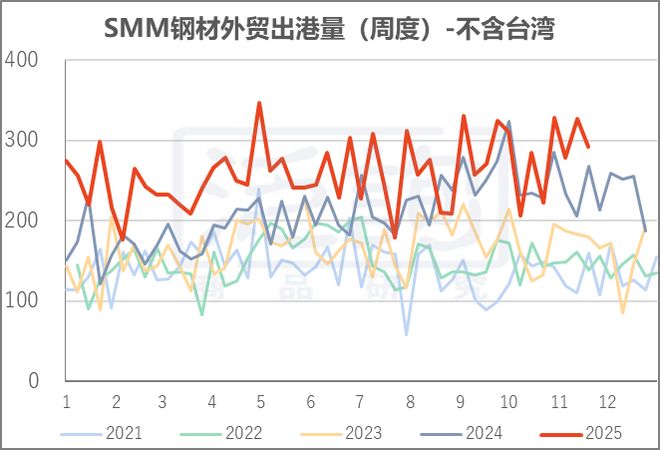
Report Industry Investment Rating - Not provided in the given content Core Viewpoint - Not explicitly stated in the given content Summary by Relevant Catalog China's Steel Exports Remain Resilient - Steel export volume and steel billet export volume are presented in monthly values from 2020 - 2025, showing the trend of steel exports [5][6][7] - There are numerous overseas anti - dumping, counter -vailing, and safeguard measure investigations on Chinese steel products in 2025, covering various steel varieties and many countries and regions [9] - There are also many overseas trade friction cases related to Chinese exported goods in 2025, including anti - dumping, counter -vailing, and anti - circumvention investigations on various products [10] - The destinations of China's direct steel exports include the Middle East (23%), EU 27 countries (5%), the CIS (3%), North America (1%), Africa (18%), South Africa (3%), Southeast Asia (36%), Japan and South Korea (9%), and India (2%) [14] - Data on the aggregated outbound volume from major domestic ports for steel (32 ports) and the outbound volume excluding Taiwan, China are presented from 2020 - 2025 [15][16][21] - The indirect steel consumption of China's commodity exports in 2024, from January to October 2025, and the estimated value for 2025 are provided for various products such as containers, ships, etc., with corresponding year - on - year growth rates [17] - The monthly and annual trends of China's trade surplus cumulative year - on - year growth rate and the global cumulative growth rate of China's exported goods are presented [25][26] - The manufacturing PMI of major world economies such as the US, Japan, the UK, Germany, and France is shown [28][30] - The relationship between the US manufacturing PMI and the 10 - year US Treasury bond yield, as well as the relationship between the average of the European and American manufacturing PMI and China's export amount year - on - year AM3M are presented [31]
钢材:供需双弱,关注12月会议
Ning Zheng Qi Huo· 2025-12-01 11:52
Report Summary 1. Investment Rating - No investment rating for the industry is provided in the report. 2. Core View - This week, steel prices rose slightly, market sentiment was high, inventory was depleted, and there were expectations of maintenance production. The overall market enthusiasm was relatively high, demand improved to some extent, and raw material support remained strong. The bottom of steel prices may have been determined. As of November 28, the average price of 20mm third - grade seismic rebar in major cities across the country was 3,291 yuan/ton, a weekly increase of 23 yuan/ton; the average price of 8.0mm HPB300 high - speed wire rod was 3,473 yuan/ton, a weekly increase of 23 yuan/ton. - In December, the Central Economic Work Conference is about to be held, and there are still expectations of interest rate cuts overseas. The macro - environment is warm, and the futures market has the driving force to rebound from a low level. However, the rebar inventory level is still relatively high year - on - year. As the off - season deepens, demand expectations are still under pressure, and the upside space of the futures market is limited. It is expected that the futures price will fluctuate widely at a low level. [2] 3. Summary by Directory Market Review and Outlook - This week, steel prices rose slightly, with improved demand and strong raw material support. The bottom of steel prices may be determined. - Looking ahead, the upcoming December Central Economic Work Conference and overseas interest rate cut expectations create a warm macro - environment, driving a potential low - level rebound in the futures market. But high rebar inventory and weakening demand in the off - season limit the upside space, and the futures price is expected to have wide - range low - level fluctuations. [2] Fundamental Data Weekly Changes | Data Item | Unit | Latest Week | Previous Week | Weekly Change | Weekly Change Rate | Frequency | | --- | --- | --- | --- | --- | --- | --- | | Daily average pig iron output of steel mills | 10,000 tons | 234.68 | 236.28 | - 1.6 | - 0.68% | Weekly | | Rebar inventory in steel mills | 10,000 tons | 146.73 | 153.32 | - 6.59 | - 4.30% | Weekly | | Rebar social inventory | 10,000 tons | 384.75 | 400.02 | - 15.27 | - 3.82% | Weekly | | Hot - rolled coil inventory in steel mills | 10,000 tons | 78.02 | 78.02 | 0 | 0% | Weekly | | Hot - rolled coil social inventory | 10,000 tons | 322.88 | 324.09 | - 1.21 | - 0.37% | Weekly | [4]
热卷周报 2025/11/29:出口扰动增强,钢市短期情绪承压-20251129
Wu Kuang Qi Huo· 2025-11-29 12:18
Report Industry Investment Rating - Not provided in the given content Core Viewpoints - This week, the commodity market maintained an adjustment pattern, with finished product prices oscillating in the bottom area. Rebar showed a neutral performance with both supply and demand declining and inventory continuously decreasing. For hot-rolled coils, production increased, apparent demand slightly declined, and inventory only decreased slightly. The decision by South Korea to impose anti-dumping duties on Chinese steel products may pressure China's steel exports. Steel demand has entered the seasonal off - season, and hot - rolled coil inventory pressure remains. Attention should be paid to the actual implementation of production cuts. Macro - level important meetings in early December need continuous tracking [9][10] Summary by Relevant Catalogs 1. Week - to - week Assessment and Strategy Recommendation - Cost side: The hot - rolled coil blast furnace profit is - 50 yuan/ton, the gross profit has a slight increase, and the futures premium is about 3 yuan/ton, with a neutral valuation [7] - Supply side: This week, the hot - rolled coil production was 3.19 million tons, a week - on - week increase of 30,000 tons, a year - on - year increase of about 2.3% for the single week and about 2.0% for the cumulative year. The daily average pig iron output was 2.3468 million tons, with a larger - than - expected decline. The hot - rolled coil production is high, and the supply pressure is large [7] - Demand side: This week, the hot - rolled coil consumption was 3.2 million tons, a week - on - week decrease of 42,000 tons, a year - on - year increase of about 0.4% for the single week and about 1.4% for the cumulative year. Affected by weak infrastructure and manufacturing demand, the current plate demand is weak [8] - Inventory: This week, the hot - rolled coil inventory was 400,900 tons, at a high level with significant inventory pressure [9] - Strategy: The recommended strategy is to wait and see [11] 2. Futures and Spot Market - The report provides multiple charts related to the futures and spot market of hot - rolled coils, including spot prices, regional price differences, basis of different contracts, futures contract price differences, and price ratios with other products such as rebar and iron ore [16][20][34] 3. Profit and Inventory - Profit: Charts show the gross profit per ton of hot - rolled and cold - rolled coils, as well as the profits of rebar blast furnaces and electric furnaces [56][58] - Inventory: Charts display the total inventory, social inventory, and steel mill inventory of hot - rolled, cold - rolled, and coated plates [60][64][70] 4. Cost Side - The report presents charts of the futures closing prices of iron ore and coke, as well as the price of scrap steel, daily average pig iron output, iron - making cost, and the prices of related products such as steel billets [76][78][81] 5. Supply Side - Hot - rolled coil production: Weekly production, cumulative year - on - year growth, and production in different regions (north, south, and east China) are shown, along with capacity utilization rates [91][93][94] - Cold - rolled coil production: Weekly production, cumulative year - on - year growth, production in different regions, and capacity utilization rates are presented [99][102][103] - Coated plate production: Weekly production and capacity utilization rates of color - coated and galvanized plates are provided [104][105] 6. Demand Side - Hot - rolled coil consumption: Apparent consumption, cumulative year - on - year growth, and consumption - related data of downstream industries such as automobiles, tractors, home appliances, and metal containers are shown [108][109][111]
略为坚强的小螺纹
Xin Lang Cai Jing· 2025-11-24 11:34
Core Viewpoint - The recent performance of rebar indicates a trend where, in the absence of macroeconomic stories, fundamentals significantly influence futures prices. The current fundamentals for rebar are relatively strong, with good inventory reduction and stable prices across the country [1][4]. Group 1: Market Fundamentals - Steel inventory reduction is performing well, contributing to a relatively strong fundamental backdrop, which helps black commodities resist declines during overall commodity downturns. It is expected that steel inventory reduction will continue this week [1]. - National prices for steel are holding firm, with northern regions experiencing specification shortages due to actual production cuts by steel mills. Eastern China is also facing specification shortages, although it is not the highest-priced region nationally [1][4]. - The overall inventory is flowing towards higher-priced areas, indicating a market adjustment based on price levels [1]. Group 2: Export Performance - Steel exports remain robust, with total outbound shipments showing a week-on-week decline but a year-on-year improvement. The total outbound shipments were 305.3 million tons, down 26.46 million tons week-on-week, and 292.04 million tons when excluding two ports in Taiwan, down 34.82 million tons [4]. - The outbound shipments from 28 major foreign ports continue to rise week-on-week, with a narrowing of year-on-year negative values [4]. Group 3: Price Trends and Market Sentiment - The main rebar futures contract (2601) has shown a fluctuating upward trend, closing higher but facing significant resistance, indicating a lack of confidence among bulls and an overall weak oscillating pattern [5]. - The coal market, particularly coking coal, is under pressure due to the increasing losses among steel mills, with the profitability ratio of steel mills dropping to 38.96%, continuing a 14-week decline. This has led to reduced procurement of coking coal by steel mills [5]. - The price of rebar in Changzhou is reported at 3160 yuan/ton, while the price for wire rod is 3390 yuan/ton, reflecting the current market conditions [6][7].