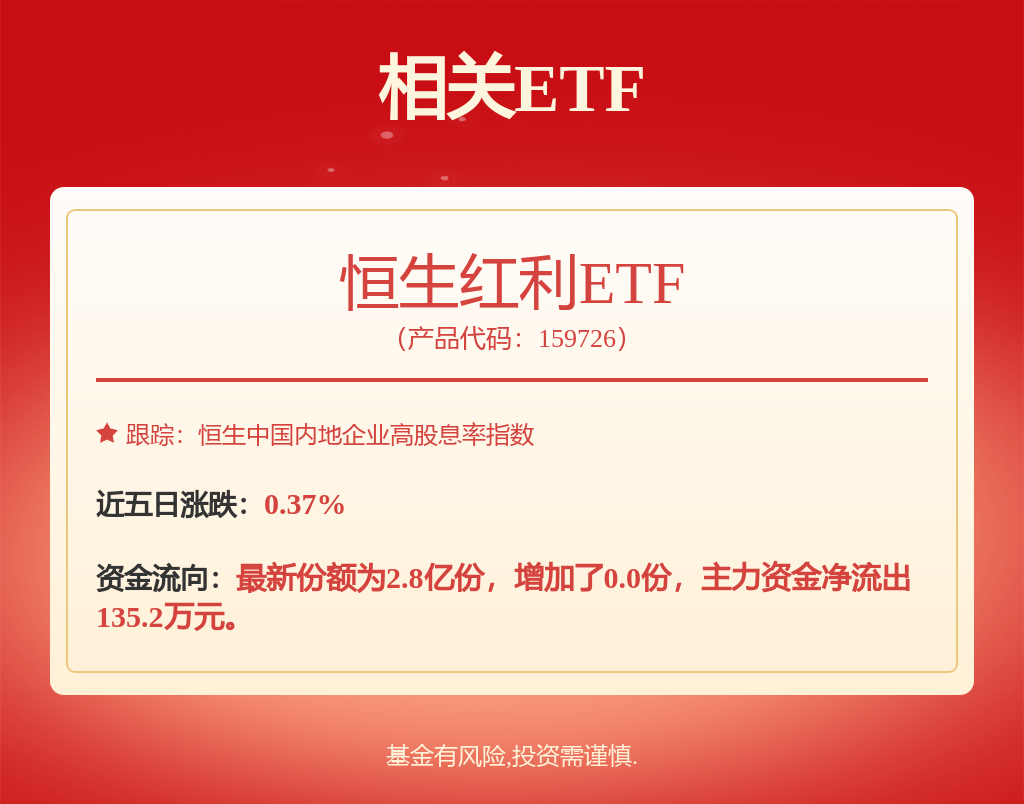
华夏中证5G通信主题ETF

Search documents
申万金工ETF组合202603
Shenwan Hongyuan Securities· 2026-03-11 14:29
1. Report Industry Investment Rating The provided content does not include information about the industry investment rating, so this part is skipped. 2. Core Viewpoints of the Report - The report constructs multiple ETF portfolios, including macro industry portfolio, macro + momentum industry portfolio, core - satellite portfolio, and trinity style rotation ETF portfolio, aiming to find potential investment opportunities and manage risks [1][5]. - The macro industry portfolio selects ETFs based on the sensitivity scores of economy, liquidity, and credit, and currently leans towards TMT and innovative drugs [1][7]. - The macro + momentum industry portfolio combines macro and momentum methods, with a relatively high proportion of cyclical industries selected by the momentum approach [1][14]. - The core - satellite portfolio uses the CSI 300 as the core and combines it with industry and Smart Beta portfolios, showing relatively stable performance [21]. - The trinity style rotation ETF portfolio constructs a style rotation model centered on macro - liquidity, and the current model leans towards the small - cap growth - high - quality part [6][29]. 3. Summary According to the Directory 3.1 ETF Portfolio Construction Methods 3.1.1 ETF Portfolio Construction Based on Macro - Methods - Calculate the macro - sensitivity of the indices tracked by broad - based, industry - themed, and Smart Beta ETFs according to economic, liquidity, and credit variables, and select ETFs monthly based on the current macro - variable status and index macro - sensitivity [5]. - Traditional cyclical industries are sensitive to the economy, TMT is sensitive to liquidity and insensitive to the economy, and consumption is relatively sensitive to credit. State - owned enterprises and ESG - related themes have low sensitivity to liquidity and credit [5]. - Three ETF portfolios, namely the macro industry portfolio, macro + momentum industry portfolio, and core - satellite industry portfolio, are constructed and rebalanced monthly [5]. 3.1.2 Trinity Style Rotation ETF Portfolio Construction - Build a medium - to long - term style rotation model centered on macro - liquidity, and compare it with the CSI 300 index [6]. - Construct three types of models: growth/value rotation model, market - cap model, and quality model. Combine the results of the three models to get the final style preference, with a total of 8 style preference results [6]. - Select ETFs with high exposure to the target style, control the industry exposure of ETFs to be similar to the style portfolio, and set the allocation upper and lower limits of 3% - 20% to obtain the ETF allocation model [6]. 3.2 Macro Industry Portfolio - Select industry - themed indices tracked by ETFs that have been established for more than 1 year and have a current scale of over 200 million. Calculate the sensitivity scores of economy, liquidity, and credit monthly, adjust the score directions according to the latest economic, liquidity, and credit judgment indicators, and sum them up. If liquidity and credit deviate significantly, remove the liquidity score. Select the top 6 industry - themed indices and allocate the corresponding largest - scale ETFs equally [7][8]. - Currently, the economy's leading indicators are falling, liquidity is loose, and credit indicators are tightened. The portfolio is configured with ETFs that are insensitive to the economy, sensitive to liquidity, and insensitive to credit, mainly focusing on TMT and innovative drugs. The March positions include ETFs such as GF China Hong Kong Innovative Drugs ETF and Huaxia CSI 5G Communication Theme ETF [12]. - The portfolio has relatively large fluctuations, and the excess return declined in February [13]. 3.3 Macro + Momentum Industry Portfolio - Combine the macro and momentum methods to form a complementary relationship. The momentum method first groups industry themes into 6 different groups using clustering, and then selects the product with the highest increase in the past 6 months from each group for equal - weight allocation [14]. - The industries selected by the momentum method still have a relatively high proportion of cyclical industries. The March positions include ETFs such as GF China Hong Kong Innovative Drugs ETF and Cathay CSI Semiconductor Materials and Equipment Theme ETF [18]. - The portfolio has performed well this year and continued to outperform in February [19]. 3.4 Core - Satellite Portfolio - Due to the high volatility of industry - themed ETFs and the accelerated industry rotation in the past two years, a "core - satellite" portfolio with the CSI 300 as the core is designed [21]. - Use the macro - sensitivity measurement method to measure the three ETF - tracking index pools of domestic broad - based, industry - themed, and Smart Beta ETFs, construct three stock portfolios, and then weight them at 50%, 30%, and 20% to obtain the final core + satellite portfolio [21]. - The current configuration of broad - based ETFs leans towards the science and technology innovation board and the ChiNext board. The portfolio has performed stably, outperforming in most months except for December, and continued to outperform in February 2026 [26][28]. 3.5 Trinity Style Rotation ETF Portfolio - The current model leans towards the small - cap growth - high - quality part. The factor exposure and historical performance of the model are provided, including factors such as the bond futures - spot spread, US one - year Treasury yield, and trading volume of the Shanghai and Shenzhen stock markets [29][30]. - The March positions include ETFs such as Invesco Great Wall CSI Hong Kong Stock Connect Technology ETF and Invesco Great Wall CSI Guoxin Hong Kong Stock Connect Central State - owned Enterprise Dividend ETF [35]. - The portfolio has achieved certain excess returns in many months [33].
国泰海通证券3月基金投资策略:A股延续上涨行情,重视主投周期和科技领域基金
GUOTAI HAITONG SECURITIES· 2026-03-01 08:26
Group 1 - The report indicates that the A-share market continued its upward trend in February 2026, despite experiencing short-term fluctuations at the beginning of the month. The recommendation is to maintain a balanced investment style while slightly favoring growth, particularly in the technology sector and cyclical industries [1][7][59]. - The report highlights that the focus of China's economic strategy is shifting towards domestic demand, which is expected to drive economic recovery and stabilize property prices. This shift is seen as a long-term national strategy rather than a short-term policy [9][10][11]. - The report identifies high-prospect industries for investment, including non-ferrous metals, machinery, steel, defense, basic chemicals, and communications, suggesting a rotation strategy towards these sectors through ETFs [61]. Group 2 - The report notes that the performance of growth-style funds has outpaced that of balanced and value-style funds, with specific sectors like midstream manufacturing and upstream cyclical industries showing strong returns [44][45]. - The report mentions that in February 2026, a total of 109 new funds were established, with a total fundraising amount of 906.40 billion, marking the highest level for the same period in four years. The enthusiasm for equity funds remains high due to the recovering A-share market [51][52]. - The report emphasizes the importance of selecting funds with strong stock-picking and risk control capabilities, particularly in the context of the ongoing recovery in the A-share market [59].
申万金工ETF组合202602
Shenwan Hongyuan Securities· 2026-02-10 09:43
1. Report Industry Investment Rating - Not provided in the given content 2. Core Viewpoints of the Report - The report focuses on constructing multiple ETF portfolios, including macro industry, macro + momentum industry, core - satellite, and trinity style rotation portfolios, aiming to find better investment opportunities by combining macro factors, momentum factors, and style rotation [4][5]. - Different industries have different sensitivities to economic, liquidity, and credit factors. For example, traditional cycle industries are sensitive to the economy, TMT is sensitive to liquidity, and consumption is sensitive to credit [4]. 3. Summary According to Relevant Catalogs 3.1 ETF Portfolio Construction Methods 3.1.1 Based on Macro Method - Calculate macro - sensitivities of broad - based, industry - themed, and Smart Beta ETFs based on economic, liquidity, and credit variables. Combine with momentum indicators for complementary analysis [4]. - Traditional cycle industries are suitable for economic up - periods, TMT for weak - economy but loose - liquidity periods, and consumption for credit - expansion periods. State - owned enterprises and ESG - related themes have low sensitivities to liquidity and credit [4]. - Construct three ETF portfolios (macro industry, macro + momentum industry, and core - satellite) and adjust positions monthly [4]. 3.1.2 Trinity Style Rotation ETF Portfolio Construction - Build a medium - to - long - term style rotation model centered on macro - liquidity, and compare it with the CSI 300 index [5]. - Construct three types of models (growth/value rotation, market - cap, and quality models) by screening macro, fundamental, and market - sentiment factors. The model has 8 style - preference results [5]. - Select ETFs with high exposure to the target style, control industry exposure, and set allocation limits to get the final ETF allocation model [5]. 3.2 Macro Industry Portfolio - Select industry - themed ETFs with over 1 - year establishment and over 200 million current scale. Calculate sensitivity scores of economic, liquidity, and credit factors monthly, adjust scores according to the latest indicators, and sum them up. If liquidity and credit deviate significantly, remove the liquidity score. Select the top 6 industry - themed indices and corresponding largest - scale ETFs for equal - weight allocation [6][7]. - Currently, with falling economic leading indicators, loose liquidity, and tightened credit, the portfolio is biased towards TMT and consumption. The February positions are shown in Table 1 [8]. - The portfolio has large fluctuations and outperformed the benchmark significantly in January [11]. 3.3 Macro + Momentum Industry Portfolio - Combine macro and momentum methods to address the left - side nature of macro - based strategies (low win - rate but high odds). Use clustering to group industry - themed indices and select the highest - rising product in each group in the past 6 months for equal - weight allocation [12]. - The momentum - selected industries still have a high proportion of cyclical industries. The February positions are shown in Table 3 [16]. - The portfolio has performed well this year and outperformed the CSI 300 significantly in January [17]. 3.4 Core - Satellite Portfolio - Design a "core - satellite" portfolio with the CSI 300 as the core to address the high volatility and rapid industry rotation of industry - themed ETFs [19]. - Calculate macro - sensitivities for broad - based, industry - themed, and Smart Beta ETFs, construct three stock portfolios, and weight them at 50%, 30%, and 20% respectively [19]. - The current allocation of broad - based ETFs is biased towards the Sci - tech Innovation Board and the ChiNext. The portfolio has performed stably, outperforming the benchmark in most months except December, and had significant excess returns in January 2026 [23][24]. 3.5 Trinity Style Rotation ETF Portfolio - The model currently favors the small - cap growth - high - quality segment. The factor exposures and historical performance are shown in Table 7 [26]. - The February positions are shown in Table 9 [31]. - The portfolio has achieved certain excess returns, especially in some months such as August 2025 and January 2026 [29].
6万亿时代,ETF一哥做对了什么?
虎嗅APP· 2025-12-30 09:21
Core Viewpoint - The article discusses the evolution of the public fund industry in China, highlighting the transition from reliance on individual "star" fund managers and products to a more systematic approach that emphasizes platformization and product toolization. 华夏基金 aims to become a "Lego" in the asset management industry, allowing investors to customize their investment strategies according to their preferences [2][3]. Group 1: Industry Evolution - The public fund industry has undergone significant changes since its inception in 1998, moving from dependence on individual personalities to a focus on enhancing overall system resilience and predictability [2]. - 华夏基金 has positioned itself as a pioneer in this transformation, advocating for a multi-asset platform that integrates various investment strategies and products [2][4]. Group 2: 华夏基金's Product Strategy - As of December 24, 华夏基金 has over 400 public fund products, reflecting a diverse range of investment strategies across global markets and asset classes. This extensive product lineup is foundational for building a multi-asset platform [5]. - In 2023, 华夏基金 launched 77 new products, demonstrating its commitment to expanding its offerings while maintaining quality [5]. - The company has successfully introduced several high-performing products, such as the 华夏上证基准做市公司债ETF and 华夏中证AAA科技创新公司债ETF, both surpassing 100 billion yuan in scale [5]. Group 3: ETF Development - 华夏基金 has been a leader in the ETF space, with 117 ETF products as of December 24, 2023. Notable ETFs like 华夏沪深300ETF and 华夏上证50ETF have achieved scales of 2287.90 billion yuan and 1773.92 billion yuan, respectively [6]. - The company has seen its global ranking among ETF providers improve, reaching 18th place with a management scale of 1268 billion USD by Q3 2025 [7]. Group 4: Active and Passive Investment Integration - 华夏基金 is also focusing on integrating active equity, fixed income, and FOF products to create a comprehensive investment ecosystem that caters to diverse investor needs [10]. - The 华夏北交所创新中小企业精选两年定开 fund has achieved impressive returns of 79.85% this year and 272.71% over the past three years, showcasing the company's proactive approach in emerging markets [10]. Group 5: Investor Education and Tools - To support its "Lego" vision, 华夏基金 has developed various educational platforms and tools, such as the "红色火箭" service, which provides a comprehensive online service for index investment [14][15]. - The "LetfGo" module within the "红色火箭" platform allows users to simulate investment combinations, enhancing the user experience and facilitating better investment decisions [15]. Group 6: Future Outlook - The company aims to lead the industry into a new phase of asset allocation, emphasizing the importance of customized investment strategies rather than a one-size-fits-all approach [15]. - 华夏基金's vision of creating a "wealth Lego" platform is expected to further enhance its business resilience and adapt to the evolving needs of investors [15].


【申万宏源策略 | 一周回顾展望】宏观环境“还原”,A股向上空间受限未变
申万宏源研究· 2025-12-15 01:18
Core Viewpoint - The A-share market has reverted to its previous state before late October, but the upward potential remains constrained. The only industry showing short-term upward movement is optical connectivity, while concerns about the decline in capital expenditure among leading US tech companies in 2026 persist, impacting the AI industry chain [2][3]. Group 1: Market Environment and Trends - Since late November, the macro environment for the A-share market has "reverted," reflecting the characteristics seen before late October. However, the upward space remains limited, with only optical connectivity showing potential for upward breakthroughs [2][3]. - The expectation for stable growth has been adjusted downward, and the anticipated return of the Federal Reserve's easing policies has led to a resurgence in optical connectivity, while other tech growth sectors are experiencing a rebound [2][3]. - The market is currently in a high-level oscillation phase, with the structural characteristics reverting to those observed before late October [2][3]. Group 2: Economic Policy Insights - The core idea of the 2025 Central Economic Work Conference is to "practice internal skills to cope with external challenges," with a focus on maintaining policy momentum in 2024 and potential marginal improvements in 2026 [5][6]. - Key policy points include addressing issues related to development and transformation, emphasizing quality and efficiency, stimulating domestic demand, and promoting technological innovation in key regions [6][7]. - The market anticipates that if economic results improve in the first half of 2026, additional efforts to stabilize growth in the second half are likely [5][7]. Group 3: Market Outlook and Investment Opportunities - The medium-term outlook remains a "two-stage bull market," with the first stage (tech structural bull) already at a high level, and the market currently in a quarterly high-level oscillation phase [7][8]. - The first half of 2026 is expected to favor cyclical and value styles, while the second half may see a comprehensive bull market driven by fundamental improvements and technological trends [7][8]. - Spring market trends are expected to focus on small-scale opportunities, particularly in optical connectivity and other tech sectors, with potential for new high-level oscillation phases [8].

5G通信ETF领涨,机构:通信长牛有望持续丨ETF基金日报
2 1 Shi Ji Jing Ji Bao Dao· 2025-12-03 02:54
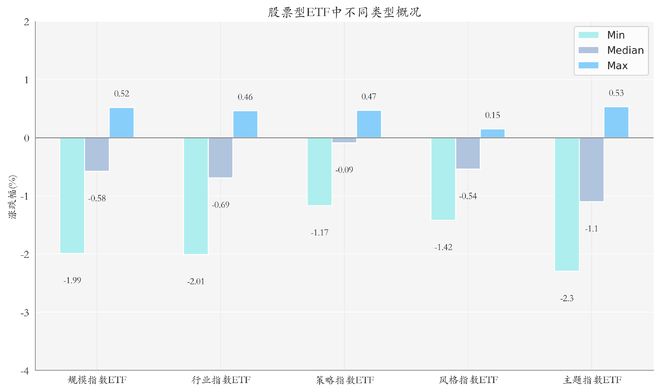
Market Overview - The Shanghai Composite Index fell by 0.42% to close at 3897.71 points, with a high of 3908.77 points during the day [1] - The Shenzhen Component Index decreased by 0.68% to 13056.7 points, reaching a peak of 13132.81 points [1] - The ChiNext Index dropped by 0.69% to 3071.15 points, with a maximum of 3094.18 points [1] ETF Market Performance - The median return of stock ETFs was -0.7% yesterday [2] - The highest performing scale index ETF was the China Tai Zhongzheng 2000 ETF with a return of 0.52% [2] - The highest performing industry index ETF was the China Tai Zhongzheng All Index Building Materials ETF with a return of 0.46% [2] - The highest performing strategy index ETF was the Great Wall Zhongzheng Dividend Low Volatility 100 ETF with a return of 0.47% [2] - The highest performing theme index ETF was the China Tai Zhongzheng 5G Communication Theme ETF with a return of 0.53% [2] ETF Performance Rankings - The top three ETFs by return were: - China Tai Zhongzheng 5G Communication Theme ETF (0.53%) - Guotai Zhongzheng 2000 ETF (0.52%) - Great Wall Zhongzheng Dividend Low Volatility 100 ETF (0.47%) [4] - The top three ETFs by decline were: - GF Zhongzheng Media ETF (-2.3%) - China Tai Zhongzheng Entertainment Media ETF (-2.12%) - Guotai Zhongzheng Film and Television Theme ETF (-2.08%) [4] ETF Fund Flows - The top three ETFs by fund inflow were: - Huabao S&P China A-share Dividend Opportunity ETF (inflow of 369 million yuan) - Wanjia Zhongzheng Industrial Nonferrous Metals Theme ETF (inflow of 282 million yuan) - Huabao Zhongzheng All Index Securities Company ETF (inflow of 250 million yuan) [6] - The top three ETFs by fund outflow were: - Penghua Zhongzheng Subdivided Chemical Industry Theme ETF (outflow of 382 million yuan) - Jiashi HuShen 300 ETF (outflow of 342 million yuan) - Huatai Bairui HuShen 300 ETF (outflow of 273 million yuan) [6] ETF Margin Trading Overview - The top three ETFs by margin buying were: - Huaxia Shanghai Stock Exchange Sci-Tech Innovation Board 50 Component ETF (384 million yuan) - Guotai Zhongzheng All Index Securities Company ETF (260 million yuan) - Huabao Zhongzheng Medical ETF (150 million yuan) [8] - The top three ETFs by margin selling were: - Southern Zhongzheng 500 ETF (44.09 million yuan) - Southern Zhongzheng 1000 ETF (27.26 million yuan) - Huatai Bairui HuShen 300 ETF (8.55 million yuan) [9] Industry Insights - The communication industry is experiencing an upturn driven by multiple factors, including accelerated AI development and increased demand for IDC construction [10] - The communication sector has seen a 51.67% increase since early 2025, ranking second among all industries, with certain optical module stocks experiencing nearly tenfold growth [10][11] - Public funds have increased their holdings in the communication sector, exceeding 6.5%, indicating a conservative market valuation that does not fully reflect the sector's high growth potential [11]
【ETF观察】11月28日行业主题ETF净流出24.94亿元
Sou Hu Cai Jing· 2025-11-28 22:37
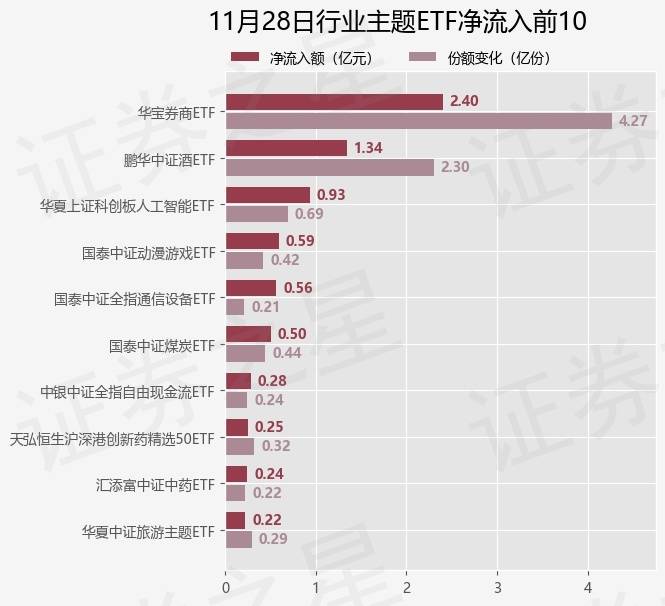
Core Insights - On November 28, industry-themed ETF funds experienced a net outflow of 2.494 billion yuan, with a cumulative net outflow of 20.054 billion yuan over the past five trading days [1] - A total of 48 industry-themed ETFs saw net inflows, with the Huabao Securities ETF (512000) leading with an increase of 427 million shares and a net inflow of 240 million yuan [1][3] - Conversely, 151 industry-themed ETFs recorded net outflows, with the Guotai Zhongzheng All-Index Securities Company ETF (512880) experiencing the largest outflow of 654 million yuan and a reduction of 556 million shares [1][4] Summary by Category Net Inflows - The Huabao Securities ETF (512000) had a net inflow of 240 million yuan, with a share increase of 427 million, bringing its total shares to 698.47 million [3][5] - Other ETFs with net inflows include: - Penghua Zhongzheng Wine ETF (512690) with a net inflow of 134 million yuan and a share increase of 230 million [3] - Huaxia Shanghai Stock Exchange Science and Technology Innovation Board Artificial Intelligence ETF (589010) with a net inflow of 93 million yuan and a share increase of 69 million [3] Net Outflows - The Guotai Zhongzheng All-Index Securities Company ETF (512880) had the highest net outflow of 654 million yuan, with a share decrease of 556 million, resulting in a total of 504.04 million shares [4][5] - Other ETFs with significant net outflows include: - Huabao Zhongzheng Bank ETF (512800) with a net outflow of 428 million yuan and a share decrease of 512 million [4] - Huaxia Zhongzheng Robot ETF (562500) with a net outflow of 163 million yuan and a share decrease of 173 million [5]
新能源ETF上周领跌,传媒ETF回撤较少丨ETF基金周报
2 1 Shi Ji Jing Ji Bao Dao· 2025-11-24 03:10
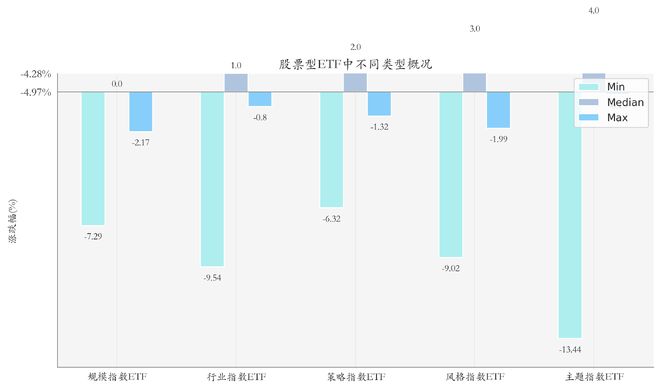
Market Performance - The Shanghai Composite Index fell by 3.9% last week, closing at 3834.89 points, with a high of 3992.4 points [1] - The Shenzhen Component Index decreased by 5.13%, ending at 12538.07 points, with a peak of 13251.78 points [1] - The ChiNext Index dropped by 6.15%, closing at 2920.08 points, with a maximum of 3137.07 points [1] - Major global indices also declined, with the Nasdaq Composite down 2.74%, the Dow Jones Industrial Average down 1.91%, and the S&P 500 down 1.95% [1] - In the Asia-Pacific region, the Hang Seng Index fell by 5.09%, and the Nikkei 225 Index decreased by 3.48% [1] ETF Market Performance - The median weekly return for stock ETFs was -4.56% [2] - The highest weekly return among scale index ETFs was -2.17% for the CCB SSE 50 ETF [2] - The highest weekly return among industry index ETFs was -0.8% for the FTSE China 800 Bank ETF [2] - The highest weekly return among strategy index ETFs was -1.32% for the Harvest CSI 300 Dividend Low Volatility ETF [2] - The highest weekly return among theme index ETFs was -0.15% for the Penghua CSI Media ETF [2] ETF Liquidity and Fund Flows - Average daily trading volume for stock ETFs increased by 32.1%, and average daily turnover rose by 6.8% [6] - The top five stock ETFs with the highest fund inflows included the Huatai-PB CSI 300 ETF with an inflow of 3.876 billion yuan [8] - The top five stock ETFs with the highest fund outflows included the Hua Bao CSI Bank ETF with an outflow of 321 million yuan [8] Financing and Margin Trading - The financing balance for stock ETFs increased from 47.722 billion yuan to 50.553 billion yuan [9] - The highest financing buy amount was for the E Fund ChiNext ETF, totaling 801 million yuan [9] ETF Market Size and Composition - The total size of the ETF market reached 55,994.97 billion yuan, a decrease of 1,305.99 billion yuan from the previous week [13] - Stock ETFs accounted for 64.0% of the total ETF market size, with a total size of 35,817.94 billion yuan [15] - The number of stock ETFs in the market was 1,065 out of a total of 1,355 ETFs [10] New ETF Issuance - No new ETFs were issued last week, but eight new ETFs were established, including the Harvest Hang Seng Technology ETF and the Penghua Hang Seng Biotechnology ETF [16] Institutional Insights - Pacific Securities highlighted the importance of advancements in AI foundational model technology, particularly in e-commerce and advertising sectors [16] - Galaxy Securities noted the potential of AI video and social ecosystems, emphasizing the shift towards ecological construction and scene penetration in various industries [17]
“国家队”近4万亿持仓曝光:重仓金融,不忘加码科技
2 1 Shi Ji Jing Ji Bao Dao· 2025-11-04 23:26
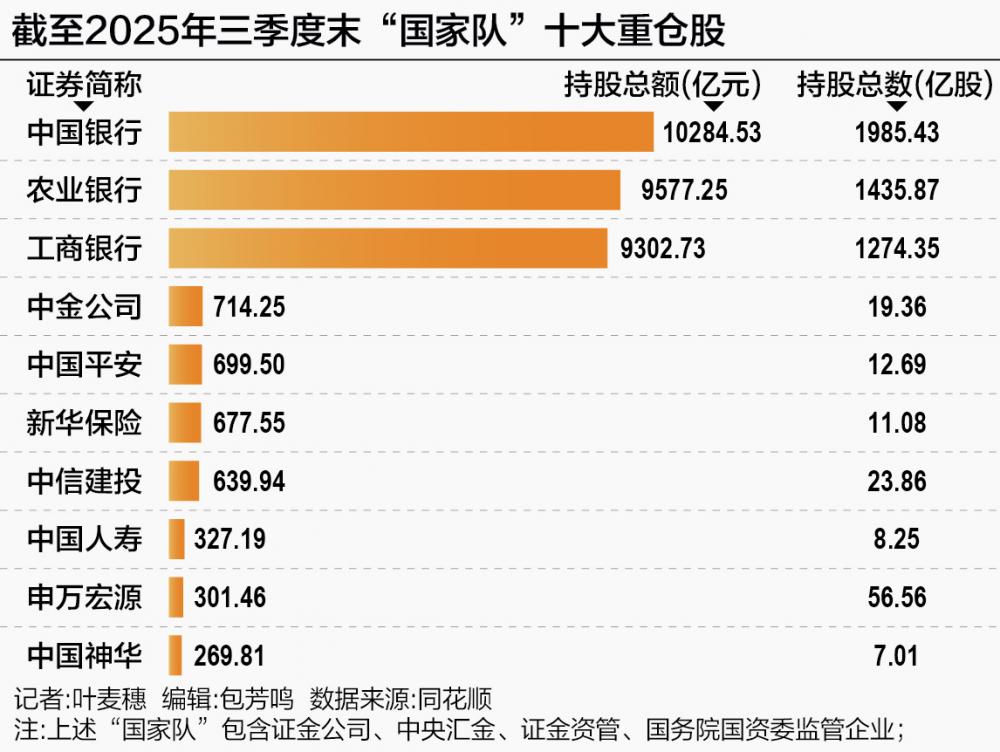
Core Insights - The "national team" has significantly increased its holdings in A-shares, with a total market value approaching 4 trillion yuan, focusing heavily on financial stocks [1][4] - The top ten holdings of the "national team" are predominantly from the financial sector, with the largest being the Bank of China, valued at over 1 trillion yuan [1][3] Holdings Overview - As of the end of Q3, the "national team" held over 222 A-share stocks, with a total market value of 3.911 trillion yuan, marking an increase from the previous quarter [4][5] - The top three holdings by market value are Bank of China (1.028 trillion yuan), Agricultural Bank of China (957.73 billion yuan), and Industrial and Commercial Bank of China (930.27 billion yuan) [2][3] Sector Focus - The "national team" remains heavily invested in financial stocks, with 9 out of the top 10 holdings being from this sector, accounting for over 83.9% of the total market value of the top ten stocks [3][4] - In addition to financial stocks, the "national team" is diversifying into sectors such as AI, semiconductors, and renewable energy, aligning with national strategic goals [3][4] ETF Investments - The "national team" has also increased its investment in ETFs, with holdings exceeding 40% of the total A-share ETF market, contributing to market stabilization [5][6] - The total market value of ETFs held by the "national team" reached approximately 1.55 trillion yuan, with significant gains from major ETFs like Huatai-PB CSI 300 ETF [6][7] Market Conditions - The current market environment is characterized by ample liquidity and favorable policy support, which is benefiting growth-oriented stocks, particularly in the technology sector [7]



近4万亿“国家队”持仓曝光:重仓金融,不忘加码科技
2 1 Shi Ji Jing Ji Bao Dao· 2025-11-04 12:40
Core Viewpoint - The "national team" has significantly increased its holdings in A-shares, focusing primarily on financial stocks, with a total market value approaching 4 trillion yuan as of the end of the third quarter [1][2]. Group 1: National Team Holdings - As of the end of Q3, the "national team" held over 222 A-share stocks, with a total market value of approximately 3.911 trillion yuan, reflecting an increase from the previous quarter [4]. - The top three stocks held by the "national team" in terms of market value are China Bank (1.03 trillion yuan), Agricultural Bank (967.73 billion yuan), and Industrial and Commercial Bank (930.27 billion yuan) [2]. - Financial stocks dominate the "national team's" portfolio, with 9 out of the top 10 holdings being from the financial sector, accounting for over 83.9% of the total market value of the top holdings [2][4]. Group 2: Sector Diversification - In addition to financial stocks, the "national team" has also invested in sectors such as AI, semiconductors, and new energy, aligning with national strategies for technological advancement [3]. - Notable technology stocks included in the "national team's" portfolio are Ultrasonic Electronics, Puxin Co., and Maike Audi, indicating a strategic shift towards innovation-driven sectors [3]. Group 3: ETF Investments - The "national team" has utilized ETFs as a significant investment tool, with holdings in A-share ETFs exceeding 40% of the total A-share ETF market size by the end of Q3 [6]. - Central Huijin Investment has emerged as a major player in the ETF market, holding significant stakes in multiple ETFs, contributing to market stabilization efforts [5][6]. - The performance of ETFs has been strong, with substantial floating profits reported, particularly in broad-based ETFs like the Huatai-PineBridge CSI 300 ETF, which saw floating profits exceeding 550 billion yuan [7].