
含权理财

Search documents
发明“负债行为框架”
Xin Lang Cai Jing· 2026-02-11 07:01
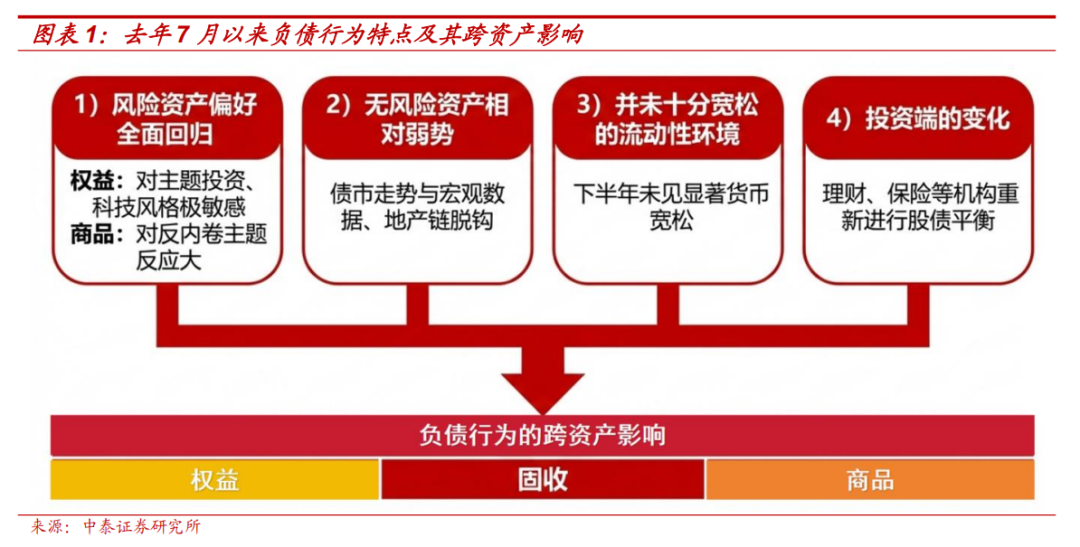
Group 1 - The core argument emphasizes the impact of liability behavior on various asset classes, including equities, fixed income, and commodities, highlighting a trend observed since July of the previous year [1][25]. - The report from July 10, 2025, indicates that the liability side is driving insurance to increase equity allocation, with institutional incremental funds propelling market growth, particularly in technology sectors [2][25]. - Since the New Year, the A-share market has been experiencing a resonance of three factors: changes in liability behavior, asset-side catalysts in technology, and a seasonal shift in bond market dynamics [3][25]. Group 2 - Liability behavior has evolved, with a surge in dividend insurance sales and a shift in wealth management products towards those with embedded rights, influencing investment behaviors across various asset management institutions [3][28]. - The technology sector is witnessing a convergence of three major directions, including commercial aerospace, memory price increases, and AI applications, which are driving upward momentum in related sectors [3][28]. - The traditional seasonal strength of the bond market has largely shifted to equities, continuing a trend observed since March 2024 where bond seasonality has failed to manifest [3][26]. Group 3 - The current environment shows that the equity market is highly sensitive to thematic investments and technology styles, indicating a comprehensive return to risk assets [5][28]. - Despite favorable macro data for the bond market, the bond market's performance has decoupled from high-frequency data and real estate chains since the second half of last year, establishing an independent trend [5][28]. - The liquidity environment remains tight, with minimal incremental monetary easing in the second half of last year, yet stocks and commodities have shown a trend-driven performance [5][28]. Group 4 - The design of financial products is shifting towards capturing "time deposits," with significant reductions in deposit rates since 2022, leading to a reallocation of funds towards more active investments [7][30]. - The attractiveness of rights-embedded wealth management products has increased compared to pure debt products, particularly for 1-3 year investment horizons [9][32]. - Dividend insurance is effectively targeting deposit customers, offering higher guaranteed returns than current deposit rates, thus appealing to those seeking long-term returns with potential upside [9][32]. Group 5 - The transition from traditional fixed income to rights-embedded products is necessary to enhance returns, as reliance solely on bond investments is no longer sufficient [15][38]. - The seasonal patterns of the bond market have not disappeared but have instead shifted towards equities, with funds that would typically flow into bonds now being directed into equity markets [17][41]. - The current financial conditions are fostering a "money-capacity" flywheel effect, reflecting a return of optimism among residents and businesses, which is expected to stimulate real economic changes [20][45].

读研报 | 理解增量资金,别总盯着总量
中泰证券资管· 2026-01-20 11:33
Core Viewpoint - The article discusses the importance of incremental capital as a market confidence indicator and a key factor in assessing market trends, highlighting the challenges in accurately predicting its inflow [1] Group 1: Incremental Capital Estimates - Different research reports provide varying estimates for incremental capital inflow in 2026, with projections ranging from 1.6 trillion to 3 trillion yuan, indicating significant discrepancies [1] - The analysis suggests that understanding the sources and types of capital is more practical than merely estimating total amounts [1] Group 2: 2025 Incremental Capital Breakdown - According to the Guosen Securities strategy report, the incremental capital for 2025 is divided into two phases: the first half sees retail investors transferring 240 billion yuan, foreign capital returning approximately 100 billion yuan, and long-term investments from insurance funds amounting to about 420 billion yuan [2] - The second half of 2025 is expected to see significant inflows from private equity and leveraged trading, with an estimated 700 billion yuan entering the market since July and around 400 billion yuan from private equity funds [2] - The sectors attracting the most capital in the first half include technology and dividend stocks, while the second half sees inflows into non-ferrous metals, electronics, and new energy sectors [2] Group 3: 2026 Main Sources of Incremental Capital - The Huatai Securities strategy report identifies three main sources of incremental capital for 2026: high-risk preference retail funds, medium-low risk preference retail funds, and long-term capital [4] - High-risk preference funds include retail, financing, and private equity funds, while medium-low risk funds consist of maturing fixed deposits with an estimated 8% allocated to non-monetary asset management products [4] - The Huaxin Securities report anticipates public funds, wealth management funds, and insurance funds as the top three sources of incremental capital [4] Group 4: Market Outlook - The article suggests that if a slow bull market becomes the prevailing trend, the main sources of incremental capital will likely be insurance and absolute return-focused funds, indicating potential investment opportunities [5]

中银理财黄党贵:建议提高中长期限产品发行比例 拓宽跨境理财业务
Feng Huang Wang Cai Jing· 2025-12-29 10:48
Core Viewpoint - The chairman of Bank of China Wealth Management, Huang Danggui, emphasized the need for wealth management companies to accelerate their professional and market-oriented transformation to better align with the high-quality development goals of the 14th Five-Year Plan [1][2] Group 1 - Wealth management companies should act as a bridge linking investment and financing more closely, focusing on expanding their positioning based on current conditions, particularly in direct and equity investments, which are currently underrepresented in their portfolios [1] - The development of multi-asset allocation and "fixed income plus" products is essential for enhancing the quality of service to the real economy and providing higher returns to clients in a low-interest-rate environment [1] - Strengthening the layout of medium- to long-term products and developing differentiated services is crucial, as the client base seeks stable returns, and longer product durations can help mitigate market volatility [1] Group 2 - Three suggestions were made for achieving high-quality development in the wealth management industry: optimizing business structure to encourage medium- to long-term products, promoting cross-border wealth management services, and enhancing investment capabilities to diversify product offerings [2]
中银理财黄党贵谈理财子高质量发展:中长期限、多资产、提能力
2 1 Shi Ji Jing Ji Bao Dao· 2025-12-29 09:49
Core Viewpoint - The banking wealth management sector is becoming increasingly important for residents' wealth allocation as deposit rates continue to decline, and the industry must effectively channel this capital into supporting the real economy [1][4]. Group 1: Industry Trends - There is a noticeable trend of residents shifting their wealth from bank deposits to diversified financial assets, which is expected to continue, driving growth in the wealth management industry [4]. - China has become the world's second-largest wealth management market, and the aging population along with a low-interest-rate environment will further support this trend [4]. Group 2: High-Quality Development - The high-quality development of the wealth management industry is crucial for enhancing the adaptability of the economic and financial systems and supporting the construction of a modern industrial system [4]. - The healthy development of the wealth management sector can promote the synergy between direct and indirect financing, thereby meeting the financing structure and new productivity development needs [4]. Group 3: Transformation Needs - Wealth management companies need to accelerate their transformation towards specialization and marketization, focusing on becoming a bridge between investment and financing [5]. - There is a need for wealth management firms to actively promote multi-asset allocation and develop "fixed income plus" products to enhance service quality for the real economy [6]. Group 4: Specific Recommendations - Three specific recommendations for achieving high-quality development in the wealth management industry include optimizing business structures, promoting cross-border wealth management, and enhancing investment capabilities [6].
黄党贵:优化业务结构、推进跨境理财、提升投资能力 三措并举助力理财行业高质量发展
Xin Lang Cai Jing· 2025-12-29 03:23
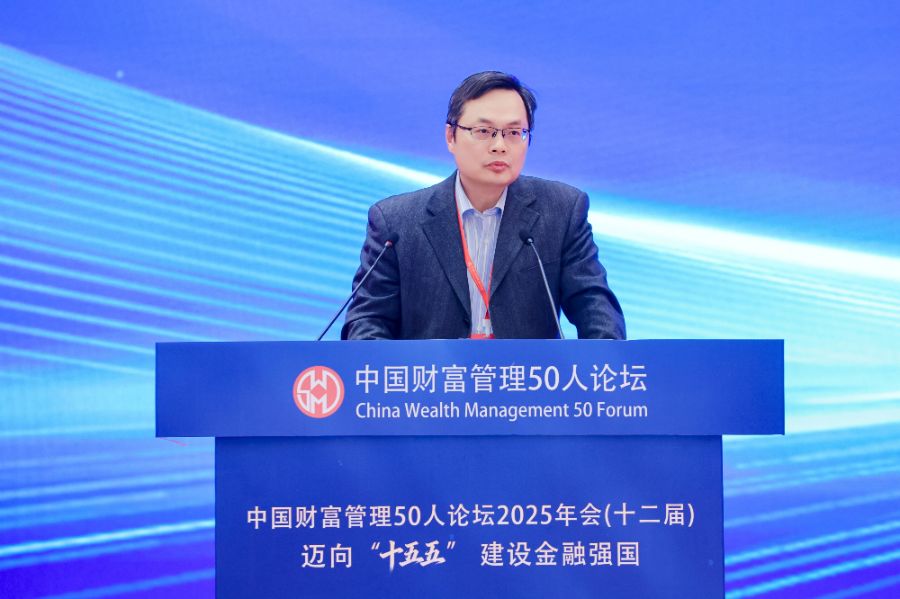
Core Viewpoint - The China Wealth Management 50 Forum 2025 Annual Meeting emphasizes the theme of "Building a Financial Power during the 14th Five-Year Plan" and discusses the restructuring and capability leap of the asset management industry [1][7]. Group 1: Industry Development Significance - Promoting high-quality development in the wealth management industry is a strong measure to meet the wealth preservation and appreciation needs of residents, aligning with the strategy to expand domestic demand [4][10]. - The wealth management industry is crucial for enhancing economic and financial adaptability, supporting the construction of a modern industrial system, and facilitating the coordination of direct and indirect financing [4][11]. - The opening up of the wealth management sector to international competition is necessary, with the 14th Five-Year Plan highlighting the need to improve the openness of the RMB capital account and attract foreign investment [4][11]. Group 2: Industry Transformation Needs - Wealth management companies need to accelerate their transformation towards specialization and marketization to better align with the high-quality development requirements of the 14th Five-Year Plan [5][12]. - The industry should act as a bridge linking investment and financing more closely, focusing on direct and equity investments, which are currently underrepresented in many firms' portfolios [5][12]. - There is a need to enhance the layout of medium- to long-term products and develop differentiated services to meet the stable return expectations of clients, which will help in controlling market volatility [6][12]. Group 3: Recommendations for High-Quality Development - Companies should optimize their business structures and encourage the development of medium- to long-term products [6][13]. - There should be an orderly promotion of cross-border wealth management business to support a high-level opening-up strategy [6][13]. - Companies need to enhance their investment capabilities and diversify their product offerings to better serve the market [6][13].
“存款搬家”入市潜力被低估了?机构称万亿级增量资金可期
Di Yi Cai Jing· 2025-12-17 23:19
Core Viewpoint - The trend of "deposit migration" is gaining attention as deposit rates decline and equity markets heat up, with potential capital inflow into the market estimated to be in the trillions [1][12]. Group 1: Deposit Migration Potential - The potential scale of "deposit migration" into the capital market is estimated to be at least in the trillion level, with over 60 trillion yuan of deposits maturing after 2024 [12]. - By 2025, approximately 105 trillion yuan of deposits will mature, with an additional 66 trillion yuan maturing in 2026 and beyond [14]. - The re-pricing of deposits is expected to lead to significant downward adjustments in interest rates, further encouraging the migration of deposits [14]. Group 2: Factors Influencing Migration - The current trend shows a slowdown in the pace of "deposit migration," but the expectation remains high due to the large volume of high-interest deposits maturing [13]. - The average savings rate has reached a 15-year high of 29.8%, indicating a significant amount of excess savings that could flow into non-deposit investments [16]. - The shift in asset allocation behavior among residents, particularly due to changes in the real estate market, has heightened sensitivity to asset prices [17]. Group 3: Financial Products and Market Impact - Financial products, particularly those with equity components, are becoming more attractive as traditional deposit rates decline, leading to a potential increase in investment in equities [19]. - The banking sector is expected to see a shift towards "solid return" products, with a projected increase in equity asset allocation in financial products, potentially bringing nearly 1 trillion yuan into the capital market by 2026 [21]. - The growth of "solid + equity" financial products is anticipated to reach a year-on-year increase of 20%, indicating a shift in investor preferences [20].
中泰证券:2026年增量资金规模或达3.1万亿,保险、理财、养老金三路并进
Xin Lang Cai Jing· 2025-12-15 03:24
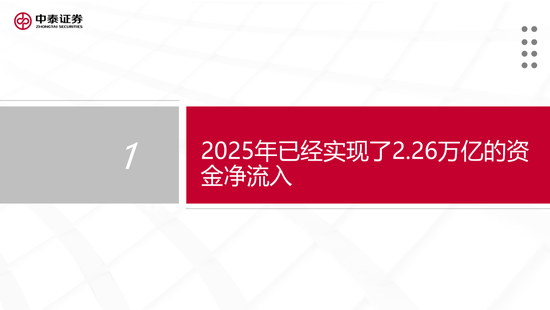
Core Viewpoint - The changes in institutional liability behavior have become a major driving factor for trends and structures in the equity market this year, despite marginal changes in macroeconomic conditions and liquidity [1][2]. Group 1: Institutional Behavior and Market Trends - The shift in institutional liability behavior is more fundamental than the observed capital flow phenomena, indicating a reversal from years of chasing low-risk assets to a focus on performance-driven technology stocks and a withdrawal from long-duration bonds [2]. - The increase in the proportion of dividend insurance, the rise of multi-asset products in wealth management, and the conversion of maturing fixed deposits have indirectly influenced long-term changes in institutional behavior [2]. Group 2: Market Outlook and Predictions - The current bull market is expected to continue, driven by liabilities pushing institutional allocations towards the stock market, with 2025 seen as a turning point for a shift back to equities [3]. - As of the first three quarters of this year, net inflows into the stock market from insurance amounted to approximately 1.44 trillion yuan, while pension funds contributed around 418.1 billion yuan [3][12]. - Predictions for 2026 suggest that institutional inflows into the stock market could reach 3.1 trillion yuan, with the scale of public fixed income products expected to double from this year's levels [3][5]. Group 3: Specific Contributions from Different Sectors - Insurance sector: The expected incremental funds entering the market from insurance in 2026 are projected to be around 1.5 trillion yuan, increasing to 1.7 trillion yuan in 2027, with the equity allocation needing to rise to 18.31% [4][18][22]. - Wealth management: With a significant amount of fixed deposits maturing, the expected incremental funds from wealth management products are estimated to be 905.1 billion yuan in 2026 and 1.3567 trillion yuan in 2027, assuming a gradual increase in equity investment [23][24]. - Pension funds: Long-term investment strategies are expected to drive pension funds to contribute approximately 678.8 billion yuan in 2026 and 801 billion yuan in 2027 to the stock market [4][15]. Group 4: Overall Market Dynamics - The total net inflow into the stock market for 2025 is projected to be around 2.26 trillion yuan, with contributions from various sectors including insurance, wealth management, and foreign investments [3][16]. - The growth in the broad fixed income plus (固收+) fund scale is expected to at least double, potentially reaching 36.099 trillion yuan by 2026 [5].

四季度以来近2000亿元资金流入权益类ETF
Shang Hai Zheng Quan Bao· 2025-11-24 18:03
Core Viewpoint - The equity ETFs have seen significant inflows, with a total net subscription of 196.48 billion yuan since the beginning of the fourth quarter, indicating strong investor interest despite market fluctuations [1][2]. Fund Inflows - As of November 21, the net subscription for equity ETFs reached 40.79 billion yuan in a single day, marking the highest daily inflow since April 9 [1][2]. - The inflow pattern shows a "barbell" configuration, with strong interest in both underperforming broker-themed ETFs and technology growth ETFs [3]. ETF Performance - Broker-themed ETFs have attracted substantial capital, with notable net subscriptions including 9.27 billion yuan for Guotai Junan ETF and 5.70 billion yuan for Huabao Broker ETF [3]. - Technology growth ETFs also received significant attention, with net subscriptions of 7.31 billion yuan for Huaxia Sci-Tech 50 ETF and 4.58 billion yuan for Jiashi Sci-Tech Chip ETF [3]. Market Outlook - The upcoming launch of new ETFs is expected to bring additional capital into the market, with 54 funds currently in issuance and 24 about to start [4]. - Analysts predict that absolute return funds will be a key source of new liquidity, driven by the conversion of household deposits [4]. - Public funds currently maintain a relatively high stock position, with an average equity position of 89.09% as of November 21 [4]. Investment Strategy - The market is currently in a policy and earnings lull, leading to a potential for short-term volatility without new catalysts [5]. - Long-term fundamentals for A-shares remain strong, with a focus on balanced investment across sectors such as consumption, real estate, and non-bank financials [5]. - Mid-term attention should be directed towards sectors benefiting from manufacturing recovery and technology growth, including AI and innovative pharmaceuticals [5].