宝马X1

Search documents
新款宝马X1谍照曝光:换装新世代外观,但沿用FAAR燃油平台;吉利第四代博越L小蓝灯版将于3月底上市丨汽车交通日报
创业邦· 2026-03-24 10:35
Group 1 - The core viewpoint of the article highlights the performance and strategic moves of various automotive companies in early 2026, including sales data and investment plans [2][3][4]. Group 2 - In January-February 2026, the top ten SUV manufacturers sold a total of 1.334 million units, accounting for 64.5% of total SUV sales. Among these, Tesla, SAIC Motor, and GAC Toyota saw varying degrees of sales growth compared to the same period last year, while other companies experienced declines [2]. - Toyota announced a $1 billion investment to upgrade its factories in Kentucky and Indiana, aimed at enhancing production capacity and electric component manufacturing [2]. - Geely's fourth-generation Boyue L "Little Blue Light" version is set to launch at the end of March 2026, featuring the unique "Qianli Haohan H3" assisted driving system. The current model was launched in May 2025, with a starting price of 99,900 yuan and dimensions of 4730×1910×1710 mm, and a wheelbase of 2785 mm [2]. - Recent spy photos of the new BMW X1 reveal a mid-cycle facelift with a new generation exterior design while retaining the FAAR fuel platform. It will feature the latest panoramic iDrive cockpit technology, closely resembling the next generation of electric vehicles [2].




住楼房开汽车 日子越过越敞亮
Xin Lang Cai Jing· 2026-02-22 17:58
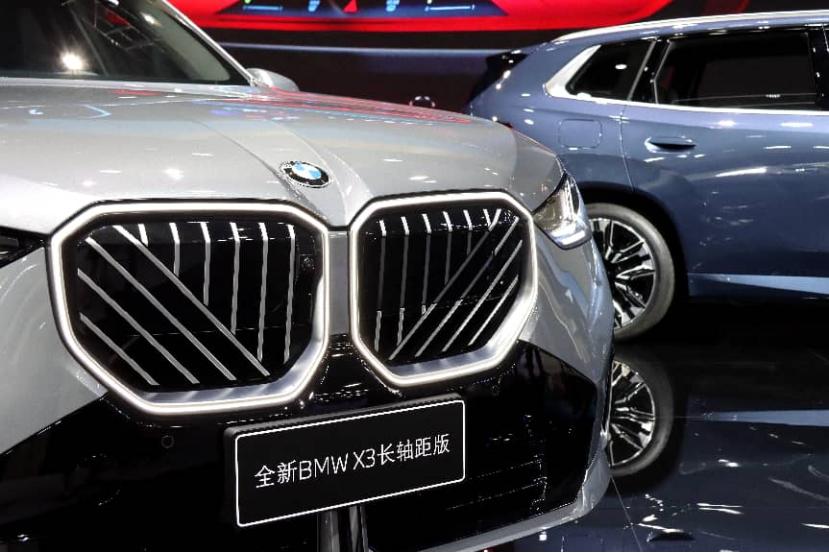
Core Viewpoint - The article highlights the life of a couple, Song Shouqing and Zhao Lanyun, who have transitioned from hard labor to a more comfortable lifestyle, including owning a BMW car and running a local restaurant, reflecting the positive impact of economic development and personal perseverance in rural China [1][2][3][4]. Group 1: Personal Background and Lifestyle - Song Shouqing and Zhao Lanyun, aged 65, have settled in Erguna City after years of working away from home, establishing a stable life with a restaurant called "Old Song's Restaurant" that serves local dishes [1][2]. - The couple's restaurant has gained popularity due to its use of locally sourced ingredients, attracting visitors from the city [2]. - They have also purchased a BMW X1, fulfilling a long-held dream, symbolizing their hard work and the rewards of their labor [3]. Group 2: Economic and Social Context - The couple benefits from government policies, including land allocation, which provides additional income, alongside their restaurant earnings and pensions [3]. - Their lifestyle reflects a broader trend of rural residents improving their living conditions and aspirations through local economic opportunities [1][3]. - The couple's story illustrates the changing dynamics in rural China, where traditional lifestyles are being complemented by modern conveniences and aspirations [4].
宝马降价20%大甩卖,但年轻人已经不迷信老派豪车了
3 6 Ke· 2026-01-16 03:58
Core Viewpoint - BMW has initiated a significant price reduction across 31 models in China, with discounts exceeding 10%, and some models seeing reductions over 20%, marking a strategic shift in response to market dynamics rather than a price war [1][3][5] Group 1: Price Reduction Details - The price cuts affect a diverse range of models, including electric vehicles like the i7 and iX1, as well as popular SUVs and sedans, but notably exclude bestsellers like the 3 Series and 5 Series [5][7] - The official statement from BMW claims this adjustment is a proactive strategy to upgrade product value rather than a reaction to competitive pricing pressures [3][5] Group 2: Market Context and Reactions - The automotive market has been experiencing intense competition, leading to various promotional strategies, including significant price cuts from competitors [7][10] - Despite BMW's official stance against price wars, dealers report that actual selling prices have not significantly decreased, indicating a disconnect between official pricing and market realities [3][5] Group 3: Sales Performance and Strategic Implications - BMW's sales in China have declined sharply, with a reported 12.5% drop in vehicle deliveries, highlighting the need for strategic adjustments to regain market share [11][13] - The brand's traditional strengths in performance and heritage are diminishing in the face of rising competition from domestic brands offering better value propositions [11][13] Group 4: Future Outlook - BMW is set to launch a new electric platform in 2026, which may help revitalize its market position, but the effectiveness of this strategy remains uncertain [15] - The price cuts may prompt other luxury brands within the BBA group to reconsider their pricing strategies in response to changing market conditions [15][16]

宝马降价30万元?深圳门店没动静
Shen Zhen Shang Bao· 2026-01-05 13:51
Core Viewpoint - BMW China has announced significant price reductions for several models, including a 301,000 yuan drop for the flagship i7 M70L, marking a 16% decrease from 1,899,000 yuan to 1,598,000 yuan [1] Group 1: Price Adjustments - The official price adjustment affects multiple popular models, with the electric SUV iX1 eDrive25L seeing a reduction from 299,900 yuan to 228,000 yuan, a decrease of approximately 24% [2][3] - Other models, including the X1 and 7 Series, also experienced varying degrees of price reductions [2] Group 2: Market Response - Despite the official price cuts, the actual terminal prices have not seen a corresponding decrease, remaining consistent with previous pricing [1][5] - Sales personnel indicated that while inquiries increased following the price announcement, actual purchases did not significantly rise [4][5] Group 3: Consumer Impact - The reduction in official prices has led to a decrease in existing cash discounts and trade-in subsidies, resulting in little change to the final purchase price for consumers [5] - For example, the effective landing price for the iX1 remains between 170,000 and 180,000 yuan, while the comparable gasoline version X1 is around 210,000 yuan [5] Group 4: Future Considerations - Sales representatives noted that upcoming changes in national and local purchase incentives may further increase vehicle costs, suggesting potential price hikes for certain models in the future [7]

9个月销量缩水近6万辆,宝马“最猛降价”还管用吗?
阿尔法工场研究院· 2026-01-05 00:03
Core Viewpoint - BMW China has initiated a significant price reduction across over 30 models, marking one of the most aggressive official price cuts in the past 30 years in China, which they describe as a "systematic value upgrade" as part of their strategy "for China, in China" [1][9]. Price Reduction Details - The price adjustment affects 31 key models, with most reductions exceeding 10%, and 24 models seeing cuts over this percentage, while 5 models have reductions greater than 20% [3]. - The largest price drop is for the i7 M70L, which decreased by 301,000 yuan, while the iX1 eDrive25L saw a reduction from 299,900 yuan to 228,000 yuan, a drop of 24% [4]. - The BMW 7 Series has also seen significant price adjustments, with the entry-level 735Li dropping from 919,000 yuan to 808,000 yuan (12% reduction) and the 740Li from 1,069,000 yuan to 938,000 yuan (12% reduction) [8]. Market Context - BMW's sales in China have declined significantly, with 465,400 vehicles delivered in the first three quarters of 2025, a year-on-year decrease of 11.2%, equating to a drop of 58,800 vehicles compared to the same period in 2024 [12]. - The price cuts occur amid a broader industry trend, with 16 automotive brands announcing promotional policies affecting nearly 70 models as of January 2, 2026 [12]. Strategic Implications - BMW officially denies that the price cuts are part of a "price war," framing them instead as a proactive response to market dynamics and an effort to alleviate pressure on dealers [9][10]. - Analysts suggest that the restructuring of pricing strategies may help maintain the health and stability of the sales system by allowing manufacturers to share some profit margins with dealers [10]. - The extensive nature of the price adjustments indicates a new competitive phase in the luxury car market, putting pressure on competitors to respond [16]. Industry Trends - The automotive market is expected to slow down in 2026, with multiple factors contributing to increased pressure on domestic demand growth [13]. - The traditional luxury car market is undergoing a transformation, with the rules of engagement being rewritten as transparency in pricing increases and high initial price settings become less viable [18][19].
出行观|宝马2026年第一天的官降,是为新世代车型清场?
Guan Cha Zhe Wang· 2026-01-03 04:57
Core Viewpoint - BMW is adjusting the suggested retail prices of 31 key models in China, with reductions ranging from 4% to 24%, in preparation for the launch of its "new generation" vehicles in 2026 [1][4]. Group 1: Price Adjustments - The number of models priced below 300,000 yuan has increased from 3 to 10, indicating BMW's strategy to compete for market share traditionally held by joint venture brands and mainstream domestic electric vehicle manufacturers [2]. - The price of the 225L M Sport version has dropped to 208,000 yuan, positioning it competitively against high-end models from Chinese brands [2]. - Electric vehicles are seeing the most significant price cuts, with the iX1 eDrive25L experiencing a 24% reduction, and the i7 M70L seeing a price drop of 301,000 yuan [2]. Group 2: Market Strategy - The price reductions for the X1 and iX1 models, with fuel versions dropping by 18-19% and electric versions by 24%, reflect the intense competition in the 200,000 to 300,000 yuan SUV market [2]. - The flagship models 735Li and 740Li have been repositioned to the 800,000 to 900,000 yuan range, indicating a response to the pressure from domestic luxury brands [3]. - BMW's price adjustments are seen as a move to clarify and standardize dealer discounts, enhancing transparency in pricing [3][5]. Group 3: Future Positioning - The price cuts are intended to clear out inventory of older technology platforms and create mental space for consumers ahead of the new generation models, which will feature advanced sixth-generation electric drive technology [4][6]. - By lowering the price floor for electric vehicles, BMW aims to maintain market share and visibility in China, ensuring that consumers continue to consider BMW when making purchasing decisions [6]. - The adjustments reflect a shift from a focus on brand premium to a product-driven strategy, emphasizing long-term growth over short-term profits in the evolving Chinese market [6].
宝马突然大范围调价,最高降30余万元
Chang Sha Wan Bao· 2026-01-02 13:16
Core Viewpoint - BMW China will adjust the suggested retail prices of several key models starting January 1, 2026, with some models seeing price reductions of over 300,000 yuan, aiming to enhance brand affinity and market competitiveness in China [1][3]. Price Adjustments - The flagship model i7 M70L will see a price drop of 301,000 yuan, from 1,899,000 yuan to 1,598,000 yuan, representing a 16% reduction [2]. - The highest price reduction is for the BMW iX1 eDrive25L, with the suggested price decreasing from 299,900 yuan to 228,000 yuan, a drop of 24% [3]. - The fuel version X1 will also see price cuts, with the X1 xDrive25Li dropping from 349,900 yuan to 288,800 yuan (18% reduction) and the X1 sDrive25Li from 316,900 yuan to 258,000 yuan (19% reduction) [3]. - The entry-level 735Li of the BMW 7 Series will decrease from 919,000 yuan to 808,000 yuan, while the 740Li will drop from 1,069,000 yuan to 938,000 yuan, both reflecting a 12% reduction [3]. Strategic Implications - BMW describes this price adjustment as a "systematic value upgrade," emphasizing its strategy of "for China, in China," aimed at lowering the purchase threshold and enhancing brand appeal [3]. - The new pricing allows consumers to purchase the BMW M235L for under 300,000 yuan and the 2 Series four-door coupe for less than 260,000 yuan, significantly lowering the entry barrier for potential buyers [3]. - This extensive price adjustment is expected to alter the competitive landscape of the domestic luxury car market, with the potential for Mercedes-Benz and Audi to respond with their own price changes, directly impacting the competitiveness of the three major German luxury brands [3].
年末行情:15个主流品牌大盘点
车fans· 2025-12-15 00:30
Group 1 - The article provides an overview of the latest market trends and discounts for popular car models from brands such as BYD, Geely, Chery, Volkswagen, Toyota, and BBA [1][2] - It emphasizes that the discounts mentioned are for cash purchases and do not include any government subsidies or financing options [3] Group 2 - For SAIC Volkswagen, models like the Lavida and Passat have significant cash discounts, with the Lavida new version priced at 7.99 million with a discount of 1.6 million, resulting in a final price of 7.4 million [4] - The Passat model offers discounts up to 5 million, bringing its price down to 15.6 million [4] - The Tiguan L also shows a discount of 5.2 million, leading to a final price of 15.2 million [4] Group 3 - GAC Toyota's Camry is highlighted as a top performer in the mid-size sedan category, with a price of 18.18 million and a discount of 4.4 million, resulting in a final price of 15.6 million [10] - The Highlander model also offers a competitive price with a final cost of 26.7 million after a discount of 4.5 million [10] Group 4 - Honda's Accord and CR-V models are presented with discounts, with the Accord priced at 19.78 million and a discount of 6.7 million, leading to a final price of 14.8 million [13] - The CR-V has a final price of 16.8 million after a discount of 5.3 million [13] Group 5 - Buick and Cadillac models are also featured, with the Buick Verano priced at 13.99 million and a discount of 6.5 million, resulting in a final price of 8.6 million [16] - The Cadillac CT5 offers a final price of 22.5 million after a discount of 1.5 million [16] Group 6 - Geely's popular models, such as the Boyue L and Xingyue L, show strong sales performance, with the Boyue L achieving 200,000 units sold in the first 11 months [20] - The article notes that younger consumers are increasingly choosing domestic brands, creating a stronger market presence for Geely [20] Group 7 - Chery's new models, particularly the fifth-generation Tiggo 8, are recommended as strong contenders in the market, with competitive pricing and discounts [23] - The article highlights the importance of considering government subsidies and trade-in offers when calculating final prices [23] Group 8 - BYD's Dynasty series showcases models like the Han EV and Song Pro, with significant discounts leading to competitive final prices [27] - The Ocean series is noted for its strong sales, attributed to models like the Dolphin and Seal, which appeal to younger consumers [30] Group 9 - The article concludes with a mention of luxury brands such as Volvo, Lexus, and Land Rover, highlighting their competitive pricing and discounts [33][34] - BMW and Audi are noted for their value propositions within the luxury segment, with significant cash discounts available [38][42]
“得用户者得天下”
Mei Ri Jing Ji Xin Wen· 2025-11-20 13:04
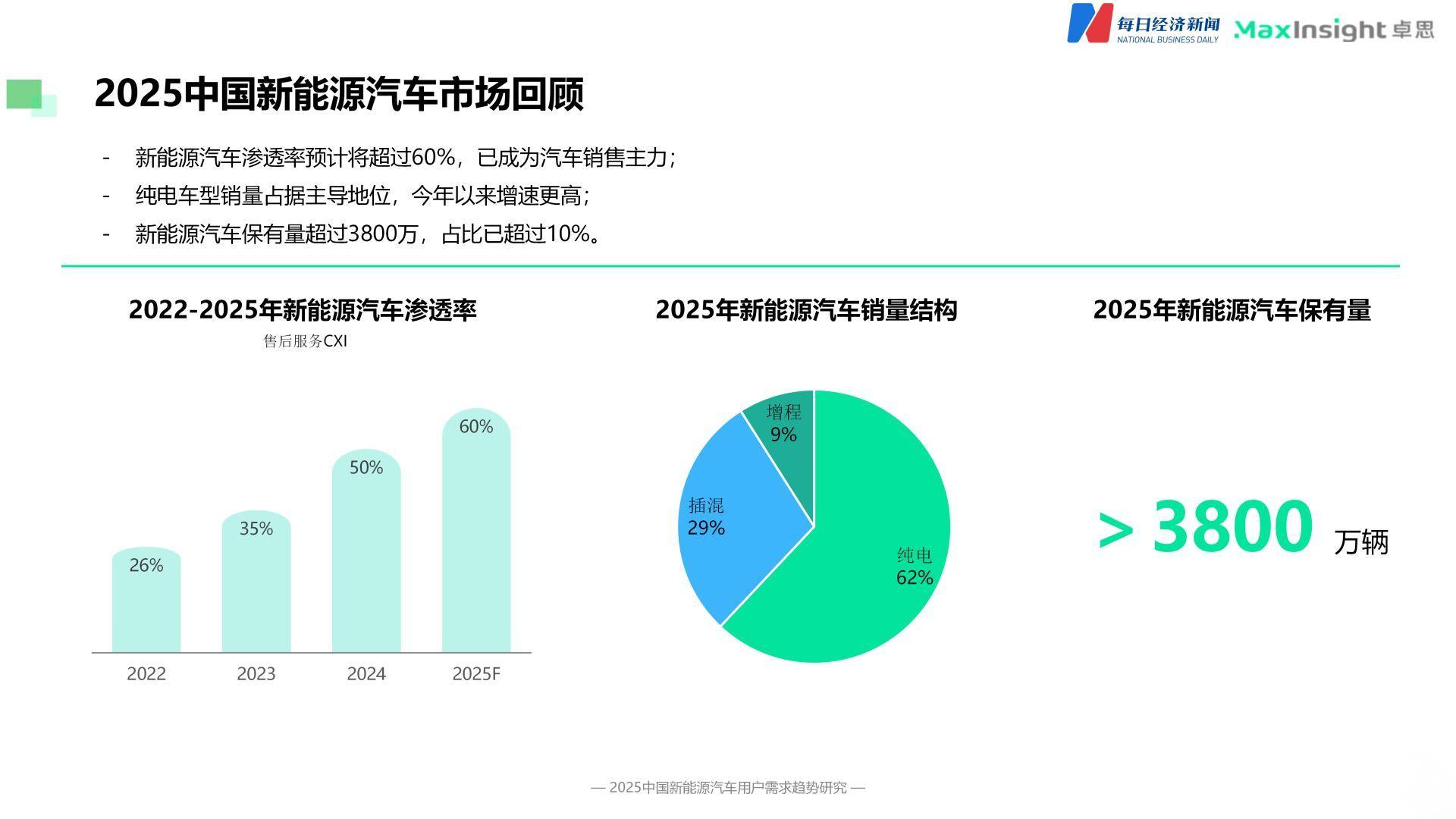
Core Insights - In 2025, China's new energy vehicle (NEV) ownership is expected to exceed 38 million, accounting for over 10% of total vehicle ownership, with a market penetration rate projected to surpass 60% [1] - The shift in consumer purchasing motivations indicates a transition from reliance on policies and technology to a focus on user experience and comprehensive product value [1][4] User Decision-Making Changes - The core purchasing motivation has shifted from "policy" to "product," with driving experience, comfort, and smart features becoming the primary drivers [2] - The average number of factors considered by consumers during the purchasing process has increased from 4.2 to 5.9, with a heightened focus on vehicle safety and smart configurations [2] Competitive Landscape - The competitive landscape is evolving, with consumers comparing models like the Li Auto L6 against a range of pure electric and smart vehicles, indicating a shift to "cross-brand electric comparisons" [3] - The average range of pure electric vehicles has improved from 450 km in 2022 to 530 km in 2025, alleviating previous concerns about range anxiety [3] Industry Transformation - The industry is moving away from a policy-driven phase to a user-value-driven phase, as financial subsidies decline and market competition intensifies [4] - Key consumer demands include high cost-performance ratio, absolute safety, and advanced smart features, which are essential for purchasing decisions [5][6] Smart Features as a Market Differentiator - Smart features are becoming critical for high-end models, with excellent smart experiences helping products stand out, while mid-range models are rapidly evolving in this area [7] - The evolution of smart features is now a significant factor influencing user experience and attracting traditional fuel vehicle users to NEVs [7] Future Market Outlook - The automotive market is expected to become more competitive by 2026, facing challenges such as reduced subsidies and increased product homogeneity [8] - The implementation of new safety standards for electric vehicle batteries will raise safety benchmarks, while ongoing technological advancements will drive the industry towards a healthier value return phase [8]
“得用户者得天下”!2025年新能源车渗透率或超60%,智能出行是未来3至5年竞争高地
Mei Ri Jing Ji Xin Wen· 2025-11-20 04:28
Core Insights - In 2025, China's new energy vehicle (NEV) ownership is expected to exceed 38 million, accounting for over 10% of total vehicle ownership, with a market penetration rate projected to surpass 60% [1][5] - The shift in consumer decision-making reflects a transition from policy-driven motivations to a focus on user experience, with driving experience, comfort, and intelligent features becoming the primary drivers of purchase decisions [5][6] Market Trends - The average number of factors considered by consumers during the car-buying process has increased from 4.2 to 5.9, with a heightened focus on vehicle safety and intelligent configurations [6] - The competitive landscape is evolving, with consumers increasingly comparing electric models against each other rather than against traditional fuel vehicles [11] User Preferences - Users are moving from "basic anxiety" regarding range to a pursuit of quality, as the average range of pure electric vehicles has improved from 450 km in 2022 to 530 km in 2025 [12] - Key consumer demands include high cost-performance ratio, absolute safety, and advanced intelligent features, which are now essential for market competitiveness [12][21] Future Outlook - The market is expected to face intensified competition by 2026, with challenges such as reduced subsidies and increased product homogeneity, yet opportunities exist for products that genuinely meet consumer needs [22] - The implementation of new safety standards for electric vehicle batteries in July 2026 will raise safety requirements, pushing the industry towards healthier value recovery [22]