汇添富消费行业

Search documents
基金分析报告:长期成长基金池202602:超额收益稳中有升
Guolian Minsheng Securities· 2026-02-14 05:29
Group 1 - The long-term growth investment strategy focuses on allocating to industries that can achieve sustained and stable profit growth over 5-10 years or longer, with representative sectors including food and beverage, and pharmaceuticals [10][11] - Selected long-term growth sectors are primarily concentrated in non-ferrous metals and electric power and public utilities [10] - The historical excess returns of the long-term growth fund pool have been stable, with an annualized return of 14.11% from February 7, 2014, to February 6, 2026, outperforming the equity fund index by 3.98% [13] Group 2 - The definition of long-term growth funds is based on the attributes of the held industries and stocks, requiring that growth stocks constitute an average of over 60% of the top holdings over the past year [22] - The screening of the long-term growth fund pool focuses on funds with strong profitability, higher management efficiency, and expected higher dividends [23] - The latest long-term growth fund pool includes funds such as Huaxia Consumption Upgrade A, Great Wall Brand Selection A, and Penghua Quality Growth A, with varying scales and returns [2][23] Group 3 - The long-term growth fund pool has shown strong industry allocation and stock selection capabilities, with a preference for large-cap and growth-oriented stocks [7] - The latest fund composition has significantly reduced holdings in cyclical, manufacturing, and pharmaceutical sectors, with approximately 86% of the portfolio allocated to consumer sectors [19][20] - The fund pool's performance has been affected by short-term fluctuations in the consumer sector, but it has demonstrated resilience during market downturns [13]
“业绩为王”时代来了,哪些基金经理有被降薪可能?
Xin Lang Cai Jing· 2025-12-08 04:16
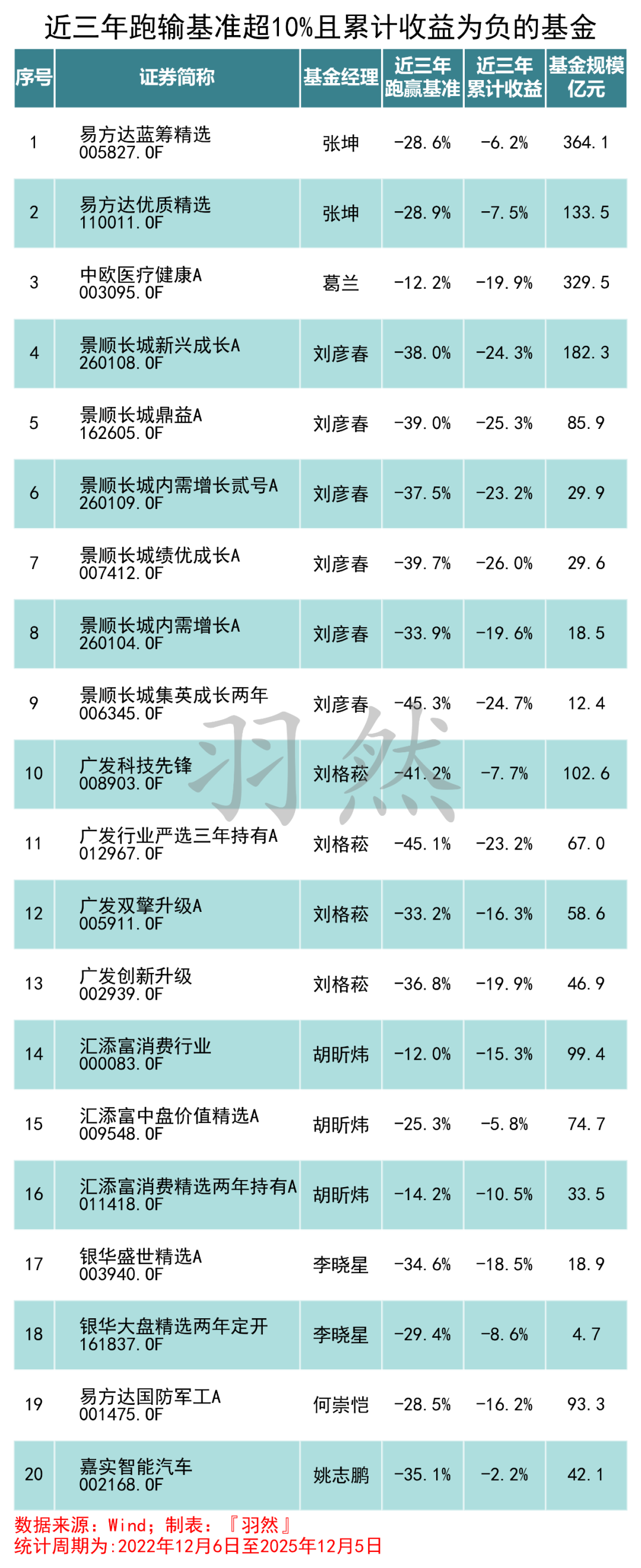
Core Viewpoint - The new guidelines for fund manager compensation will significantly tie salaries to performance, marking a shift towards a performance-driven culture in the public fund industry [2][6]. Summary by Relevant Sections Performance-Based Compensation - The new regulations require fund managers' performance pay to be closely linked to three-year performance metrics, with mandatory salary reductions of at least 30% for products that underperform their benchmarks by over 10% and incur losses [2][6]. - This change indicates a decline in the reliance on the "star fund manager" phenomenon, emphasizing that performance will now be the primary measure of success in the industry [2][6]. Impact on Fund Managers - A number of prominent fund managers, particularly those managing actively managed equity funds exceeding 20 billion, are at risk of salary reductions due to poor performance over the past three years [2][7]. - Specific funds that have crossed the performance threshold include: - E Fund Blue Chip Selection: underperformed by 28.6% with a cumulative loss of 6.2% [3][10]. - E Fund Quality Selection: underperformed by 28.9% with a cumulative loss of 7.5% [3][10]. - Other funds managed by Liu Yanchun and Liu Gesong also show significant underperformance [5][10]. Cultural Shift in the Industry - The new guidelines represent not just a salary adjustment but a cultural transformation within the industry, encouraging absolute return strategies and a focus on risk management and positive returns rather than merely relative rankings or asset growth [5][11]. - The emphasis will shift towards a more rational evaluation of fund managers' past performances, moving away from blind admiration for top performers to a focus on their long-term profitability [6][11]. - The era of high salaries disconnected from performance is coming to an end, prompting both fund managers and investors to reassess the meaning of "performance" in terms of actual returns [6][11].

长期成长基金池202511:超额稳健提升
Minsheng Securities· 2025-11-18 11:59
Group 1 - The long-term growth investment strategy focuses on allocating to industries that are likely to achieve sustained and stable profit growth over 5-10 years or longer, with representative industries including food and beverage, and pharmaceuticals. Current selected long-term growth sectors are primarily concentrated in non-ferrous metals and electricity and public utilities [1][7][10] - The long-term growth fund pool has shown historical excess returns, with an annualized return of 14.30% from February 7, 2014, to November 11, 2025, outperforming the equity fund index by 4.47%. The fund pool has a volatility of 20.96% and a Sharpe ratio of 0.68, indicating a high investment cost-performance ratio [1][10][12] - The fund pool demonstrates strong industry allocation and stock selection capabilities, with stock selection consistently contributing to excess returns. The latest portfolio shows a significant reduction in liquidity preference, with a primary focus on consumer sectors and an increased allocation to the pharmaceutical industry [1][10][18] Group 2 - The definition of long-term growth funds is based on the attributes of the holding industries and stocks, requiring that the average proportion of growth stocks in the top holdings over the past year exceeds 60%, with a minimum of 40%. Additionally, the proportion of long-term growth stocks in the top holdings must exceed 40% [2][20] - The latest long-term growth fund pool includes several funds, with notable performances such as "汇添富大盘核心资产 A" achieving a return of 30.55% and "前海开源国家比较优势 A" returning 9.50% [2][21] - The long-term growth fund pool is primarily focused on sectors with strong profitability, higher management efficiency, and expected higher dividends, with a sample of funds selected based on these criteria [2][21] Group 3 - The long-term growth sectors selected for analysis include non-ferrous metals, electricity and public utilities, with specific industries showing significant net profit growth rates over 5 and 10 years, such as copper at 58.54% and gas at 42.07% [8][9] - The historical performance of the long-term growth fund pool indicates that it has generally outperformed the equity fund index, particularly in bull markets, while also managing to control drawdowns during market downturns [10][12][13] - The latest portfolio shows a significant allocation to consumer sectors, with approximately 66% of the positions in consumer-related industries, reflecting a strategic shift towards increasing exposure to the pharmaceutical sector [18][19]
上一轮牛市买的主动权益基金,近40%未回本
2 1 Shi Ji Jing Ji Bao Dao· 2025-11-12 13:49
Core Insights - The recent performance of active equity funds has been under scrutiny, with over 38% of these funds still in losses over the past five years despite a significant number achieving positive returns since 2025 [1][2][3] - Key factors contributing to the underperformance include high-level accumulation, frequent trading, and reliance on specific sectors, which have eroded fund values [1][5][7] Performance Overview - As of November 10, 2025, the Shanghai Composite Index has risen by 19.42%, while 97.45% of active equity funds reported positive returns [2][3] - However, 1019 active equity funds remain in losses, with 38% of the total, indicating a stark contrast in performance for investors who entered the market earlier [1][2] Fund Performance Analysis - Among the 2695 active equity funds with over five years of existence, 1676 have achieved positive returns, with six funds reporting over 200% returns [3] - Conversely, nearly 40% of active equity funds have not turned a profit in five years, with some funds experiencing maximum drawdowns starting in 2021 [3][4] Underperforming Funds - Notable underperformers include funds managed by well-known managers, with losses exceeding 30% over five years [4] - Specific funds like Tianzhi New Consumption and Fangzheng Fubang Innovation Power have reported losses of -65.25% and -62.32%, respectively [3][4] Trading Behavior - High average stock positions during market peaks have been linked to poor long-term performance, with funds showing an average stock position of 84.22% during critical periods [5][6] - Frequent trading has also negatively impacted fund performance, with an average turnover rate of 460.71% across all active equity funds, rising to 508.45% for those with over 30% losses [7][8] Sector Reliance - Many funds have shown over-reliance on traditional sectors, leading to underperformance despite being labeled as "new" or "growth" funds [8][9] - Funds like Tianzhi New Consumption and Invesco Great Wall New Growth have shifted their holdings but still struggle to achieve positive returns [8][9] Market Outlook - The active equity fund market is seeing a resurgence, with 1354 new funds launched in 2025, indicating renewed investor interest [11] - Fund managers are advised to focus on sectors with long-term growth potential, such as high-end manufacturing and new consumption, while being cautious of market volatility [12]
上一轮牛市买的主动权益基金,为何还有4成未回本?
2 1 Shi Ji Jing Ji Bao Dao· 2025-11-12 12:13
Core Insights - The article highlights the performance of active equity funds in the context of the Shanghai Composite Index surpassing 4000 points for the first time in a decade, revealing that over 97% of these funds achieved positive returns since 2025, yet 38% remain in losses over the past five years [1][2][3] - Key reasons for the underperformance of many active funds include high-level accumulation, frequent trading, and reliance on specific sectors, which have eroded fund values [1][5][6] Performance Overview - As of November 10, the Shanghai Composite Index closed at 4018 points, marking a significant recovery, with major indices like the Shenzhen Composite and ChiNext Index showing gains of 27.6% and 46.35% respectively since 2025 [2] - Despite a high percentage of active equity funds showing positive returns in 2023, the long-term performance reveals a stark contrast, with many investors experiencing losses since entering the market around the end of 2020 [2][3] Fund Performance Analysis - Among the 2695 active equity funds with over five years of existence, 1676 have achieved positive returns, while nearly 40% remain unprofitable, with some funds experiencing drawdowns exceeding 50% [3][4] - Notable underperformers include funds managed by well-known managers, indicating that even established names are not immune to market challenges [4] Causes of Underperformance - High-level accumulation during market peaks has been identified as a significant factor contributing to the long-term underperformance of active equity funds [5][6] - Frequent trading has also negatively impacted fund performance, with average turnover rates for underperforming funds significantly higher than the market average [7][8] Market Trends and Future Outlook - The article notes a shift in investor sentiment towards active management products, with a notable increase in the number of newly established funds and a doubling of issuance scale compared to the previous year [11] - Fund managers are advised to focus on sectors with long-term growth potential, such as high-end manufacturing and new consumption, while being cautious of over-reliance on specific themes or sectors [12]
金融产品每周见:消费行业基金:从投资能力分析到基金经理画像-20251107
Shenwan Hongyuan Securities· 2025-11-07 15:30
1. Report Industry Investment Rating No relevant content provided. 2. Core Views of the Report - Based on fund holdings, consumption - related funds can be classified into five types, with most fund managers adopting the "segmented track (mainly liquor)" strategy [3]. - Consumption - related funds can generate relatively stable excess returns in the long - term compared to the sector index, are relatively good at stock - picking in certain industries, and it's difficult to identify their stock - picking ability for consumer stocks compared to all - industry funds [3]. - When comparing consumption - related funds with different style characteristics from seven dimensions, high turnover may lead to high returns recently, high - ROE style funds usually have high dividend attributes, etc. [3]. - To screen the observation list of consumption - related funds, quantitative indicators such as excess performance momentum, performance in favorable and unfavorable environments, stock - picking ability, etc. can be referred to [3]. 3. Summary According to the Directory 3.1 Classification of Consumption - Related Funds - The classification method is based on the fund's full - position data and heavy - position stock data in a certain sector. For consumption funds, some Hong Kong stocks are additionally included. Most of the top 10 consumption - related funds in terms of scale have some commonalities in allocation [6]. - Consumption - related funds are classified into five types: consumption + satellite, sector rotation, segmented track, consumption rotation, and consumption equilibrium, with "segmented track (mainly liquor)" being the most commonly adopted strategy [3]. 3.2 Holding Characteristics: Can Consumption - Related Funds Create Positive Excess Returns? - As a whole, consumption - related funds have similar performance to the consumption sector index before 2025, and have achieved certain excess returns compared to the index since this year [22]. - Consumption - related funds are relatively good at stock - picking in industries such as household appliances, textile and apparel, agriculture, forestry, animal husbandry and fishery, etc., and have prominent excess returns in some industries during certain periods [23][26]. - It's difficult to determine whether consumption - related fund managers have stronger stock - picking ability for consumer stocks compared to all - industry funds [28]. - Consumption - related funds prefer to allocate liquor in food and beverage, and their individual - stock allocation is relatively stable. They had positions in new - consumption stocks earlier [36]. - Through cluster analysis, different types of consumption - related funds can be identified, such as those focusing on agriculture, forestry, animal husbandry and fishery, those focusing on liquor investment, etc. [39] 3.3 Comparison of Consumption - Related Funds with Different Style Characteristics - In terms of turnover trading, high - turnover consumption - related funds have better short - term performance recently, and some liquor - themed funds with low turnover have return drag. In the long - term, both high - and low - turnover funds have excellent performers [42][44]. - In terms of holding style, funds with high ROE generally have high dividend attributes. Different segmented tracks have significant differences in market - value styles [48][52]. - In terms of holding popularity, the structure of market - preferred stocks in the consumption sector has changed significantly, and there are excellent performers in various types of products [53]. - In terms of left - and right - side investment, consumption - related funds are generally on the right side of the market median, and there are excellent performers on both sides [59]. - In terms of stock - picking ability, by calculating the skewness, kurtosis, and mean/standard deviation of stock - picking returns, funds with strong stock - picking ability can be found [60][62]. - In terms of adaptability to different market environments, different types of products show different adaptability results, and there are products with strong performance in favorable or unfavorable environments [63][65]. - In terms of segmented - track rotation, there are both products with good and poor rotation effects among consumption - related funds [71]. 3.4 Observation List of Consumption - Related Funds - The screening of the observation list refers to quantitative indicators such as excess performance momentum, performance in favorable and unfavorable environments, stock - picking ability, left - and right - side investment ability, and segmented - track rotation effect. Other factors such as the fund manager's tenure and fund scale are also considered [75]. - The observation list includes funds like E Fund Long - Term Value, Cathay Pacific Consumption Optimization, Changxin Multi - Benefit, etc. [3][76]
百亿基金经理阵营重回百人关,新贵vs老将谁更能打?
Di Yi Cai Jing· 2025-11-06 12:08
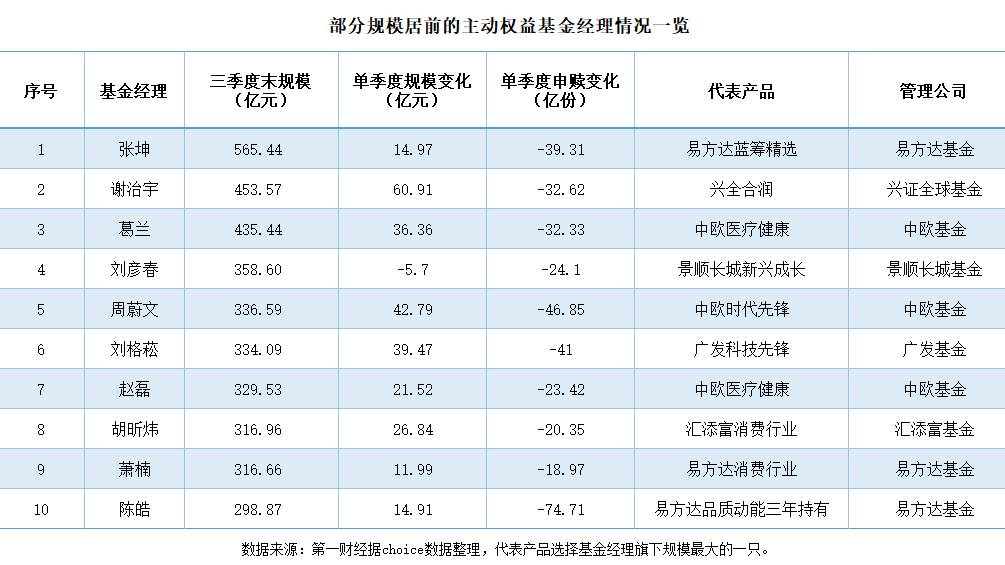
Core Insights - The number of fund managers managing over 10 billion yuan has increased significantly, reaching 109 by the end of Q3, marking a nearly one-third increase from the previous quarter [1][2] - The industry is transitioning from a "star-making" model to a "platform" strategy, indicating a shift in focus from individual fund managers to a more collaborative approach [1][9] - The era of "trillion-level" top fund managers is unlikely to return, as the highest management scale among current fund managers has not exceeded 600 billion yuan, a significant drop from previous peaks [9][10] Fund Manager Performance - Notable fund managers like Zhang Kun, Xie Zhiyu, and Ge Lan have seen their management scales rebound, with Zhang Kun managing 565.44 billion yuan, an increase of nearly 15 billion yuan in a single quarter [3][4] - Newer fund managers, such as Ren Jie from Yongying Fund, have rapidly increased their management scales, with Ren's scale growing from 0.26 billion yuan to 128.78 billion yuan in just over a year [2][7] - Despite the growth in management scales, many top fund managers still face net redemptions, with over 330 billion units redeemed across their products in Q3 [6][11] Industry Dynamics - The current landscape features a mix of large institutions and emerging mid-sized firms, with companies like Yongying and Jinying successfully entering the "billion club" [1][7] - The top fund managers are distributed across 38 fund companies, with seven companies having five or more billion-yuan fund managers, accounting for nearly half of the total [6][10] - The industry is increasingly aware of the "double-edged sword" of scale, with many fund managers opting to limit rapid growth to maintain operational effectiveness and avoid the pitfalls of excessive scale [10][11] Market Outlook - The A-share market is experiencing a steady upward trend, with increased investor enthusiasm and significant inflows into equity markets, particularly in technology sectors [12][13] - Fund managers express cautious optimism about the market, predicting potential new highs while acknowledging the risks of profit-taking due to previous gains [12][13] - Long-term investment strategies focus on sectors like innovative pharmaceuticals and consumer healthcare, driven by structural changes in the economy and supportive policies [14]
那些曾被赋予光环的明星基金经理,跑赢大盘了吗?
3 6 Ke· 2025-08-15 01:59
Core Insights - The performance of star fund managers in the current bull market is mixed, with some outperforming the market while others lag behind [1][2]. Market Performance - As of August 13, the Shanghai Composite Index has risen by 9.90% year-to-date, the Shenzhen Component Index by 10.91%, and the ChiNext Index by 16.57%. The Wind Mixed Equity Fund Index has yielded 19.67% this year and 38% over the past year [1]. Star Fund Managers' Performance - Nearly 20 star fund managers have managed over 200 billion yuan in assets as of the end of Q2, showcasing diverse investment styles including growth, value, balanced, and thematic approaches [2]. - Notable performers include Ge Lan and Fu Pengbo, with Ge Lan's funds achieving returns of 26.60%, 67.85%, and 1.88% year-to-date, while Fu Pengbo's fund has returned 32.11% [3][4]. Sector Highlights - The innovative drug sector has been a standout, with Ge Lan's focus on this area leading to significant returns, particularly from Hong Kong-listed innovative drug stocks [3]. - Fu Pengbo has increased holdings in the pharmaceutical sector, focusing on innovative drugs and traditional medicine benefiting from AI [4]. Balanced Investment Styles - Xie Zhiyu and Zhu Shaoxing, known for their balanced investment styles, have shown performance divergence this year. Xie Zhiyu's funds have returned between 12.84% and 37.65%, while Zhu Shaoxing's single fund has returned 9.29% [5][6]. Challenges in Consumer Sector - Liu Yanchun, focusing on consumer stocks, has faced challenges with returns ranging from 0.13% to 2.43% year-to-date, as the consumer sector struggles with demand and competition [7]. - Xiao Nan's consumer-focused funds have also shown mixed results, with one fund down 3.45% while another gained 15.97% [8]. Broader Market Trends - The current market environment emphasizes the importance of sector selection over individual stock-picking abilities, as many star fund managers have not outperformed the market [9]. - The industry is reflecting on the definition of "star fund managers," suggesting that long-term risk management may be more indicative of skill than short-term performance spikes [9].
那些曾被赋予光环的明星基金经理,跑赢大盘了吗?
经济观察报· 2025-08-14 11:41
Core Viewpoint - The performance of billion-level star fund managers during the current bull market is mixed, with some achieving significant returns while others underperforming the market [1][3]. Market Overview - The A-share market has shown a bullish trend with the Shanghai Composite Index up 9.90%, the Shenzhen Component Index up 10.91%, and the ChiNext Index up 16.57% as of August 13 [2]. - The Wande Equity Mixed Fund Index has a year-to-date return of 19.67% and a one-year return of 38% [2]. Star Fund Managers Performance - Approximately 20 star fund managers with over 200 billion yuan in assets under management have diverse investment styles, including growth, value, balanced, and thematic strategies [3]. - Some star fund managers have successfully captured market trends, while others have lagged behind the market [3]. Notable Performers - Fund managers Ge Lan and Fu Pengbo have shown impressive performance, with Ge Lan managing three funds totaling 399.08 billion yuan, achieving returns of 26.60%, 67.85%, and 1.88% year-to-date [5]. - Fu Pengbo's fund, Ruiyuan Growth Value, has a return of 32.11% this year and 51.91% over the past year, with significant holdings in sectors like PCB and new energy [5][6]. Balanced Investment Style - Fund managers Xie Zhiyu and Zhu Shaoxing, known for their balanced investment styles, have shown performance divergence this year [7]. - Xie Zhiyu manages three funds with returns of 12.84%, 27.54%, and 37.65% year-to-date, benefiting from a diversified portfolio across various sectors [8]. - Zhu Shaoxing's single fund, with a return of 9.29% this year, has been negatively impacted by poor performance in consumer stocks, particularly in the liquor sector [9]. Challenges in Consumer Sector - Fund managers focusing on consumer and new energy sectors face significant challenges due to market conditions [10]. - Liu Yanchun's six funds have returns ranging from 0.13% to 2.43% this year, heavily affected by the underperformance of consumer stocks, particularly in the liquor industry [11]. - Xiao Nan's consumer-focused funds have shown a stark performance difference, with one fund down 3.45% and another up 15.97% year-to-date [12]. Market Dynamics - The current market environment emphasizes the importance of sector selection over individual stock-picking abilities, as many star fund managers have not outperformed the market [13]. - A reevaluation of what constitutes a "star fund manager" is underway, with a focus on long-term performance and risk management rather than short-term gains [14].

葛兰、张坤等明星基金经理们跑赢指数了吗?
Jing Ji Guan Cha Wang· 2025-08-14 10:12
Market Overview - The A-share market has shown a bullish trend in 2023, with the Shanghai Composite Index up 9.90%, the Shenzhen Component Index up 10.91%, and the ChiNext Index up 16.57% as of August 13 [2] - The Wind data indicates that the Wande Equity Mixed Fund Index has a year-to-date return of 19.67% and a one-year return of 38% [2] Star Fund Managers Performance - Approximately 20 star fund managers managing over 20 billion yuan have shown mixed performance during the bullish market, with some outperforming the market while others lagged behind [2] - Notable fund managers include Ge Lan and Fu Pengbo, who have achieved significant returns through their investment strategies [3] Sector Performance - Ge Lan's funds, particularly in the healthcare sector, have performed exceptionally well, with returns of 26.60% and 67.85% for her medical-themed funds [3] - Fu Pengbo's "Ruiyuan Growth Value" fund has a year-to-date return of 32.11%, focusing on sectors like PCB and new energy [3][4] Balanced Investment Style - Xie Zhiyu has shown a balanced investment style with returns of 12.84%, 27.54%, and 37.65% across his three funds, benefiting from diversified sector exposure [5] - In contrast, Zhu Shaoxing's single fund has underperformed with a return of 9.29%, primarily due to poor performance in consumer stocks [6] Challenges in Consumer Sector - Liu Yanchun's funds, focused on consumer stocks, have struggled with returns ranging from 0.13% to 2.43% due to weak performance in the consumer sector, particularly in the liquor industry [7] - Xiao Nan's consumer-themed funds have shown significant performance disparity, with one fund down 3.45% while another is up 15.97% [8] Market Dynamics and Reflections - The current market environment emphasizes the importance of sector selection over individual stock-picking abilities, as many star fund managers have not outperformed the market [9] - There is a growing sentiment within the industry to redefine what constitutes a "star fund manager," focusing on long-term performance and risk management rather than short-term gains [9]