
磷化工

Search documents
迫近历史新高的化工板块,底层逻辑究竟是什么?
虎嗅APP· 2026-03-12 14:19
Core Viewpoint - The chemical industry, while complex and often overlooked, is experiencing a resurgence due to geopolitical factors, particularly rising oil prices, which have brought the sector back into focus for investors [5][6]. Group 1: Market Dynamics - The basic chemical index has shown a two-phase market performance, nearing historical highs from 2021 [8]. - The first phase began in July 2025 with the introduction of "anti-involution" policies, leading to coordinated production cuts among industry leaders, which improved supply expectations and ended a prolonged bottoming phase [9]. - The second phase, from early 2026 to the present, has been characterized by a surge in the basic chemical index, driven by heightened interest in cyclical sectors and rising international oil prices [11]. Group 2: Global Perspective on China's Chemical Industry - China's chemical industry is a global leader, with a total output value projected to reach 16 trillion yuan in 2024, accounting for 12% of the national industrial output [17]. - In 2022, China's chemical product sales accounted for 44% of the global total, with capital expenditures and R&D spending also leading globally [18]. - The industry is often misperceived as purely domestic; however, it is heavily reliant on imports for key raw materials, with over 70% dependence on imported crude oil [20]. Group 3: Competitive Advantages - China's chemical industry exhibits a dual focus on cost and technology, with a strong emphasis on bulk chemicals while catching up in fine chemicals [22]. - The country has achieved significant scale in bulk chemicals, with global production shares for products like methanol and PTA reaching 60% and 71%, respectively [30]. - In fine chemicals, while there is still a reliance on imports for high-end products, domestic companies are beginning to break the monopolies of foreign giants in certain segments [32]. Group 4: Supply-Side Dynamics - The supply side is crucial for understanding the chemical industry's pricing and profitability, with recent years seeing a shift from overcapacity to relative balance due to stricter regulations [37]. - The geopolitical situation, particularly in the Middle East, is expected to lead to a systemic clearing of global chemical capacities, benefiting Chinese companies due to their cost advantages [42][46]. - Future profitability in the chemical sector will depend on the certainty of earnings adjustments, with a focus on supply constraints rather than broad demand recovery [48].

中信证券:中东局势从短期激烈冲突转向持续的小规模混乱,涨价为矛,增加低估值敞口,高估值板块情绪降温
Xin Lang Cai Jing· 2026-03-08 09:34
Group 1 - The core viewpoint is that the market sentiment for high valuation sectors may continue to cool, while the relative advantage of low valuation factors will gradually manifest [1][3][4] - The ongoing situation in the Middle East is shifting from short-term intense conflict to sustained small-scale chaos, which may impact global energy prices and economic concerns [2][15] - The policy design aimed at enhancing corporate quality and efficiency is expected to be the main theme for the next five years, reflecting a shift from traditional production scale expansion to improving profitability [9][22] Group 2 - The emotional sentiment in high valuation sectors has shown signs of decline, with significant fluctuations in investor sentiment indices observed during the spring market [3][16] - There is a potential shift in market styles between large and small caps, as well as between high and low valuation stocks, which may be accelerated by the Middle East conflict [4][17] - The revaluation space for Chinese resources and traditional manufacturing industries remains substantial, especially if return on equity (ROE) returns to reasonable levels [6][19] Group 3 - The current market configuration suggests a focus on sectors with competitive advantages and high barriers to overseas capacity reset, such as chemicals, non-ferrous metals, and renewable energy [11][22] - The report emphasizes the importance of profit margin recovery in various industries, as many sectors are still below historical profit margin levels [8][21] - The recommendation includes increasing exposure to low valuation factors, particularly in industries like insurance and brokerage, which are currently rare [11][22]

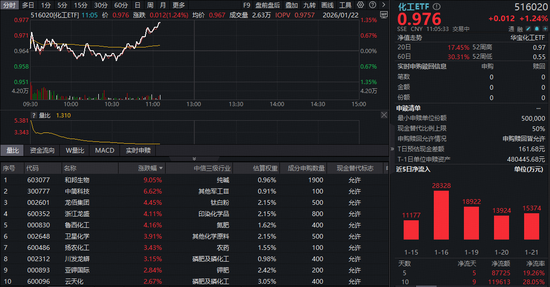
化工行情燃爆!化工ETF(516020)突然拉升涨超1%,资金疯狂涌入!
Xin Lang Cai Jing· 2026-01-22 03:23
Core Viewpoint - The chemical sector is experiencing a strong upward trend, with the chemical ETF (516020) showing a price increase of 1.24% as of January 22, 2026, driven by significant gains in stocks such as Hebang Biotechnology and Zhongjian Technology [1][8]. Group 1: Market Performance - The chemical ETF (516020) has seen a net inflow of over 870 million yuan in the last five days and nearly 1.2 billion yuan in the last ten days [3][10]. - Key stocks in the sector include Hebang Biotechnology, which surged over 9%, and Zhongjian Technology, which rose over 6% [1][8]. Group 2: Industry Outlook - Dongfang Securities is optimistic about the chemical industry, citing a collective shift in corporate strategies that could lead to improved market conditions [3][10]. - The report highlights five areas of focus: MDI, petrochemicals, phosphate chemicals, PVC, and polyester bottle chips [3][10]. Group 3: Investment Opportunities - Huaxin Securities notes that while the overall chemical industry remains weak, certain sub-sectors like lubricants have outperformed expectations [3][11]. - Investment opportunities are suggested in glyphosate, fertilizers, import substitution, domestic demand, and high-dividend assets [3][11]. Group 4: ETF Structure - The chemical ETF (516020) tracks the CSI sub-sector chemical industry theme index, with nearly 50% of its holdings in large-cap leading stocks like Wanhua Chemical and Salt Lake Industry [4][11]. - The remaining 50% is diversified across leading stocks in phosphate fertilizers, fluorine chemicals, and nitrogen fertilizers [4][11].





投顾晨报:慢牛预期强化,把握中盘蓝筹-20260121
Orient Securities· 2026-01-21 12:11
Core Insights - The report emphasizes a "slow bull" market expectation, suggesting a shift from a previous "crazy bull" sentiment to a more stable outlook, maintaining confidence in mid-cap blue chips and cyclical sectors [2][3] - The cyclical mid-cap blue chips, particularly in the chemical and non-ferrous sectors, are highlighted as key investment opportunities, with a focus on manufacturing and technology growth [3] - The chemical industry is undergoing a transformation, moving from a focus on market share to profitability, influenced by internal policy adjustments and external anti-dumping measures [3] Market Strategy - The report suggests maintaining a focus on mid-cap blue chips, particularly in cyclical and manufacturing sectors, with an emphasis on non-ferrous metals and chemicals, as well as smart vehicles and robotics [3] - Recommended ETFs include the Hang Seng ETF, Hang Seng Technology ETF, and various sector-specific ETFs such as the Chemical ETF and Non-ferrous ETF [3] Industry Analysis - The chemical industry is reaching the limits of market share expansion due to policy constraints and increased scrutiny on low-quality growth, signaling a need for companies to adjust their strategies [3] - Key areas of focus within the chemical sector include MDI, petrochemicals, phosphate chemicals, PVC, and polyester bottle chips, with a preference for companies demonstrating strong leadership advantages [3] - The zinc market is expected to see price increases due to favorable supply-demand dynamics, driven by infrastructure needs in developing regions and a tightening supply of zinc ore [4][3]
年末关口的强劲反弹能否延续?丨每周研选
Sou Hu Cai Jing· 2025-12-28 16:13
Core Viewpoint - The A-share market is experiencing a strong year-end rebound, with the Shanghai Composite Index achieving an eight-day consecutive rise, and trading volume in the Shanghai and Shenzhen markets returning to 2 trillion yuan, indicating a potential "spring rally" in the near future [4][6]. Group 1: Market Trends - The A-share market is showing signs of a "small rally" as it approaches the year-end, with significant trading volume and a notable rise in sectors such as non-ferrous metals, lithium mining, and commercial aerospace [8]. - The recent upward movement in the index is primarily driven by cyclical sectors, particularly non-ferrous metals, reflecting a recovery in market risk appetite [9]. - The current market environment is characterized by a "bottom consolidation" phase, preparing for a potential rally before the Spring Festival, rather than a full-blown upward trend [9]. Group 2: Capital Flow and Investment Strategies - Institutional buying power is expected to strengthen, driven by favorable policy expectations and a stable economic backdrop, with a notable increase in inflows into stock ETFs [10]. - The weak dollar and the appreciation of the RMB are enhancing the attractiveness of Chinese assets, leading to increased foreign investment [10]. - There is a strong willingness among various funds to enter the market, particularly as the new year approaches, indicating a potential continuation of the "spring rally" [11]. Group 3: Sector Focus and Investment Opportunities - High-growth sectors such as optical modules, PCB, and short-term supply-constrained areas like optical chips and high-speed copper cables are recommended for investment [12]. - The "price increase" narrative is acting as a catalyst for the current rally, with significant inflows into broad-based ETFs and a focus on sectors like chemicals and new energy materials [13]. - The consumption sector is also highlighted as a potential area for investment, given its relative underperformance this year and the supportive policy environment [16].
开源证券:8连阳后看本轮春季躁动的变化
智通财经网· 2025-12-27 13:38
Core Viewpoint - The strong inflow of incremental funds has driven the recent market rally, contributing to the Shanghai Composite Index achieving eight consecutive days of gains, and there is a recommendation to actively position for the upcoming spring market rally, focusing on both technology and cyclical sectors [1][2]. Group 1: Market Performance - As of December 26, 2025, the Shanghai Composite Index has achieved eight consecutive days of gains, marking the third occurrence since the "9.24" market rally in 2024 [2]. - The market has shown signs of recovery from previous adjustments, with three major factors influencing the market's positive outlook diminishing [2]. Group 2: Fund Inflows - December saw an unusual net inflow into broad-based ETFs, with a total net inflow of 110.6 billion yuan, primarily driven by the A500 ETF, which accounted for 101.9 billion yuan, or 92.2% of the total [3]. - The net inflow into the A500 ETF is likely to be new capital rather than a reallocation from other ETFs, indicating a strong demand for this specific fund [3]. Group 3: Investment Opportunities - The current macroeconomic environment, characterized by PPI recovery and anti-involution policies, alongside a weak dollar and increased demand for AI hardware, presents investment opportunities in various sectors, including chemicals, new energy materials, and electronic communication products [4]. - The investment strategy should focus on technology and PPI, with attention to new marginal changes, such as the strengthening of domestic demand policies and the potential for growth in commercial aerospace and satellite industries [5]. Group 4: Sector Allocation - Recommended sector allocations include technology sectors such as military, media (gaming), AI applications, and core AI hardware, as well as PPI beneficiaries like photovoltaic, chemicals, steel, and power [5]. - Long-term holdings should consider gold and optimized high-dividend stocks as part of the investment strategy [5].
华泰证券:春季躁动提前的能见度上升
Xin Lang Cai Jing· 2025-12-08 01:01
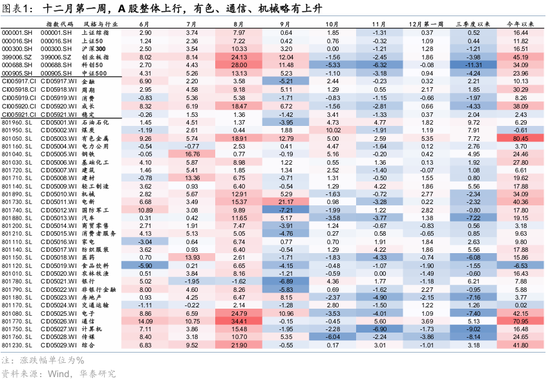
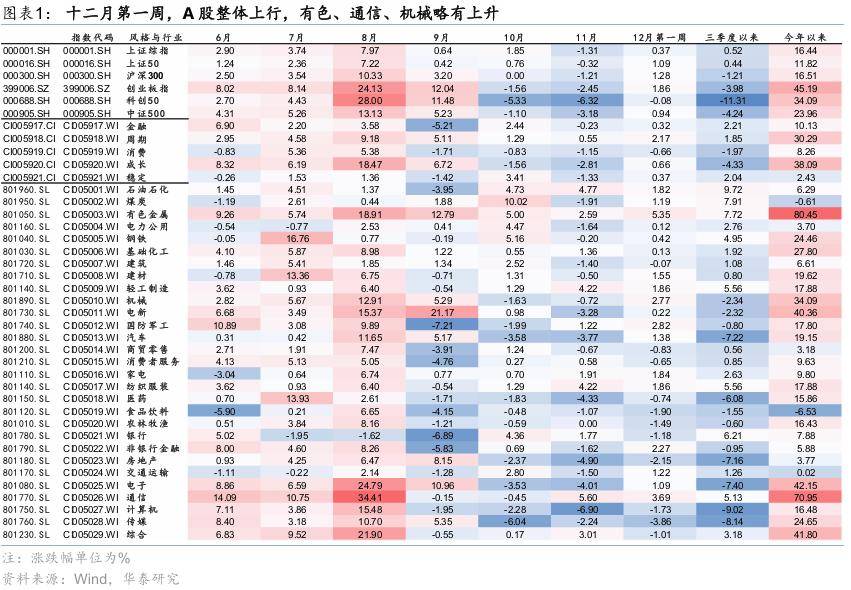
Core Viewpoint - The A-share market continues to rebound with reduced trading volume, supported by improved liquidity conditions and expectations of policy easing ahead of the Central Economic Work Conference [1][16]. Group 1: Funding Observation - Recent improvements in the funding environment include a slight recovery in margin trading balances and a decrease in the scale of net outflows from foreign capital [2][17]. - New equity funds have seen a slight decrease in shares, but the estimated positions of ordinary stock and mixed equity funds have increased [2][19]. - The number of newly issued ETFs has significantly increased, with 22 currently being issued, 10 awaiting issuance, and 11 pending approval [2][19]. Group 2: Economic Tracking - The overall industry prosperity index continued to decline in November, influenced by holiday effects on October production data [3][19]. - Key sectors showing improvement include TMT, upstream resources, and public industries, with notable recovery in AI applications, commodity prices, and consumer goods [3][19]. - Specific areas of focus include the AI chain, price increase chain, capital goods, consumer goods, and infrastructure chains [3][19]. Group 3: Policy Outlook - Expectations for policy changes are rising ahead of the December Political Bureau meeting and the Central Economic Work Conference, with anticipated focuses on proactive macro policies and expanding domestic demand [4][19]. - Historical data suggests a higher probability of market increases in the week leading up to the Central Economic Work Conference, particularly in sectors like consumer services and home appliances [4][19]. Group 4: Investment Strategy - The market is currently in a phase of recovery, with potential for a "spring surge" starting in mid-December [5][20]. - A balanced allocation between growth and cyclical sectors is recommended, with a focus on high-value consumption and financial sectors as long-term investment choices [5][20]. - Key sectors to watch include aviation equipment, AI chains, and power equipment for growth, while non-ferrous metals and certain chemicals are highlighted for cyclical investments [5][20].

华泰证券:12月中下旬“春躁”可能提前启动,均衡配置成长和周期
Sou Hu Cai Jing· 2025-12-07 23:59
Group 1: Core Insights - The funding environment has improved, with signs of recovery in allocation-type funds and a reduction in insurance risk factors potentially leading to increased equity asset allocation [2][4] - Recent trends indicate a marginal slowdown in trading funds, while private equity registrations have slowed to 178, but product issuance and positioning are expected to accelerate [2][3] Group 2: Economic Trends - The TMT sector, upstream resources, and public industries have shown significant improvement in economic sentiment over the past three months, with AI applications, price increases in commodities, and capital goods leading the way [3][4] - The construction PMI has strengthened, indicating a positive outlook for the infrastructure chain, while consumer goods such as cinema, cosmetics, and dairy products are also experiencing a recovery [3][4] Group 3: Policy Outlook - Anticipation of policy changes ahead of the December Political Bureau and Central Economic Work Conference is rising, with expectations for more proactive macro policies and a focus on expanding domestic demand [4] - Historical data suggests a higher probability of market gains leading up to the Central Economic Work Conference, particularly in sectors like consumer services and home appliances [4] Group 4: Investment Strategy - The market is currently in a phase of recovery, with potential for a "spring rally" to begin in late December, emphasizing a balanced allocation between growth and cyclical sectors [4] - Key sectors to focus on include aviation equipment, AI chains, and power equipment for growth, while non-ferrous metals and certain chemicals are highlighted for cyclical investments [4]
国信证券:石化化工行业景气度有望复苏 更看好资源品等方向投资机会
智通财经网· 2025-11-17 03:16
Industry Overview - The petrochemical industry is cyclical, with net profits in the SW basic chemical sector reaching a historical high in 2021, followed by a downturn. By 2024, industry net profits are expected to be only 52% of 2021 levels, but some sub-industries are beginning to recover, with a 10.56% year-on-year increase in net profits for the first three quarters [1] Supply Side - Investment in fixed assets for the chemical raw materials and products manufacturing industry turned negative starting June 2025, with capital expenditures in the SW basic chemical sector and several sub-industries declining for multiple consecutive quarters. The current expansion cycle in the industry is nearing its end. The "anti-involution" policy introduced in July aims to address low-price disorderly competition and promote the orderly exit of backward production capacity, with responses from sub-industries like pesticides, petrochemicals, and PTA polyester [2] Demand Side - Traditional demand is expected to see a mild recovery due to global central banks entering a rate-cutting cycle and pausing balance sheet reductions, supported by monetary and fiscal policy stimuli. Emerging demand is driven by sectors such as new energy and AI, with key chemical materials being crucial for technological upgrades. The company is optimistic about the rapid increase in new energy storage capacity impacting iron phosphate and PVDF, AI industry growth affecting high-frequency and high-speed electronic resins, and the aviation industry's decarbonization efforts boosting demand for sustainable aviation fuel (SAF) [3] Overseas Capacity Reduction - The European chemical industry is experiencing a wave of plant shutdowns due to high energy costs and aging facilities. Currently, China's chemical product sales account for over 40% of the global market. The domestic petrochemical industry chain is well-established, with many chemical products being highly competitive globally. In the context of accelerated overseas capacity reduction and anticipated demand recovery, the company believes that Chinese chemical enterprises will continue to increase their global market share, effectively alleviating excess capacity [4]
股市面面观丨10月物价指数回升 大消费板块集体反弹但AI主题分歧加大
Xin Hua Cai Jing· 2025-11-10 13:47
Group 1: Market Performance - The A-share consumer sector experienced a collective rebound, with leading companies such as China Duty Free Group hitting the daily limit, and other major players like Jinlongyu, Yili, and Kweichow Moutai also showing significant gains [2] - The rebound in the consumer sector is attributed to the improved October price data released over the weekend, indicating a potential stabilization of domestic prices [2][3] Group 2: Economic Indicators - In October, the Consumer Price Index (CPI) rose by 0.2% month-on-month and year-on-year, marking a shift from negative to positive growth [3] - The core CPI, excluding food and energy, increased by 1.2% year-on-year, continuing its upward trend for six consecutive months [3] - The Producer Price Index (PPI) saw a month-on-month increase of 0.1%, the first rise this year, while the year-on-year decline narrowed to 2.1% [3] Group 3: Future Outlook - Analysts expect the CPI to continue rebounding in November and December due to a lower base for pork prices, suggesting a positive trend for consumer prices [4] - Investment opportunities are highlighted in sectors such as coal, cement, photovoltaic equipment, and lithium batteries, which showed significant improvement in October data [4] - The ongoing "anti-involution" policies are anticipated to further stabilize prices in the domestic market [4] Group 4: AI Market Dynamics - The A-share market is showing signs of a "high-low cut" phenomenon, with consumer stocks rebounding while AI-related sectors like optical modules and PCBs are experiencing corrections [5] - Discussions around AI market bubbles are intensifying, particularly in the U.S., affecting related stocks in the A-share market [5][6] - Concerns about the sustainability of AI infrastructure investments are growing, with credit default swap spreads for major North American tech companies increasing significantly [7]
