
超导量子计算原型机祖冲之三号

Search documents
国家统计局:2025年GDP首破140万亿!人均可支配收入43377元,同比增长5.0%,A股累计筹资12583亿元
Xin Lang Cai Jing· 2026-02-28 04:14
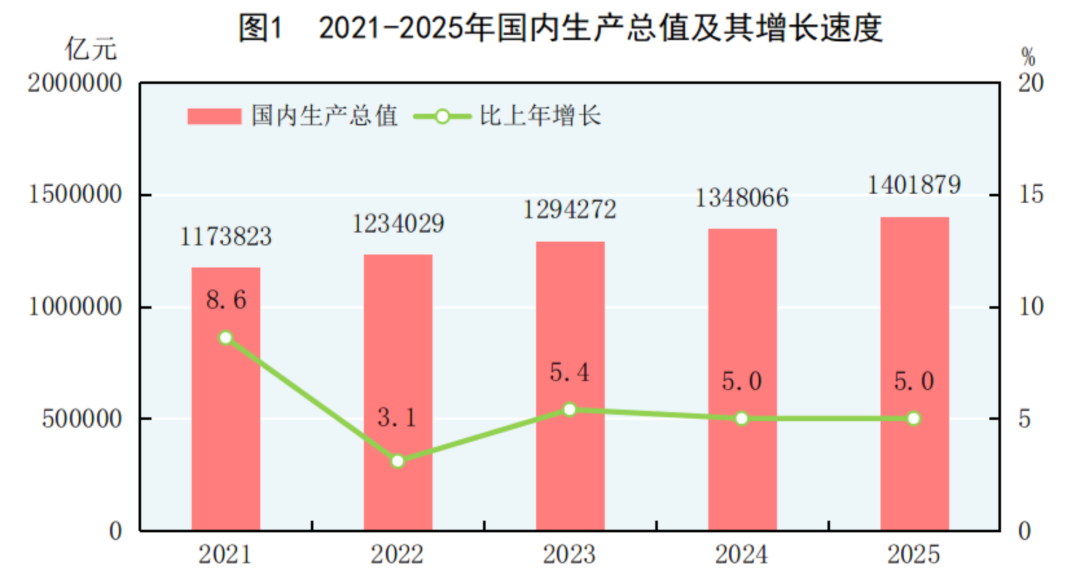
年末全国人口140489万人,比上年末减少339万人,其中城镇常住人口95380万人。全年出生人口792万人,出生率为5.63‰;死亡人口1131万人,死亡率 为8.04‰;自然增长率为-2.41‰。 (来源:湾区财经传媒) 2月28日,国家统计局发布《中华人民共和国2025年国民经济和社会发展统计公报》。 2025年是"十四五"规划收官之年,是中国式现代化进程中具有重要意义的一年。面对国内外形势深刻复杂变化,在以习近平同志为核心的党中央坚强领导 下,各地区各部门坚持以习近平新时代中国特色社会主义思想为指导,全面贯彻落实党的二十大和二十届历次全会精神,按照党中央和国务院决策部署, 完整准确全面贯彻新发展理念,加快构建新发展格局,着力推动高质量发展,坚持稳中求进工作总基调,统筹国内国际两个大局,统筹发展和安全,实施 更加积极有为的宏观政策,我国经济顶压前行、向新向优发展,现代化产业体系建设持续推进,改革开放迈出新步伐,重点领域风险化解取得积极进展, 民生保障更加有力,社会大局保持稳定,第二个百年奋斗目标新征程实现良好开局。 初步核算,全年国内生产总值1401879亿元,比上年增长5.0%。其中,第一产业增加值9 ...

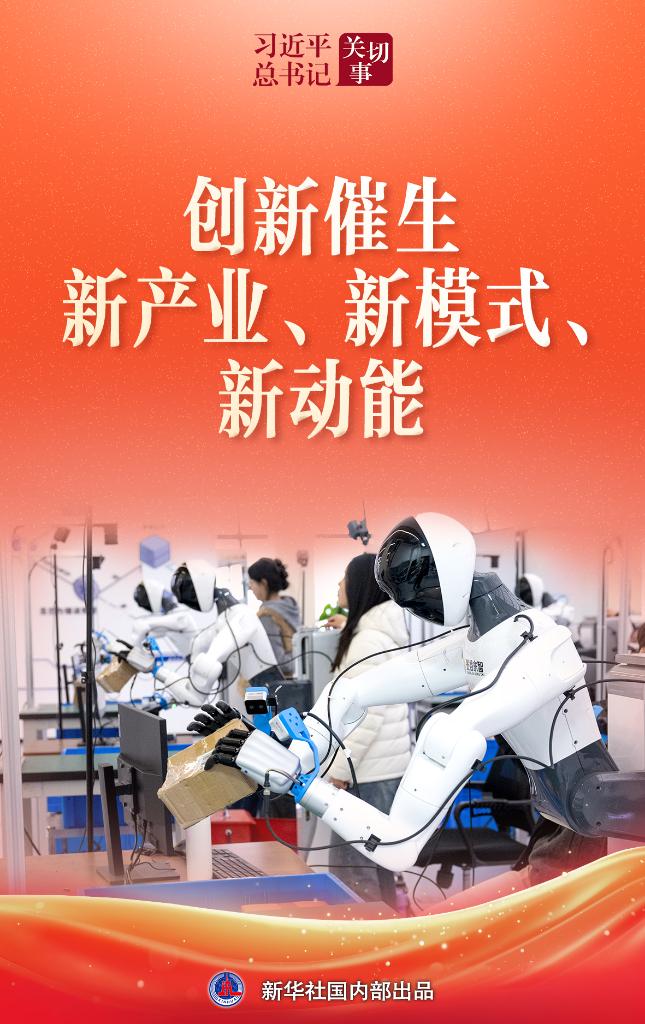
习近平总书记关切事·两会看落实丨创新催生新产业、新模式、新动能
Xin Hua She· 2026-02-26 10:30
Group 1 - The core viewpoint emphasizes the integration of technological innovation and industrial innovation as a fundamental path for developing new productive forces, as highlighted by Xi Jinping [3][18] - The "China Sky Eye" (FAST) has made significant breakthroughs in studying fast radio bursts, showcasing the capabilities of China's largest single-dish radio telescope [4][5] - The research team at the Chinese Academy of Sciences has successfully monitored and analyzed fast radio bursts, contributing to understanding their origins [5][7] Group 2 - The development of high-performance carbon fiber in Shanxi represents a significant leap from following to keeping pace with global advancements, providing essential materials for various industries [9][13] - The successful establishment of a thousand-ton production line for carbon fiber demonstrates China's ability to innovate and produce critical materials independently [13][15] - The emphasis on upgrading traditional industries through new technologies aligns with Xi Jinping's vision for high-end, intelligent, and green development [15][18] Group 3 - The launch of the 3D scientific computer "Tianqiong" marks a major advancement in computational technology, significantly outperforming traditional systems [16][18] - The development of this technology reflects a long-term commitment to innovation, with a focus on mastering core technologies domestically [16][18] - The integration of technological and industrial innovation is accelerating, with new economic growth points emerging in fields like artificial intelligence and biotechnology [18]

记录今天的突破 孕育明天的可能(科技自立自强)
Ren Min Ri Bao· 2026-01-27 03:34
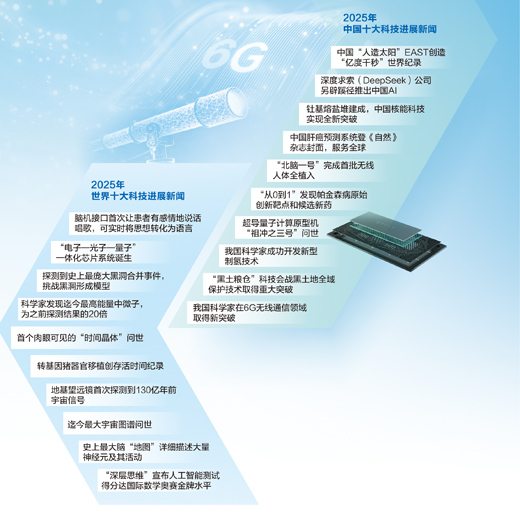
Core Insights - The announcement of the "Top Ten Scientific Advances" in China and the world for 2025 highlights significant technological breakthroughs that have the potential for rapid industrialization and future development [2][3][4]. Group 1: China's Top Ten Scientific Advances - The top ten scientific advances in China include the "artificial sun" EAST achieving a world record of "one billion degrees for a thousand seconds," the development of a liver cancer prediction system featured on the cover of Nature, and the successful creation of a thorium molten salt reactor [3][4]. - Other notable advancements include the completion of the "North Brain No. 1" wireless human implant, the discovery of original innovation targets and candidate drugs for Parkinson's disease, and the development of a new hydrogen production technology [3][4]. - The advancements also encompass breakthroughs in 6G wireless communication and significant progress in the protection of black soil through the "Black Soil Granary" technology campaign [3][4]. Group 2: World's Top Ten Scientific Advances - The world's top ten scientific advances feature a brain-computer interface enabling patients to express emotions through speech, the birth of an integrated "electronic-photonic-quantum" chip system, and the detection of the largest black hole merger event to date [4]. - Additional highlights include the discovery of the highest energy neutrino, the first visible "time crystal," and the successful organ transplantation from genetically modified pigs [4]. - The advances also include the first detection of cosmic signals from 13 billion years ago and the largest cosmic map ever created, along with a detailed brain map describing numerous neurons and their activities [4]. Group 3: Characteristics and Implications - The selected scientific advances reflect three main characteristics: alignment with global scientific frontiers, addressing national major needs, and focusing on public health and well-being [4][5]. - The evaluation emphasizes originality and practical utility, showcasing China's robust development in science and technology, which is increasingly aligned with national demands and public welfare [4][5]. - The ongoing technological revolution and industrial transformation are reshaping global innovation dynamics, highlighting the need for China to focus on key challenges while responding to public concerns and filling developmental gaps [5][6].
【科技日报】两院院士评出2025年中国/世界十大科技进展
Ke Ji Ri Bao· 2026-01-27 02:36
Group 1: China's Top Ten Scientific Advances of 2025 - The "artificial sun" EAST achieved a world record of "one billion degrees for a thousand seconds" [1] - DeepSeek company introduced a new AI technology in China [1] - The construction of a thorium molten salt reactor marks a breakthrough in China's nuclear energy technology [1] - A liver cancer prediction system was featured on the cover of "Nature" magazine, serving a global audience [1] - The "North Brain No. 1" completed its first batch of wireless full-body implants [1] - A novel innovative target and candidate new drug for Parkinson's disease was discovered [1] - The superconducting quantum computing prototype "Zu Chongzhi No. 3" was unveiled [1] - Chinese scientists successfully developed a new hydrogen production technology [1] - Significant breakthroughs were made in the protection technology of black soil in the "Black Soil Granary" campaign [1] - Chinese scientists achieved new advancements in 6G wireless communication [1] Group 2: World's Top Ten Scientific Advances of 2025 - Brain-machine interfaces enabled patients to express emotions through speech and song, translating thoughts into language in real-time [2] - An integrated chip system combining electronics, photonics, and quantum technology was developed [2] - The largest black hole merger event ever detected challenges existing black hole formation models [2] - Scientists discovered the highest energy neutrino to date, which is 20 times more energetic than previous detections [2] - The first visible "time crystal" was created [2] - Transgenic pig organ transplants set a record for survival time [2] - Ground-based telescopes detected signals from the universe dating back 13 billion years [2] - The largest cosmic map to date was published [2] - The most detailed brain "map" was created, describing numerous neurons and their activities [2] - "Deep Thinking" announced that its artificial intelligence test scores reached the level of an international mathematics Olympiad gold medal [2]
两院院士评出2025中国十大科技进展:“人造太阳”创世界纪录等入选
Xin Lang Cai Jing· 2026-01-26 09:43
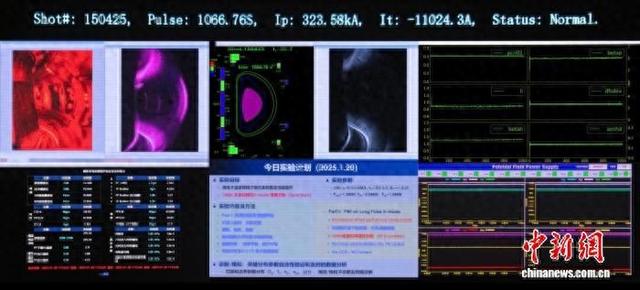
Core Insights - The announcement of the 2025 Top Ten Scientific Advances in China highlights significant achievements in various fields, including nuclear fusion, artificial intelligence, and advanced medical technologies [1][9]. Group 1: Nuclear Energy and Fusion - The Chinese "artificial sun" (EAST) achieved a world record by maintaining a temperature of 100 million degrees Celsius for 1066 seconds, marking a significant leap from basic science to engineering practice in fusion energy research [1][3]. - The thorium molten salt reactor, developed by the Shanghai Institute of Applied Physics, successfully converted thorium into uranium fuel, becoming the only operational molten salt reactor utilizing thorium, thus reinforcing China's leadership in this research area [3][5]. Group 2: Artificial Intelligence - DeepSeek, a company established just over a year ago, launched a new generation AI model R1, which matches the performance of OpenAI's models while achieving significantly lower training costs and being fully open-sourced, creating a major impact in the global AI landscape [3]. Group 3: Medical Innovations - A high-precision AI diagnostic tool for predicting liver cancer recurrence, developed by a research team from the University of Science and Technology of China, achieved an accuracy rate of 82.2% and was featured on the cover of Nature, marking a new direction in computational tumor immunology [5][6]. - The "North Brain No. 1" system, a wireless brain-computer interface, successfully helped patients with speech loss due to ALS regain communication abilities, representing a significant advancement in neurotechnology [6]. Group 4: Quantum Computing - The "Zu Chongzhi III" superconducting quantum computing prototype was developed, demonstrating a processing speed that is a trillion times faster than the fastest supercomputers, showcasing significant advancements in quantum computing capabilities [6][8]. Group 5: Hydrogen Production and Environmental Technology - A new hydrogen production method was developed by a team from Peking University, which eliminates carbon dioxide emissions at the source, contributing to zero-carbon hydrogen production [8]. - The "Black Soil Granary" technology campaign achieved breakthroughs in black soil protection, supporting national strategies for sustainable agricultural practices [8]. Group 6: Communication Technology - A joint team from Peking University and City University of Hong Kong developed an ultra-broadband optoelectronic integrated system for 6G communication, enabling high-speed wireless communication across all frequency bands, which will enhance the reliability and intelligence of future wireless networks [8].
基础研究进入“从0到1”突破期
Huan Qiu Wang Zi Xun· 2026-01-22 01:12
Core Insights - In 2025, China's foundational research is entering a breakthrough phase characterized by significant original achievements and increased funding, with basic research funding reaching a historical high of 7.08% of total R&D expenditure [1][12]. Group 1: Breakthroughs in Fundamental Research - China has made notable advancements in various fields, including the first successful large-scale preparation of two-dimensional metallic materials and the development of the "Zu Chongzhi III" quantum computing prototype, which set a world record [1]. - The country has achieved a world-first in thorium-uranium nuclear fuel conversion, reinforcing its leadership in molten salt reactor research and providing core technological support for future thorium resource development [3]. - In quantum technology, China maintains a leading position globally, with significant breakthroughs in computational power and secure communication networks [3]. Group 2: Major Scientific Facilities - China has over 70 major scientific facilities, which are crucial for supporting foundational research and have led to significant discoveries, such as improved measurements of neutrino oscillation parameters and insights into cosmic rays [8][9]. - The "FAST" telescope has made a significant discovery regarding a rare pulsar, showcasing the importance of major scientific infrastructure in advancing research [6]. Group 3: Systematic Enhancements in Research Framework - The Chinese government has prioritized foundational research in its strategic planning, aiming to enhance original innovation capabilities and increase funding for basic research [11]. - The revised National Natural Science Foundation regulations, effective from January 1, 2025, aim to diversify funding mechanisms and encourage original research, particularly among young scientists [11][12]. - Continuous improvements in the research system, stable funding, and a growing pool of young talent are driving the surge in original innovations [12].
2025年创新领域盘点——创新活力持续迸发(人民日报海外版)
Ren Min Ri Bao Hai Wai Ban· 2025-12-30 08:36
Core Insights - In 2025, China's technological innovation continues to thrive, with significant advancements in various fields such as artificial intelligence, quantum information, life sciences, and clean energy, contributing to high-quality development and improved living standards [1] Group 1: Fundamental Research - China has achieved new heights in fundamental scientific research, with multiple results breaking international records and filling gaps in various fields [2] - The Jiangmen Underground Neutrino Observatory (JUNO) has successfully measured two key parameters of neutrino oscillation with a precision 1.5 to 1.8 times better than previous international standards [2] - A team from the Chinese Academy of Sciences has created five types of two-dimensional metals with single-atom thickness, marking a significant breakthrough in material science [3] - As of August 2025, China leads the world with 2,342 hot papers, accounting for 53.2% of the global total, and ranks second in highly cited papers [3] Group 2: Cutting-edge Technologies - In quantum computing, the "Zuchongzhi 3" prototype has been developed, featuring 105 readable qubits and achieving speeds surpassing the fastest supercomputers [4] - The AI model DeepSeek-R1 has been released, achieving performance comparable to top global models with fewer computational resources, marking a shift in AI development strategies [4] - The number of AI companies in China has exceeded 5,300, representing 15% of the global total, establishing a comprehensive industrial system [4] Group 3: Robotics and Aerospace - The humanoid robot industry is rapidly emerging, with significant public demonstrations showcasing advancements in embodied intelligence [5][6] - The Tianwen-2 probe has been successfully launched, marking China's first asteroid sampling and comet flyby mission, filling a technological gap in small celestial body exploration [6] - The EAST nuclear fusion experiment has achieved a world record of 1 million degrees Celsius for 1,066 seconds, validating the feasibility of steady-state operation for fusion reactors [6] Group 4: Life Sciences and Resource Utilization - In life sciences, breakthroughs in pest control and cancer treatment have been made, promoting green and precise pest management and developing new strategies for nasopharyngeal cancer immunotherapy [8] - The South-to-North Water Diversion Project has delivered over 80 billion cubic meters of water, benefiting 185 million people and addressing groundwater over-extraction issues [9] - China's high-speed rail technology has set new records, with the CR450 train achieving a single-column speed of 453 km/h, leading the world in rail technology [9] Group 5: Global Collaboration - China is leading global renewable energy development, with solar and wind power surpassing fossil fuels in new electricity generation [10] - Major scientific projects like the Jiangmen Neutrino Experiment are open to global collaboration, attracting top scientists to tackle significant scientific challenges [10] - China is sharing technological advancements in public health and agriculture, contributing to global governance improvements [11]
【人民日报】科学有答案 创新无止境——八位院士眼中的二〇二五
Ren Min Ri Bao· 2025-12-29 03:02
Core Insights - China's technological innovation is expanding into various fields, including quantum technology and lunar research, with significant breakthroughs expected by 2025 [4][6] - The "14th Five-Year Plan" emphasizes the importance of technology and innovation, highlighting a commitment to advancing scientific research and applications [4] - The development of deep space exploration and quantum computing is seen as crucial for China's strategic technological autonomy and future economic growth [8][17] Group 1: Deep Space Exploration - Major breakthroughs in lunar research are anticipated, including the discovery of new mineral types from samples returned by the Chang'e 6 mission, which will enhance understanding of lunar oxidation mechanisms [5] - The Tianwen-2 probe is set to conduct close-range exploration of a near-Earth asteroid, with sample return expected by the end of 2027 [5] - Future projects include the construction of a lunar research station, manned lunar missions, and exploration of Mars and Jupiter, aiming to enhance capabilities in deep space science and resource utilization [5][6] Group 2: Quantum Computing - Quantum computing is identified as a key technology for future strategic autonomy, requiring advancements in hardware and software integration [8] - China's third-generation superconducting quantum computer, "Benyuan Wukong," has been successfully deployed, participating in numerous collaborations across various sectors [9] - The development of quantum computing is likened to building a rocket, emphasizing the need for a comprehensive approach from hardware to software [8] Group 3: Brain-Computer Interfaces - Brain-computer interface technology is evolving to connect biological and machine intelligence, with advancements in decoding and encoding neural signals [10] - Clinical applications of brain-computer interfaces are emerging, with significant progress in invasive and non-invasive technologies [12] - The technology aims to redefine the boundaries of intelligence by integrating carbon-based and silicon-based systems [11] Group 4: Hydrogen Energy - Hydrogen energy is positioned as a vital component of the renewable energy revolution, complementing electricity and addressing sustainability challenges [17] - The development of hydrogen fuel cells is expanding into various sectors, including transportation and machinery, with China making significant strides in related technologies [18] - The strategic importance of hydrogen energy is underscored by its potential to facilitate a low-carbon energy transition [17] Group 5: Talent Development in Research - The cultivation of research talent is critical for supporting high-level technological independence, with a focus on aligning educational programs with national strategic needs [20] - Young researchers are increasingly prominent in key national projects, indicating a shift towards a younger demographic in scientific achievements [21] - A supportive environment for basic research is essential, requiring stable funding and a culture that encourages innovation and tolerates failure [22][23]
硬核创新铸底气 2025步履铿锵
Zhong Guo Qing Nian Bao· 2025-12-28 22:16
Group 1 - The Jiangmen neutrino experiment officially began data collection in August 2025, becoming the world's first large-scale, high-precision neutrino facility [2][7] - China's manned space program has successfully completed multiple missions, including emergency launches, marking significant milestones in the development of the Chinese space station [3][7] - The "Chang'e 6" mission returned 1935.3 grams of lunar soil from the moon's far side, contributing to ongoing research that enhances understanding of lunar geology [4][8] Group 2 - The National Space Administration's action plan for commercial space development outlines 22 key initiatives to promote high-quality growth in the commercial space sector [5] - The "DeepSeek" AI model has transformed search habits, indicating a significant shift in how people interact with technology [9][12] - The introduction of the revised National Natural Science Foundation regulations encourages collaboration between government, enterprises, and organizations to foster innovation [14][15] Group 3 - The "Youth Science and Technology Talent Cultivation Project" aims to support the development of young scientists, emphasizing the importance of nurturing talent for future innovation [18][20] - The "Deep Time Digital Earth" international scientific plan, initiated by China, aims to enhance global geological knowledge through international collaboration [23][24] - The ITER project, a major international nuclear fusion initiative, has seen significant progress with China's successful development of a critical component [24][26]
2025年国内国际十大科技新闻揭晓
Ke Ji Ri Bao· 2025-12-25 01:00
Core Insights - The announcement of the top ten domestic and international technology news for 2025 highlights significant advancements in various fields, particularly in artificial intelligence, quantum computing, and biomedical engineering [1] Domestic Technology News - The domestically developed AI model DeepSeek has garnered global attention [1] - China's "artificial sun" has set a world record by achieving "one billion degrees for a thousand seconds" [1] - The superconducting quantum computing prototype "Zuchongzhi No. 3" has been successfully constructed [1] - For the first time, large-area two-dimensional metallic materials have been synthesized internationally [1] - The first invasive brain-computer interface clinical trial in China has commenced [1] - The evolutionary history of the moon's far side has been unveiled for the first time [1] - The mystery of transforming a single cell into a complete plant has been revealed [1] - A high-precision, scalable simulation matrix computing chip has been successfully developed [1] - The Fourth Plenary Session's recommendations emphasize the leading role of technological innovation [1] - China's first electromagnetic catapult aircraft carrier has been commissioned [1] International Technology News - The "Deep Seek" model is leading the open-source artificial intelligence paradigm [1] - Brain-computer interfaces are decoding brain activity into continuous sentences [1] - Artificial intelligence has designed proteases "from scratch" [1] - Photonic computing chips have surpassed the performance of traditional electronic hardware [1] - The Rubin Observatory has released the first cosmic photography [1] - Intelligent robots have autonomously completed gallbladder removal surgeries [1] - A new algorithm has achieved the first verifiable quantum advantage [1] - Gravitational wave signals have validated Hawking's black hole area theorem [1] - The Earth has reached its first catastrophic climate tipping point [1] - A developmental map of mammalian brain cells across species has been created [1]