
Mate 80系列

Search documents
孟晚舟华为年报致辞:坚持开源开放,繁荣产业生态
凤凰网财经· 2026-03-31 15:37
Core Viewpoint - Huawei's 2025 annual report indicates a stable business performance with a global sales revenue of 880.9 billion RMB and a net profit of 68 billion RMB, marking the second-highest revenue in the company's history [2][4]. Group 1: Revenue and Business Performance - Huawei's overall revenue for 2025 reached 880.9 billion RMB, showing a year-on-year growth of 2.2% [2][4]. - The revenue breakdown by business segments includes: - ICT Infrastructure: 375.014 billion RMB, up 2.6% - Terminal Business: 344.473 billion RMB, up 1.6% - Digital Energy: 77.312 billion RMB, up 12.7% - Intelligent Automotive Solutions: 45.018 billion RMB, up 72.1% [5][6]. - The intelligent automotive solutions business achieved significant growth and profitability, with a revenue increase of over 70% [7]. Group 2: Strategic Focus and R&D Investment - Huawei emphasizes strategic focus on four main pillars: strategic focus, battlefield transformation, open-source collaboration, and quality-driven success [2][6]. - The company invested 192.3 billion RMB in R&D in 2025, accounting for 21.8% of total sales revenue, with cumulative R&D investment exceeding 1.382 trillion RMB over the past decade [8][9]. Group 3: Ecosystem Development - The Harmony ecosystem has crossed a critical threshold, with over 10 million developers and more than 36 million devices running Harmony 5.0 by the end of 2025 [9][10]. - The Ascend ecosystem has developed over 3,000 partners and 4 million developers, while the Kunpeng ecosystem has over 6,800 partners and 3.8 million developers [10][26]. Group 4: Future Outlook - Huawei plans to strengthen its core ecosystem in 2026, focusing on enhancing developer tools and services to improve the Harmony ecosystem experience [28]. - The company aims to maintain strategic focus and high-quality development, ensuring that quality remains the foundation of its survival and growth [29][30].


回归存储卡槽?手机行业利润承压,国产储存成香饽饽
Sou Hu Cai Jing· 2026-02-11 00:44
Core Viewpoint - The global consumer electronics industry is facing a severe cost crisis due to the continuous surge in storage chip prices, which has evolved from supply chain fluctuations to a significant profit crisis in the smartphone sector [1] Group 1: Price Surge and Impact on Smartphone Industry - According to Counterpoint's latest report, memory prices have seen an astonishing increase of 80%-90% quarter-on-quarter in Q1 2026, with the price of 64GB server memory rising from $450 to over $900 [3] - TrendForce has revised its annual DRAM price increase forecast from 55%-60% to 90%-95%, indicating a profound impact on the industry chain [3] - The share of storage chips in the bill of materials (BOM) for smartphones has surged from a stable 10%-15% to 20%-30%, directly affecting the cost structure of the smartphone industry [3] Group 2: Profit Margin Pressures - Many smartphone manufacturers are experiencing squeezed overall gross margins, particularly affecting mid-range and low-end models, with Xiaomi's smartphone business gross margin nearing a critical 10% threshold [5] - The average selling price of smartphones is significantly lower for brands like Xiaomi, which is only 15% of Apple's average price, making it difficult for them to maintain profitability amid rising costs [5] Group 3: Strategic Responses - Xiaomi's president, Lu Weibing, outlined strategies to mitigate cost pressures, including securing storage supply agreements for 2026 and accelerating the "domestic substitution" strategy by increasing procurement from local suppliers [7] - Domestic storage solutions offer a cost advantage of 15%-20% compared to international suppliers, which is crucial for building a self-controlled supply chain [7] - Counterpoint Research indicates that Yangtze Memory Technologies has achieved a global market share of 13% in NAND flash shipments by Q3 2025, ranking fifth globally [7] Group 4: Industry Sentiment and Challenges - There is widespread anxiety in the industry, with insiders expressing uncertainty about future product planning due to soaring memory prices, leading to discussions about potentially reintroducing external storage options [9] - Despite the rising costs, the likelihood of reintroducing storage card slots in smartphones is low, as it would add to overall costs and is not favored in current market trends [9] Group 5: Huawei's Differentiated Strategy - Unlike other companies, Huawei has adopted a proactive approach by adjusting prices on certain models to strengthen market share, demonstrating resilience amid cost pressures [11] - Huawei's higher degree of supply chain localization allows for better cost control and flexibility in response to price fluctuations in key components [11] - The ability to balance costs and market strategies through internal collaboration and localization gives Huawei a competitive edge in the current environment [13]

全球CMO都在关注什么?
3 6 Ke· 2026-01-30 10:15
Core Insights - The Dentsu Group's "2025 CMO Survey" reveals a key trend: marketers are focusing more on "human values" and the deep integration of technology rather than becoming overly reliant on algorithms and AI [1][2] - The report outlines ten major marketing trends post-2025, emphasizing the importance of brand growth through innovative strategies [1] Algorithm Competition - The era of algorithm-driven traffic distribution has rendered "trend-chasing" marketing ineffective, leading to a need for brands to predict user demand rather than follow platform rules [2] - 71% of CMOs believe that "algorithm competitiveness directly determines brand presence," while nearly 80% express concerns that "over-optimizing algorithms will lead to homogenized content" [2] Empathy as Core Competitiveness - As algorithms proliferate, human empathy becomes a critical competitive advantage, capturing nuanced consumer emotions and unmet needs that AI cannot replicate [3] - 86% of CMOs emphasize the importance of listening to customers' real voices in the AI era, and 87% agree that modern strategies must combine creativity, empathy, and human warmth [3] Co-Creation Models - The traditional model of "brand unilateral output" is outdated; consumers prefer brands they can co-create with [4] - 91% of CMOs believe that future brand building will rely on multi-party partnerships, while 87% recognize that interaction with consumers is a powerful means to expand brand influence [4] Influencer Marketing - Traditional advertising's effectiveness is declining, prompting CMOs to significantly increase investments in influencer marketing, recognizing its role in enhancing content visibility and conversion rates [5][6] - 90% of CMOs believe that "social media + influencer marketing interaction rates far exceed traditional advertising," with 39% planning to allocate 20%-30% of their marketing budgets to this area [5] Cultural Connection - There is a growing demand for brands to have cultural depth, especially among younger consumers who are willing to pay for brands with cultural significance [8] - 81% of CMOs acknowledge the importance of building brands through culture, but many struggle with how to establish credible cultural connections [8] Innovation as a Necessity - Innovation is no longer optional but essential for survival in a market where traditional marketing methods are losing effectiveness [9] - 40% of marketers plan to allocate 20%-30% of their marketing budgets to innovation in the 2025-2026 fiscal year [9] AI Collaboration - AI is increasingly becoming a daily assistant for CMOs, enhancing efficiency by handling standard tasks, but its role is to assist rather than replace human creativity [11][12] - Over 30% of CMOs have normalized the use of AI, which allows them to focus more on creative work [11] Brand Experience - The importance of customer experience is rising, with 86% of CMOs agreeing that modern brands are defined by experience [13][14] - Effective brand experience combines AI efficiency with human warmth, ensuring that customer interactions remain personal and engaging [14] Content Distribution - In an age of information overload, the focus has shifted from quantity to precision in content marketing, with nearly 80% of CMOs noting that content production is increasing while its impact is declining [15] - Brands need to leverage data insights to deliver highly relevant messages to target audiences at the right moments [15] Trust and Sensory Experience - Trust and sensory experiences are becoming the strongest differentiators for brands in the AI era, with 89% of CMOs recognizing their growing importance [16] - The ability to foster long-term trust and create unique sensory memories will be crucial for brands to stand out in the future [16]
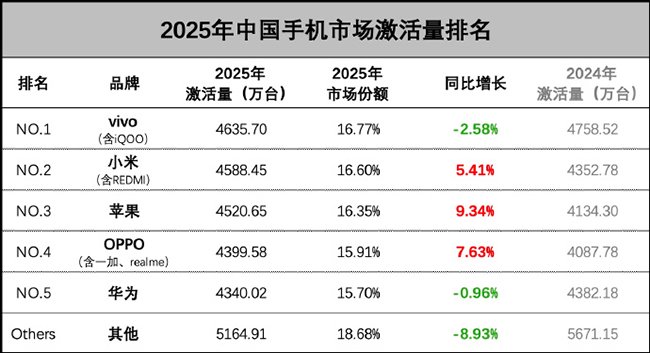
2025年中国手机激活量排名:vivo蝉联榜首 小米反超苹果登次席
Xin Lang Cai Jing· 2026-01-20 13:39
Core Insights - The 2025 Chinese smartphone market has seen a subtle shift in the competitive landscape, with vivo maintaining its lead, followed by Xiaomi and Apple, all surpassing 40 million units in activation volume [1][7]. Market Rankings - Vivo (including iQOO) ranked first with an activation volume of 46.357 million units, holding a market share of 16.77%, despite a slight decline of 2.58% from 2024 [2][8]. - Xiaomi (including REDMI) achieved an activation volume of 45.884 million units, capturing a market share of 16.60%, marking a growth of 5.41% year-on-year, thus surpassing Apple to claim the second position [3][9]. - Apple secured the third position with an activation volume of 45.206 million units and a market share of 16.35%, experiencing a significant growth of 9.34% [3][10]. - OPPO (including OnePlus and realme) ranked fourth with 43.996 million units and a market share of 15.91%, showing a year-on-year increase of 7.63% [4][10]. - Huawei placed fifth with an activation volume of 43.400 million units and a market share of 15.70%, reflecting a slight decline of 0.96% [4][10]. Market Trends - The overall smartphone market in China saw a slight decline in demand, with total shipments around 285 million units, down 0.6% year-on-year, indicating a softening consumer demand [2][8]. - The market is characterized by a "high-end consolidation and mid-range competition," with AI smartphones and foldable screens emerging as key growth areas [4][10]. - In 2025, the shipment volume of AI smartphones reached 118 million units, achieving a penetration rate of over 40% [4][10]. Future Outlook - Industry experts predict a continued slight decline in overall shipments by 2%-3% in 2026, with rising memory chip prices potentially increasing average smartphone prices by 10%-20% [11]. - The focus for leading brands will likely shift towards high-profit segments, intensifying market competition [11]. - Key questions for 2026 include whether vivo can maintain its lead, if Xiaomi can solidify its second position, and whether Apple can sustain its high-end growth trajectory [11].

以实力破圈,Mate 80系列何以成为中国科技的高端坐标?
36氪· 2025-12-28 09:30
Core Viewpoint - The true high-end is not about momentary advantages in parameters but about the long-term realization of systemic capabilities in complex environments [2][28]. Market Dynamics - By the end of 2025, the Chinese smartphone market is expected to undergo a significant reshuffle, with key components like memory entering a price increase cycle, reshaping pricing logic [3]. - The mid-to-low-end market is shrinking under cost pressures, while the high-end market, driven by AI, imaging, and system ecosystems, remains a certain growth segment [3]. - Huawei has made a strong comeback, surpassing Apple in domestic market share, achieving 27.81% in week 48 and 22.89% in week 49 of 2025 [3]. Competitive Landscape - The competition in the high-end smartphone market is shifting from parameter gimmicks to the construction of systemic capabilities [4]. - Huawei's Mate 80 series signifies a new phase focused on systemic maturity, moving from merely re-entering the competition to upgrading the paradigm of high-end competition driven by systemic capabilities [7][19]. Symbolic Value - In a highly homogeneous smartphone market, the value of symbols is often underestimated, as hardware supply chains become shared and functional innovations diminish [10]. - The Mate series embodies a clear and stable symbolic system that represents technological breakthroughs and consumer value choices [10]. - The dual-ring design of the Mate 80 series symbolizes a commitment to "infinite exploration" and continuous breakthroughs [10]. Technological Innovations - The Mate 80 series features a full metal design, overcoming technical challenges related to signal integrity, representing a dual breakthrough in design aesthetics and structural engineering [11]. - The Mate 80 Pro Max includes a new ultra-bright screen with peak brightness of 8000 nits, addressing visibility issues in bright outdoor conditions [14]. - The second-generation Red Maple imaging system allows for true-to-life color reproduction, optimizing color fidelity under complex lighting conditions [14]. - The Mate 80 series supports 2.4GHz seamless communication over distances of up to 7 kilometers and boasts a battery life of up to 14 days in extreme conditions [14]. Systemic Capabilities - The Mate 80 series constructs a comprehensive set of systemic capabilities, enabling users to explore complex environments with enhanced safety and experience [15]. - With the support of HarmonyOS 6, the Mate 80 series features advanced AI capabilities, enhancing user interaction and experience [17]. - The Mate 80 series has positioned itself as a significant milestone in the Harmony ecosystem, with over 350,000 applications and a 95% compatibility rate [17]. Market Strategy - The Mate 80 series has adopted a rare pricing strategy, lowering its starting price to 4699 yuan despite rising component costs, triggering a strong market response [18]. - This pricing strategy reflects Huawei's long-term technological accumulation and systemic capabilities, allowing for proactive market choices rather than reactive pricing [18]. Historical Context - The Mate series has evolved over twelve years, establishing itself as a leading force in the high-end smartphone market, transitioning from technology follower to technology leader [20][28]. - Each generation of the Mate series has introduced significant technological advancements, from large screens to AI imaging capabilities, consistently pushing the boundaries of user experience [22][23]. Conclusion - The Mate series represents a new starting point for Chinese technology in the high-end sector, demonstrating that true high-end status is achieved through long-term systemic capabilities rather than short-term parameter advantages [28].
鸿蒙生态的“好用”跃迁,道出一个清晰事实
Huan Qiu Wang· 2025-12-25 14:12
Core Insights - Huawei's Mate 80 series, featuring the HarmonyOS 6, marks a significant milestone in the global tech industry, showcasing hardware innovations and a successful transition of HarmonyOS from "usable" to "user-friendly" [1] - The total number of devices running HarmonyOS 5 and 6 has surpassed 32 million, with over 350,000 applications and services available, achieving a compatibility rate of over 95% [1] Group 1: Industry Context - The global mobile ecosystem has long been dominated by Android and iOS, leaving Chinese developers in a passive role as "rule acceptors" [2] - HarmonyOS breaks this deadlock by providing a fully self-developed technology stack and a collaborative ecosystem approach, allowing developers to become partners rather than mere tenants [2] Group 2: Technological Advancements - HarmonyOS 6 addresses usability concerns by leveraging AI to enhance user experience, introducing features like the "Harmony Smart Body Framework" for easy integration of advanced AI functionalities [3] - The system's capabilities include natural language processing for image editing and automatic video generation, significantly lowering the barriers to intelligent application development [3] Group 3: Connectivity and Security - HarmonyOS 6 enhances interconnectivity across devices, supporting over 60 applications for seamless sharing and collaboration [7] - The system introduces advanced security features, including the upgraded Star Shield security architecture, which offers over 20 security capabilities for financial and enterprise applications [9] Group 4: Ecosystem Growth - The rise of the Harmony ecosystem is attributed to both technological success and innovative institutional collaboration, with major applications like WeChat and Alipay fully adapting to the platform [11] - The ecosystem is also seeing an influx of mid-tail applications, with significant improvements in user experience and new functionalities being introduced [13] Group 5: Economic Impact - The Harmony ecosystem presents a talent gap of over one million, with potential job opportunities exceeding three million, and an average salary increase for developers of 43.1% in 2024 [13] - Huawei's "Harmony Star Plan" aims to support campus developers and creative talents, further solidifying the ecosystem's foundation [13] Group 6: Global Implications - The success of HarmonyOS demonstrates the viability of a software ecosystem led by China, providing a "Chinese solution" for global digital ecosystem diversification [15] - HarmonyOS represents a new starting point for broader ecosystem development, emphasizing open collaboration and enhanced user experience as key competitive advantages [17]

超轻薄手机遇冷,真“AI手机”登场? 聊聊2025年手机行业的新玩意
Xin Lang Cai Jing· 2025-12-18 14:23
Core Insights - The mobile market in 2025 is witnessing significant changes, including the introduction of ultra-thin designs, emergency communication technologies, new folding phone forms, and AI-integrated smartphones, all impacting industry development [1][38]. Ultra-Thin Design - Major manufacturers like Samsung and Apple have launched ultra-thin smartphones, with Samsung's Galaxy S25 Edge at 5.8mm and 163g, and Apple's iPhone Air at 5.6mm and 165g, both priced from 7999 yuan [3][40]. - Despite the hype, sales for these ultra-thin models have been disappointing due to a mismatch between product definition and market positioning, sacrificing essential features for thinness [5][42]. - The ultra-thin design captures a niche market focused on portability and aesthetics, but it is not a mainstream demand, indicating a need for balance between functionality and design [7][45]. Emergency Communication Technology - Huawei's Mate 80 series introduced a "black technology" called emergency communication, allowing point-to-point communication without external networks, crucial for disaster scenarios [9][46]. - This technology operates on a 700MHz frequency, enabling communication over distances of up to 13km and penetrating obstacles like concrete walls, making it vital for rescue operations in extreme conditions [11][50]. - Huawei's approach to emergency communication is distinct from other manufacturers, focusing on critical situations like natural disasters, thus creating a new category of mobile communication [18][55]. New Folding Phone Forms - The folding phone market sees competition with Huawei's Mate XT and Samsung's Galaxy Z TriFold, which have different folding mechanisms and design philosophies [20][57]. - Both devices offer large screens around 10 inches, with Samsung's design providing better protection for the inner screen, while Huawei allows for more flexible screen usage [23][60]. - The emphasis is on software ecosystem development to maximize the advantages of larger screens, as both companies aim to enhance user experience through innovative designs [27][64]. AI-Integrated Smartphones - The introduction of the "Doubao AI phone" marks a significant advancement in AI integration within smartphones, featuring a deep system-level AI assistant capable of multi-modal interactions and automated operations [28][65]. - This AI assistant can perform complex tasks like price comparisons across platforms and provide contextual information, representing a leap towards AI agents in mobile technology [30][70]. - However, concerns regarding execution efficiency and user privacy persist, highlighting the need for ongoing exploration in balancing innovation with data security [35][72].


iPhone 17上市仅两个月即迎来官方降价 苹果今年出货量或创新高
Shen Zhen Shang Bao· 2025-12-09 17:32
Group 1 - Apple has experienced a revenue decline in the Chinese market for seven consecutive quarters, with a 3.6% year-on-year drop in the latest quarter [3] - The iPhone 17 series has been a significant growth driver globally, with a production forecast of 133 million units for the year, and a record market share of 24.2% in October 2025 [2][3] - Despite strong global performance, the Chinese market remains a challenge, with local competitors like Huawei and Xiaomi offering compelling alternatives that emphasize AI capabilities and user experience [3][5] Group 2 - The iPhone 17 series contributed to a 3% increase in smartphone sales during the "Double 11" shopping festival in China, contrasting with declines from other manufacturers [4] - Recent executive departures and a lack of clarity in AI strategy have raised concerns about Apple's future direction, alongside rumors regarding CEO Tim Cook's potential departure in 2026 [5] - The early price reduction of the iPhone 17 series is seen as a strategic move to recalibrate in the high-end market and address competitive pressures from domestic brands [5]
吉利高管:有车企为博流量盲目模仿,拉低中国车设计高度;因「薪资过高」限制招聘信息发布?BOSS直聘回应;曝苹果芯片核心人物将离职
雷峰网· 2025-12-08 00:52
Group 1 - Geely's executive criticized some car companies for blindly imitating designs to gain traffic, which lowers the standards of Chinese car design [4][5] - Geely emphasized that true Chinese design must be rooted in Chinese culture, possess independent aesthetic judgment, and have distinct characteristics [5] - Huawei's Ren Zhengfei stated that self-reliance is a necessity due to external pressures, and acknowledged that China is still lagging behind in technology compared to the U.S. [7][8] Group 2 - A wind power company in Guangdong offered a starting salary of 8,500 to 10,000 yuan, but faced restrictions from BOSS Zhipin for exceeding average salary levels [16][17] - New Oriental's chairman, Yu Minhong, reassured that employees who expressed concerns in an open letter would not face repercussions and that their issues would be investigated [19][20] - The CEO of Ele.me, Fan Yu, highlighted the strategic importance of the newly launched "Taobao Flash Purchase" as a significant move for Alibaba in the consumer service sector [26] Group 3 - The launch of the new AI model GPT-5.2 by OpenAI is anticipated to counter the competition from Google's Gemini 3, with a release expected on December 9 [39][40] - Meta has postponed the release of its mixed reality glasses to 2027 to ensure a fully polished product, reflecting the company's commitment to user experience [42][43] - Musk criticized the EU's fine against his platform X, calling it absurd and indicative of bureaucratic overreach, while also highlighting the broader implications for U.S. tech companies [48][49]

更多品牌加速上线 即时零售行业提质扩围
Zhong Guo Zheng Quan Bao· 2025-12-07 20:21
Core Insights - 361° has officially joined Taobao Flash Purchase, launching in Chongqing and expanding to 160 cities with 1,500 stores [1] - The combination of "30-minute delivery + free returns" is becoming a standard in the instant retail industry, driving growth towards a trillion-dollar market [1][2] - The instant retail sector is evolving from a single focus on food delivery to a comprehensive model covering all categories and scenarios [2] Group 1: Market Dynamics - The instant retail market in China is projected to reach over 1 trillion yuan by 2026 and 2 trillion yuan by 2030, with an average annual growth rate of 12.6% [3] - Alibaba reported a 60% year-on-year increase in instant retail revenue for Q2 of the 2026 fiscal year, indicating strong market performance [3] - Meituan's instant retail daily order volume peaked at 150 million in July, reflecting increased user engagement and diverse consumption scenarios [3] Group 2: Service Innovations - Meituan Flash Purchase has partnered with over 50 apparel brands to offer a unique return service that includes free shipping for returns, enhancing customer experience [2] - The industry is shifting from price-driven competition to a focus on user experience, with an emphasis on service quality and efficiency [2] - Meituan's "Assured Flash Purchase" service has expanded to cover 20 service items, helping nearly one million merchants reduce disputes and improve customer satisfaction [2]
