
Mona M03

Search documents
小鹏汽车20260320
2026-03-22 14:35
Summary of XPeng Motors Conference Call Company Overview - **Company**: XPeng Motors - **Industry**: Electric Vehicles (EVs) Key Operational and Financial Highlights - **Deliveries**: Total deliveries in fiscal year 2025 reached 429,445 units, a 126% year-over-year increase [3] - **Top Models**: Mona M03 was the best-selling pure electric sedan in the 100,000 to 150,000 RMB segment; P7+ ranked first in the 150,000 to 200,000 RMB segment [3] - **Overseas Sales**: Nearly doubled to 45,000 units, contributing over 15% to total revenue [5] Financial Performance - **Revenue**: Q4 2025 revenue was 22.25 billion RMB, marking the first quarterly profit with a net profit exceeding 380 million RMB [5] - **Gross Margin**: Full-year gross margin was 18.9%, an increase of 4.6 percentage points year-over-year; Q4 gross margin was 21.3% [5] - **Cash Flow**: Free cash flow for the year was approximately 5 billion RMB, with cash on hand at year-end of 47.7 billion RMB [5] - **Q1 2026 Guidance**: Deliveries expected between 61,000 and 66,000 units, with total revenue projected between 12.2 billion and 13.2 billion RMB [5] Product Launch Plans for 2026 - **New Models**: Four new models planned for 2026, including the flagship six-seat SUV 'GX' launching in Q2 2026 [4][6] - **Technology Features**: New models will feature dual-energy platforms and support autonomous driving capabilities from L2+ to L4 [6] Global Expansion Strategy - **Sales Goals**: Aim to double overseas sales in 2026, increasing international business contribution to over 20% of total revenue [7] - **Store Expansion**: Targeting to expand the overseas sales and service network to 680 stores [7] - **Charging Network**: Plans to expand the self-operated 5C ultra-fast charging network to cover 10 key international markets [7] Autonomous Driving Technology - **VLA 2.0 Rollout**: Gradual rollout began on March 21, 2026, with significant improvements in test drive conversions [9] - **Performance Targets**: Aiming for a 25x improvement in average miles per takeover compared to industry average [9] - **International Deployment**: Preparations for R&D and testing of VLA 2.0 in overseas markets are underway, with monetization opportunities being explored [10] Turing AI SoC Development - **Performance Improvement**: Turing AI SoC achieved a 10-fold improvement in effective compute power; cumulative shipments exceeded 200,000 units [11] - **Collaboration**: Volkswagen is the first external customer for Turing SoC and VLA 2.0, with openness to collaborate with more partners [11] Investment in Physical AI - **R&D Investment**: Investment in physical AI-related R&D will rise to 7 billion RMB in 2026, with a focus on humanoid robots and autonomous driving [12][18] - **Humanoid Robot "Iron"**: Targeting mass production by the end of 2026, with a monthly production capacity goal of over 1,000 units [13] Robotaxi Business Development - **Timeline**: Passenger-carrying operations with a safety driver to start in H2 2026, with plans to operate without a safety driver by early 2027 [20] - **Scaling Strategy**: Expansion will depend on social acceptance and regulatory permissions, with a focus on select countries and regions [21] Conclusion XPeng Motors is positioned for significant growth in the EV market with ambitious plans for product launches, global expansion, and advancements in autonomous driving technology. The company aims to leverage its technological innovations and strategic investments to enhance its competitive edge in both domestic and international markets.
XPENG Q4 Earnings Call Highlights
Yahoo Finance· 2026-03-20 14:06
Core Insights - XPeng reported significant growth in Q4 2025, with total revenue reaching RMB 22.25 billion, a 38.2% increase year-over-year and a 9.2% increase sequentially [1] - The company achieved a gross margin of 18.9% for fiscal year 2025, up 4.6 percentage points from the previous year, and generated approximately RMB 5 billion in free cash flow [2] - Vehicle deliveries surged to 42,945 units in 2025, marking a 126% year-over-year increase, and the company recorded its first quarterly profit in Q4 2025 [6] Financial Performance - Total revenue for Q4 was RMB 22.25 billion, with vehicle sales revenue at RMB 19.07 billion and services revenue at RMB 3.18 billion, which increased by 121.9% year-over-year [1] - The gross margin for Q4 was 21.3%, up from 14.4% a year earlier, while vehicle margin was 13.0%, reflecting ongoing cost reductions and an improved product mix [6] - R&D expenses rose to RMB 2.87 billion, a 43.2% increase year-over-year, driven by new model and technology development [7] Product and Technology Developments - XPeng plans to launch four new models in 2026, including the flagship GX, which will support L4-level hardware and software [15] - The VLA 2.0 autonomous system has passed a "physical Turing test" and is set for user rollout, with plans for Robotaxi pilot operations in Guangzhou [5][11] - The company aims to achieve mass production of its humanoid robot, IRON, by the end of 2026, targeting commercial deployment in various scenarios [19] International Expansion - XPeng's overseas deliveries nearly doubled to 45,000 units in 2025, contributing over 15% of total revenue, with a goal to double overseas deliveries again in 2026 [16] - The company plans to expand its self-operated ultra-fast charging network to 10 overseas markets and aims to reach 680 overseas sales and service stores by the end of 2026 [16] - Europe is identified as the largest overseas market, representing about 50% of overseas volume, with growth opportunities in Southeast Asia and other regions [17][18] Future Guidance - For Q1 2026, XPeng expects deliveries between 61,000 and 66,000 units, with revenue projected at RMB 12.2 billion to RMB 13.2 billion [4][20] - The company anticipates a sequential increase in March deliveries by 69% to 101% [20]

XPENG(XPEV) - 2025 Q4 - Earnings Call Transcript
2026-03-20 13:02
Financial Data and Key Metrics Changes - XPeng achieved total revenues of RMB 22.25 billion for Q4 2025, representing a year-over-year increase of 38.2% and a quarter-over-quarter increase of 9.2% [32] - Vehicle sales revenues were RMB 19.07 billion for Q4 2025, up 30% year-over-year and 5.6% quarter-over-quarter, primarily due to higher deliveries [33] - Gross margin for Q4 2025 was 21.3%, compared to 14.4% in Q4 2024 and 20.1% in Q3 2025 [34] - Net profit for Q4 2025 was RMB 0.38 billion, marking the first positive net profit for a single quarter [37] Business Line Data and Key Metrics Changes - Annual delivery reached 42,945 units, a 126% increase year-over-year [5] - Revenues from services and others were RMB 3.18 billion for Q4 2025, up 121.9% year-over-year, driven by technical R&D services to Volkswagen and increased parts sales [34] Market Data and Key Metrics Changes - Overseas deliveries nearly doubled to 45,000 units, contributing over 15% of total revenue [5] - The company aims to double overseas deliveries in 2026, targeting international business to contribute over 20% of total revenue [13] Company Strategy and Development Direction - XPeng plans to launch four new models in 2026, expanding into both large and compact vehicles, designed for global markets [10] - The company is focusing on enhancing its AI capabilities and aims to push the technological frontier in autonomous driving and smart cockpit systems [8] - XPeng's strategy includes significant investment in physical AI R&D, with a planned increase to RMB 7 billion in 2026 [28] Management's Comments on Operating Environment and Future Outlook - Management expressed confidence in achieving significant growth in the physical AI market, which is expected to surpass the automotive industry in the next 5-10 years [26] - The company anticipates that the VLA 2.0 will enhance user retention and conversion rates, with expectations of higher sales volumes [45] - Management highlighted the importance of addressing safety issues and weaknesses in their technology before scaling up operations globally [47] Other Important Information - XPeng's cash position at the end of 2025 was RMB 47.66 billion, providing strong financial support for ongoing investments [37] - The company has begun mass production of its Turing AI SoC and has shipped over 200,000 units [19] Q&A Session Summary Question: What type of major upgrade should we expect for XPeng's VLA 2.0 in the coming months? - Management expects at least one major version of OTA each quarter, with enhancements in autonomous driving capabilities and multi-language support [42][44] Question: What is the deployment roadmap for XPeng Ultra model and VLA 2.0 in the overseas market? - VLA 2.0 testing is set to begin by the end of this year, with plans for gradual rollout in international markets [52] Question: What are the key markets for achieving 100% volume growth overseas this year? - Europe and Southeast Asia are identified as key markets, with local production efforts underway to support growth [71][74] Question: What is the current progress of Robotaxi testing? - Management indicated that fully autonomous driving capability is expected in 1-3 years, with ongoing testing and regulatory compliance efforts [83]
XPENG(XPEV) - 2025 Q4 - Earnings Call Transcript
2026-03-20 13:00
Financial Data and Key Metrics Changes - XPeng's total revenues for Q4 2025 were RMB 22.25 billion, an increase of 38.2% year-over-year and 9.2% quarter-over-quarter [32] - Vehicle sales revenue was RMB 19.07 billion, up 30% year-over-year and 5.6% quarter-over-quarter, primarily due to higher deliveries [32] - Gross margin for Q4 2025 was 21.3%, compared to 14.4% in Q4 2024 and 20.1% in Q3 2025 [33] - Net profit for Q4 2025 was RMB 0.38 billion, marking the first positive net profit for a single quarter [36] Business Line Data and Key Metrics Changes - Annual delivery reached 42,945 units, a 126% increase year-over-year [5] - Revenues from services and others were RMB 3.18 billion, representing a 121.9% year-over-year increase [33] - Vehicle margin for Q4 2025 was 13%, up from 10% in Q4 2024 [34] Market Data and Key Metrics Changes - Overseas deliveries nearly doubled to 45,000 units, contributing over 15% of total revenue [5] - The company aims to double overseas deliveries in 2026, targeting international business to contribute over 20% of total revenue [13] Company Strategy and Development Direction - XPeng plans to launch four new models in 2026, expanding into both large and compact vehicles [11] - The company is focusing on enhancing its global market share and expanding its AI vehicle offerings [12] - XPeng's strategy includes significant investment in R&D, with CNY 9.5 billion allocated in 2025, including CNY 4.5 billion for AI [26] Management's Comments on Operating Environment and Future Outlook - Management expressed confidence in achieving significant growth in the physical AI market, which is expected to surpass the automotive industry in the next 5-10 years [26] - The company anticipates that the VLA 2.0 will enhance user retention and conversion rates, with expectations of higher sales volume [44] - Management highlighted the importance of addressing safety issues and weaknesses in their technology before global deployment [46] Other Important Information - XPeng's cash position as of December 31, 2025, was RMB 47.66 billion, providing robust financial support for ongoing investments [36] - The company has begun construction of a humanoid robot mass production base in Guangzhou, targeting over 1,000 units per month by the end of 2026 [25] Q&A Session Summary Question: What type of major upgrade should we expect for XPeng's VLA 2.0 in the coming months? - Management indicated that they expect at least one major version of OTA each quarter, with significant improvements in autonomous driving capabilities [40][41] Question: What is the deployment roadmap for XPeng Ultra model and VLA 2.0 in the overseas market? - Management confirmed that VLA 2.0 testing is underway, with plans for gradual rollout in international markets by the end of the year [48][50] Question: What are the key markets for achieving 100% volume growth overseas this year? - Europe and Southeast Asia were identified as key markets, with local production efforts underway to support growth [67][70] Question: What is the current progress of Robotaxi testing? - Management stated that fully autonomous driving capability is expected to be achieved in 1-3 years, with ongoing testing and regulatory compliance efforts [78]
【汽车】春节长假扰动销量,关注财报季业绩表现——新势力2月销量跟踪报告(倪昱婧/邢萍)
光大证券研究· 2026-03-03 23:03
Core Viewpoint - The article discusses the impact of the Spring Festival holiday on February's new energy vehicle (NEV) sales, highlighting the performance of various manufacturers and the upcoming product launches in the industry [4][5][7]. Group 1: February NEV Sales Performance - Li Auto's delivery volume increased by 0.6% year-on-year but decreased by 4.5% month-on-month to 26,421 units [4] - NIO's delivery volume rose by 57.6% year-on-year but fell by 23.5% month-on-month to 20,797 units, with the NIO brand up by 65.8% year-on-year and down by 27.5% month-on-month to 15,159 units, while the Lada brand decreased by 26.4% year-on-year and 14.3% month-on-month to 2,981 units [4] - Xpeng's delivery volume dropped by 49.9% year-on-year and 23.8% month-on-month to 15,256 units [4] Group 2: New Flagship Models Launch - On February 6, Li Auto officially launched the L9 Livis, a flagship SUV featuring an 800V fully active suspension and a self-developed high-performance driving platform [5] - On February 8, Xpeng announced the core parameters of the GX, an AI luxury six-seat flagship SUV, equipped with an 800V high-voltage platform and L4-level autonomous driving capabilities [5] - The flagship models from Li Auto and Xpeng aim to enhance product strength through chassis architecture and intelligent driving features to capture high-end NEV market share [5] Group 3: Financing and Delivery Updates - Tesla's domestic Model 3 delivery cycle has been shortened to 1-3 weeks, with various financing policies extended, including an 8,000 yuan limited-time insurance subsidy [6] - Li Auto maintains delivery cycles for L6/L9 at 1-3 weeks, while the delivery cycle for L8 has been extended to 2-4 weeks [6] - NIO's delivery cycles for several models remain stable, with the new ES8's cycle shortened to 4-5 weeks [6] - Xpeng's delivery cycles for several models have been adjusted, with the G9's cycle extended to 1-5 weeks [6] - Xiaomi's delivery volume exceeded 20,000 units in February, with financing offers continuing [6] - Huawei's Hongmeng Zhixing saw a year-on-year delivery increase of 31.1% but a month-on-month decrease of 51.3% to 28,000 units [6] Group 4: Upcoming Product Launches and Financial Performance - The industry anticipates a surge of new vehicle launches from multiple manufacturers in March and April, with a focus on financial performance amid rising costs [7][8] - Tesla is expected to launch the third-generation Optimus humanoid robot in Q1 2026, presenting potential investment opportunities in components related to domestic and international robot mass production [8]


蔚来跌超6%三季度亏30亿,理想由盈转亏,零跑盈利,造车新势力洗牌加剧
2 1 Shi Ji Jing Ji Bao Dao· 2025-12-02 02:43
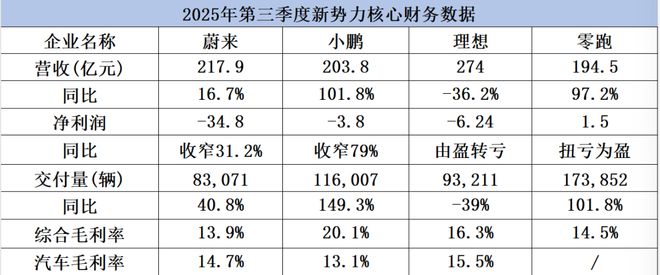
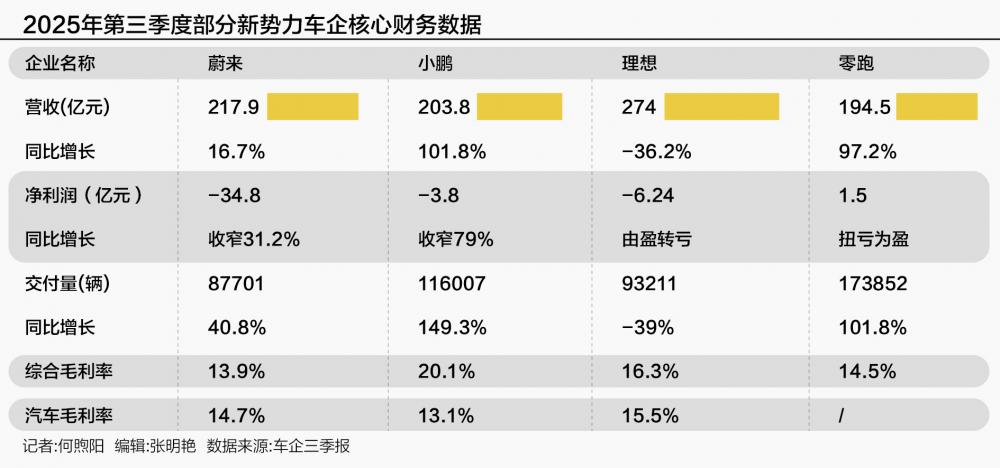
Core Viewpoint - The competitive landscape of new energy vehicle manufacturers is reshaping as Q3 2025 financial reports are released, highlighting significant performance variations among companies, with some showing improved profitability while others struggle with losses [1][3]. Group 1: Company Performance - Xiaopeng Motors achieved a revenue of 203.8 billion yuan, a year-on-year increase of 101.8%, despite a net loss of 3.9 billion yuan, which narrowed by 79% [2][5]. - NIO reported a revenue of 217.9 billion yuan, a year-on-year increase of 16.7%, but remains the largest loss-maker among new energy vehicle companies with a net loss of 34.8 billion yuan, although this loss narrowed by 31.2% [2][13]. - Li Auto, once profitable, faced a revenue decline of 36.2% to 274 billion yuan, resulting in a net loss of 6.24 billion yuan, ending its streak of 11 consecutive profitable quarters [2][10]. - Leap Motor recorded a revenue of 194.5 billion yuan, a year-on-year increase of 97.2%, and achieved a net profit of 1.5 billion yuan, marking its second consecutive profitable quarter [2][16]. Group 2: Strategic Adjustments - Xiaopeng Motors is shifting its strategy by embracing range-extended electric vehicles (REEVs) and enhancing its overseas market presence, with a focus on models like the Xiaopeng X9 [5][8]. - NIO is refocusing on its core automotive business, reducing costs, and aiming for improved sales efficiency while cutting down on non-core expenditures [13][14]. - Li Auto is pivoting towards AI technology, emphasizing the transformation of vehicles into smart terminals, while still facing challenges in its electric vehicle transition [11][10]. - Leap Motor is entering the REEV market and targeting the high-end SUV segment, attempting to elevate its brand image beyond its previous focus on cost-effectiveness [16][17]. Group 3: Market Dynamics - The Chinese new energy vehicle market is transitioning from growth to competition for existing market share, with companies needing to enhance their product, technology, and brand strengths to survive [3][17]. - The competitive landscape is characterized by companies learning from each other and adjusting their strategies to remain relevant in a rapidly evolving market [3][17]. - The overall profitability of the new energy vehicle sector is under scrutiny, with the upcoming financial results expected to determine which companies will thrive in the future [17].
造车新势力Q3财报
2 1 Shi Ji Jing Ji Bao Dao· 2025-12-01 23:13
Core Insights - The competitive landscape of new energy vehicle manufacturers in China is undergoing significant changes as Q3 2025 financial reports are released, with Xpeng Motors showing remarkable growth while NIO and Li Auto face challenges [1][2][3] Company Performance - **Xpeng Motors**: Achieved a revenue of 203.8 billion yuan, with a year-on-year growth of 101.8%. Despite a net loss of 3.8 billion yuan, this represents a 79% reduction in losses compared to the previous year. The company delivered 116,007 vehicles, marking a 149.3% increase year-on-year [4][6][8] - **NIO**: Reported a revenue of 217.9 billion yuan, with a year-on-year growth of 16.7%. The net loss was 34.8 billion yuan, a 31.2% reduction from the previous year. NIO delivered 87,701 vehicles, a 40.8% increase year-on-year [4][12][14] - **Li Auto**: Generated a revenue of 274 billion yuan, but experienced a 36.2% year-on-year decline. The company reported a net loss of 6.24 billion yuan, ending an 11-quarter streak of profitability. Vehicle deliveries fell by 39% to over 93,000 units [4][9][11] - **Leap Motor**: Achieved a revenue of 194.5 billion yuan, with a year-on-year growth of 97.2%. The company reported a net profit of 1.5 billion yuan, marking its second consecutive profitable quarter. Leap Motor delivered nearly 174,000 vehicles, a 101.8% increase year-on-year [4][15][16] Strategic Adjustments - The new energy vehicle market is shifting from growth to competition based on product, technology, and brand strength, as companies adapt their strategies to survive in a more competitive environment [3][16] - **Xpeng Motors**: Focused on improving operational efficiency and profitability, launching new models like the X9 Super Range Extender, which aims to address consumer pain points regarding range and charging speed [7][8] - **Li Auto**: Shifted focus towards AI integration in vehicles, moving away from traditional family-oriented branding to emphasize technological advancements [10][11] - **NIO**: Reduced operational costs and refocused on core automotive sales, moving away from previous explorations in other business areas [12][13] - **Leap Motor**: Adjusted its strategy to enter the range extender market and target the high-end SUV segment, while also attempting to elevate its brand image [15][16]

小鹏汽车突围,智能化布局日益显露
2 1 Shi Ji Jing Ji Bao Dao· 2025-11-29 14:37
Core Insights - The new energy vehicle (NEV) market is experiencing significant shifts, with XPeng surpassing NIO and Li Auto to become the largest NEV company by market capitalization as of Q3 2025, valued at 160.2 billion yuan [2] - Li Auto, which previously achieved profitability through its "range extender + family" strategy, is losing its competitive edge as other companies enter the range extender market [2] - NIO, once the highest valued NEV company, is now focusing on core automotive products due to financial burdens from its expansive business model [2] - XPeng's recovery from internal management issues and high supply chain costs has led to a resurgence in sales and a renewed focus on advanced technologies like autonomous driving and robotics [3][4] Company Performance - XPeng's Q3 report shows a gross margin exceeding 20% for the first time, with a year-on-year revenue growth of 100% [3] - The company has launched popular models such as the XPeng P7+ and Mona M03, contributing to its improved performance [2] - XPeng's strategic partnerships, particularly with Volkswagen for autonomous driving technology, are expected to enhance its market position [4] Technological Ambitions - XPeng is focusing on autonomous driving, Robotaxi services, and humanoid robots, with plans to launch three Robotaxi models by 2026 [4] - The company aims to start mass production of advanced humanoid robots by the end of 2026, targeting various service applications [4] - XPeng's self-developed Turing chip has received procurement certification from Volkswagen, marking a significant milestone in its technology development [4] Competitive Landscape - The NEV sector is entering a new phase of competition centered around AI technologies, with Li Auto and NIO also announcing their AI commercialization strategies [4] - Li Auto plans to launch its first AI glasses in December, while NIO's self-developed Dimensity chip will open for external collaboration in Q4 [4] - XPeng's technological focus positions it favorably in the ongoing AI competition, although it faces challenges in commercializing its Robotaxi and humanoid robot initiatives [5] Strategic Direction - XPeng's management emphasizes a strategy of "steady progress" to ensure long-term success, indicating that strong vehicle sales will support its technological explorations [6]
【小鹏汽车(XPEV.N)】2026E“一车双能”全面启动,聚集AI应用场景的分批落地——25Q3业绩点评报告(倪昱婧/邢萍)
光大证券研究· 2025-11-20 23:03
Core Viewpoint - Xiaopeng Motors reported strong revenue growth in Q3 2025, with total revenue increasing by 101.8% year-on-year and 11.5% quarter-on-quarter to 20.38 billion yuan, indicating robust business performance despite challenges in automotive gross margins [4][5]. Group 1: Q3 2025 Performance - Total revenue for Q3 2025 reached 20.38 billion yuan, reflecting a year-on-year increase of 101.8% and a quarter-on-quarter increase of 11.5% [4]. - Gross margin improved by 4.8 percentage points year-on-year and 2.8 percentage points quarter-on-quarter to 20.1% [4]. - Non-GAAP net loss narrowed significantly by 90.1% year-on-year and 60.6% quarter-on-quarter to 150 million yuan [4]. Group 2: Automotive Business Insights - Automotive revenue for Q3 2025 was 18.05 billion yuan, up 105.3% year-on-year and 6.9% quarter-on-quarter, with a delivery volume of 116,000 units, representing a 149.3% year-on-year increase [5]. - The average selling price (ASP) decreased by 17.7% year-on-year and 4.9% quarter-on-quarter to 156,000 yuan [5]. - Automotive gross margin decreased by 1.2 percentage points quarter-on-quarter to 13.1%, attributed to a higher sales proportion of the Mona M03 model and inventory clearance of older models [5]. Group 3: Future Outlook and Strategic Initiatives - For 2026, the company plans to launch seven "dual-energy" models, including four new models, and ramp up production at overseas factories [6]. - Collaboration with Volkswagen on G9 platform models is expected to begin mass production in 2026, enhancing revenue potential [6]. - The company aims to introduce three Robotaxi models and a new generation of humanoid robots by the end of 2026, leveraging AI technology [6][7].
小鹏汽车-W(09868):看好强势产品周期,物理AI商业化推进中
GOLDEN SUN SECURITIES· 2025-11-19 08:16
Investment Rating - The report maintains a "Buy" rating for the company [7][9]. Core Insights - The company is expected to benefit from a strong product cycle, overseas expansion, advancements in autonomous driving, and emerging business opportunities in robotics and Robotaxi [7]. - The company delivered 116,007 vehicles in Q3, a year-on-year increase of 149%, leading to a revenue growth of 102% to 20.38 billion yuan [1]. - The gross margin for Q3 was 20.1%, with a notable improvement in profitability as the net loss narrowed significantly [1][2]. Financial Performance - For Q3, the company achieved a revenue of 20.38 billion yuan, with automotive sales revenue of 18.1 billion yuan and service revenue of 2.3 billion yuan, reflecting year-on-year growth of 105% and 78% respectively [1]. - The company’s Q3 net loss was 380 million yuan, a significant reduction compared to previous periods, with a Non-GAAP net loss of 150 million yuan, narrowing by 90% year-on-year [1]. - The projected total revenue for Q4 is expected to be between 21.5 billion and 23 billion yuan, representing a year-on-year increase of 33.5% to 42.8% [2]. Product and Market Outlook - The company plans to launch the X9 super range extender model on November 20, with additional models set to be released in early 2026 [3]. - The overseas market is showing strong growth, with Q1-Q3 overseas deliveries reaching 29,706 units, a 79% increase year-on-year [4]. - The company is enhancing its autonomous driving capabilities with the introduction of the VLA 2.0 model, which significantly improves performance in complex driving scenarios [5]. Future Projections - The company forecasts total vehicle sales of approximately 440,000, 700,000, and 910,000 units for the years 2025, 2026, and 2027 respectively, with total revenues projected to reach 773 billion yuan by 2025 [7][8]. - The gross margin is expected to remain around 20% for Q4, with a long-term target of achieving a Non-GAAP net profit margin of 5.1% by 2027 [2][8].