Vera Rubin AI平台

Search documents
“AI界春晚”重磅来袭!一文读懂:英伟达GTC今年有哪些看点?
Zhong Jin Zai Xian· 2026-03-16 13:32
Core Insights - The Nvidia GTC 2026 conference, often referred to as the "Spring Festival of AI," will take place from March 16 to 19 in San Jose, California, featuring a keynote speech by CEO Jensen Huang [1] - The conference is expected to showcase Nvidia's integration of recent acquisitions and partnerships, particularly with AI chip startup Groq, which has developed a Language Processing Unit (LPU) that claims to be ten times more efficient than GPUs for AI inference tasks [1][2] - Nvidia may also unveil new PC processors, N1 and N1X, aimed at Windows laptops, which are based on Arm architecture and targeted towards gaming scenarios [2] - The gaming business generated $22.5 billion in revenue in 2025, while the data center business reached $193.5 billion, indicating a significant revenue disparity [3] - Nvidia is anticipated to provide updates on the upcoming Vera Rubin AI platform and the Vera Ultra, as well as details on the Feynman GPU expected in 2028 [3] - The company is likely to introduce an AI agent platform named NemoClaw, allowing enterprises to deploy intelligent agents within their systems [3] - The conference is expected to highlight innovations in chip products, including the potential release of LPU inference chips and further details on the Rubin Ultra chip [4][5] - The next-generation Feynman architecture and its implications for future computing infrastructure and the AI industry will also be discussed, reinforcing market confidence in the growth of the AI sector [6]

“AI届春晚”,重磅来袭
财联社· 2026-03-16 05:59
Core Viewpoint - The upcoming NVIDIA GTC 2026 conference is expected to showcase significant product announcements and technological updates, particularly in AI and chip development, as CEO Jensen Huang will present the company's future plans [2][3]. Group 1: Product Announcements - NVIDIA is anticipated to reveal new products and technology updates during the GTC, including the integration of recent acquisitions and partnerships into its product ecosystem [3]. - A notable agreement with AI chip startup Groq allows NVIDIA to utilize Groq's inference technology, which claims to run AI models with ten times the efficiency of GPUs [3]. - NVIDIA may also introduce two new PC processors, N1 and N1X, designed for Windows laptops, which will be based on Arm architecture and target gaming scenarios [4][5]. Group 2: Software Developments - The company is expected to launch an AI agent platform named NemoClaw, enabling businesses to deploy intelligent agents within their systems [6]. - NVIDIA's focus on software capabilities is evident, with plans to release various open-source AI models applicable in multiple fields, including autonomous driving [6]. - The GTC will likely feature announcements related to AI and robotics, which could represent a multi-trillion-dollar market opportunity [6]. Group 3: Future Projections - Huang is expected to provide details on the upcoming Vera Rubin AI platform and the Vera Ultra set to launch in the second half of 2027, along with insights into the Feynman GPU expected in 2028 [5]. - The conference is anticipated to enhance market confidence in the sustained growth of the AI industry and the realization of incremental logic [6].

中信证券:聚焦算力链通胀主线 看好英伟达GTC强化AI产业持续增长信心
智通财经网· 2026-03-16 00:33
Core Insights - Nvidia is expected to expand its chip product matrix at the upcoming GTC 2026 conference, potentially unveiling details about the Rubin Ultra chip and cabinet, which may lead to innovations in data interconnectivity and power supply design [1] - The global demand for computing power continues to exceed expectations, indicating sustained growth in the upstream sector and price increases, making it a key focus for technology sector investments [1] Group 1 - The Rubin platform introduces a new chip combination that reflects extreme collaborative design [1] - At the 2026 CES, Nvidia launched the full suite of six core chips for the Vera Rubin AI platform, including Rubin GPU, Vera CPU, BlueField-4 DPU, NVLink 6 Switch, ConnectX-9 SuperNIC, and Spectrum-6 Ethernet Switch, all upgraded to TSMC's 3nm process and featuring HBM4 [2] - The new product lineup enhances the synergy between GPU, CPU, and interconnect chips, with a modular design that improves overall cabinet integrity compared to the previous Blackwell generation [2] Group 2 - Nvidia is expected to disclose more details about the Rubin Ultra chip and cabinet at GTC 2026, with significant improvements in data interconnectivity and power supply systems [2] - The architecture of the Rubin Ultra chip is anticipated to include a two-layer super network structure and advanced power supply solutions, addressing the bottlenecks in computing power expansion [2] Group 3 - Nvidia is likely to introduce a new inference chip, LPU, to strengthen its inference product line, designed specifically for LLM inference with a custom chip architecture [3] - The LPU is expected to enhance data storage and retrieval speeds, while the CPX, launched in 2025, may transition to an independent cabinet form [3] Group 4 - The next-generation Feynman architecture is gaining attention, with expectations for Nvidia to showcase related content at GTC 2026 [4] - Feynman is projected to be among the first chips utilizing TSMC's A16 process, with potential innovations in power delivery and 3D stacking technology [4]

算力|从芯片角度看英伟达GTC前瞻
Xin Lang Cai Jing· 2026-03-16 00:17
Core Insights - The upcoming NVIDIA GTC 2026 conference is expected to showcase an expanded chip product matrix, including the full suite of six core chips from the Vera Rubin AI platform, and potentially reveal details about the Rubin Ultra chip and cabinet innovations, enhancing data interconnectivity and power supply designs [1] Group 1: Rubin Platform and Chip Innovations - The Vera Rubin AI platform, unveiled at CES 2026, includes six core chips: Rubin GPU, Vera CPU, BlueField-4 DPU, NVLink 6 Switch, ConnectX-9 SuperNIC, and Spectrum-6 Ethernet Switch, all utilizing TSMC's 3nm process and upgraded HBM4 memory, enhancing synergy among GPU, CPU, and interconnect chips [2] - At GTC 2026, NVIDIA is likely to disclose more details about the Rubin Ultra chip, which is expected to double the computing performance compared to Rubin by integrating four computing dies, and introduce a two-layer super network architecture for data interconnectivity and power supply systems [2] Group 2: New Inference Chip and System-Level Infrastructure - NVIDIA is anticipated to launch a new inference chip, LPU, at GTC 2026, which will integrate Groq LPU technology and feature a custom chip architecture designed for LLM inference, significantly improving data storage and retrieval speeds [3] - The Rubin CPX, introduced in 2025, is expected to lower prefill costs and may transition from an integrated form to an independent cabinet setup, potentially utilizing GDDR7 or HBM3E memory specifications [3] Group 3: Future Architecture and Industry Trends - The next-generation Feynman architecture is expected to be showcased at GTC 2026, with predictions that it will adopt TSMC's A16 process and incorporate backside power delivery and 3D stacking technologies, with production starting in 2028 and deliveries in 2029 [4] - NVIDIA's insights into the future of AI computing infrastructure will be crucial, especially in the context of the slowing Moore's Law, focusing on innovations in computing, storage, and operational capabilities to support the ongoing evolution of the AI industry [4]

英伟达重回“首选”宝座,华尔街发出AI投资风向标:现在是入场点?
Jin Shi Shu Ju· 2026-03-03 03:31
Core Viewpoint - Nvidia has regained its position as Morgan Stanley's top pick in the semiconductor sector, overtaking Micron Technology, indicating a shift in market discussions regarding AI investment paths [1] Group 1: Nvidia's Market Position - Analyst Joseph Moore believes that despite Nvidia's recent stock performance being flat, market enthusiasm for its 2027 outlook may increase in the coming months, with the current stock price corresponding to an estimated earnings multiple of about 18 times for the 2027 calendar year, presenting an "unexpectedly good entry point" [1] - There is an ongoing debate about whether memory stocks or Nvidia stocks represent the best bet on the AI boom, with Moore suggesting that while memory stocks reflect a longer-term cycle, Nvidia's strength is central to the memory shortage, and AI's profit leverage may not be limited to memory companies [1] Group 2: Industry Demand and Competition - Moore indicates that memory and Nvidia's logic are closely linked, with comprehensive surveys showing that capital expenditures from hyperscale cloud service providers are expected to grow for several years, although sustainability is harder to determine [2] - Some hyperscale customers have placed three-year orders with memory suppliers, even making full prepayments, indicating that companies are preparing for broader long-term infrastructure expansions, which should enhance market confidence in their long-term narratives [2] - Nvidia is not the only beneficiary in the competitive landscape, as AMD is strengthening its graphics processor offerings, while Alphabet and Broadcom's partners are gradually expanding market share through lower-cost application-specific integrated circuits [2] Group 3: Nvidia's Product Development - Despite some weakening of "moats" among AI chip manufacturers, customers still prefer Nvidia products, with expectations that demand for AI chips will continue to exceed supply [3] - Nvidia's current Blackwell chip is expected to remain the preferred processor, and the upcoming Vera Rubin AI platform, set to ship in the second half of the year, is anticipated to further solidify the company's appeal among large cloud customers [3] - Nvidia plans to launch a new inference-oriented chip system and is accelerating innovation through a new partnership with startup Groq, although the company has not commented on this potential new product [3]
英伟达交付Vera Rubin AI平台样品,下半年将启动量产
Huan Qiu Wang Zi Xun· 2026-02-26 06:38
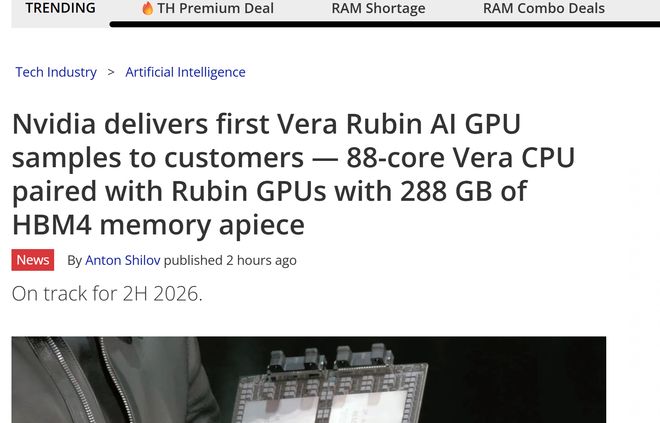
Group 1 - Nvidia announced the delivery of samples for the next-generation AI data center platform, Vera Rubin, with mass production expected to start in the second half of 2026 [1][3] - The Vera Rubin platform features significant performance upgrades, including an 88-core Vera CPU, 288GB HBM4 memory, and 128GB GDDR7 Rubin CPX GPU, among other advanced components [3][4] - Nvidia is requiring partners to complete hardware and software stack adaptations in advance, with various partners receiving different components, including complete NVL72 VR200 systems [4] Group 2 - The modular design of the Rubin platform enhances reliability and maintainability compared to the previous Blackwell platform, with expectations for widespread deployment among major cloud service providers [4]
国信证券晨会纪要-20260119
Guoxin Securities· 2026-01-19 00:55
Group 1: Outdoor Apparel Industry - The outdoor footwear and apparel industry has maintained rapid growth since 2021, with a CAGR of 25.3% for outdoor apparel and 18.4% for outdoor footwear, projected to grow by 24.5% and 16.3% respectively in 2025 [24][26] - Online sales of outdoor footwear are growing at over 40%, while growth in outdoor apparel has slowed to low single digits since Q2 2025; specific categories like down jackets and quick-dry clothing are experiencing strong growth, with some quarterly YoY growth nearing 100% [24][26] - The industry is seeing increased competition among brands, with top brands like Kailas and Berghaus maintaining high growth through specialized product lines, while others like The North Face are underperforming; pricing trends are weakening overall, but some high-demand brands are still able to increase prices [24][26] Group 2: AI Application in Computing Industry - Major international companies are focusing on AI application in vertical scenarios, with OpenAI launching ChatGPT Health and Amazon optimizing cross-border e-commerce operations through AI [28] - Domestic companies are also advancing in AI applications, with Alibaba upgrading health services and ByteDance's Volcano Engine becoming a key AI cloud partner for major events [28] - The market for AI applications is expected to see significant growth, with predictions indicating that the GEO market will reach $24 billion globally by 2026, driven by high consumer trust in AI applications in China [30][32] Group 3: Public Utilities Industry - The public utilities sector, including electricity, gas, and water, is characterized by its "essential" nature, with stable long-term growth prospects; the transition to low-carbon energy sources is expected to increase the share of clean energy consumption to 28.6% by 2024 [32][33] - The global electricity shortage is becoming more pronounced, leading to increased electricity prices and making the sector an attractive investment area, particularly as AI development accelerates [33]
AI应用专题:各大厂新模型持续迭代,重视AI应用板块投资机会
Guoxin Securities· 2026-01-16 06:42
Investment Rating - The report maintains an investment rating of "Outperform the Market" for the industry [1]. Core Insights - Major international companies are focusing on AI application deployment, with innovations in vertical scenarios such as healthcare and e-commerce. OpenAI's ChatGPT Health and Anthropic's Claude for Healthcare are examples of AI solutions targeting compliance and professional services in healthcare [2]. - Domestic companies are also advancing AI applications, with Alibaba's "Ant Aifu" upgrading health services and ByteDance's Volcano Engine becoming the exclusive AI cloud partner for the Spring Festival Gala. The stock prices of newly listed AI companies like Zhiyu and Minimax have surged significantly post-IPO [2]. Summary by Sections 01 International Companies' AI Application Deployment - OpenAI launched ChatGPT Health, which has received over 230 million health-related inquiries weekly, focusing on data integration and compliance [9]. - Anthropic introduced Claude for Healthcare, covering clinical services and personal health management while adhering to strict data security standards [14]. 02 Domestic Companies' AI Application Deployment - Alibaba's "Ant Aifu" aims to become the leading health app in China, integrating with major health devices and offering various health services [32]. - ByteDance's Volcano Engine is set to enhance the Spring Festival Gala experience through AI, marking its third collaboration with the event [37]. - Deepseek is expected to release its V4 flagship model, which promises significant advancements in AI capabilities [39]. 03 Industry Chain Overview - The report outlines various application directions and key companies in sectors such as healthcare, e-commerce, and gaming, highlighting potential investment opportunities [49].
沪指收出“十字星” 后期盯紧成交量
Sou Hu Cai Jing· 2026-01-07 14:16
Market Overview - A-shares experienced slight gains on January 7, with the Shanghai Composite Index achieving a 14-day consecutive rise, closing up 0.05% at 4085.77 points [1] - The Shenzhen Component Index rose 0.06% to 14030.56 points, while the ChiNext Index increased by 0.31% to 3329.69 points [1] - Total trading volume in the Shanghai and Shenzhen markets reached 288.18 billion yuan, an increase of 49.2 billion yuan compared to January 6 [1] Sector Performance - The electronic chemicals, coal, semiconductor, power equipment, minor metals, biopharmaceuticals, and power grid equipment sectors showed the most significant gains [1] - Conversely, the shipbuilding, education, securities, aerospace, and jewelry sectors experienced the largest declines [1] - On January 7, 2173 stocks rose, with 97 hitting the daily limit, while 3190 stocks fell, with 7 hitting the lower limit [1] Technical Analysis - The Shanghai Composite Index formed a "doji" candlestick pattern with a larger upper shadow than lower shadow, indicating significant selling pressure [3] - Future trading days will require close monitoring of trading volume; a surge above 3 trillion yuan may indicate substantial capital withdrawal, potentially leading to significant adjustments [3] - If trading volume begins to shrink, a minor adjustment is expected, but the extent of this adjustment is anticipated to be limited [3] Specific Stock Movements - Storage chips saw a significant rise at the market open, driven by NVIDIA's announcement of the new Vera Rubin AI platform, which is set to enhance training efficiency and reduce inference costs [2] - However, many strong stocks in the storage chip sector experienced a pullback, suggesting that some investors are taking profits [2] - The securities and oil sectors faced selling pressure, with the oil sector's decline attributed to fluctuations in international oil prices [2]
超1000家A股公司2025年股价创新高!上纬新材涨逾18倍领衔!多只存储芯片股翻倍
私募排排网· 2026-01-07 12:00
Core Viewpoint - In 2025, A-shares experienced a "slow bull" trend driven by ample liquidity, policy catalysts, and a technology cycle, with the Shanghai Composite Index rising by 18.41% and the Shenzhen Component Index increasing by 29.87% [2] Group 1: Market Performance - The Shanghai Composite Index surpassed 4000 points for the first time in ten years, while the ChiNext Index surged by 49.57%, leading global major markets [2] - A total of 1086 companies in A-shares reached historical highs in 2025, with an average increase of 95.22% [2] - The top five industries with the most companies reaching historical highs were General Equipment, Auto Parts, Semiconductors, Specialized Equipment, and Chemical Pharmaceuticals, with average increases of 111.50%, 117.95%, 84.67%, 87.92%, and 76.06% respectively [2] Group 2: Individual Stock Highlights - Among the 1086 companies, 353 saw stock prices rise over 100%, 104 over 200%, and 38 over 300% [5] - The company with the highest increase was Shangwei New Materials, which rose by 1820.29%, reaching a peak price of 132.50 yuan [5][8] - Other notable companies included Tianpu Co., which increased by 1645.35%, and several companies in the automotive and communication equipment sectors [5] Group 3: Semiconductor Sector - The semiconductor sector had 61 companies reaching historical highs, with 33 of them increasing by at least 50% [14] - The demand for storage chips is expected to grow significantly due to advancements in AI and the upcoming release of new products by major companies like NVIDIA [13] - Companies such as Yingxin Development and Tongcheng New Materials saw significant stock price increases, driven by the AI boom [9][14] Group 4: Institutional Investment - Institutional investments played a crucial role in the stock price increases, with 563 companies having public fund holdings exceeding 1% and 350 with foreign investment [15] - Among the companies that reached historical highs, 50 had both public fund and foreign investment holdings exceeding 5% [15]