
Jing Ji Ri Bao

Search documents
合力共治小区充电桩落地难
Jing Ji Ri Bao· 2025-12-26 00:03
小区安装充电桩,看似是小工程,却需多方共同努力。只有把充电"最后一公里"真正打通,才能让 这件"关键小事"转化为提升群众获得感的"暖心实事"。(本文来源:经济日报 作者:张思) document.getElementById("article_m").innerHTML=document.getElementById("article_p").innerHTML; (责任编辑:臧梦雅) 解决充电桩"落地难",既要算成本账,也绕不开管理关。安装充电设施并非简单"装几个插座"。按 照相关规定,除充电和计费设备外,还需配套监控、消防等安全设施,后期维护也需持续投入。钱从哪 里来、谁来承担,往往难以迅速形成共识。此外,选址和审批牵涉物业公司、业委会、消防部门等多个 主体,流程繁琐、周期较长。一旦安全责任界定不清,容易出现"多头管理、相互观望"情况,让迫切的 民生需求卡在"推进中"。 解决这一难题,首先需要业委会和物业公司凝聚共识、主动作为。通过方案公示、居民座谈、意见 征集等方式,把协商前置,将安全标准和使用规则讲清楚,回应居民关切、消除顾虑。同时,加强对飞 线充电等高风险行为的宣传与治理,引导居民在认清隐患的基础上 ...
徐剑波:把握农业全链建设关键点
Jing Ji Ri Bao· 2025-12-26 00:03
Core Viewpoint - The development of the agricultural full industry chain in China has significantly improved agricultural comprehensive benefits and competitiveness, transitioning from production-focused to a more integrated approach that emphasizes the entire chain, industry, and system [1] Group 1: Agricultural Full Industry Chain Development - The agricultural full industry chain integrates production, processing, and sales, breaking the traditional segmentation of agricultural processes and achieving a transformation from "production-product-link" to "chain-industry-system" [1] - Major agricultural developed countries view the construction of efficient, high-value full industry chains as a core competitive advantage in modern agriculture [1] Group 2: Challenges and Solutions - China faces issues such as short, weak, and missing links in the agricultural industry chain, characterized by low added value, low technology transfer rates, and inadequate agricultural social service systems [2] - To address these challenges, the focus should be on extending, supplementing, and strengthening the agricultural industry chain, promoting integrated development across upstream and downstream sectors [2][3] Group 3: Key Strategies for Improvement - Extending the chain involves enhancing agricultural product processing technology, improving the integration of production, processing, and sales, and promoting new business models such as e-commerce and health agriculture [2] - Supplementing the chain requires strengthening agricultural technology innovation, improving market and logistics infrastructure, and fostering diverse service entities [3] - Strengthening the chain includes cultivating leading agricultural enterprises, innovating benefit-sharing mechanisms, and promoting orderly land management and financing [3] Group 4: Value Enhancement and Digital Transformation - Enhancing industry value involves establishing a high-quality development standard system for agriculture, promoting digital transformation through new technologies, and implementing brand enhancement strategies [4] - The goal is to create a traceable system from farm to table, improving product quality and competitiveness [4]
中经评论:5G遇冷了吗
Jing Ji Ri Bao· 2025-12-26 00:03
Core Insights - The number of 5G mobile phone users in China reached 1.193 billion by the end of November, with a net increase of 179 million users compared to the end of the previous year, accounting for 65.3% of total mobile phone users [1] - Despite the growth in 5G users, skepticism remains regarding its utility, with some arguing that 5G has cooled off and is unnecessary [1][2] - The skepticism is primarily driven by two factors: cost and perception. The higher costs of 5G devices and plans compared to 4G, along with a lack of compelling applications that demonstrate 5G's advantages to consumers, contribute to the reluctance to upgrade [1][2] Cost Factors - 5G devices are more expensive due to higher costs in core components, patents, design, and manufacturing compared to 4G devices [1] - Although 5G plan prices have been reduced, the cost-benefit ratio compared to 4G remains unclear for many users, leading to a lack of motivation to switch [1][2] Perception Factors - Most users' communication needs are met by 4G, making it difficult for them to perceive the advantages of 5G, such as high bandwidth and low latency [2] - The majority of 5G applications are industry-focused, with only 20% targeting personal consumption, which diminishes the perceived value for average consumers [2] Industrial Impact - In the industrial sector, 5G is transforming production models, enhancing efficiency and resource utilization in smart factories, and enabling remote diagnostics through AR technology [3] - Data shows that 5G-enabled factories in China have seen a 25% increase in average production capacity, a 21% improvement in product quality, and a 19% reduction in operational costs [3] Societal Benefits - 5G is creating new possibilities in various sectors, including healthcare, education, transportation, and agriculture, by enabling remote surgeries, equitable education access, and precise agricultural monitoring [3] Technological Foundation - 5G serves as a foundational technology for other advanced technologies, such as AI and AR/VR, requiring its high-speed, high-bandwidth, and low-latency capabilities [4] - The development of 6G relies on the groundwork laid by 5G in network architecture and spectrum resources [4] Long-term Perspective - The skepticism surrounding 5G mirrors past doubts about 4G, which only gained recognition after the emergence of transformative applications [4] - The transition from a construction boom to a focus on application development indicates a rational shift in the 5G landscape, with ongoing efforts to enhance network coverage, reduce costs, and expand application scenarios [4]
杨志成:擦亮中国式现代化的鲜明底色
Jing Ji Ri Bao· 2025-12-26 00:03
Group 1: Core Perspectives - Green development is a prominent feature of Chinese-style modernization, emphasizing the need for a comprehensive green transformation in economic and social development as outlined in the 14th Five-Year Plan [1] - The Central Economic Work Conference has prioritized "adhering to 'dual carbon' leadership and promoting comprehensive green transformation" as a key task for the upcoming year [1] Group 2: Ecological Civilization Awareness - Enhancing ecological civilization awareness is crucial for fostering a societal atmosphere that supports environmental protection, requiring the internalization of ecological concepts [2] - There is a need to strengthen public consciousness regarding ecological protection and to integrate ecological education into the national education system [2] Group 3: Industrial Green Transformation - Accelerating the green transformation and upgrading of industries is essential, as industries are significant contributors to energy consumption and pollution [3] - The number of national-level green factories has increased to 6,430, accounting for approximately 20% of total manufacturing output, indicating progress in industrial structure transformation [3] Group 4: Promoting Green Lifestyles - Green development encompasses both production and lifestyle changes, necessitating the promotion of green consumption and living practices [4] - Encouraging the adoption of green products and services, as well as enhancing the supply of such offerings, is vital for fostering a low-carbon lifestyle [4]
中经评论:以最大努力抓好就业这个“最大民生”
Jing Ji Ri Bao· 2025-12-26 00:03
Core Insights - The employment situation in China has shown significant improvement, with 12.1 million new urban jobs created from January to November, surpassing the annual target, and the urban survey unemployment rate averaging 5.2%, below the 5.5% control target [1] Group 1: Employment Stability - Employment is prioritized as the largest aspect of people's livelihoods, with stable employment directly correlating to maintaining the livelihood baseline and development confidence [1] - The central government has placed a strong emphasis on stabilizing employment as part of its broader economic strategy, implementing coordinated fiscal, monetary, industrial, and employment policies to ensure basic stability in employment [1] Group 2: Structural Challenges - Despite overall stability, there are significant structural contradictions in the employment sector, characterized by strong supply and weak demand [2] - The strong supply is evident in the large number of over 10 million college graduates and nearly 300 million migrant workers each year, posing challenges in stabilizing existing jobs and expanding new ones [1][2] - The weak demand reflects a mismatch between the quality and stability of job growth and the expectations of laborers, with traditional industries and small businesses being cautious in expanding job opportunities [1][2] Group 3: Policy Directions - The central economic work conference has outlined a direction for employment policies, emphasizing the need for actions to stabilize jobs, expand capacity, and improve quality [2] - Key strategies include stabilizing business operations to ensure job retention, enhancing support for small and micro enterprises, and creating a stable and predictable business environment to boost hiring confidence [2][3] Group 4: Expanding Employment Opportunities - There is a focus on developing new economic sectors such as the digital economy, green economy, and silver economy to create more job opportunities [3] - The service sector is highlighted as a significant employment reservoir, with increased policy support for labor-intensive industries like construction and hospitality [3] - The scale of flexible employment has exceeded 200 million, indicating that new employment forms are becoming vital channels for income generation [3] Group 5: Improving Job Quality - Addressing structural contradictions requires aligning human capital with industry upgrades, focusing on resolving the issue of "having jobs but no workers" [3] - There is a call for profound reforms in vocational education and skills training to better match industry needs and reduce the gap between education and employment [3] - Enhancing public employment services and utilizing big data to improve job matching efficiency is essential for supporting key groups in finding employment [3] Group 6: Interconnected Strategies - The strategies of stabilizing jobs, expanding capacity, and improving quality are interconnected, with job stability serving as the foundation, expansion as the key, and quality improvement as the direction [4] - The employment pressure is expected to rise next year, necessitating a continued prioritization of employment stability and effective implementation of the outlined actions [4]
坚持以习近平生态文明思想为指引 全面推进美丽中国建设
Jing Ji Ri Bao· 2025-12-26 00:03
Core Viewpoint - The construction of a beautiful China is a significant goal for the comprehensive modernization of the socialist nation and is essential for realizing the Chinese Dream of national rejuvenation [1][2][3]. Group 1: Importance of Beautiful China Construction - The construction of a beautiful China is a major strategic deployment by the Central Committee, focusing on the harmonious coexistence of humans and nature, and responding to the people's aspirations for a better life [2][3]. - The concept of a beautiful China is a distinctive feature of Xi Jinping's ecological civilization thought, marking a shift from practical exploration to scientific theoretical guidance in ecological civilization construction since the 18th National Congress [2][3]. - Beautiful China encompasses various aspects such as beautiful homes, cities, and villages, forming a multi-dimensional conceptual system [2]. Group 2: Strategic Positioning - The construction of a beautiful China is emphasized as a key element in the construction of a strong nation and the rejuvenation of the nation, adapting to changes in domestic and international development environments [3][4]. - It is crucial for high-quality development and achieving the second centenary goal, highlighting the importance of ecological civilization for the sustainable development of the Chinese nation [3][4]. Group 3: Pathways to Modernization - The construction of a beautiful China is identified as a pathway to achieve modernization characterized by harmonious coexistence between humans and nature, emphasizing the need for coordinated development of prosperity, national strength, and beauty [4][5]. - The reports from the 18th, 19th, and 20th National Congresses have progressively integrated the concept of beauty into the goals of socialist modernization [4]. Group 4: Achievements in Ecological Civilization - Significant progress has been made in ecological civilization construction, transitioning from targeted remediation to systematic governance, and from passive responses to proactive actions [6][7]. - The "14th Five-Year Plan" marks a milestone in ecological civilization and environmental protection, with comprehensive frameworks and implementation mechanisms being established [7][8]. Group 5: Pollution Control and Environmental Quality - The national air quality has improved significantly, with PM2.5 concentrations in cities dropping to 29.3 micrograms per cubic meter, a 16.3% decrease from 2020 [8]. - The proportion of surface water with good quality has reached 90.4%, and the elimination of black and odorous water bodies in cities has been largely achieved [8]. Group 6: Green and Low-Carbon Transition - The transition towards a green and low-carbon economy is accelerating, with coal consumption decreasing from 56.8% in 2020 to 53.2% in 2024, and renewable energy accounting for approximately 59.1% of total installed capacity [9]. - China has established the world's largest carbon trading market and is leading in green finance, with significant growth in green loans and bonds [9]. Group 7: Global Environmental Governance - China is actively participating in global environmental governance, contributing to the Paris Agreement and committing to carbon peak and neutrality goals [12][13]. - The country has mobilized over 177 billion yuan for climate change initiatives in developing countries, showcasing its role as a key player in global sustainable development [13].
数智水平提升 机械工业强基拓新增动能
Jing Ji Ri Bao· 2025-12-26 00:03
Core Viewpoint - The mechanical industry is a foundational and strategic sector for national economic development, achieving significant progress in scale, foreign trade, and innovation capabilities during the "14th Five-Year Plan" period, laying a solid foundation for new industrialization [1] Group 1: Achievements and Developments - The first commercial supercritical carbon dioxide power generation unit has successfully commenced operation, achieving over 85% efficiency improvement compared to existing technologies [2] - The mechanical industry has shown steady growth during the "14th Five-Year Plan," with enhanced resilience in supply chains and significant improvements in the supply capacity of major technical equipment [2] - By the end of 2024, the number of large-scale enterprises in the mechanical industry is expected to increase from 92,000 to 132,000, with the industry's share of national industrial output rising from 24.1% to 25.8% [3] Group 2: Global Expansion - The launch of the "BYD Changsha" roll-on/roll-off cargo ship marks a new phase for the export of electric vehicles from China to Europe, indicating deepening global integration of the mechanical industry [4] - The mechanical industry has achieved a historic leap in foreign trade, with exports and imports exceeding $1 trillion for four consecutive years, projected to reach $1.17 trillion in 2024 [4] Group 3: Digital and Intelligent Transformation - The launch of the first open robot leasing platform in Shanghai signifies a shift towards ecological and convenient rental models in the robotics industry, reflecting the digital and intelligent transformation of the mechanical sector [7] - By 2024, over 90% of the mechanical industry is expected to adopt digital design tools, with more than 80 companies recognized as top-level smart factories [7] Group 4: Strategic Directions - The mechanical industry is encouraged to enhance its digital capabilities and accelerate the transition towards high-end, intelligent, green, and integrated development [8] - The integration of artificial intelligence into the industrialization process is seen as a key driver for innovation and optimization of the industrial structure [9]
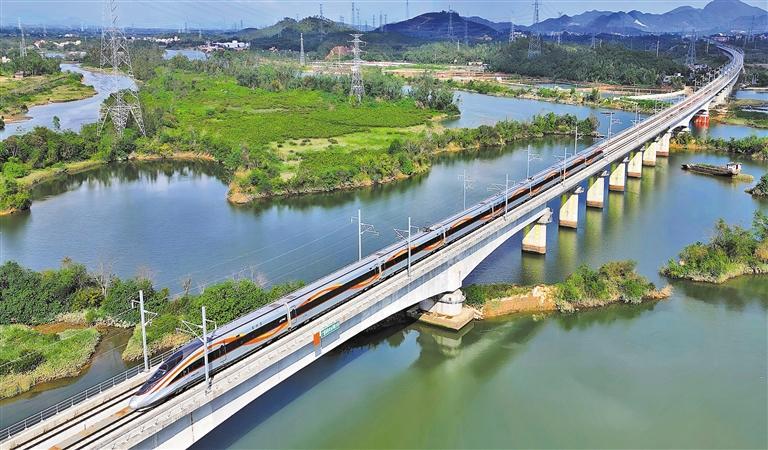
【高质量发展产业调研】高铁领跑
Jing Ji Ri Bao· 2025-12-26 00:03
Core Insights - The opening of the Guangzhou-Zhanjiang high-speed railway marks a significant step towards achieving Guangdong's goal of "city-to-city 350 km/h high-speed rail" [2] - China's high-speed rail network is set to exceed 50,000 kilometers, accounting for 70% of the world's total high-speed rail mileage, and has become the preferred mode of transportation for 3 billion passengers annually [2][3] - The development of high-speed rail in China has transformed the economic geography and daily lives of millions, showcasing the country's industrial strength and engineering capabilities [3][5] Development History - China's high-speed rail began over 40 years later than developed countries but has made a historic leap from catching up to leading the world in just over a decade [3][4] - The first high-speed rail line, the Beijing-Tianjin intercity railway, opened in 2008, followed by several others, significantly increasing the operational mileage [5][6] - Since the 18th National Congress, China's high-speed rail has received systematic support from top-level strategic planning to funding and technological innovation [5][6] Technological Innovation - The innovation system of China's high-speed rail is driven by national strategy, focusing on collaborative innovation across the entire industry chain [8][9] - The introduction of the Fuxing train, which achieved 84% of Chinese standards and full autonomy in core systems, represents a significant milestone in achieving self-reliance in technology [9][10] - Continuous innovation has led to the development of smart high-speed rail technologies, with the Beijing-Zhangjiakou high-speed railway being the world's first to achieve automatic driving at 350 km/h [13][14] Economic Impact - High-speed rail serves as a "main artery" for economic operation, significantly enhancing efficiency and capacity in transportation [5][22] - The high-speed rail network has transformed passenger transport, handling 80% of passenger volume and covering 97% of cities with populations over 500,000 [6][22] - The construction cost of China's high-speed rail is significantly lower than that of Europe and the United States, contributing to its profitability [22] Structural Changes - The high-speed rail network has reshaped transportation structures, increasing its market share from less than 1% in 2008 to 28% in 2023, while reducing the market share of air travel on certain routes [26][27] - Cities are being restructured, with high-speed rail facilitating economic integration and attracting businesses, as seen in cities like Shangrao [28][29] - The development of high-speed rail has led to a redefinition of economic zones, creating new corridors and functional areas that enhance regional economic collaboration [29][30] Future Prospects - The CR450 technology innovation project aims to further enhance high-speed rail capabilities, focusing on higher speeds and improved operational efficiency [15][33] - The profitability of high-speed rail is expected to improve with continued passenger growth and market-oriented pricing mechanisms [36][38] - China's high-speed rail is positioned to expand its influence internationally, with projects like the Jakarta-Bandung high-speed railway demonstrating its global reach [40][41]

【中国制造新观察】5G遇冷了吗
Jing Ji Ri Bao· 2025-12-26 00:03
Core Insights - The scale of 5G users continues to expand, reaching 1.193 billion by the end of November, with a net increase of 179 million users compared to the end of the previous year, accounting for 65.3% of mobile phone users [2] - Despite the growth in user numbers, skepticism about 5G persists, with concerns primarily centered around cost and user perception [3] Cost Factors - The hardware costs for 5G terminals are higher than those for 4G, leading to reluctance among existing 4G users to upgrade their devices [2] - Although 5G package prices have been reduced, the cost-performance ratio compared to 4G remains unclear, and some users perceive that 5G packages consume data more quickly, reducing their willingness to upgrade [2] Perception Factors - Most users' communication needs are met by 4G, making it difficult for them to perceive the advantages of 5G, such as high bandwidth and low latency [3] - The lack of transformative applications similar to those seen during the 4G era contributes to a dominant consumer mindset of "good enough" regarding their current 4G services [3] Industrial Impact - 5G is reshaping production models in the manufacturing sector, enhancing efficiency and resource utilization through features like low latency and wide connectivity [4] - In various sectors such as healthcare, education, transportation, and agriculture, 5G is enabling new possibilities and improving service delivery [4] Technological Foundation - 5G serves as a foundational technology for other advanced technologies, including AI and AR/VR, requiring its high-speed, high-bandwidth, and low-latency capabilities [5] - The development of 6G relies on the groundwork laid by 5G in network architecture and spectrum resources [5] Long-term Perspective - The skepticism surrounding 5G mirrors past doubts about 4G, which were dispelled as transformative applications emerged [5] - The transition from a construction boom to a focus on application development represents a rational shift in the 5G landscape, with ongoing efforts to optimize network coverage and enhance user experience [5]

经济日报财经早餐【12月26日星期五】
Jing Ji Ri Bao· 2025-12-25 23:50
Group 1 - The Central Political Bureau of the Communist Party of China held a meeting to discuss the work report of the Central Commission for Discipline Inspection and the National Supervisory Commission, focusing on the construction of party conduct and anti-corruption work for 2026 [1] - During the 14th Five-Year Plan period, China's 5G user penetration rate increased from 15% to 83.9%, with gigabit broadband users rising from 6.4 million to 239 million, and mobile IoT users growing from 1.136 billion to 2.9 billion [1] Group 2 - The Ministry of Water Resources reported that the national irrigated farmland area has exceeded 109 million acres, an increase of over 5.3 million acres since the end of 2020 [2] - The National Defense Science and Technology University achieved a world record in magnetic levitation testing, accelerating a test vehicle weighing tons to 700 kilometers per hour in just two seconds [2] - The Ministry of Industry and Information Technology announced that the added value of the consumer goods industry above designated size grew by 3.7% year-on-year in the first 11 months, accounting for 26.4% of all industrial output above designated size [2] - The State Administration for Market Regulation responded to issues revealed by the "Antarctic Krill Oil" incident, highlighting problems with the non-standard behavior of enterprises in commissioned production and processing [2] - The "China Ice and Snow Economy Development Report (2025)" indicated that from 2016 to 2024, the scale of China's ice and snow industry increased from 364.7 billion yuan to 980 billion yuan, with an average annual growth rate of 21.09%, and is expected to exceed 1 trillion yuan by 2025 [2] - The Three Gorges Group announced that the first unit of the Zhejiang Tiantai Pumped Storage Power Station, the largest single-unit capacity pumped storage power station in China, has been connected to the grid, marking a significant breakthrough in hydropower equipment and engineering construction [2] Group 3 - The Ministry of Housing and Urban-Rural Development reported that from January to November, 25,800 old urban residential communities were newly started for renovation [4] - The Ministry of Veterans Affairs and the Ministry of Finance announced an increase in the standards for pensions and living allowances for certain veterans and other beneficiaries starting from August 1, 2025 [4] - The world's longest highway tunnel, the Tianshan Victory Tunnel, and the G0711 Xinjiang Urumqi to Weili Highway will open on December 26, reducing the driving time from Urumqi to Korla from 7 hours to 3.5 hours [4] - Beijing Yizhuang announced the hosting of a humanoid robot half marathon and the Beijing Yizhuang half marathon on April 19, 2026, with registration now open [4]