
Guan Cha Zhe Wang

Search documents
古井贡酒把“年酒”端上寻常餐桌,让“中国年酒”成为人人举得起的团圆符号
Guan Cha Zhe Wang· 2026-01-14 02:32
Core Viewpoint - Gujinggongjiu has reaffirmed its position as the exclusive partner of the Spring Festival Gala for the eleventh consecutive year, emphasizing its deep integration into Chinese New Year culture and its commitment to making traditional liquor accessible to the general public [1][5][9]. Brand Partnership and Cultural Significance - The partnership with the Spring Festival Gala has transformed Gujinggongjiu from a mere product into a cultural symbol, representing collective memories of Chinese families during the New Year [5][9]. - The introduction of "Gujinggongjiu · Year Thirty [He]" at a price point of 220 yuan aims to democratize the experience of traditional liquor, making it a staple for family gatherings rather than a luxury item [10][11]. Product Development and Market Strategy - The new product "Gujinggongjiu · Year Thirty [He]" retains the brand's cultural essence while lowering the price to appeal to a broader consumer base, thus enhancing its market presence [10][12]. - The product's design incorporates traditional elements, such as the red lantern and auspicious symbols, reinforcing its connection to Chinese New Year celebrations [6][14]. Craftsmanship and Heritage - Gujinggongjiu boasts a rich heritage of over 1800 years, with its brewing techniques recognized as the oldest distillation method in the world, contributing to its unique market position [13][14]. - The brand emphasizes a balance between traditional craftsmanship and modern innovation, ensuring high-quality production while respecting cultural heritage [14][15]. Cultural Impact and Consumer Engagement - The phrase "Celebrate the New Year, drink Gujing, watch the Spring Festival Gala" has become a cultural phenomenon, reflecting the brand's successful integration into the fabric of Chinese New Year celebrations [15][17]. - The brand's strategy not only focuses on sales but also on fostering cultural connections, making it a vital part of family traditions during the festive season [15][17].



中式快餐“饺子王”袁记食品冲刺港股,计划将中国饺子卖向全球
Guan Cha Zhe Wang· 2026-01-14 00:56
Core Viewpoint - Yuanji Food Group has submitted its listing application to the Hong Kong Stock Exchange, marking a significant step in its capital expansion process [1] Group 1: Company Overview - Yuanji Food is a well-known Chinese fast-food enterprise specializing in fresh dumplings, wontons, and noodle products, with brands "Yuanji Cloud Dumplings" and "Yuanji Taste Enjoy" [2] - The company operates 4,266 stores globally, generating over 2.5 billion in annual revenue, with a steady growth in revenue projected at 2.026 billion in 2023 and 2.561 billion in 2024 [2][3] - The total gross merchandise value (GMV) from all stores increased by 31% from 4.772 billion in 2023 to 6.248 billion in 2024 [3] Group 2: Business Model and Expansion - Yuanji Food's expansion relies on a robust supply chain and a stable franchise system, with 24 warehouses supporting over 4,000 stores [4] - The company has a strong customer base with over 35 million members and an average quarterly repurchase rate of approximately 32.3% [4] - The company plans to deepen its domestic market presence while expanding into Southeast Asia, having opened its first overseas store in Singapore in late 2024 [5] Group 3: Market Position and Challenges - Yuanji Food is the largest Chinese fast-food company by store count and leads the market in dumpling and wonton retail and dining GMV [3] - The Chinese fast-food industry is highly competitive, with market size projected to grow from 529.6 billion in 2020 to 809.7 billion in 2024, and further to 1,285.3 billion by 2030 [6] - Future growth will depend on the company's ability to maintain brand recognition and effectively manage its franchise network [6]

蓝箭航天与中国星网、垣信卫星签署正式发射服务合同,将提供批量发射服务
Guan Cha Zhe Wang· 2026-01-14 00:54
Core Viewpoint - Blue Arrow Aerospace has received acceptance for its IPO on the Sci-Tech Innovation Board, indicating a significant step towards capitalizing on the growing commercial space industry in China [2] Group 1: Company Overview - Blue Arrow Aerospace was established in June 2015 and is primarily focused on providing commercial rocket launch services using its self-developed liquid oxygen-methane rockets [2][3] - The company’s main product is the "Zhuque" series of rockets, particularly the Zhuque-3, which is a medium to large reusable launch vehicle [5] - The actual controller of the company is Zhang Changwu, and it has not yet achieved profitability [6] Group 2: Contracts and Partnerships - Blue Arrow has signed formal launch service contracts with China Star Network and Yuanxin Satellite, positioning itself as a core supplier for major satellite internet projects in China [2] - The company has been selected for the 2025 launch service procurement project by Yuanxin Satellite, which involves launching 18 satellites in one mission [2] Group 3: Market and Product Demand - The company aims to meet the strategic needs of large satellite internet projects, specifically the "GW Constellation" and "Qianfan Constellation," which involve deploying thousands of satellites [2] - The GW Constellation plans to launch approximately 12,992 satellites, with 10% of the deployment expected within five years, while the Qianfan Constellation plans to launch around 15,000 satellites [2] Group 4: Financials and Future Plans - As of June 30, 2025, Blue Arrow's undistributed profits are approximately -4.84 billion yuan, indicating financial challenges [6] - The company plans to raise 7.5 billion yuan through its IPO to enhance the production capacity and technology of its reusable rockets [6] - In the first half of 2025, Blue Arrow's sales to a single customer accounted for about 98% of its revenue, highlighting a high customer concentration risk [6] Group 5: Industry Insights - Industry experts emphasize the importance of capital support for the sustainable development of commercial space ventures, suggesting that companies need to balance idealism with practical market needs [6][7] - The focus should be on developing proven technologies like reusable rockets to reduce costs and meet immediate market demands, while gradually working towards larger goals [7]

十个勤天、许翠花登顶,天猫报告揭秘年度十大破亿“新势力”品牌
Guan Cha Zhe Wang· 2026-01-14 00:54
Core Insights - Tmall's 2025 New Brand Development Report indicates that over 150,000 quality new merchants launched brands on Tmall in the past year, marking a historical high for brand creation [1] - The number of brands achieving over 100 million yuan in sales in their opening year increased by over 40% year-on-year [1] - Among new brands established within three years, 276 achieved over 100 million yuan in annual sales, and 5,026 surpassed 10 million yuan [1] Industry Breakdown - The top ten industries with the most new brands achieving over 10 million yuan in sales include apparel, home appliances, home decoration, 3C digital products, health, sports and outdoor, maternal and infant products, home goods, food and fresh produce, and jewelry [1] - Notable brands that achieved over 100 million yuan in sales on Tmall in 2025 include Tenko Qintian, Tongpin, Xu Cuihua, Kutaike, Xiaoban Furniture, Junpei, LiberLive, Juequling, PANE, and CrzYoga, each leading in their respective niche markets [1][4] Regional Insights - The cities with the highest number of new merchants include Guangzhou, Shenzhen, Jinhua, Hangzhou, Quanzhou, Xiamen, Wuhan, Xuzhou, Dongguan, and Zhengzhou, with Guangzhou leading for three consecutive years [4] - In 2025, over 18,000 new merchants opened stores in Guangzhou, doubling the number from 2023 [4] Strategic Initiatives - Tmall plans to implement a "supporting excellence" strategy in 2025, focusing on brands with originality and creativity that can drive consumer demand and retain users [8] - Different support policies are provided based on the stage of new brands, including the "Blue Star Plan" for new merchants and the "Treasure New Brand" initiative to help brands grow from 1 to 10 [8] - The report also identifies 50 blue ocean opportunity sectors for 2026, including smart robots, AI glasses, skin science, personalized makeup, and more, indicating significant growth potential in these areas [8]
供需错配下的新蓝海:新兴城市消费上涌与一线品牌“双向奔赴”
Guan Cha Zhe Wang· 2026-01-14 00:50
Core Insights - Hema's CEO announced that the company expects a revenue growth rate exceeding 40% by 2025, with its annual GMV projected to surpass 100 billion yuan [1] - The growth is driven by Hema's expansion into 40 emerging cities, achieving high initial sales performance in these locations [1] - Other brands like Starbucks and Lululemon are also accelerating their presence in non-first-tier cities, indicating a broader market shift [1] Group 1: Market Dynamics - There is a significant shift in China's urban development, with a reversal of the traditional trend of population influx into first-tier cities, leading to increased consumer activity in emerging cities [3] - The 2024 migration index for second-tier cities and above shows a decline, with more individuals choosing to stay in their hometowns for work [3] - Over 130 cities are projected to experience net population growth by the end of 2025, with 17 of the top 30 cities being second-tier or below [3] Group 2: Consumer Behavior - The influx of new residents, including internet professionals and entrepreneurs, is driving higher income levels and consumer willingness in emerging cities [5] - The fast-moving consumer goods market is stabilizing, with three to five-tier cities contributing 80% of the market's growth [5] - A significant majority of non-first-tier cities reported positive retail sales growth, with many third-tier cities exceeding the national average [5] Group 3: Supply and Demand Mismatch - Despite rising consumer demand, the supply chain in emerging cities has not kept pace, leading to a mismatch [7] - Consumers face challenges in accessing high-quality products, as local supermarkets primarily offer traditional goods [7] - The lack of modern retail experiences in emerging cities limits consumer engagement and frequency of purchases [7][9] Group 4: Brand Strategies - Major brands are capitalizing on the supply-demand gap by expanding into emerging cities, offering established product lines and service models [10] - Hema's strategy includes leveraging a national supply chain to provide high-quality products directly to consumers in these cities [12] - Other brands, such as Haidilao and Luckin Coffee, are also expanding their presence in lower-tier cities, indicating a trend towards market saturation in these areas [12][14] Group 5: Future Outlook - Emerging cities are becoming essential markets for brands, transitioning from experimental zones to critical battlegrounds for growth [14] - There is significant potential for continued consumer growth in these areas, necessitating brands to tailor their offerings to local demands [14] - The development of local policies and infrastructure will be crucial in unlocking the full consumer potential in emerging cities [14]
蓝箭航天与中国星网、垣信卫星签署正式发射服务合同
Guan Cha Zhe Wang· 2026-01-14 00:49
Core Viewpoint - Blue Arrow Aerospace has received acceptance for its IPO on the Sci-Tech Innovation Board, indicating a significant step towards capitalizing on the growing commercial space industry in China [1] Company Overview - Blue Arrow Aerospace was established in June 2015 and is primarily focused on providing commercial rocket launch services using its self-developed liquid oxygen-methane rockets, particularly the "Zhuque" series [1][2] - The company is controlled by Zhang Changwu and aims to meet the strategic needs of major satellite internet projects in China [1] Product and Services - The core product is the "Zhuque" series of liquid oxygen-methane rockets, which includes the medium-sized Zhuque-2 and the larger reusable Zhuque-3 rockets [4] - The company has successfully executed four liquid-fueled rocket launch missions during the reporting period [4] - Blue Arrow's services primarily cater to the launch needs of near-Earth orbit satellites for communication and remote sensing, with a focus on exclusive launch services [4] Financial Performance - Blue Arrow Aerospace has not yet achieved profitability, with an undistributed profit of approximately -4.84 billion yuan as of June 30, 2025 [5] - The sales volume of the Zhuque-2 series rockets from 2022 to the first half of 2025 was relatively low, with a high customer concentration, as 98% of the revenue in the first half of 2025 came from a single client [5] Market Context - The commercial space industry in China is increasingly reliant on capital support for sustainable development, with companies needing to balance strategic communication and market understanding [6] - Industry experts emphasize the importance of achieving clear milestones in technology and commercialization before going public to gain pricing power [6][7] - The focus for many domestic commercial space companies is on developing practical launch vehicles that address real market demands, particularly in the low Earth orbit satellite sector [7]

“扫遍”东南亚,中国品牌靠什么拿下八成市场?
Guan Cha Zhe Wang· 2026-01-14 00:48
Core Viewpoint - The Southeast Asian market is emerging as a new opportunity for Chinese smart cleaning device brands, despite previous doubts about its consumer spending power, especially following the bankruptcy of iRobot, which once dominated the global market with nearly 80% share [1][3]. Market Dynamics - Chinese brands have rapidly gained market share in Southeast Asia, capturing 80% of the local robotic vacuum market, driven by technological innovation and localized strategies [4]. - The Southeast Asian e-commerce market is projected to reach $128.4 billion in 2024, with double-digit GMV growth and a young population enhancing online purchasing power [4][9]. Competitive Strategy - Companies like Roborock, Ecovacs, and others are leveraging localized product strategies to adapt to the unique living environments and climates of Southeast Asia, focusing on features such as extended battery life and odor control [4]. - The "online + offline" collaborative model is being employed to enhance brand recognition and consumer trust, with over 100 experience stores established in Vietnam alone [5]. E-commerce Ecosystem - Alibaba's international business group is crucial in supporting Chinese brands' expansion into Southeast Asia, providing a comprehensive service system that facilitates market entry [6]. - Lazada, as a key platform, offers a "one-click light export" project that simplifies the process for merchants, allowing them to synchronize product and marketing information without additional investment [6][8]. Future Outlook - The digital economy in Southeast Asia is expected to drive continued growth for smart cleaning products, with e-commerce transactions projected to reach $186 billion by 2025 [9]. - The outflow model of Chinese brands is evolving from simple product exports to deep localization, with a focus on understanding local consumer preferences and building localized teams [9][10]. - Innovations in platform operations are lowering barriers for market entry, as demonstrated by Lazada's significant sales growth during major shopping events [10].


海正动保牵手中誉宠食,国产处方粮等来了第一个认真的挑战者
Guan Cha Zhe Wang· 2026-01-14 00:46
Core Viewpoint - The partnership between Haizheng Animal Health and Zhongyu Pet Food aims to enter the pet prescription food market, which is currently dominated by international brands, particularly Mars' Royal Canin, holding over 70% market share [1][2]. Industry Overview - The pet prescription food market in China is estimated to have a production-scale market size of approximately 1 billion yuan, indicating a significant demand gap and trust issues among consumers [1]. - There is a lack of national standards for prescription food in China, leading to regulatory ambiguities and industry chaos, as highlighted by past scandals [1]. Company Strategy - Haizheng Animal Health views this collaboration as a strategic investment rather than an immediate challenge to existing market leaders, focusing on becoming a trusted domestic option [2]. - The partnership with Zhongyu Pet Food is based on Zhongyu's extensive experience and technological advancements in pet food production, which Haizheng lacks [7][9]. Technological Edge - Zhongyu Pet Food has developed unique production techniques over nearly 30 years, which are crucial for creating palatable prescription food that pets will consume long-term [7][8]. - The collaboration emphasizes the importance of palatability in prescription food, as it must be consumed over extended periods for therapeutic effectiveness [7][8]. Investment and Development Plans - Haizheng plans to invest 200 million yuan to build a smart factory in Taizhou, Zhejiang, with an annual production capacity of 10,000 tons of pet prescription food, marking a significant commitment to in-house manufacturing [8][9]. - The decision to establish a factory rather than relying solely on contract manufacturing reflects a cautious approach to product quality and control [9].

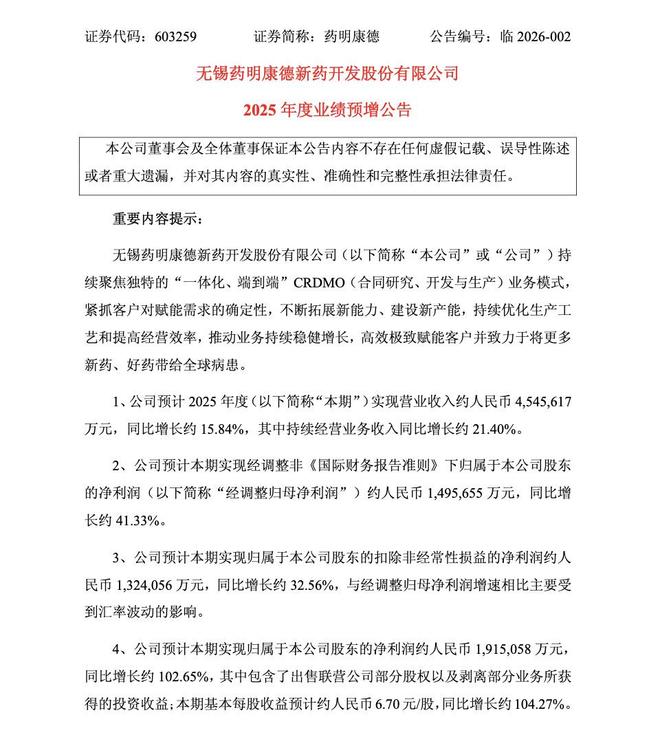
药明康德2025年预计全年营收454.6亿,净利润预增逾一倍
Guan Cha Zhe Wang· 2026-01-14 00:44
Financial Performance - The company expects to achieve an annual revenue of approximately 45.46 billion yuan in 2025, representing a year-on-year growth of about 15.8%. Excluding the impact of non-continuing operations, the revenue growth rate for continuing operations is expected to reach approximately 21.4% [1] - The adjusted Non-IFRS net profit attributable to shareholders is projected to be around 14.96 billion yuan, reflecting a year-on-year increase of approximately 41.3%. The net profit attributable to shareholders, excluding non-recurring gains and losses, is expected to be about 13.24 billion yuan, with a year-on-year growth of approximately 32.6% [1] - The company anticipates a significant increase in net profit attributable to shareholders, expected to reach about 19.15 billion yuan, a substantial year-on-year growth of approximately 102.6%. The basic earnings per share are projected to be around 6.70 yuan, representing a year-on-year increase of approximately 104.3% [1] Strategic Focus - The company emphasizes its commitment to the "integrated, end-to-end" CRDMO business model, which aims to provide comprehensive services from drug discovery to commercial production for global pharmaceutical and biotechnology companies [3] - The company is enhancing operational efficiency by expanding new capabilities, building new production capacity, and optimizing production processes to solidify its differentiated position in the global pharmaceutical R&D outsourcing market [4] Future Outlook - The disclosed financial data is a preliminary estimate, with the complete annual report set to be officially released in March 2026. The company will also update its performance guidance for 2026 at that time, allowing the market to further assess its sustainable profitability post-business divestitures and the growth prospects of its core business for the upcoming year [4]

把“手工现包”做成25亿生意,袁记云饺母公司拟赴港上市
Guan Cha Zhe Wang· 2026-01-14 00:44
Core Viewpoint - Yuanji Food Group has submitted its listing application to the Hong Kong Stock Exchange, marking a significant step in its capital expansion process [1] Group 1: Company Overview - Yuanji Food is a well-known Chinese fast-food enterprise, primarily engaged in the research, production, distribution, and sales of fresh dumplings, wontons, and noodle products [2] - The company operates two main brands: "Yuanji Cloud Dumplings" for dining services and "Yuanji Weixiang" for retail and B2B channels [2] - As of September 30, 2025, Yuanji Food has a total of 4,266 stores globally, covering 32 provinces, autonomous regions, and municipalities in China, as well as Southeast Asian countries [2][3] Group 2: Financial Performance - The company's revenue for 2023 and 2024 was reported at 2.026 billion and 2.561 billion respectively, with a revenue of 1.982 billion in the first nine months of 2025, reflecting an 11% increase compared to the same period in 2024 [2] - The total gross merchandise value (GMV) generated by all stores increased by 31% from 4.772 billion in 2023 to 6.248 billion in 2024 [3] - Adjusted net profit for the first nine months of 2025 was 192 million, representing a 31% year-on-year growth [2] Group 3: Expansion Strategy - The company relies on a robust supply chain and a stable franchise system for its scale expansion, with 24 warehouses established nationwide to support over 4,000 stores [4] - As of September 30, 2025, more than 86% of stores are within 200 kilometers of a warehouse, and the inventory turnover time is 12.1 days, outperforming the market average [4] - Yuanji Food plans to deepen its domestic market presence while expanding into Southeast Asia, having opened its first overseas store in Singapore in late 2024 and aiming for selective entry into East Asia, Europe, and North America [5] Group 4: Industry Context - The Chinese fast-food industry is highly competitive, with the market size projected to grow from 529.6 billion in 2020 to 809.7 billion in 2024, and further to 1,285.3 billion by 2030, reflecting a compound annual growth rate of 8.0% [6] - The company acknowledges the challenges posed by increasing competition and emphasizes the need to enhance brand recognition and value [6] - Future growth will depend on the successful operation and expansion of its store network, primarily composed of franchise-operated locations [6]
