
Guo Ji Jin Rong Bao

Search documents
新年首例!太保寿险举牌上海机场,险资入市马不停蹄
Guo Ji Jin Rong Bao· 2026-01-15 14:13
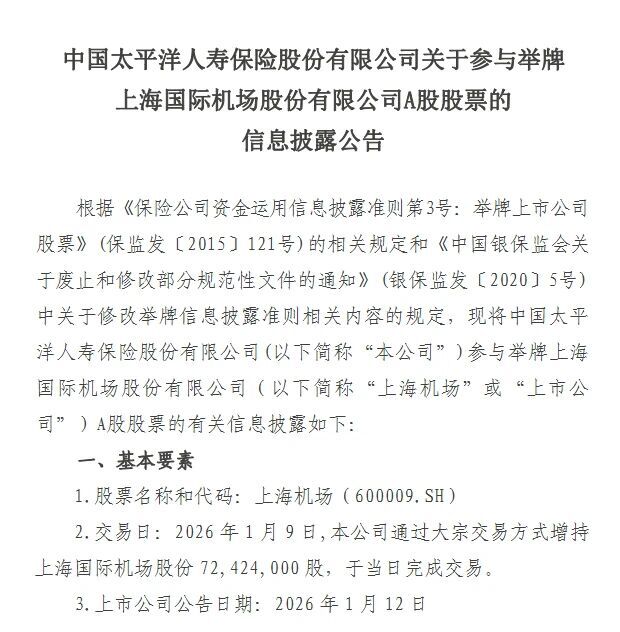
Core Viewpoint - China Pacific Life Insurance Co., Ltd. (CPIC Life) has increased its stake in Shanghai International Airport Co., Ltd. (Shanghai Airport) to 5.00%, triggering a regulatory notification due to the acquisition of 72.424 million A-shares through block trading [1][4]. Group 1: Investment Details - CPIC Life and its affiliates now hold a total of 124 million A-shares of Shanghai Airport, representing 5.00% of the company's A-share capital, up from 51.9917 million shares (2.09%) prior to the acquisition [1][4]. - The market value of CPIC Life's holdings in Shanghai Airport is approximately 4.067 billion yuan, accounting for 0.15% of CPIC Life's total assets as of Q3 2025 [4][5]. Group 2: Company Background - Shanghai Airport was established in May 1997 and listed on the Shanghai Stock Exchange in February 1998. The company underwent a significant asset restructuring in 2022, unifying the management of its air transport business [5]. - For the first three quarters of 2025, Shanghai Airport reported total revenue of 9.714 billion yuan, a year-on-year increase of 5.69%, and a net profit of 1.634 billion yuan, up 35.98% [5]. Group 3: Industry Trends - The insurance sector has seen a significant increase in equity market participation, with 20 instances of stake acquisitions in 2024 and 36 in 2025, marking a new high since 2016 [6][7]. - Analysts suggest that insurance companies are motivated by two main factors for these acquisitions: stable dividend cash flows and investments in companies with strong return on equity (ROE) and market positions [6][7].



结构性降息0.25个百分点!央行最新发布会释放重要信号
Guo Ji Jin Rong Bao· 2026-01-15 14:12
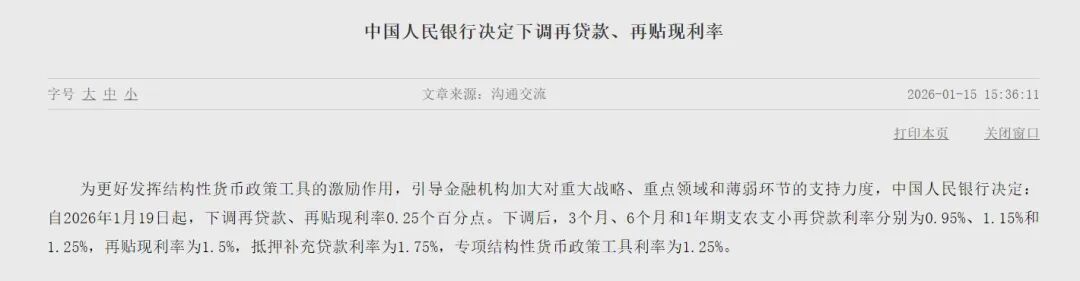
Core Viewpoint - The People's Bank of China (PBOC) is implementing monetary policy measures to support high-quality economic development, including a 0.25 percentage point reduction in various structural monetary policy tool rates to enhance bank lending in key areas [1][2]. Group 1: Policy Measures - The PBOC will lower the interest rates of various structural monetary policy tools by 0.25 percentage points, with the one-year re-lending rate decreasing from 1.5% to 1.25% [2]. - The new rates for re-lending and re-discounting will be 0.95%, 1.15%, and 1.25% for 3-month, 6-month, and 1-year terms respectively, with the re-discount rate set at 1.5% [2]. Group 2: Economic Impact - The reduction in rates aims to lower financing costs in specific sectors, encouraging banks to lend at lower rates to small and micro enterprises, technological innovation, and green transformation [4]. - The targeted approach of structural monetary policy tools is expected to improve the efficiency of fund utilization and enhance financial services for the real economy [4]. Group 3: Future Monetary Policy Outlook - There is still room for further reductions in the reserve requirement ratio, with the current average at 6.3%, indicating a potential decrease of about 1.3 percentage points [5][6]. - The PBOC is expected to maintain a moderately loose monetary policy, focusing on the integration of existing and new policies to create a conducive financial environment for stable economic growth [7][8].
锐康迪退出中国市场,罕见病患者陷“断供”危机
Guo Ji Jin Rong Bao· 2026-01-15 14:01
Group 1 - Recordati's subsidiary in China, Ruikangdi, has officially exited the Chinese market, ceasing the supply of three rare disease drugs, which may disrupt treatment for patients [1][2] - The drug with the most significant impact from the exit is the innovative drug Shireza, which has no domestic generic alternatives, potentially leaving Cushing's syndrome patients without medication [1][2] - Approximately 40,000 to 50,000 patients in China suffer from Cushing's syndrome, with only about 3,000 requiring drug treatment [1] Group 2 - Ruikangdi, a small enterprise focused on rare diseases, is a subsidiary of Recordati, which operates in around 150 countries and has been involved in the rare disease sector since 1990 [2] - The direct reason for the market exit was a failure in health insurance negotiations, as two of its drugs did not make it into the 2025 health insurance directory [2] - The challenges faced by rare disease drug companies in China include high investment costs with low returns, as the development cost for a single orphan drug is approximately 260 million yuan, while the rare disease drug market in China accounts for only 3% of the global market [3] Group 3 - The Chinese rare disease patient population exceeds 20 million, with over 200,000 new patients added each year [3] - The industry is facing insufficient health insurance coverage, with 83% of rare disease drugs having annual treatment costs exceeding 300,000 yuan, and only 50% being included in health insurance [3] - Policy initiatives are being explored to address these challenges, such as the Boao Lecheng Pilot Zone allowing expedited approval for unapproved drugs and encouraging local innovation in the rare disease sector [3]
上海28条新政让服务消费更有“含金量”
Guo Ji Jin Rong Bao· 2026-01-15 13:09
Core Insights - Shanghai is shifting its focus on boosting consumption towards the service industry, with the introduction of the "Measures for Promoting Quality Improvement and Efficiency Enhancement in the Service Industry and Expanding Consumption" [1][2] - The measures aim to transform Shanghai's consumption market from "scale expansion" to "quality enhancement," providing a model for expanding domestic demand in mega cities [2][4] Group 1: Service Industry and Consumption Growth - The service industry in Shanghai showed a robust growth of 5.9% in value added, accounting for approximately 79.1% of GDP in the first three quarters [2] - Retail sales of consumer goods increased by 5% from January to November, both key indicators surpassing the national average [2] - The measures include 28 specific initiatives targeting six key areas: finance, information services, transportation, cultural and entertainment services, life services, and inspection and certification [1][2] Group 2: Innovative Consumption Mechanisms - A significant breakthrough is the establishment of a "cultural, tourism, commerce, sports, and exhibition" linkage mechanism, creating immersive consumer experiences [3] - The "ticket root linkage consumption mechanism" allows consumers to enjoy discounts at nearby restaurants and hotels when they hold tickets for events, enhancing the value of single purchases [3] - The "Pyramid Summit: Ancient Egyptian Civilization Exhibition" set a record with 2.77 million visitors and generated over 7.6 billion yuan in ticket and cultural product revenue, driving a total consumption of over 35 billion yuan in the city [3] Group 3: New Consumption Tracks - The policy emphasizes the development of emerging consumption sectors, particularly in gaming e-sports and AI micro-dramas [5] - By 2025, the Qingpu District aims to attract 96 gaming e-sports companies, leveraging its advantages as a cultural center [5] - The measures propose to create a globally influential brand event system and support original games and AI-native games through rewards [5] Group 4: Platform Economy and Regulation - The measures support the innovation and development of e-commerce and life service platforms while enhancing market regulation [6] - Platforms are encouraged to adopt transparent pricing rules and reduce commission fees, shifting from price competition to quality competition [6] - The policy aims to enhance the value and quality of the service industry, improving the consumption environment and the city's economic resilience [6] Group 5: Financial Support Network - A comprehensive financial support network is being established to activate market potential through diverse financial tools [7][8] - Financial institutions are encouraged to support key projects related to consumer infrastructure and develop customized financial products for new consumption scenarios [8] - The measures also promote the securitization of retail loans and innovative financing models to support quality projects in the cultural and tourism sectors [8]

83亿港元战略相互持股!顺丰极兔再“牵手”
Guo Ji Jin Rong Bao· 2026-01-15 13:09
Core Viewpoint - SF Holding and Jitu Express have announced a strategic mutual shareholding agreement, involving a total investment of HKD 8.3 billion, aimed at enhancing their business collaboration and capital cooperation [1][2] Group 1: Investment Details - SF Holding plans to acquire 822 million newly issued Class B shares of Jitu Express at a price of HKD 10.10 per share, totaling approximately HKD 8.3 billion, which will represent about 8.45% of Jitu's expanded issued share capital [1] - After the transaction, SF Holding will hold 972 million Class B shares of Jitu Express, accounting for 10% of Jitu's total issued shares [1] - Jitu Express will issue 226 million H shares to SF Holding at a price of HKD 36.74 per share, resulting in Jitu holding 4.29% of SF Holding's shares post-transaction [1] Group 2: Historical Context and Strategic Importance - This is not the first collaboration between SF Holding and Jitu Express; in May 2023, SF sold its franchise-based express business to Jitu for HKD 1.18 billion, allowing SF to mitigate losses from the business while enabling Jitu to expand its market share [2] - The mutual shareholding signifies a deepening of the strategic partnership between the two companies, moving from operational collaboration to a more integrated capital and strategic alliance [2] Group 3: Industry Context - The logistics industry is currently experiencing accelerated consolidation and group operations, as evidenced by recent developments such as the delisting of Debon Logistics and the privatization of Dada Group by JD Logistics [3] - SF Holding aims to enhance its international network coverage and operational efficiency through strategic investments and collaborations, particularly in cross-border logistics [3][4] - Jitu Express reported a significant increase in package volume, with a total of 30.13 billion packages in 2025, marking a 22.2% year-on-year growth, driven by strong performance in Southeast Asia and new markets [3]
700亿芯片龙头出手!紫光国微拟揽入IPO多次失利的瑞能半导
Guo Ji Jin Rong Bao· 2026-01-15 13:09
Core Viewpoint - Unisoc Microelectronics (002049.SZ) resumed trading and hit the daily limit up, closing at 86.69 yuan per share, with a total market capitalization soaring to 73.7 billion yuan following the announcement of acquiring 100% equity of Ruineng Semiconductor Technology Co., Ltd. [1] Group 1: Company Overview - Unisoc Microelectronics, a core semiconductor listed company under the new Unisoc Group, was established in September 2001 and initially focused on quartz crystal components [1] - The company transitioned to special integrated circuits and smart security chips, while also expanding into quartz crystal frequency devices and power semiconductors, with applications across various sectors including mobile communication, finance, and automotive [2] Group 2: Financial Performance - In the first half of 2025, Unisoc Microelectronics reported revenue of 3.047 billion yuan, a year-on-year increase of 6.07%, while net profit attributable to shareholders was 692 million yuan, a year-on-year decrease of 6.18% [2] - Revenue breakdown shows that smart security chips contributed 1.395 billion yuan (45.78% of total revenue), special integrated circuits contributed 1.469 billion yuan (48.20%), and quartz crystal frequency devices contributed 151 million yuan (4.96%) [2] Group 3: Acquisition Details - The acquisition of Ruineng Semiconductor is expected to enhance Unisoc's capabilities in the power semiconductor sector, allowing for a more comprehensive semiconductor industry chain and strengthening its competitive position [2] - Ruineng Semiconductor specializes in power semiconductor research, production, and sales, with products including thyristors, power diodes, and silicon carbide MOSFETs, applicable in consumer electronics and industrial manufacturing [3] Group 4: Historical Context of Ruineng Semiconductor - Ruineng Semiconductor has faced multiple challenges in its attempts to enter the A-share market, including a failed attempt to list on the Sci-Tech Innovation Board in 2020 and a subsequent unsuccessful reverse merger attempt in 2021 [4] - After transitioning to the New Third Board in January 2023 and completing guidance for listing on the Beijing Stock Exchange, the company announced a delay in its listing application in July 2024 due to adjustments in capital market operations [4]

日元持续贬值!日本两大在野党联手对抗高市
Guo Ji Jin Rong Bao· 2026-01-15 13:05
Core Viewpoint - The Japanese Prime Minister, Fumio Kishida, is attempting to consolidate power through an early election, a strategy that may be riskier than anticipated due to political uncertainties and economic pressures [1][4]. Currency and Economic Impact - The Japanese yen fell to 159.45 against the US dollar on January 14, marking the lowest point since July 2024, with subsequent warnings from Finance Minister Shunichi Suzuki aimed at slowing the yen's depreciation [1][6]. - As of January 15, the yen was trading around 158.55, with hedge funds betting on a potential drop to 165 before any government intervention [2][6]. - Despite the Bank of Japan raising interest rates to the highest level since 1995, the yen continues to weaken, with predictions that it could fall to 160 or lower by the end of 2026 due to high US-Japan interest rate differentials and capital outflows [6][7]. Political Landscape - The early election announcement has altered Japan's political landscape, with the largest opposition party, the Constitutional Democratic Party, forming a new alliance with the Komeito party to challenge Kishida's government [5][6]. - Kishida's government, which currently holds a slim majority in the House of Representatives, faces pressure to secure support from opposition parties to pass the 2026 fiscal budget [3][5]. - Public sentiment is shifting, with 58% of respondents expressing concern over the economic impact of deteriorating Japan-China relations, indicating rising dissatisfaction with Kishida's administration [4][5]. Market Reactions and Predictions - Investors are anticipating that if Kishida's party secures a stable majority, expansionary policies will continue, potentially exacerbating the yen's depreciation and complicating the Bank of Japan's goals for price stability [7]. - The Deutsche Bank report suggests that failure to achieve a majority could lead to market sell-offs and a flight to safety, resulting in a stronger yen [7].
卫龙前CEO孙亦农加盟大窑,任首席执行官
Guo Ji Jin Rong Bao· 2026-01-15 13:02
Group 1 - The core point of the article is the appointment of Sun Yinan as the CEO of Dayao, a significant move following KKR's acquisition of 85% of the company's shares, aimed at accelerating its national expansion and capital market entry [1][6][7] - Sun Yinan has over 20 years of experience in the food and beverage industry, with a strong background in market operations, corporate integration, and capital operations, having previously worked at Coca-Cola and Nestlé [1][4] - During his tenure at Weilong, Sun played a crucial role in the company's growth, leading to its successful listing on the Hong Kong Stock Exchange in December 2022 and achieving a revenue of 6.266 billion yuan in 2024, a year-on-year increase of 28.63% [2][4] Group 2 - Dayao, originating from Inner Mongolia, is a well-established soft drink company known for its flagship product, Dayao Guest Soda, and has been actively pursuing national expansion in recent years [4][6] - The appointment of Sun Yinan is seen as a strategic move by KKR to enhance Dayao's management and operational capabilities post-acquisition, leveraging his experience in the carbonated beverage market and corporate integration [1][7] - Analysts believe that Sun's arrival will significantly boost Dayao's resource optimization, brand strength, and competitive edge in high-end retail channels such as Sam's Club and JD.com [7]
在华东,绿城启动人事调整
Guo Ji Jin Rong Bao· 2026-01-15 13:02
Group 1 - The core point of the article is the personnel change at Greentown China, with Lai Shengchang stepping down as the East China Regional General Manager and taking on the role of Chairman and General Manager at Greentown Life Technology Group [1] - Pan Siyuan, the former Deputy General Manager of the Zhejiang Region, has been appointed as the new East China Regional General Manager, marking a significant internal promotion of a young professional manager [2][4] - Pan Siyuan has over 20 years of experience in the Hong Kong-funded real estate sector and has previously worked on projects for Greentown, which positions him well for his new role [3][4] Group 2 - During his tenure as the General Manager of the South Zhejiang Region, Pan Siyuan successfully managed projects in cities like Yiwu, achieving over 10 billion in sales [4] - The East China region, particularly Shanghai, is a strategic area for Greentown China, where they have launched several projects under Lai Shengchang's leadership [4] - The competitive landscape in Shanghai has intensified, with many developers increasing their efforts, leading to challenges for Greentown China in maintaining its market position [5] Group 3 - In the first 11 months of 2025, Greentown China's sales in the Shanghai market reached 12.279 billion, ranking 7th, while top competitors achieved over 28 billion [7] - The sales performance of Greentown's new projects, such as the "land king" project Greentown Yilou, has been disappointing, with a sales rate of only 36.5% shortly after launch [8] - The sales situation for another project, Huangpu ONE, is also underwhelming, with a current sales rate of less than 15% for the latest batch of units [12]

天晟新材:拟发行股票募集资金不超过2.53亿元
Guo Ji Jin Rong Bao· 2026-01-15 12:48
Core Viewpoint - The company Tian Sheng New Materials plans to raise no more than 253 million yuan through a private placement of shares, with the net proceeds intended for repaying bank loans and/or supplementing working capital [1] Group 1: Fundraising Details - The company will issue shares to a specific entity, Beijing Rongsheng Zhizhi Technology Development Partnership (Limited Partnership) [1] - The issue price is set at 5.06 yuan per share, with a total of 50 million shares to be subscribed [1] - After the issuance, the controlling shareholder will change to Beijing Rongsheng Zhizhi Technology Development Partnership (Limited Partnership) [1] Group 2: Ownership Changes - Prior to the issuance, the company had no controlling shareholder or actual controller [1] - Following the issuance, the actual controller will change to Wei Lidong [1]
