
Jin Rong Shi Bao

Search documents
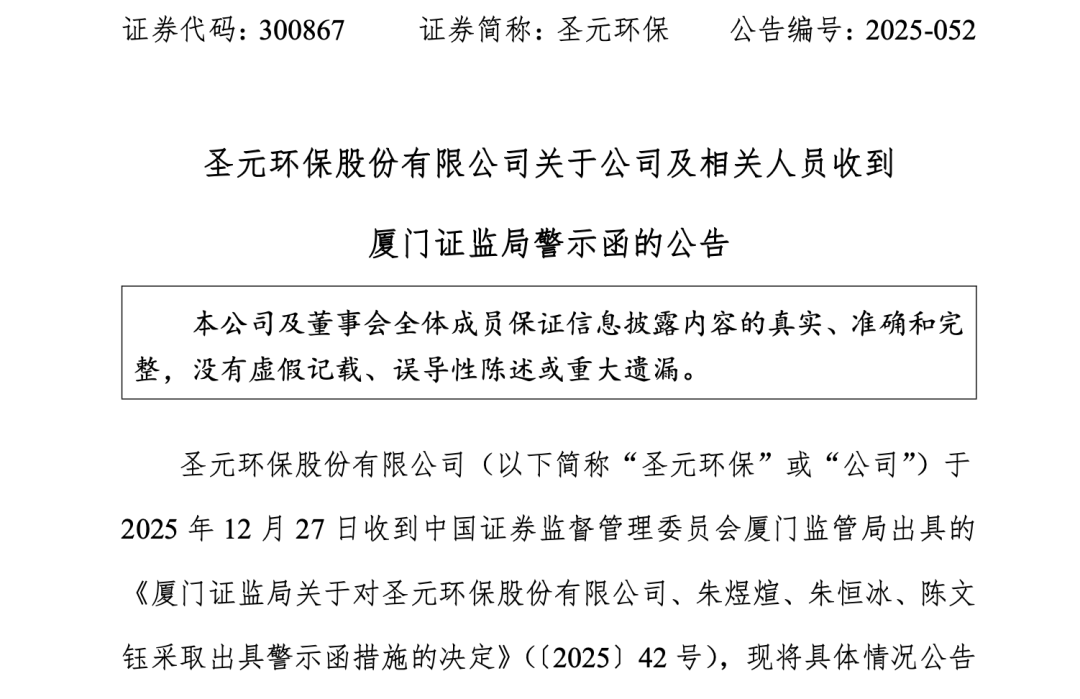
理财惊魂记:7天巨亏四千万……
Jin Rong Shi Bao· 2025-12-31 14:30
Core Viewpoint - The company and its three core executives failed to disclose significant losses from a subscribed private equity product in a timely manner, leading to warnings from regulatory bodies. The controlling shareholders committed to compensating for the investment losses to protect the company's and shareholders' interests [1][21]. Group 1: Financial Losses and Fund Performance - The company invested 60 million yuan in a private equity product, which reported a net value growth rate of -81.54%, resulting in a loss of approximately 46.92 million yuan, including 2 million yuan recovered from the fund manager [6][11]. - The fund's net value plummeted from 0.9215 yuan per share on December 4, 2025, to 0.2596 yuan per share by December 11, 2025, indicating a loss of nearly 72% in just seven days [10][11]. - By December 25, 2025, the fund's net value further declined to 0.1846 yuan per share, reflecting a cumulative loss of nearly 80% within 21 days [11][21]. Group 2: Regulatory and Legal Actions - The company reported the fund manager's potential violations, including unauthorized trading and failure to disclose critical information, leading to significant losses. Legal actions have been initiated against the fund manager and the fund custodian [12][21]. - The company has filed a report with the police and the China Securities Regulatory Commission regarding the incident, indicating the seriousness of the situation [12][21]. Group 3: Shareholder Commitments and Future Actions - The controlling shareholders, Zhu Yuxuan and Zhu Hengbing, pledged to compensate for the investment losses, with the final compensation amount to be determined after accounting for any recovered funds [21][22]. - The company is in the process of pursuing legal remedies against the fund manager and custodian, highlighting the ongoing complexity of the case and the need for thorough investigation [21][22].


招联“十四五”发展答卷:以数智赋能为笔 绘就普惠新图景
Jin Rong Shi Bao· 2025-12-31 12:27
Core Viewpoint - The "14th Five-Year Plan" period marks a critical phase for the consumption finance industry in China, transitioning from "scale expansion" to "quality and quantity improvement," with 招联消费金融股份有限公司 (Zhaolian) emerging as a benchmark for high-quality development through digital innovation and social responsibility [1] Group 1: Digital Transformation and Innovation - Zhaolian has established itself as a pioneer in the digital transformation of the consumption finance sector, being the first to explore a fully online consumption finance model, significantly reducing operational costs and expanding access to credit services for underserved populations [2] - The company has developed a comprehensive consumption finance system based on cloud technology, achieving a "go IOE" status, which has set a standard for digital transformation in the industry [2] - In response to the AI revolution, Zhaolian launched the industry’s first open-source large model, "Zhaolian Zhilu," with 130 billion parameters, followed by iterations that enhanced its reliability in financial applications [3] Group 2: Consumer Protection and Satisfaction - Zhaolian has integrated its AI model with consumer rights protection, creating the first intelligent consumer protection system in the industry, which has led to a customer satisfaction rate of 98% and a complaint handling timely rate exceeding 99% [3] - The company’s innovative self-service system empowers consumers, allowing them to take the lead in financial services, enhancing user experience and engagement [5][6] Group 3: Social Responsibility and Community Engagement - Zhaolian actively participates in social responsibility initiatives, focusing on traditional industry empowerment, green development, and rural revitalization, thereby aligning its business growth with societal value creation [8] - The company has developed an intelligent traditional Chinese medicine diagnosis model to assist grassroots healthcare, addressing resource shortages and improving healthcare quality [8] - Zhaolian has launched the "Green Yuan" platform for smart waste management, promoting environmental sustainability and efficiency in waste collection [9] Group 4: Targeting New Citizen Demographics - Zhaolian has tailored its services to meet the financial needs of new citizens, providing targeted financial products and establishing a dedicated service area in its app to enhance accessibility and support for this demographic [6][7] - The company has implemented initiatives such as the "New Citizen Dream Action" to facilitate consumer convenience and security for new residents [6] Group 5: Future Outlook - As it moves into the "15th Five-Year Plan," Zhaolian aims to deepen digital innovation, expand inclusive services, and fulfill its social responsibilities, contributing to the construction of a financially strong nation and promoting common prosperity [10]
最高补2万元,2026年汽车“国补”细则来啦!
Jin Rong Shi Bao· 2025-12-31 11:34
12月31日,商务部等部门发布《2026年汽车以旧换新补贴实施细则》,明确参与申领2026年汽车报废更 新补贴旧车的注册登记时间,相比2025年进一步扩大支持范围。 2026年汽车报废更新: 若参与申领补贴的报废旧车为汽油乘用车,则其注册登记时间应在2013年6月30日(含当日,下同)之 前; 若参与申领补贴的报废旧车为柴油及其他燃料乘用车,则其注册登记时间应在2015年6月30日之前; 对换购符合上述条件新能源乘用车的,按新车销售价格的8%给予补贴,补贴金额最高1.5万元;对换购 符合上述条件燃油乘用车的,按新车销售价格的6%给予补贴,补贴金额最高1.3万元。 若参与申领补贴的报废旧车为新能源乘用车,则其注册登记时间应在2019年12月31日之前。 消费者可通过""网站,点击"汽车以旧换新"专题,进入申请页面,填写申请信息并上传所需附件。 对报废上述符合条件旧车并购买新能源乘用车的,按新车销售价格(价税合计,下同)的12%给予补 贴,补贴金额(向上取整至整元,下同)最高2万元;对报废上述符合条件燃油乘用车并购买2.0升及以 下排量燃油乘用车的,按新车销售价格的10%给予补贴,补贴金额最高1.5万元。 202 ...
A股2025年收官:上证指数11连阳
Jin Rong Shi Bao· 2025-12-31 09:17
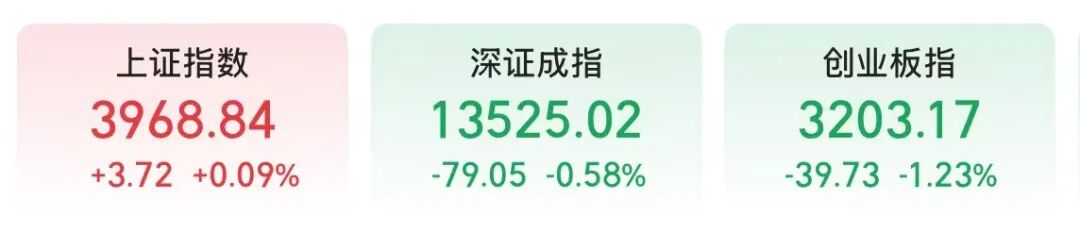
Market Performance - The Shanghai Composite Index closed at 3968.84 points on the last trading day of 2025, marking an 11-day consecutive rise with a slight increase of 0.09% [1] - For the entire year, the Shanghai Composite Index rose by 18.41%, the Shenzhen Component Index increased by 29.87%, and the ChiNext Index surged by 49.57% [1] Sector Performance - The cultural media and commercial aerospace sectors led the gains on the last trading day, with the cultural media sector rising by 3.11% and a net capital inflow of 95.93 billion yuan, while the commercial aerospace sector increased by 2.77% with a net inflow of 122.35 billion yuan [2] - The cultural media sector is expected to benefit from the upcoming three-day New Year holiday in 2026, which is anticipated to significantly boost consumption in the cultural and tourism sectors [2] - The film industry in China achieved a total box office of over 50 billion yuan in 2025, driven by popular films, and is expected to maintain high audience enthusiasm as the Spring Festival approaches [2] Aerospace Industry Insights - The successful launch of the Practice-29 satellite by the Long March 7 rocket at the Wenchang Space Launch Site has reignited market enthusiasm for the commercial aerospace sector [3] - The commercial aerospace sector has expanded into various primary industries, including machinery, automotive, and battery sectors, and is integrating new technologies such as photovoltaics [3] - Market attention towards the commercial aerospace sector is driven by policy support and developments in the industry chain, particularly in low-orbit satellite launches [3]

刚刚,国家发改委回应热点问题!
Jin Rong Shi Bao· 2025-12-31 08:24
12月31日,国家发展改革委举行新闻发布会,国家发展改革委政策研究室副主任、新闻发言人李超回应 经济社会领域热点问题。 2026年"两新"政策有三方面新变化 2026年"两新"政策有哪些新变化? 对此,李超介绍称,2026年"两新"政策重点在设备更新政策惠及面、支持绿色低碳智能产品推广应用、 资金使用监管等方面进行了优化,可以概括为以下三个方面。 一是优化支持范围。设备更新方面,在总体延续2025年支持范围的基础上,主要增加了三个方面的更新 补贴,在民生领域增加老旧小区加装电梯、养老机构设备更新,安全领域,增加消防救援、检验检测设 备更新,消费基础设施方面,增加商业综合体、购物中心、百货店、大型超市等线下消费商业设施的设 备更新。消费品以旧换新方面,进一步集中资源,着力提升覆盖人群广、带动效应强的重点消费品"得 补率"。具体来看,继续实施汽车报废更新和汽车置换更新补贴;继续实施家电以旧换新补贴,支持范 围聚焦冰箱、洗衣机、电视、空调、电脑、热水器等6类产品;同时,将数码产品购新补贴拓展为数码 和智能产品购新补贴,支持范围包括手机、平板、智能手表(手环)、智能眼镜和智能家居产品(含适 老化家居产品)。 二是优化 ...
“国补”新变化!这些产品也能享受补贴→
Jin Rong Shi Bao· 2025-12-31 06:47
12月30日,国家发展改革委、财政部发布了《关于2026年实施大规模设备更新和消费品以旧换新政策的 通知》,明确了明年"两新"政策的支持范围和补贴标准。 其中,消费品以旧换新(以下简称"'国补'")政策方面,进一步集中资源,着力提升覆盖人群广、带动效 应强的重点消费品"得补率"。 "国补"政策都有哪些变化?哪些产品可以享受"国补"?个人能享受多少"国补"?记者进行了梳理: 支持汽车报废更新 个人消费者报废登记在本人名下的乘用车,并购买纳入《减免车辆购置税的新能源汽车车型目录》的新 能源乘用车或2.0升及以下排量燃油乘用车的,给予汽车报废更新补贴支持。 ——购买新能源乘用车补贴车价的12%(最高不超过2万元)。 ——购买新能源乘用车补贴车价的8%(最高不超过1.5万元)。 ——购买2.0升及以下排量燃油乘用车补贴车价的6%(最高不超过1.3万元)。 支持家电以旧换新 个人消费者购买冰箱、洗衣机、电视、空调、电脑、热水器等6类家电中1级能效或水效标准的产品,按 产品销售价格的15%给予补贴,每位消费者每类产品可补贴1件,每件补贴不超过1500元。 支持数码和智能产品购新 相较于2025年,2026年将数码产品购新 ...
地方金融构建“政产学研金”生态圈
Jin Rong Shi Bao· 2025-12-31 03:43
Group 1 - The central economic work conference has outlined comprehensive plans for economic work in 2026, emphasizing the need for financial institutions to support key areas such as domestic demand, technological innovation, and small and micro enterprises [1] - The national local finance cooperation exchange meeting focused on the theme of "integration of industry and talent, financial empowerment for high-quality development," gathering over 300 representatives from various provinces to discuss pathways for high-quality local financial development during the 14th Five-Year Plan period [1][2] - The meeting highlighted the importance of creating a favorable business environment to support financial innovation and the integration of financial services with the real economy [3] Group 2 - The conference emphasized the necessity for local finance to align with the "five major articles" of financial development, which include technology finance, green finance, inclusive finance, pension finance, and digital finance [2] - Local financial institutions are encouraged to integrate resources and develop innovative financial products to better serve small and micro enterprises, particularly in rural areas [3][4] - The integration of digital technology in financial services is seen as crucial for enhancing service efficiency and risk management [6][7] Group 3 - The establishment of a "government-industry-academia-research-finance" ecosystem is deemed essential for fostering high-quality development and innovation [8] - Local financial institutions are urged to collaborate with research institutions to develop specialized financial products that meet the needs of emerging industries [8][9] - The meeting concluded with a commitment to implement the central economic work conference's directives, aiming to provide precise and efficient financial support for technological innovation, industrial upgrading, and rural revitalization [9]
二手房交易迎重大利好!
Jin Rong Shi Bao· 2025-12-31 02:46
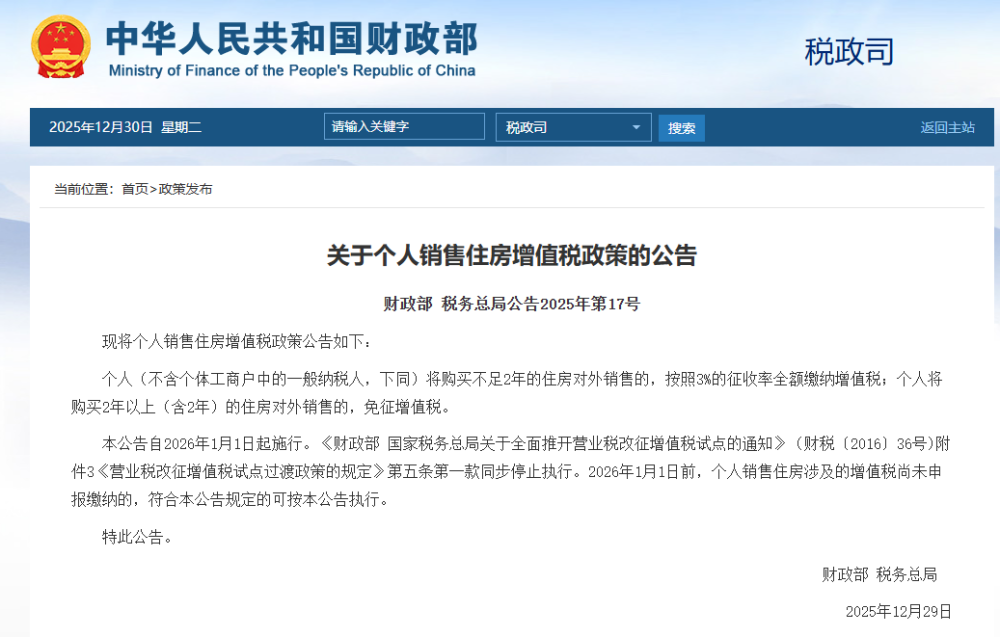
个人(不含个体工商户中的一般纳税人,下同)将购买不足2年的住房对外销售的,按照3%的征收率全额缴纳增值税;个人将购买2年以上 (含2年)的住房对外销售的,免征增值税。 2025年12月30日,财政部、税务总局发布《关于个人销售住房增值税政策的公告》(2025年第17号),明确自2026年1月1日起,调整个人销售 住房的增值税政策。 新规规定: 根据公告,个人销售购买不足2年的住房,增值税征收率由原政策下的5%下调至3%,按销售额全额征收;销售购买2年以上(含2年)的住 房,则继续免征增值税。 对此,上海易居房地产研究院副院长严跃进分析称,此次调整最直接的影响是降低了短期持有住房的交易成本。他以一套售价100万元、持有 未满2年的住房为例:原先需缴纳增值税约5万元,新政后仅需3万元,业主税费负担直接减少2万元。 "这有助于减轻业主出售短期房产的压力,提高房源流动性。"严跃进分析称,成本的降低有望促使一部分因税费过高而犹豫的业主进入市场, 增加二手房供应。 广东省住房政策研究中心首席研究员李宇嘉告诉记者,新政出台的背景是,当前新房和二手房市场开始分化,导致"卖旧买新"循环受阻。新政 将降低"卖旧买新"的循环阻力, ...
以金融支持乡村振兴样板区为引领 助推黑龙江现代化大农业发展
Jin Rong Shi Bao· 2025-12-31 02:14
Core Viewpoint - The People's Bank of China Heilongjiang Branch is implementing financial support for rural revitalization, focusing on agricultural modernization and enhancing financial services to ensure food security and promote sustainable agricultural development [1][2][3]. Group 1: Financial Support and Growth - Agricultural loans in Heilongjiang increased from 929.61 billion yuan at the beginning of 2023 to 1,029.43 billion yuan by the end of November 2025, with a year-on-year growth of 11.0% [1]. - The total grain production in Heilongjiang reached 164 billion jin in 2023, marking the 16th consecutive year of being the highest in the country [1]. Group 2: Policy and Mechanism Development - The establishment of a comprehensive financial support system for rural revitalization includes a four-part mechanism involving local government coordination, the People's Bank of China leadership, functional department cooperation, and financial institution implementation [1][2]. - A total of 9 key policy documents have been issued to guide financial support for rural revitalization, focusing on areas such as agricultural operation entities, land protection, and agricultural industry chains [1]. Group 3: Financial Tools and Services - The Heilongjiang Branch has issued 910.5 billion yuan in re-loans for agricultural support since the establishment of the rural revitalization model area [2]. - The establishment of 6,200 comprehensive service stations in administrative villages provides one-stop services for credit matchmaking and agricultural payments [2]. Group 4: Focus on Key Areas and Product Diversification - The financial services system aims to support the entire agricultural production cycle, with 2,523.8 billion yuan allocated for spring plowing loans, a 14.1% increase year-on-year [4]. - The introduction of specialized credit products for various agricultural sectors, including livestock and specialty crops, has provided 24.23 billion yuan in targeted financial support [4]. Group 5: Continuous Improvement and Risk Management - A mechanism for regular financing connections has been established, resulting in 392.6 billion yuan in credit for new agricultural business entities since 2023 [5]. - The implementation of risk-sharing models, including credit, insurance, and futures, has led to the issuance of 59.65 billion yuan in loans to mitigate risks for agricultural entities [5]. Group 6: Future Directions - The Heilongjiang Branch plans to enhance the rural financial service system from 2024 to 2027, focusing on key areas and weaknesses to support agricultural modernization and food security [6].
金融助力“大国粮仓”根基稳固
Jin Rong Shi Bao· 2025-12-31 02:10
Core Insights - The article emphasizes the stability and sufficiency of China's grain market during the "14th Five-Year Plan" period, with grain production consistently exceeding 1.3 trillion jin and projected to reach 1.4 trillion jin in 2024, ensuring food security for the population [1][8] - Financial support has been crucial in achieving these results, with a focus on enhancing the grain security system and adapting to complex domestic and international environments [1][8] Financial Support Framework - A clear and efficient financial support policy framework for grain security has been established, with collaboration between financial management departments and agricultural sectors [2] - Structural monetary policy tools have been optimized to direct more credit resources towards grain production and related sectors, with significant increases in agricultural insurance subsidies [2] Credit Supply and Services - Financial institutions have prioritized support for grain production, with agricultural loans reaching 53.4 trillion yuan, a year-on-year increase of 6.8% [3] - Specialized loan products have been developed to support key areas such as seed industry innovation and high-standard farmland construction, enhancing grain storage and logistics capabilities [3][4] Agricultural Bank Initiatives - The Agricultural Development Bank has actively implemented policies, with over 1 trillion yuan in loans for food security initiatives, including significant funding for grain circulation and production capacity [4] - The Agricultural Bank has also provided substantial loans to grain producers, enhancing financial services for the agricultural sector [4] Seasonal and Customized Financial Products - Financial institutions have introduced seasonal and customized loan products to support agricultural inputs and operations, stabilizing planting areas and improving yield levels [5] - Targeted financial products have been developed for family farms and cooperatives, addressing financing challenges and enhancing their capacity to support modern agriculture [5] Agricultural Insurance Role - Agricultural insurance has played a vital role in mitigating risks associated with grain production, with comprehensive coverage for major crops and increased subsidy rates encouraging farmer participation [6] - The integration of insurance with financial tools has created a robust risk-sharing mechanism, enhancing the resilience of grain production against natural disasters and market fluctuations [6] Technological Integration in Financial Services - The application of financial technology has transformed financial services in the grain sector, with online credit products becoming widely accessible to farmers [7] - Collaboration between financial institutions and agricultural tech companies has led to integrated services that enhance credit availability and risk management [7] Overall Achievements and Future Outlook - The financial system has significantly improved its capacity to support national grain security, with a multi-layered policy framework and increased credit supply [8] - Looking ahead, the financial sector is expected to strengthen its role in ensuring food security, adapting to ongoing challenges, and enhancing resource allocation and service innovation [8]