
Jin Rong Shi Bao

Search documents
科技创新与产业创新如何实现“双向奔赴”
Jin Rong Shi Bao· 2025-11-25 00:51
Core Insights - Wuxi is positioning itself as a leading hub for industrial technology innovation in Jiangsu Province, focusing on the integration of technology and industry to enhance its modern industrial clusters [1][2] - The city is making significant strides in the semiconductor industry, particularly in developing domestic chip solutions to address supply chain challenges faced during the pandemic [2][3] - The establishment of the Jiangsu Integrated Circuit Application Technology Innovation Center is pivotal in fostering collaboration among various stakeholders to drive innovation in industrial-grade chips [3][4] Industry Developments - Wuxi is becoming a critical support point for national integrated circuit development, leveraging its strong industrial foundation and innovative capabilities [2][3] - The innovation center has successfully developed domestic chips for medical devices, significantly reducing reliance on imports and enhancing local production capabilities [2][3] - The center's focus on industrial-grade chips addresses the urgent need for supply chain security and self-sufficiency in the automotive sector, particularly for MCU chips [3][4] Innovation Ecosystem - The innovation center operates as a non-profit entity, facilitating collaboration across the industry without competing with enterprises, thus lowering barriers for startups [4][5] - Over five years, the center has supported over 100 companies and established a regional automotive chip industry alliance, fostering a collaborative innovation ecosystem [4][5] - Future initiatives will focus on smart vehicles, low-altitude economy, and commercial satellites, aiming to create a national-level testing platform for automotive-grade chips [5][6] Talent and AI Development - The Tsinghua University Wuxi Institute's Smart Industry Innovation Center exemplifies the importance of top talent in driving AI-related technological advancements [6][7] - The center aims to focus on cutting-edge technologies such as smart transportation, smart healthcare, and IoT, leveraging Tsinghua's research capabilities [6][7] - Successful projects include AI-driven drug development and the establishment of a smart hospital, showcasing the potential of AI in transforming industries [7] Commercial Aerospace Initiatives - Wuxi is emerging as a key player in the commercial aerospace sector, with significant developments in private rocket manufacturing [8][9] - The city has established a robust supply chain for rocket engine production, significantly increasing local sourcing capabilities from 20% to 80% [9][10] - Wuxi's strategic policies and funding initiatives are designed to support the growth of the aerospace industry, with a focus on creating a comprehensive ecosystem for rockets, satellites, and data services [10][11]

如何理解央行最新中期借贷便利操作
Jin Rong Shi Bao· 2025-11-25 00:47
Core Viewpoint - The People's Bank of China (PBOC) is maintaining ample liquidity in the banking system through various monetary tools, including a 1 trillion yuan Medium-term Lending Facility (MLF) operation, which is expected to support economic stability and growth [1][2]. Group 1: MLF Operations - On November 25, the PBOC conducted a 1 trillion yuan MLF operation with a one-year term, marking a net injection of 100 billion yuan for November, continuing a trend of increased MLF operations for nine consecutive months [1]. - The total net liquidity injection for November reached 600 billion yuan, consistent with the previous month and representing a high level maintained for four months [1]. Group 2: Monetary Policy and Economic Support - The PBOC's actions, including MLF and reverse repos, are aimed at ensuring a stable and ample liquidity environment, which is crucial for encouraging financial institutions to increase credit supply [2]. - The central bank's supportive monetary policy is expected to contribute to stabilizing growth, expectations, and employment, while also enhancing the allocation of financial resources to key areas such as technological innovation and green development [2].
中国银行发行300亿元绿色金融债券
Jin Rong Shi Bao· 2025-11-25 00:40
近日,中国银行成功发行300亿元绿色金融债券,其中,固定利率品种200亿元,票面利率1.72%, 浮动利率品种100亿元,票面利率较1年期LPR减点121个基点(1.79%)。债券得到市场投资者踊跃认 购,全场倍数达1.69倍。 据悉,这是中国银行近10年来首次在境内市场发行浮动利率债券,也是目前境内商业银行单笔发行 规模最大的浮动利率债券,有助于实现资产投放与市场融资在价格方面的精准匹配,进而有效拓宽绿色 产业项目融资渠道。作为《绿色金融支持项目目录(2025年版)》施行以来市场首批适用新目录的商业 银行绿色金融债券,本期债券募集资金将精准投向基础设施绿色升级、能源绿色低碳转型等合规绿色产 业领域。 责任编辑:杨喜亭 数据显示,截至三季度末,中国银行绿色贷款余额超过4.66万亿元,较上年末增长20.11%;绿色债 券投资规模超1000亿元。 ...

日本债市:会成为下一个全球风险源吗?
Jin Rong Shi Bao· 2025-11-24 09:59
Core Viewpoint - The Japanese bond market is experiencing significant volatility, raising concerns among global investors about its potential to become a focal point of market turbulence amid diplomatic crises, high inflation, and economic stagnation [1] Group 1: Economic Stimulus and Market Reaction - The Japanese government announced a massive stimulus plan of 21.3 trillion yen to alleviate public anxiety over inflation, but this has led to increased turmoil in the bond market [1] - The yield on 10-year Japanese government bonds recently approached 1.8%, the highest level since 2008, while the 30-year yield exceeded 3.3%, marking a significant shift for a country that has maintained a "zero interest rate" policy for decades [1] Group 2: Debt Levels and Fiscal Concerns - Japan's debt-to-GDP ratio has remained around 230%, and the new stimulus plan is expected to be accompanied by a large-scale bond issuance, potentially exceeding last year's borrowing of 6.69 trillion yen [2] - The total impact of the stimulus plan, including local government spending and private sector investment, could reach 42.8 trillion yen, surpassing last year's 39 trillion yen plan [2] Group 3: Interest Rate and Financial Health - The Bank of Japan's shift towards raising interest rates marks the end of decades of ultra-loose monetary policy, with rates now at their highest in over a decade [3] - Rising bond yields could create a vicious cycle, forcing the government to allocate more budget to interest payments, which may further increase the need for borrowing and push yields even higher [3] Group 4: Global Investment Implications - Japan is not only the world's most indebted nation but also the largest creditor, holding trillions of dollars in global assets, including U.S. Treasury bonds [3] - If Japanese bond yields continue to rise, it may lead to a reversal of yen carry trades, forcing investors to sell overseas assets to repay yen loans, potentially impacting global markets [3]
用心服务:解构光大银行APP13.0的焕新体验
Jin Rong Shi Bao· 2025-11-24 09:54
Core Insights - The banking industry is transitioning from a "channel-centric" model to an "experience-centric" model, with mobile banking evolving into a strategic tool for deepening connections with users [1] - The launch of Everbright Bank's mobile banking version 13.0 signifies a shift from merely providing functions to creating comprehensive user experiences [1][5] Interface Revamp - The most noticeable change in Everbright Bank's mobile banking 13.0 is the systematic restructuring of its five main pages: "Home, Borrowing, Wealth, Activities, and My" [2] - This restructuring reflects a shift from a "bank-centric" to a "user-centric" service logic, transforming the homepage into a responsive tool for customer needs [2] - The "Borrowing" page consolidates previously scattered credit services into a dual-core model, addressing the financial pain points of various customer segments [2][3] Service Upgrade - Wealth management remains a focal point, with retail asset management expected to reach 3.15 trillion yuan and wealth management products at 1.89 trillion yuan by September 2025 [4] - The 13.0 version enhances the "Sunshine Wealth" brand and introduces a "Enjoyment Services" section, integrating financial services with healthcare and lifestyle offerings [4] - The app also aims to simplify complex financial needs for scenarios like studying abroad and foreign nationals in China, enhancing user engagement [4] Value Enhancement - The goal of the 13.0 iteration is to establish deeper customer relationships, moving beyond being a mere transactional tool to becoming a "digital partner" [7] - Features like "Popularity Rankings" and "Investment Plans" transform wealth management into a dynamic process that aligns with user investment philosophies [7] - The integration of intelligent and human services aims to create a personalized experience, fostering emotional connections in the digital age [7][8] Industry Trends - The evolution of Everbright Bank's mobile banking reflects broader industry trends, where banking services are shifting from function provision to value creation [8] - The focus on emotional resonance and value recognition in financial services is seen as crucial for success in the digital finance landscape [8]

九台农商行将于近日正式从港股退市
Jin Rong Shi Bao· 2025-11-24 03:14
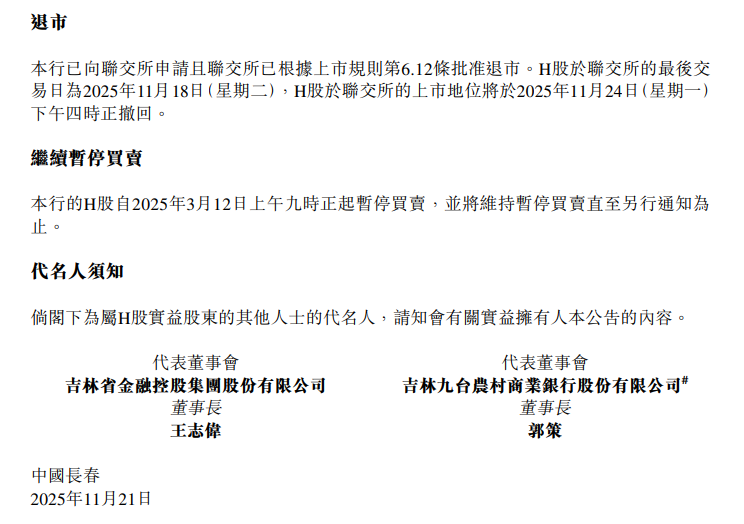
Core Viewpoint - Jilin Jiutai Rural Commercial Bank plans to delist its H-shares from the Hong Kong Stock Exchange following a buyout offer from Jilin Financial Holding Group and its associates, with the delisting expected to occur on November 24, 2025 [1][3] Group 1: Buyout Details - Jilin Financial Holding Group has made a voluntary conditional cash offer to acquire all issued H-shares at HKD 0.7 per share and domestic shares at CNY 0.63 per share [3][4] - As of November 21, 2025, the buyout offer received valid acceptances for 920,676,734 H-shares, representing approximately 95.26% of the independent H-share holders and 18.14% of the total issued shares [4] - The buyout also received acceptances for 3,782,689,850 domestic shares, accounting for about 92.09% of the issued domestic shares and 74.55% of the total issued shares [4] Group 2: Financial Performance - As of Q3 2024, Jilin Jiutai Rural Commercial Bank reported total assets of CNY 262.058 billion, marking it as the first rural commercial bank to delist [3] - The bank projected a net loss of approximately CNY 898 million for the first half of 2025, primarily due to increased asset impairment losses, which rose by about 312.42% compared to the first half of 2024 [5] Group 3: Industry Context - The delisting is part of a broader reform of the rural credit cooperative system in Jilin Province, which includes the establishment of a provincial rural commercial bank [6] - The Jilin provincial government plans to issue CNY 260 billion in special bonds to support the development of small and medium-sized banks, indicating a significant restructuring within the local banking sector [6]

深化央地协同 盘活地方资源 支持小微融资协调机制在厦门落地见效
Jin Rong Shi Bao· 2025-11-24 02:11
Core Insights - The establishment of the "Small and Micro Enterprise Financing Coordination Mechanism" has significantly improved financing access for small and micro enterprises, with notable success stories emerging from Xiamen [1][2][3] Group 1: Mechanism Implementation - The mechanism has been operational for a year, with local financial management departments collaborating with governments to address financing needs and enhance service efficiency [1][2] - Xiamen's financial regulatory authorities have actively promoted the mechanism, optimizing financial services and ensuring that credit resources reach small and micro enterprises effectively [3] Group 2: Case Studies - A small micro enterprise in Xiamen faced financing difficulties due to excessive loan inquiries on its credit record; local authorities helped repair its credit and secured a loan of 1.5 million yuan [2] - An application software development company received a tailored financing solution that increased its credit limit to 10 million yuan, along with a 30% interest subsidy [4] - A specialized electric company was granted a 10 million yuan unsecured loan within three days, addressing its urgent funding needs for international orders [5] Group 3: Credit Enhancement Strategies - The Xiamen financial regulatory bureau has implemented a "credit + finance" model to enhance creditworthiness through various data-driven methods, alleviating financing challenges for small enterprises [6][7] - The introduction of a "data replacement for collateral" credit assessment system allows banks to evaluate credit based on tax data and transaction information, facilitating quicker loan approvals [7][8] Group 4: Financial Impact - As of September 2025, Xiamen's inclusive financing for small and micro enterprises has reached a loan balance exceeding 400 billion yuan, with a year-on-year growth of over 3.6% [5][6] - The proportion of credit loans for small and micro enterprises in Xiamen has surpassed 23%, with significant funding provided through credit enhancement funds [7][8]
构建适应“十五五”未来产业发展的现代化金融体制
Jin Rong Shi Bao· 2025-11-24 02:11
Core Viewpoint - The construction of a financial system that adapts to the development of future industries is a complex system engineering task, requiring a balance between effective markets and proactive government intervention, while breaking path dependence and institutional barriers [1][22]. Group 1: Future Industry Characteristics - Future industries are characterized by the deep integration of technological and industrial innovation, representing a shift towards disruptive innovation driven by cutting-edge technologies [4]. - These industries face fundamental differences in financing needs compared to traditional industries, primarily due to their inherent uncertainty and the lack of established market applications [4][3]. - The rise of future industries necessitates a profound structural reform of the financial supply side to create a modern financial ecosystem that effectively accommodates their unique risk-return characteristics [3][4]. Group 2: Financial System Requirements - The financial system must develop mechanisms for prudent management of uncertainty, flexible operational mechanisms, inclusive development mechanisms, and transparent regulatory mechanisms to adapt to the uncertainties of future industries [4]. - There is a need for a financial infrastructure that can price and manage innovation-related uncertainties, utilizing financial technology for real-time risk monitoring and developing diversified investment tools [9][10]. Group 3: Capital Market Development - The capital market must evolve to support a modern industrial system, focusing on maintaining a reasonable proportion of manufacturing and enhancing the service capabilities of various market segments [5][7]. - A multi-layered capital market system should be established to enhance the service capabilities for specialized small and medium enterprises, particularly those with high intangible asset ratios [7][12]. Group 4: Investment and Financing Coordination - A seamless and complementary financing ecosystem is required to support the growth trajectory of future industries, necessitating a diverse "toolbox" of financing options tailored to different stages of enterprise development [12]. - The financial system should transition from a focus on collateral-based lending to a value discovery approach, emphasizing the importance of intangible assets and future growth potential [6][13]. Group 5: Innovation in Financial Products - Financial products must be innovated to align with the characteristics of future industries, including the development of green finance, digital finance, and inclusive finance to support various sectors of the economy [17][20]. - The establishment of a comprehensive financial service standard system is essential to support the growth of future industries and ensure that financial resources are effectively allocated [18][19]. Group 6: Regulatory Framework - A modern regulatory framework is necessary to ensure that financial resources are effectively directed towards innovation while managing risks, requiring a shift towards functional and penetrating regulation [21]. - The financial system must be equipped to handle systemic risks while promoting a culture of investment in innovative sectors, ensuring that financial resources are available for long-term projects [21].
美联储降息开启全球货币政策新周期: 理论逻辑、多维影响与中国方略
Jin Rong Shi Bao· 2025-11-24 02:09
Group 1 - The Federal Reserve's shift in monetary policy is expected to significantly alter the international monetary system and global financial governance structure [1][10] - The Fed's recent interest rate cuts mark a pivotal change in its monetary policy cycle, responding to both domestic economic conditions and global economic slowdowns [2][3] - The U.S. economy is experiencing a complex interplay of cyclical slowdown and structural weaknesses, leading to increased unemployment and a need for preemptive policy actions [3][4] Group 2 - The current inflation dynamics, while still above the Fed's target, show a declining trend, necessitating a balanced approach to monetary policy [4] - Political pressures are influencing the Fed's decisions, but the institution maintains its independence in policy-making, opting for a cautious approach to rate cuts [5] - The interconnectedness of the global economy means that U.S. monetary policy adjustments will have significant spillover effects on other countries [6] Group 3 - The global financial system is entering a phase of profound transformation, with opportunities for restructuring policy coordination among major central banks [7] - Emerging markets may benefit from capital inflows as the attractiveness of U.S. dollar assets diminishes, providing a window for structural reforms [8] - The sustainability of global debt levels is under scrutiny, particularly for emerging markets with significant foreign currency debt [9] Group 4 - The shift in U.S. monetary policy is likely to accelerate the diversification of the international monetary system, impacting financing costs and channels for emerging markets [10] - The Fed's actions are expected to reshape asset pricing mechanisms and market structures, influencing investor behavior and capital flows [12][14] - Commodity pricing mechanisms are undergoing changes, with precious metals benefiting from the Fed's rate cuts, while industrial commodities may see increased demand due to lower financing costs [13] Group 5 - The adjustment in global capital flows is evident, with a notable shift towards non-U.S. assets as the dollar's appeal wanes [14] - Investment strategies will need to adapt to the new monetary environment, with a focus on risk assessment and asset allocation [15] - China's monetary policy may gain more flexibility in response to the Fed's actions, allowing for more proactive economic support measures [16][17] Group 6 - The Fed's policy shift presents new opportunities for international financial cooperation and enhances China's role in global governance [19] - The internationalization of the renminbi may gain momentum in the new monetary landscape, promoting a more diversified and stable international monetary system [19]
把握养老金融发展规律 落实“投资于人”政策部署 访国民养老保险股份有限公司总经理黄涛
Jin Rong Shi Bao· 2025-11-24 02:06
Core Viewpoint - The article emphasizes the importance of integrating financial resources with the public's pension needs to achieve common prosperity, as highlighted by the recent directives from the Chinese Communist Party's 20th Central Committee [1][2]. Group 1: Role of Pension Finance - Pension finance is a crucial aspect of the "investment in people" strategy, addressing challenges posed by aging and declining birth rates [2]. - It can optimize resource allocation efficiency, enhance individual sustainable development, and reduce disparities in pension security among different groups [2]. - By improving the quality of the population structure, pension finance can extend effective working years and enhance the quality of life for the elderly [3]. - It can also optimize the employment structure by creating new job opportunities in sectors like smart care and elderly-friendly renovations [3]. - Enhancing economic development quality through pension finance can stimulate domestic consumption and improve the sustainability of economic growth [4]. Group 2: Development Principles of Pension Finance - The development of pension finance must adhere to its fundamental principles, focusing on long-term investment strategies and the effective allocation of personal wealth over decades [6]. - Financial institutions should prioritize long-term performance and risk management to ensure the steady growth of pension funds [6][7]. Group 3: Inclusivity and Accessibility - Pension finance must be designed to be inclusive, ensuring that products and services are accessible to low-income groups, new citizens, and rural residents [7]. - Financial institutions should lower service costs and enhance digital capabilities to improve customer service and operational efficiency [7]. Group 4: Policy Recommendations - Continuous optimization of the pension security system is necessary, with a focus on fairness and efficiency, particularly for vulnerable groups [8]. - There should be increased public awareness and education regarding pension planning to shift from passive to proactive approaches [8]. - Encouraging financial institutions to develop products that meet the needs of the public and simplifying approval processes can enhance market vitality [9]. - Establishing a supportive ecosystem for the pension industry through targeted financial tools and long-term performance assessments is essential [9].