
Qi Huo Ri Bao Wang

Search documents
甲醇 库存压力增加
Qi Huo Ri Bao Wang· 2025-11-21 14:29
Core Viewpoint - Since the end of July, domestic methanol futures prices have been continuously declining, with the 2601 contract dropping below 2000 yuan/ton, marking the lowest level since October 2020. The decline is primarily due to increased imports and high port inventories, which are expected to persist into the first quarter of next year [1][5]. Group 1: Domestic Supply and Inventory - Domestic operating rates remain high, with a current operating rate of 76.5% as of November 14, 2023. The coal-based methanol operating rate is at 82.5%, while natural gas-based and coke oven gas-based rates are at 50.6% and 59.4%, respectively. There are few domestic maintenance activities, but some natural gas-based facilities may undergo maintenance starting late November [2]. - Port inventories have surged to over 1.6 million tons, the highest level in recent years, driven by continuous imports since June. The expected import volumes for November and December suggest that inventory reduction is unlikely until at least 2025 [2][3]. Group 2: Profit Margins - Upstream profits have been significantly compressed due to rising coal prices since September, which have increased production costs for coal-based methanol. Despite this, methanol prices have fallen, leading to some regions experiencing profits dropping below breakeven levels [4]. - Conversely, downstream profits have begun to recover, particularly in the olefins sector, where profits have rebounded to their highest levels of the year following the decline in methanol prices. Traditional downstream profits are also improving, although they are expected to remain at historically low levels in 2024 and 2025 [4]. Group 3: Future Outlook - The recent acceleration in methanol price declines is attributed to increased imports and sustained high port inventories, which are expected to limit price recovery. If Iranian methanol facilities begin to shut down as planned at the end of November, import pressures may ease, but high inventories will continue to suppress prices into 2025 [5][6].
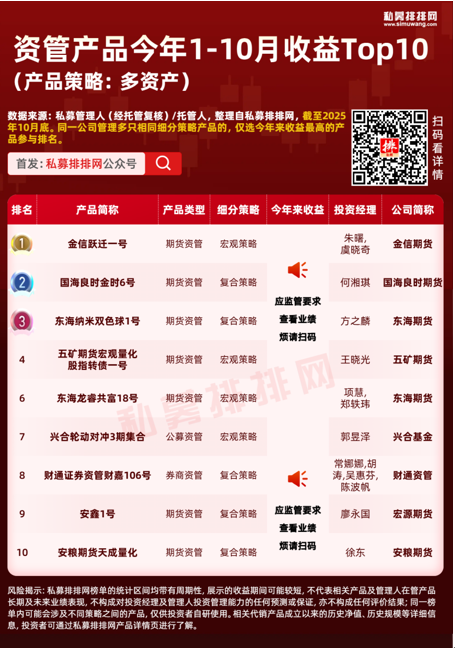
资管产品最新10强出炉!金信跃迁一号业绩持续领跑!
Qi Huo Ri Bao Wang· 2025-11-21 05:16
Core Insights - The asset management market is highly competitive, with 352 products showcasing performance as of October 2025, according to data from Private Placement Network [1] - Jin Xin Futures' "Jin Xin Jump One Asset Management Plan" has emerged as the top performer in the multi-asset product strategy category, outperforming various public funds and licensed financial institutions [1][4] Performance Rankings - As of October 2025, Jin Xin Jump One is ranked first among multi-asset strategies, demonstrating exceptional performance in a crowded market [2] - The product has consistently ranked in the top three of its category since October 2024, indicating stable returns and effective asset allocation strategies [4] Investment Strategy - The core investment philosophy of Jin Xin Jump One revolves around "macro game," focusing on macroeconomic analysis and market dynamics for asset and strategy allocation [6] - The product team aims to discover investment opportunities in complex market environments, utilizing a dynamic approach to adjust allocations across stocks, bonds, and commodities [6]

未来宽松取向明确 降息节奏充满变数
Qi Huo Ri Bao Wang· 2025-11-21 03:23
Core Viewpoint - The Federal Reserve's October meeting minutes reveal significant internal divisions regarding the decision to lower interest rates and the potential for further cuts in December, leading to increased uncertainty about future monetary policy direction [1][2][3] Group 1: Interest Rate Decisions - The Federal Reserve lowered the federal funds rate by 25 basis points in October, bringing the target range to 3.75% to 4.0%, marking the second consecutive rate cut of the year [1] - There is a notable split among Federal Reserve members regarding the appropriateness of the October rate cut, with some members expressing support for maintaining rates unchanged [2] - The outlook for a potential December rate cut is uncertain, with some members suggesting it may be suitable if economic conditions align with expectations, while others caution against further cuts due to inflation risks [2][3] Group 2: Economic Indicators - The labor market is expected to soften gradually, with recent data indicating a relatively weak job market, which may support the Fed's continued accommodative stance [4] - Initial jobless claims were reported at 232,000, and continuing claims at 1.957 million, both higher than previous values, indicating labor market challenges [4] - The uncertainty surrounding key economic data, particularly employment and inflation figures, may lead the Fed to adopt a cautious approach in its December meeting [4][6] Group 3: Monetary Policy Outlook - The current monetary policy approach is characterized as "risk management-style easing," reflecting the Fed's cautious stance amid internal disagreements on the pace of rate cuts [3][6] - The Fed's future policy path may enter a new phase, marked by a clear accommodative stance but with variable timing based on economic data performance [3] - The potential for inflation to exceed expectations poses a significant constraint on the Fed's ability to lower rates further, especially in light of the recent tariff policies [4][6]
贵州修文生猪“保险+期货”项目圆满结项 助力农户稳定增收
Qi Huo Ri Bao Wang· 2025-11-21 01:53
Core Insights - The successful completion of the "Insurance + Futures" project for pig farming in Xiuwen County, Guizhou Province, demonstrates the effective use of innovative financial tools to mitigate price volatility risks in the pig farming industry, benefiting local farmers and enterprises [1][2][3] Group 1: Project Overview - The project was initiated by CITIC Futures Guizhou Branch in collaboration with Guoyuan Agricultural Insurance Co., Ltd., focusing on the unique characteristics of the pig farming industry in Xiuwen County [1][2] - The project received subsidies from the Dalian Commodity Exchange, with remaining premiums shared among local governments and farmers, effectively reducing insurance costs for participants [2] Group 2: Impact on Farmers - The project provided insurance coverage for three farming entities, ensuring comprehensive protection for both large-scale farms and individual farmers [2] - Farmers reported significant relief from financial losses due to price drops, with one farmer receiving 29,100 yuan in compensation, which bolstered their confidence in continuing operations [2] Group 3: Future Plans - CITIC Futures aims to continue focusing on Guizhou's agricultural specialties, optimizing the "Insurance + Futures" model, and expanding project coverage to benefit more farmers [3]
期权车轮“碾”出套利新赛道
Qi Huo Ri Bao Wang· 2025-11-21 01:46
Core Viewpoint - The interview highlights the trading strategies employed by a company in the polycrystalline silicon market, focusing on their successful use of various arbitrage and options strategies to enhance profitability. Group 1: Trading Strategies - The company utilizes three main trading strategies: spot-futures arbitrage, inter-month arbitrage, and options spread arbitrage [2]. - Initially, the company focused on spot-futures arbitrage, entering the market when reasonable price differences appeared, and increasing operations as price differences widened [2]. - In July, due to the "anti-involution" policy, the company shifted its strategy towards inter-month arbitrage, employing grid strategies to capture trading opportunities, resulting in a significant increase in trading volume [2]. Group 2: Options Strategies - The company employs a variety of options strategies, with a preference for vertical spreads and ratio spreads [2]. - The primary strategy involves a "bull spread," where the company buys near-month contracts and sells far-month contracts, allowing for profit locking even if price differences continue to widen [2]. - The company actively manages positions based on market conditions, using techniques such as pyramid averaging to gradually increase positions when price differences narrow [2]. Group 3: Unique Aspects of Options Trading - The company favors the options products offered by the exchange due to their sufficient strike price depth and wide coverage, which facilitates the implementation of the "wheel strategy" [3]. - The "wheel strategy" begins with selling put options, optimizing costs and generating income based on the demand in the spot market [3]. - The company emphasizes the role of options sellers, who focus on time value in addition to directional profits, and employs strategies to maximize returns or provide protection based on market volatility [4].
“广期所多晶硅优秀交易者奖”三等奖:期权车轮“碾”出多晶硅套利新赛道
Qi Huo Ri Bao Wang· 2025-11-21 01:38
Core Insights - The company employs a diversified trading strategy focusing on three main types: spot-futures arbitrage, inter-month futures arbitrage, and options spread arbitrage [2][3][4] Group 1: Trading Strategies - The initial trading strategy involved spot-futures arbitrage, which allowed the company to earn stable profits from price differences when market conditions were favorable [2] - Following the implementation of anti-involution policies, the company shifted its focus towards inter-month arbitrage due to increased volatility in the price differences of polysilicon futures [2][3] - The company actively engages in rolling operations to capture market fluctuations, enhancing trading volume significantly [2][3] Group 2: Options Strategy - The company favors options trading due to the sufficient depth of strike prices available, which supports the implementation of a "wheel strategy" [4][5] - The wheel strategy involves selling put options to optimize costs and generate revenue, allowing the company to acquire futures at a lower effective price [4] - The company emphasizes the importance of time value in options trading, focusing on selling options to capture this value while also employing various strategies to maximize profits or provide protection for existing positions [5]
欲望管理是交易者的必修课
Qi Huo Ri Bao Wang· 2025-11-21 01:38
Core Insights - Liu Tao achieved the seventh place in the long-term stable profit category of the national real trading competition, showcasing his consistent performance since 2015 [1] Trading System - Liu Tao emphasizes the importance of continuous self-awareness in trading, stating that traders can only earn money within the limits of their understanding [2] - He developed a trading system that integrates fundamental research, technical analysis, and programmatic execution, which he refers to as a "three-in-one" trading system [2] - Liu Tao optimizes his trading strategies annually based on market conditions while adhering to a core logic of macro selection, technical entry validation, and strict programmatic execution [2] - His "human-machine integration" model has matured over ten years, allowing for automated trading operations and effective risk control during market volatility [2] Evolution of Understanding - Liu Tao's trading journey reflects significant learning experiences, with three major liquidation events shaping his trading philosophy [3] - The first liquidation taught him the importance of stop-loss, the second highlighted the limitations of relying solely on technical analysis, and the third broke his blind faith in fundamental analysis [3] - In 2014, he began constructing a programmatic trading system that established disciplined trading practices and a stable profit model [3] - Liu Tao advocates for new traders to focus on building a trading system with positive expected value and emphasizes execution over profit [3] Future Aspirations - Liu Tao views his recent award as a new starting point and aims to guide more traders out of confusion [4] - He believes that one's perspective on the world influences the returns one receives, summarizing his thirty years of trading experience with this philosophy [4]
大力提振消费 夯实发展根基
Qi Huo Ri Bao Wang· 2025-11-21 01:32
Core Viewpoint - The "14th Five-Year Plan" emphasizes boosting consumption as a key driver for sustainable economic growth and improving the quality of life for citizens, especially in the context of a complex global economic environment and domestic economic transformation [1] Group 1: Implementation of Consumption Boosting Actions - The government will implement targeted actions to stimulate consumption through a combination of policies aimed at enhancing market vitality [2] - Focus on increasing employment and income, particularly for key groups such as recent graduates and migrant workers, to enhance consumer capacity [2] - Increase public service spending in areas like education and healthcare to reduce the financial burden on residents, encouraging them to spend more [2] Group 2: Development of International Consumption Centers - The plan includes cultivating international consumption center cities to attract global quality consumption resources and enhance the national image [3] - Improvement of urban consumption infrastructure and introduction of international brands to meet consumer demand for global products [3] - Expansion of inbound consumption by optimizing the environment for international tourists, including simplifying visa processes and enhancing payment options [3] Group 3: Direct Consumer Benefits through Inclusive Policies - The government will increase funding for consumer welfare initiatives, such as issuing consumption vouchers and providing subsidies for upgrading old products [4] - Policies will target high-demand sectors like dining and tourism to stimulate market recovery [4] - Removal of unreasonable restrictions on consumption, such as easing car purchase limits, to unleash consumer potential [4] Group 4: Strengthening Consumer Rights Protection - Enhancing consumer rights protection is crucial for boosting consumption, with plans to improve legislation and market regulation [5] - Establishing efficient complaint resolution mechanisms to lower the cost of consumer rights protection [6] - Promoting consumer education to foster informed and responsible consumption behaviors [6]
绿色期货品种扩容空间广阔
Qi Huo Ri Bao Wang· 2025-11-21 01:18
Group 1: Green Futures Market Development - The Chinese futures market has established a diversified green futures product system, focusing on new energy metals, clean energy, and recycled metals, including lithium carbonate, polysilicon, industrial silicon, low-sulfur fuel oil, liquefied petroleum gas, and casting aluminum alloys [1] - Future green futures products are expected to expand along the new energy industry chain, strategic resource supplementation, and circular economy coverage, providing precise risk management tools for the green transformation of the real economy [1] Group 2: Key Areas of Focus in New Energy - Current green futures products mainly focus on upstream raw materials of new energy, such as industrial silicon and lithium carbonate, while there is a significant gap in risk management tools for midstream materials and core auxiliary materials [2] - The wind and solar industries face significant price volatility risks for raw materials, with wind turbine blade costs accounting for 20%-30% of total costs, and photovoltaic glass being a critical packaging material [2] - The introduction of futures for photovoltaic glass and hydrogen energy is anticipated to help stabilize costs and manage price risks effectively [2][3] Group 3: Strategic Green Products - Electricity and carbon emission rights are identified as core strategic green products, with electricity futures expected to serve as a stabilizing tool for new energy generation enterprises [4] - The carbon market in China has matured since its launch in 2021, covering over 2,000 key enterprises in the power generation sector, with a significant annual spot trading volume [4] - Carbon emission rights futures can help enterprises lock in carbon costs and guide capital towards low-carbon projects, contributing to the achievement of carbon neutrality goals [4] Group 4: Circular Economy and Recycling - The expansion of the circular economy is supported by the introduction of futures for recycled metals and plastics, addressing issues of raw material sourcing and price volatility [6][7] - The first recycled metal futures, casting aluminum alloy futures, have been launched, with future expansions expected to cover a range of recycled resources [6] - Recycled copper futures are anticipated to facilitate the low-carbon transition in the copper industry, while recycled plastic futures could serve as a tool for reducing carbon emissions in packaging and automotive sectors [7] Group 5: Future Trends in Green Futures Market - The green futures market is expected to accelerate in product expansion, deepen functional applications, and enhance international influence [8] - A comprehensive product system is likely to emerge, covering new energy, clean energy, recycled resources, and weather derivatives [8] - The futures market is positioned as a core infrastructure for promoting energy transition, resource recycling, and low-carbon industry development, providing sustained momentum for high-quality green economic growth [8]
以花生期货为媒 益新实业打造共赢链
Qi Huo Ri Bao Wang· 2025-11-20 18:09
Core Viewpoint - The article highlights the importance of utilizing financial derivatives, particularly peanut futures, to manage price risks and enhance operational stability in the peanut industry in Henan Province, China [1][2]. Group 1: Industry Characteristics - The peanut market is characterized by a differentiated supply-demand structure, increased price volatility, and a diverse range of participants, posing significant challenges for enterprises, especially small processing companies [2]. - The fluctuation in agricultural product prices and market uncertainties have made effective price risk management a persistent challenge for companies in the peanut industry [1]. Group 2: Company Initiatives - Henan Yixin Industrial Co., Ltd. has embraced financial tools under the guidance of Tongzhou Group, establishing a professional futures research and risk control team, which has led to a mature trading system and strategy execution capabilities [2][3]. - The company has shifted from a passive market price acceptance to an active pricing strategy based on market analysis, allowing for better inventory management and procurement optimization [5]. Group 3: Risk Management Strategies - Yixin Industrial has successfully implemented a "cooperative hedging" approach, allowing them to reduce procurement costs by buying peanut futures at a lower price compared to the spot market [3]. - The company collaborates with downstream enterprises to hedge against price declines, demonstrating the effectiveness of customized hedging solutions in managing risks [3][4]. Group 4: Industry Impact - The promotion of peanut futures is expected to enhance the entire industry chain's ability to respond to price fluctuations, stabilize development, and improve operational efficiency [6][7]. - The integration of financial tools with traditional agriculture is seen as a key factor for companies to enhance competitiveness and achieve high-quality development [7].